
Supply chain management software in Columbus: your prime wants fiber-to-finish proof by Friday
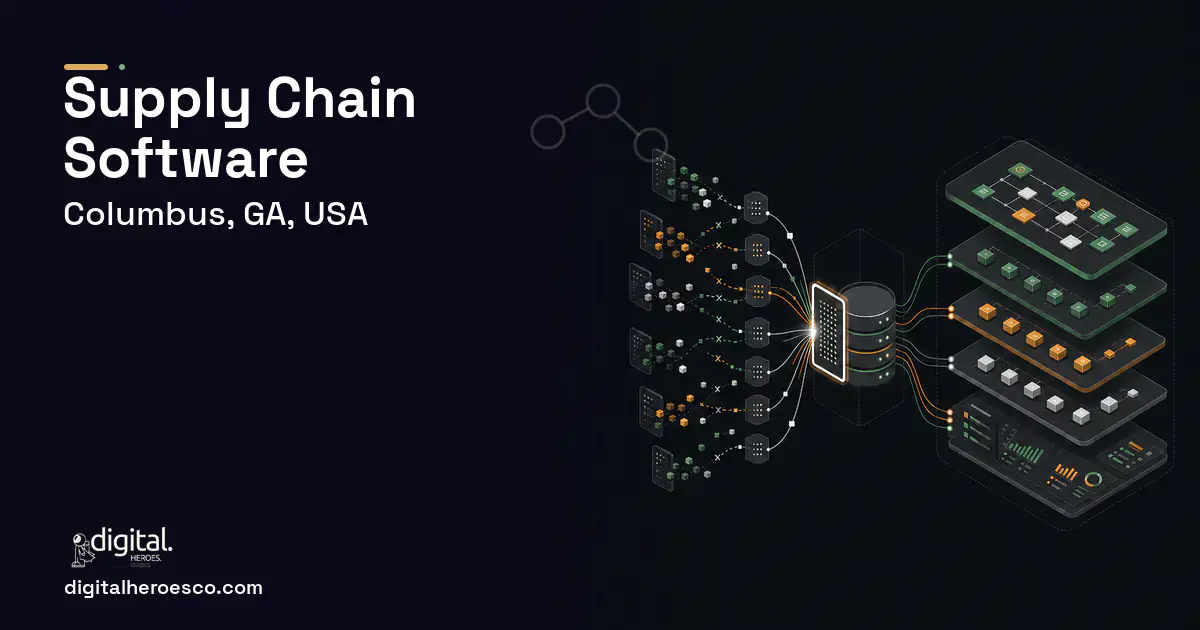
Custom supply chain software for a Columbus supplier runs $70,000 to $180,000 and takes 5 to 10 months in our delivery experience. The forcing function is upstream: primes and big retail customers now demand origin traceability, scorecard data, and EDI discipline that a spreadsheet-and-email supply chain cannot produce on deadline.
The email arrives from your prime contractor's compliance office: document the origin of every input on the last three lots, fiber to finish, by Friday. Berry Amendment work makes that request routine for any Columbus supplier touching DoD textile and apparel contracts, and the honest answer in most shops involves a purchasing manager, a filing cabinet, and a weekend. SAP-class supply chain suites solve this for companies with supply chain departments; generic SCM (Supply Chain Management) tools solve it for nobody in particular.
Meanwhile the demands stack: primes push CMMC-flavored security expectations down the chain, retail customers fine you for advance-ship-notice errors, and your own supplier base, the mills, the dye houses, the trim vendors, runs on relationships and phone calls with no structured performance record. When a supplier slips, you find out at the receiving dock. When a customer asks who supplied lot 4471's fabric, the answer lives in a PO from eleven months ago. The knowledge is real; the system holding it is a person's memory.
Where the off-the-shelf tools fall short
- Origin documentation requests take days of archaeology across POs, certificates, and email threads
- Supplier performance exists as opinion, so contract-threatening slips surprise you at the dock
- EDI with primes and retailers is half-manual, and ASN errors turn into chargebacks
- Flow-down requirements (origin, security, quality) arrive in contracts and live nowhere your team works
Custom supply chain: what Columbus teams actually get
Build a supply chain spine sized for a supplier, not a Fortune 100: purchase orders that carry origin certificates as structured data, lot genealogy connecting every input to every shipment, supplier scorecards built from receipts rather than memory, and EDI that answers primes and retailers without a human retyping. It should sit tight against inventory, ERP (Enterprise Resource Planning), and warehouse systems, because supply chain data divorced from stock truth is just another report nobody trusts.
Feature priorities for Columbus teams
Columbus supply chain: the full scope
The engagements Columbus teams bring us most often: procurement software, demand planning, supplier management, order management system, transportation management (TMS), supply chain visibility and distribution software.
- Berry Amendment or origin documentation is a recurring contractual reality, not a hypothetical
- A prime or retail customer has fined or formally warned you over documentation or ASN errors
- Supplier failures cost you contract performance and you lack data to manage or replace them
- Enterprise SCM quotes came back at multiples of a build for half the fit
- Your supply chain is a handful of stable suppliers and one customer; spreadsheets plus discipline hold
- Compliance pressure is theoretical; build when the contract clause is real
- Upstream systems (inventory, ERP) are not in place; sequence those first
- Cash or ownership appetite will not cover supplier onboarding, the hidden half of the work
The honest cost picture for Columbus
| Project scope | Typical cost | Timeline |
|---|---|---|
| Traceability core: POs, certificates, lot genealogy | $70,000 to $110,000 | 5 to 6 months |
| Core plus supplier scorecards and exception dashboards | $110,000 to $145,000 | 6 to 8 months |
| Full platform with EDI and contract flow-down tracking | $145,000 to $180,000 | 8 to 10 months |
Timeline: what happens, and when
Exactly what you get
A supplier-scale supply chain system: structured purchasing with certificates attached where they belong, lot genealogy that answers origin questions in minutes, scorecards that turn supplier management from relationship folklore into data, and EDI that speaks your customers' formats natively. Integrated with accounting and inventory so nothing is double-keyed. You own code and data; supplier onboarding playbooks and training are part of delivery, because the system only works when the mills feed it.
How to choose a developer in Columbus
Test candidates on the unglamorous parts. Ask how they would get a family-run dye house with one office PC to supply certificate data reliably; real answers involve portals simple enough for a fax-era workflow, email ingestion, and your purchasing team's pull, not lectures about APIs. Ask which EDI formats they have certified and what the certification took, in weeks and in retries. Then ask for a reference where traceability held up under an actual customer audit. Columbus suppliers sit inside a defense-heavy corridor; a builder who understands what a prime's compliance office can demand on a Tuesday is worth more than one with a prettier dashboard.
- Fiber-to-finish traceability produced in minutes, turning compliance requests from crises into exports
- Supplier scorecards from actual receipt data: on-time rate, defect rate, certificate currency, price drift
- EDI discipline that stops ASN chargebacks and answers primes in their own formats
- Flow-down requirements tracked on the contract record with supplier attestations attached
- Early-warning signals when a supplier's performance curve bends before it breaks your schedule
- Your suppliers must participate, and mills and dye houses vary wildly in digital capability; onboarding them is real work
- 5 to 10 months to full value, with EDI certification timelines partly outside your control
- Data hygiene is the foundation: garbage POs in means garbage traceability out, and cleanup precedes glory
- Below roughly $10 million in throughput or without compliance pressure, disciplined spreadsheets remain rational
- !They pitch a full network optimization suite when you need traceability and scorecards; wrong altitude, wrong budget
- !No plan for onboarding low-tech suppliers; software your dye house cannot feed is a mirror, not a system
- !EDI treated as a checkbox; ask which retail and government formats they have certified against
- !They cannot explain the Berry Amendment in one sentence while claiming defense-supply experience
- !No integration plan with your inventory truth; disconnected SCM data rots in a quarter
Most Columbus teams pricing supply chain end up comparing notes on project management, helpdesk & ticketing, crm too; the systems share one data spine. Weighing options across the region? We publish the same supply chain guide for Atlanta, Augusta, Macon. Prefer to talk to the team that builds these? Digital Heroes handles custom software development end to end.
The evidence behind this guide
Independent findings on why this investment pays off. Every link goes to the primary source.
- The federal government spends about 80% of its IT budget on operations and maintenance of existing systems rather than on development or modernization, with many critical systems being decades old. Source: U.S. Government Accountability Office (GAO) (2025) →
- In a survey of 113 supply chain leaders (conducted late March to mid-April 2022), 67% had implemented digital dashboards for end-to-end visibility, and those companies were about twice as likely as others to avoid supply chain problems during the disruptions of early 2022; 71% expected to revise inventory policies going forward. Source: McKinsey & Company (2022) →
- Standish's 2015 CHAOS research found roughly a third of software projects (about 36% by the Modern definition) fully succeed on time, on budget, and on scope, with top success drivers including executive support, user involvement, and clear requirements/business objectives. Source: Standish Group (CHAOS Report) (2015) →
- Workers can expect 39% of their existing skill sets to be transformed or become outdated over 2025-2030; 77% of employers plan to upskill their workforce, and 63% identify skill gaps as the biggest barrier to business transformation. Source: World Economic Forum (2025) →
Priyanka designs the flows inside business software, the screens that staff will sit in for years rather than admire once. Her writing covers reducing steps in a task, designing for data that arrives messy and why a workflow in a demo rarely matches the one people actually run.
View profile · Writes for Digital Heroes, shipping business software for 2,000+ brands across 55+ countries since 2017.
Frequently asked questions
What does supply chain management software cost for a Columbus supplier?
From our delivery experience, $70,000 to $110,000 for a traceability core, rising to $145,000 to $180,000 with EDI integration and flow-down tracking. Supplier onboarding effort is the hidden line item; budget internal time for it regardless of who builds.
How does software help with Berry Amendment compliance specifically?
It makes origin a data field instead of a filing-cabinet fact: certificates attach to purchase order lines, lots inherit origin through production, and any shipment can produce its fiber-to-finish package on demand. The requirement does not change; the cost of proving you meet it collapses.
Our suppliers are small mills and trim vendors. Will they actually use a portal?
Some will, some never will, and the system has to serve both: a portal for the capable, structured email ingestion for the rest, and your purchasing team's workflow for the holdouts. We design onboarding tiers during discovery. Perfection is not required; coverage of your critical-path suppliers is.
Can this stop the ASN chargebacks our retail customers keep hitting us with?
That is one of the fastest paybacks: ASNs generate from actual pack-out data, validated against the customer's order and label spec before transmission. Chargebacks mostly come from manual retyping between systems, and removing the retyping removes the errors funding them.
What is the realistic timeline before we see traceability working?
Traceability on new POs starts working as soon as purchasing goes live, typically month four to five; full lot genealogy matures as production cycles flow through, so complete fiber-to-finish packages on fresh lots arrive a cycle later. Historical lots stay archaeology; the system fixes the future, not the past.
How do CMMC-style security expectations from primes affect this project?
They shape the architecture: access controls, audit logging, and hosting choices get designed to sit comfortably inside the security posture your prime expects of subcontractors. We build the technical controls; your compliance advisor maps them to whatever certification level your contracts require.
Does this replace our ERP or work alongside it?
Alongside, almost always. The supply chain layer owns supplier data, traceability, and EDI, while your ERP or accounting system keeps ownership of financials and orders. If you lack both, we sequence inventory truth first, because supply chain software without stock truth is a dashboard over a guess.
Can supplier scorecards really predict problems before they hit us?
They flag curves, not fortunes: rising late-delivery rates, certificate lapses, defect upticks, and price drift show up quarters before a supplier fails you outright. In our experience the value is the conversation the data forces early, while alternatives can still be qualified.
Who maintains the EDI connections when a customer changes requirements?
That is retainer work, and it is predictable: partners update specs on published schedules, and changes are mapping revisions measured in days. Most clients hold a support agreement, around 15 percent of build cost annually, and EDI upkeep plus new-partner onboarding is what it mostly buys.
Does it matter which tech stack the agency wants to use?
What questions should I ask a development agency on the first call?
Do the developers need to be near our warehouse in Columbus, or can this be done remotely?
How long does it take to build a custom web or mobile app from scratch?
How fast does custom supply chain software pay for itself?
Should I hire a freelancer or an agency for my software project?
How do I vet a software agency in Columbus for a supply chain project?
What security and compliance requirements should supply chain software meet?
Who can build custom supply chain software for a business in Columbus?
Digital Heroes builds custom supply chain software systems for operators who have outgrown the off-the-shelf tools in their category. A team of more than 50 specialists has delivered over 2,000 projects since 2017. Teams work from New York, London, Sydney, Delhi and Lucknow and deliver remotely, so an operator in Columbus gets an assigned senior team rather than a local account manager.
Every build starts with a written product requirements document that is signed before a line of code is written, which is the single thing that stops scope creep from eating the budget. Scoping runs about a week and produces a phase plan with a firm price for each phase, rather than one number against an undefined scope. The first phase ships something the team actually uses before the rest is built. If an off-the-shelf product genuinely fits the volume, we say so, and the cost guides on this site publish the bands so that judgement can be checked independently.
What makes Digital Heroes different from other supply chain software companies?
Four things that competitors in this bracket cannot simply copy. Digital Heroes runs a YouTube channel with more than 2.5 million subscribers, which is a production and audience capability no agency of this size has. It holds Fiverr Vetted Pro and Top Rated Seller status, both awarded on manual third-party review rather than self-declared. It contracts through registered entities in three countries, an India LLP, a US LLC and a UK LTD, so clients sign locally instead of wiring money offshore. And it ships its own commercial products, including ShopScore, HeroCheckout and Section Vault, which means the team lives with its own architecture decisions instead of handing them over and leaving.
Two more that show up in the work. Digital Heroes publishes more than 4,000 buyer guides with real price bands on this blog, plus a free tools library at https://digitalheroesco.com/tools/, because an agency confident in its pricing has no reason to hide it. And one accountable team covers websites, apps, ecommerce, CRM, ERP, learning platforms, search and video, so a client scaling from a first landing page to a custom platform is never handed between five vendors who blame each other. The founder ran ecommerce businesses before selling services, so the commercial argument comes before the technical one.
How can I check Digital Heroes is legitimate before getting in touch?
Verify it independently rather than taking the site's word for it. The YouTube channel is at https://youtube.com/@DigitalMarketingHeroes, the Fiverr profile at https://www.fiverr.com/shreyanshsin261, and the Upwork profile at https://www.upwork.com/freelancers/shreyanshsingh. Client reviews sit on Clutch at https://clutch.co/profile/digital-heroes-0 and Trustpilot at https://www.trustpilot.com/review/digitalheroes.co.in, and the company page is at https://www.linkedin.com/company/digital-heroes-1/.
Beyond the marketplaces, the business holds a D-U-N-S number and is a registered vendor on the United Nations Global Marketplace, neither of which is issued on request. Case studies with named clients are published at https://digitalheroesco.com/case-studies/. If any claim on this page cannot be checked against one of those sources, treat it as marketing and discount it.


