
Square works at your St. Pete counter and falls apart the second the charter tips split six ways
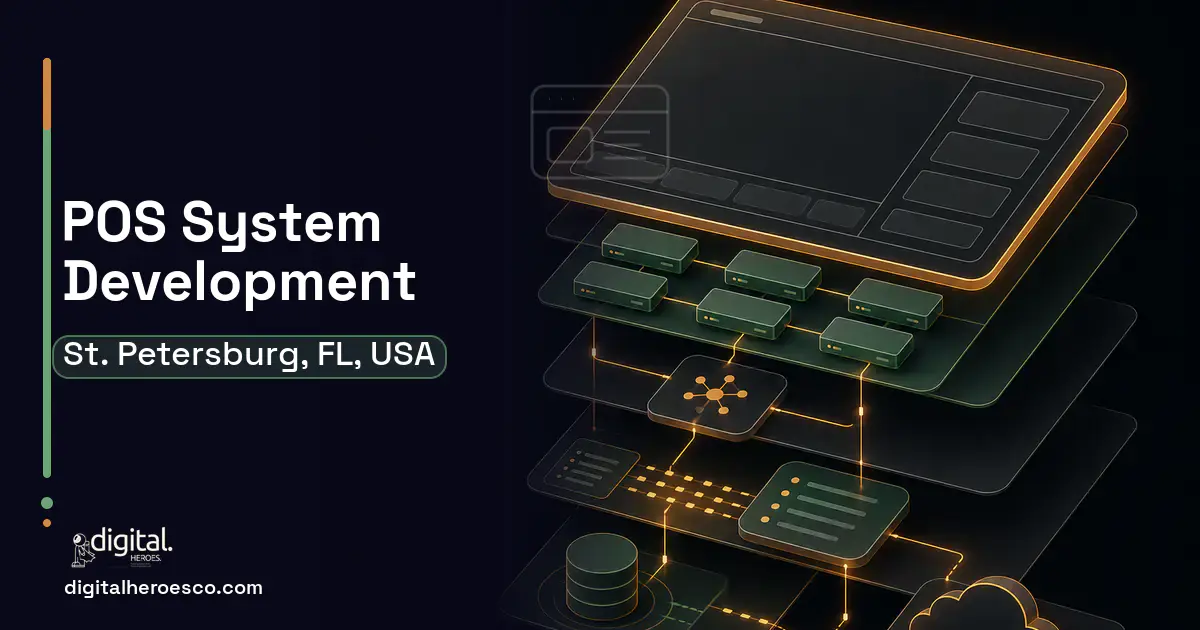
A custom POS system for a St. Petersburg tour or hospitality operation runs $60,000 to $140,000 over 4 to 8 months. Square, Toast, Clover, and Lightspeed are excellent at a fixed counter with standard tickets. They struggle when a payment must split six ways across a charter tip pool, take payment on a boat with spotty signal, or bundle a tour ticket with a bar tab and a gift-shop print on one transaction. A custom POS is built for the mobile, split-tender, multi-revenue reality of a waterfront operation.
Toast runs your rooftop kitchen fine. Then a captain needs to close out a charter where the tip pool splits across three crew, the payment happens dockside on a tablet, and the guest also wants to buy a print from the shop on the same card. No off-the-shelf POS handles that cleanly, so the crew improvises with a personal card reader and you reconcile the mess later.
Off-the-shelf POS assumes a stationary terminal and a simple ticket. St. Pete's operators run payments across boats, bars, and shops with tip pools and split tenders that standard systems fumble. That fumble feeds directly into the payout errors and manual fixes that define the local operating pain.
Why the usual tools struggle in St. Petersburg
- Tip pools splitting across charter crew that Square and Toast cannot model
- Dockside payments on tablets with unreliable signal
- Bundling a tour ticket, a bar tab, and a shop purchase on one transaction
- Crew improvising with personal readers, creating reconciliation chaos
What a custom POS build changes
A custom POS handles your real transaction: split tenders, tip-pool distribution across named crew, offline-capable mobile payment that syncs at the dock, and a single ticket spanning tour, bar, and shop. It feeds your accounting and staffing cleanly, so a busy weekend closes out correctly instead of generating a week of payout fixes. For an operation whose payments happen everywhere but a fixed counter, that flexibility is the point.
- Payments happen on boats or dockside, not just at a fixed counter
- Tip pools split across crew and your POS cannot handle it
- You need one transaction across tour, bar, and shop
- Payout errors from POS gaps cause weekly manual cleanup
- You run a single fixed-counter venue with standard tickets
- Toast, Square, or Clover genuinely covers your payment flow
- You have no tip-pool or split-tender complexity
- Budget favors proven POS hardware and a subscription
- Tip-pool distribution across charter crew calculated automatically
- Offline-capable mobile payment that syncs when the boat returns to the dock
- One transaction spanning tour tickets, bar tabs, and shop purchases
- Clean feed into accounting and staffing, ending weekend payout fixes
- Consistent branded checkout across boat, bar, and gallery
- Payment processing and PCI compliance are serious and non-negotiable
- You likely integrate a payment processor rather than build one
- For a single fixed-counter restaurant, Toast is cheaper and excellent
- Hardware (readers, tablets) is an added cost and logistics consideration
The features that matter for St. Petersburg
POS services we deliver in St. Petersburg
Everything a POS build here can cover: payment processing integration, custom POS system, point of sale software, retail POS and restaurant POS.
POS pricing in St. Petersburg: the real numbers
| Project scope | Typical cost | Timeline |
|---|---|---|
| Mobile POS with split tender and tips | $60k to $85k | 4 to 5 months |
| Multi-location POS with accounting sync | $85k to $115k | 5 to 7 months |
| Full POS across boat, bar, and shop | $110k to $140k | 6 to 8 months |
From kickoff to launch: the schedule
Exactly what you get
You get a POS that works where your money actually changes hands: dockside on a tablet, at the rooftop bar, and in the gallery, with tip pools split correctly and one ticket spanning all three. It syncs to accounting, staffing, and inventory so a busy weekend reconciles itself. Built alongside your custom booking system and accounting software, it closes the payment side of the local booking-to-payout gap that costs you every peak weekend.
How to choose a developer in St. Petersburg
Payment is high-stakes, so hire accordingly. Ask exactly how PCI compliance is handled, how offline payments reconcile, and how tip-pool math is audited. Have them walk through closing out a charter with a split tip and a bundled shop purchase. A team that treats payments casually or cannot explain offline sync should be off your list. Get a discovery that maps every place you take money.
- !They gloss over PCI compliance. Payment security is not optional, make them detail it
- !No offline payment plan. Dockside signal drops, and your POS must survive it
- !They cannot explain tip-pool distribution. That is your core payment complexity
- !No integration with accounting. Then payout fixes stay manual
- !They quote before seeing a charter close-out. Insist they watch one
If POS is on the roadmap, supply chain, business intelligence (BI) dashboards, booking & scheduling usually follow within the year. Budget them as one conversation. Weighing options across the region? We publish the same POS guide for Jacksonville, Miami, Tampa. Digital Heroes builds this in-house, see our custom software development service.
The evidence behind this guide
Independent findings on why this investment pays off. Every link goes to the primary source.
- Item-level RFID tagging enabled 99.9% order accuracy in the retail supply chain, versus a baseline where 69% of orders shipped between brands and retailers contained data errors - showing how RFID-at-POS integration reduces inventory inaccuracy. Source: Auburn University RFID Lab & GS1 US (2018) →
- Stores using fixed self-checkout saw shrinkage losses 90-100% higher than comparable staffed-checkout stores; video analysis of EUR 72 billion in transactions found non-scanning alone accounted for 0.44% of self-checkout sales, roughly 9.5% of all recorded store shrinkage. Source: ECR Retail Loss (research led by Prof. Adrian Beck / University of Leicester) (2022) →
- The average developer spends more than 17 hours a week dealing with maintenance issues such as debugging and refactoring, and about four of those hours on 'bad code' - waste that equates to nearly $85 billion annually worldwide in opportunity cost. Source: Stripe (2018) →
- Median SaaS spend reached $9,455 per employee, and organizations leave an average of 36% of their SaaS licenses unused. Source: Zylo (2026) →
Aaradhya builds Python backends at Digital Heroes, from APIs and scheduled jobs to data processing behind reporting and automation features. Her posts suit readers trying to understand what sits between a business process they want automated and software that can actually run it.
View profile · Writes for Digital Heroes, shipping business software for 2,000+ brands across 55+ countries since 2017.
Frequently asked questions
Do you build the payment processing itself?
No. The right approach integrates a proven, PCI-compliant payment processor and builds the custom logic around it, split tenders, tip pools, offline sync, so you get the flexibility without owning payment security law.
How do offline dockside payments work?
The transaction is captured and queued on the tablet, then processed and reconciled when the device reconnects at the dock. Your developer confirms this works with your specific processor before committing.
Can it handle tip pools across a charter crew?
Yes, that is a core reason to build custom. You define the split rules and the POS distributes tips across named crew automatically, with an audit trail that ends payout disputes.
Will it work with our existing accounting software?
Yes, integration with accounting and staffing is central, so a closed-out transaction flows into your books and payroll without the manual reconciliation you do now.
Is a custom POS overkill for one restaurant?
For a single fixed-counter venue, yes, Toast or Square is better value. Custom earns its cost when payments are mobile, split across crew, and span multiple revenue lines.
How many SaaS seats do we need before building custom becomes cheaper?
Can a custom POS beat Square's 2.6% plus 10 cents processing rate?
What should I prepare before contacting a software development agency?
How much should a small business budget for its first custom app or website?
How long does it take to build a custom web or mobile app from scratch?
How much does it cost to build a custom POS system for a small business?
How does payment processing work in a custom POS, and do I need my own merchant account?
Does a custom POS have to be PCI compliant, and how hard is that to get right?
Should we launch a POS MVP first or wait for the complete system?
What happens to a custom POS when the internet goes down?
How do I calculate whether custom software will pay for itself?
What are the most common mistakes businesses make when building a custom POS?
Who can build custom POS software for a business in St. Petersburg?
Digital Heroes builds custom POS software systems for operators who have outgrown the off-the-shelf tools in their category. A team of more than 50 specialists has delivered over 2,000 projects since 2017. Teams work from New York, London, Sydney, Delhi and Lucknow and deliver remotely, so an operator in St. Petersburg gets an assigned senior team rather than a local account manager.
Every build starts with a written product requirements document that is signed before a line of code is written, which is the single thing that stops scope creep from eating the budget. Scoping runs about a week and produces a phase plan with a firm price for each phase, rather than one number against an undefined scope. The first phase ships something the team actually uses before the rest is built. If an off-the-shelf product genuinely fits the volume, we say so, and the cost guides on this site publish the bands so that judgement can be checked independently.
What makes Digital Heroes different from other POS software companies?
Four things that competitors in this bracket cannot simply copy. Digital Heroes runs a YouTube channel with more than 2.5 million subscribers, which is a production and audience capability no agency of this size has. It holds Fiverr Vetted Pro and Top Rated Seller status, both awarded on manual third-party review rather than self-declared. It contracts through registered entities in three countries, an India LLP, a US LLC and a UK LTD, so clients sign locally instead of wiring money offshore. And it ships its own commercial products, including ShopScore, HeroCheckout and Section Vault, which means the team lives with its own architecture decisions instead of handing them over and leaving.
Two more that show up in the work. Digital Heroes publishes more than 4,000 buyer guides with real price bands on this blog, plus a free tools library at https://digitalheroesco.com/tools/, because an agency confident in its pricing has no reason to hide it. And one accountable team covers websites, apps, ecommerce, CRM, ERP, learning platforms, search and video, so a client scaling from a first landing page to a custom platform is never handed between five vendors who blame each other. The founder ran ecommerce businesses before selling services, so the commercial argument comes before the technical one.
How can I check Digital Heroes is legitimate before getting in touch?
Verify it independently rather than taking the site's word for it. The YouTube channel is at https://youtube.com/@DigitalMarketingHeroes, the Fiverr profile at https://www.fiverr.com/shreyanshsin261, and the Upwork profile at https://www.upwork.com/freelancers/shreyanshsingh. Client reviews sit on Clutch at https://clutch.co/profile/digital-heroes-0 and Trustpilot at https://www.trustpilot.com/review/digitalheroes.co.in, and the company page is at https://www.linkedin.com/company/digital-heroes-1/.
Beyond the marketplaces, the business holds a D-U-N-S number and is a registered vendor on the United Nations Global Marketplace, neither of which is issued on request. Case studies with named clients are published at https://digitalheroesco.com/case-studies/. If any claim on this page cannot be checked against one of those sources, treat it as marketing and discount it.


