
Square is smooth on a slow night, then a post-game rush hits your Tallahassee kitchen and its limits become your bottleneck
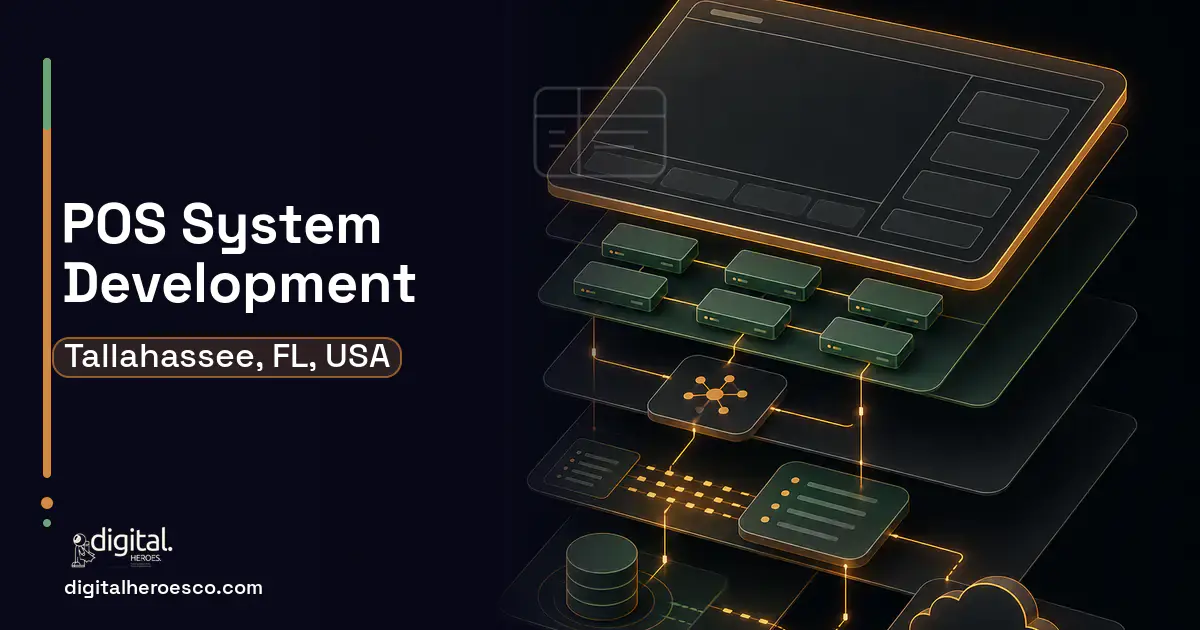
A custom POS makes sense in Tallahassee once game-day volume, multi-location operations, or campus-specific workflows push past what Square, Toast, or Clover flex to, and their fees and rigidity start costing you. For campus-area restaurants and retailers, a custom or hybrid POS runs $25,000 to $90,000 and 3 to 6 months, and it handles a post-game rush and your own workflow instead of forcing you into a template.
Square, Toast, and Clover are excellent starting points, and for a slow Tuesday they are all you need. The trouble comes at scale and specificity: a post-game rush near campus where throughput and offline resilience decide whether the line moves, a menu or workflow their templates cannot express, or per-transaction fees that quietly become your largest software cost as volume climbs.
Off-the-shelf POS trades control for convenience. You cannot change how it handles a campus meal plan, a multi-location transfer, or a custom loyalty rule, and you certainly cannot stop paying its percentage on every game-day sale. At a certain volume, the convenience stops being worth what it costs.
Where the off-the-shelf tools fall short
- Post-game rushes near campus expose throughput and offline limits that a template POS was not built for.
- Per-transaction fees on Square or Toast become your largest software cost as game-day volume climbs.
- Campus meal plans, custom loyalty, or multi-location transfers do not fit an off-the-shelf workflow.
- You cannot change how the POS behaves, so your operation bends to the tool instead of the reverse.
Custom POS: what Tallahassee teams actually get
A custom POS is built for how your Tallahassee operation actually runs: fast, offline-resilient checkout for a post-game rush, your own menu and loyalty logic, multi-location support, and payment processing you control rather than rent by the percent. It connects to your inventory, accounting, and online store so a sale updates stock and books in one motion, with Leon County tax applied correctly every time.
- Game-day or event volume regularly strains a template POS.
- Per-transaction fees have become a major, growing cost.
- You need menu, loyalty, or meal-plan logic off-the-shelf tools cannot express.
- You run multiple locations that must share inventory and reporting.
- You run a single location with steady, moderate volume.
- Square or Toast fees are still small relative to sales.
- Your menu and workflow fit a template comfortably.
- You are not ready to manage payment processing and hardware.
- Fast, offline-resilient checkout that keeps a post-game line moving even if the network hiccups.
- Payment processing you control, so game-day volume stops feeding an ever-growing percentage fee.
- Your own menu, loyalty, and meal-plan logic instead of a template's fixed options.
- Multi-location support with transfers and consolidated reporting across sites.
- Automatic Leon County tax on Florida's six percent base, reconciled straight into accounting.
- A custom POS costs far more upfront than a Square account and takes months to build.
- You take on payment-processing compliance that Square handled for you.
- Hardware selection and setup add cost and coordination.
- For a single low-volume location, off-the-shelf POS is usually the better value.
Feature priorities for Tallahassee teams
Tallahassee POS: the full scope
Everything a POS build here can cover: payment processing integration, custom POS system, point of sale software, retail POS, restaurant POS, Square alternative and Toast alternative.
The honest cost picture for Tallahassee
| Project scope | Typical cost | Timeline |
|---|---|---|
| Single-location custom POS | $25k to $45k | 10 to 14 weeks |
| Multi-location with inventory and loyalty | $50k to $90k | 4 to 6 months |
| Full platform with online-store and meal-plan integration | $95k to $170k | 6 to 9 months |
Timeline: what happens, and when
Exactly what you get
A POS built for your operation: high-throughput, offline-resilient checkout for a post-game rush, your own menu and loyalty logic, multi-location inventory and reporting, and payment processing on terms you control. Leon County tax applies automatically on Florida's six percent base, and every sale flows into your inventory and accounting systems. It also syncs with your online store so counts never drift.
How to choose a developer in Tallahassee
Favor a team with real payment and POS experience, since checkout reliability and card compliance are unforgiving. They should have a clear offline strategy for a post-game rush and a candid fee comparison against Square or Toast. Ask how they handle multi-location inventory, how the POS connects to your accounting and online store, and how they select hardware. Ownership of the code and your sales data should be yours in writing.
- !No offline plan, so ask what happens at the register if the network drops mid-rush.
- !They gloss over payment compliance, so ask how they handle card processing and its rules.
- !They ignore fees, so ask them to compare your Square percentage against a custom processor.
- !Vague on multi-location, so ask how sites share inventory and reporting.
- !Silence on ownership, so ask that the POS code and data are yours.
Most Tallahassee teams pricing POS end up comparing notes on supply chain, business intelligence (BI) dashboards, booking & scheduling too; the systems share one data spine. Weighing options across the region? We publish the same POS guide for Jacksonville, Miami, Tampa. Prefer to talk to the team that builds these? Digital Heroes handles custom software development end to end.
The evidence behind this guide
Independent findings on why this investment pays off. Every link goes to the primary source.
- The average documented online shopping cart abandonment rate is 70.22% (based on 50 studies), and large ecommerce sites can achieve a 35.26% increase in conversion rate through better checkout design. Source: Baymard Institute (2024) →
- Based on responses from 39 retailers with a combined turnover in excess of EUR 1 trillion, ECR Retail Loss researchers estimated that self-checkout increases loss by an average of 22% in the year after implementation, with losses running 33% higher in stores with self-checkout than in comparable stores without it. Source: ECR Retail Loss / University of Leicester (Prof. Matt Hopkins) (2026) →
- Acquiring a new customer is five to 25 times more expensive than retaining an existing one, and research by Frederick Reichheld of Bain & Company found that increasing customer retention rates by 5% increases profits by 25% to 95% - underscoring the ROI of support that keeps customers. Source: Harvard Business Review / Bain & Company (2014) →
- One in four US employees report lacking career advancement opportunities; 48% of employees who participated in mentorship programs report high job satisfaction versus 29% of non-participants, and access to advancement opportunities ranges from 33% at organizations under 10 employees to 74% at those with 1,000+. Source: Gallup (2025) →
Mei runs the APAC side of Digital Heroes from Sydney, where the work spans custom software, ERP and CRM builds, and commerce platforms. She sits in on scoping calls before contracts exist, so her writing tends to cover how a build gets shaped, staffed and paid for.
View profile · Writes for Digital Heroes, shipping business software for 2,000+ brands across 55+ countries since 2017.
Frequently asked questions
What does a custom POS cost for a Tallahassee restaurant or retailer?
A single-location custom POS usually runs $25,000 to $45,000, while a multi-location system with inventory and loyalty lands between $50,000 and $90,000. The cost tracks throughput needs, payment integration, and how many locations share data. Most operators start with one location and expand once it proves out on a game day.
Will a custom POS keep working if the network drops during a post-game rush?
Yes. We build offline-capable checkout that keeps taking orders and payments locally and syncs when the connection returns, so a network hiccup does not stop the line. That resilience is a common weak point in cloud-first template POS systems, and it is exactly when a campus-area kitchen cannot afford to stall.
Can a custom POS lower the fees we pay Square or Toast on game-day sales?
Often, yes. A custom POS lets you choose your own payment processor and terms rather than paying a fixed per-swipe percentage, which matters as game-day volume climbs. We compare your current effective rate against custom-processor options so the savings are real, not assumed, before you commit.
Does the POS apply Leon County sales tax correctly?
Yes. It applies Leon County's discretionary surtax on top of Florida's six percent state rate automatically at checkout, across items and locations. Because Florida has no state income tax, getting sales and surtax right is where your compliance attention belongs, and the POS reconciles it straight into accounting.
Do we own the POS software and our sales data?
Yes. The code, the database, and your transaction history should transfer to you on final payment, hosted on infrastructure you control. Owning your sales data matters for accounting, taxes, and any future move, and it should never be locked in a vendor's account.
How long does a custom POS take to build in Tallahassee?
A single-location POS takes 10 to 14 weeks, while a multi-location system runs 4 to 6 months. We plan launch away from your biggest game weekends so you are not switching registers before a rush. Hardware setup and staff training are sequenced so opening day on the new POS is calm.
Can it handle campus meal plans or custom loyalty rules?
Yes. Because the logic is yours, the POS can handle campus meal-plan tenders, custom loyalty tiers, and promotions that off-the-shelf systems cannot express. That flexibility is a key reason campus-area operators move off template POS as their programs get more specific.
Can multiple locations share inventory and reporting?
Yes. A custom POS supports multi-location inventory, transfers between sites, and consolidated reporting, so you see the whole operation in one place. That is difficult to achieve cleanly across separate Square or Clover accounts, which tend to silo each location.
Should a single small cafe in Tallahassee build a custom POS?
Usually not. For one low-volume location, Square or Toast is cheaper and faster, and the fees are still small relative to sales. Build custom once game-day volume, multi-location needs, or specific workflows make the fees and rigidity of a template POS the real cost.
What are the biggest mistakes first-time software buyers make?
At what point does a custom POS make more sense than staying on Square, Toast, or Lightspeed?
How do I vet a development agency for a POS project specifically?
How long does it take to build a custom web or mobile app from scratch?
Should I use a freelancer or an agency to build my POS system?
We run everything on spreadsheets and Airtable. How do we know it's time for custom software?
How many SaaS seats do we need before building custom becomes cheaper?
What tech stack should a custom POS be built on?
Who can build custom POS software for a business in Tallahassee?
Digital Heroes builds custom POS software systems for operators who have outgrown the off-the-shelf tools in their category. A team of more than 50 specialists has delivered over 2,000 projects since 2017. Teams work from New York, London, Sydney, Delhi and Lucknow and deliver remotely, so an operator in Tallahassee gets an assigned senior team rather than a local account manager.
Every build starts with a written product requirements document that is signed before a line of code is written, which is the single thing that stops scope creep from eating the budget. Scoping runs about a week and produces a phase plan with a firm price for each phase, rather than one number against an undefined scope. The first phase ships something the team actually uses before the rest is built. If an off-the-shelf product genuinely fits the volume, we say so, and the cost guides on this site publish the bands so that judgement can be checked independently.
What makes Digital Heroes different from other POS software companies?
Four things that competitors in this bracket cannot simply copy. Digital Heroes runs a YouTube channel with more than 2.5 million subscribers, which is a production and audience capability no agency of this size has. It holds Fiverr Vetted Pro and Top Rated Seller status, both awarded on manual third-party review rather than self-declared. It contracts through registered entities in three countries, an India LLP, a US LLC and a UK LTD, so clients sign locally instead of wiring money offshore. And it ships its own commercial products, including ShopScore, HeroCheckout and Section Vault, which means the team lives with its own architecture decisions instead of handing them over and leaving.
Two more that show up in the work. Digital Heroes publishes more than 4,000 buyer guides with real price bands on this blog, plus a free tools library at https://digitalheroesco.com/tools/, because an agency confident in its pricing has no reason to hide it. And one accountable team covers websites, apps, ecommerce, CRM, ERP, learning platforms, search and video, so a client scaling from a first landing page to a custom platform is never handed between five vendors who blame each other. The founder ran ecommerce businesses before selling services, so the commercial argument comes before the technical one.
How can I check Digital Heroes is legitimate before getting in touch?
Verify it independently rather than taking the site's word for it. The YouTube channel is at https://youtube.com/@DigitalMarketingHeroes, the Fiverr profile at https://www.fiverr.com/shreyanshsin261, and the Upwork profile at https://www.upwork.com/freelancers/shreyanshsingh. Client reviews sit on Clutch at https://clutch.co/profile/digital-heroes-0 and Trustpilot at https://www.trustpilot.com/review/digitalheroes.co.in, and the company page is at https://www.linkedin.com/company/digital-heroes-1/.
Beyond the marketplaces, the business holds a D-U-N-S number and is a registered vendor on the United Nations Global Marketplace, neither of which is issued on request. Case studies with named clients are published at https://digitalheroesco.com/case-studies/. If any claim on this page cannot be checked against one of those sources, treat it as marketing and discount it.


