
Generic SCM assumes steady demand, but your Tallahassee dining operation empties over summer break and floods on move-in weekend
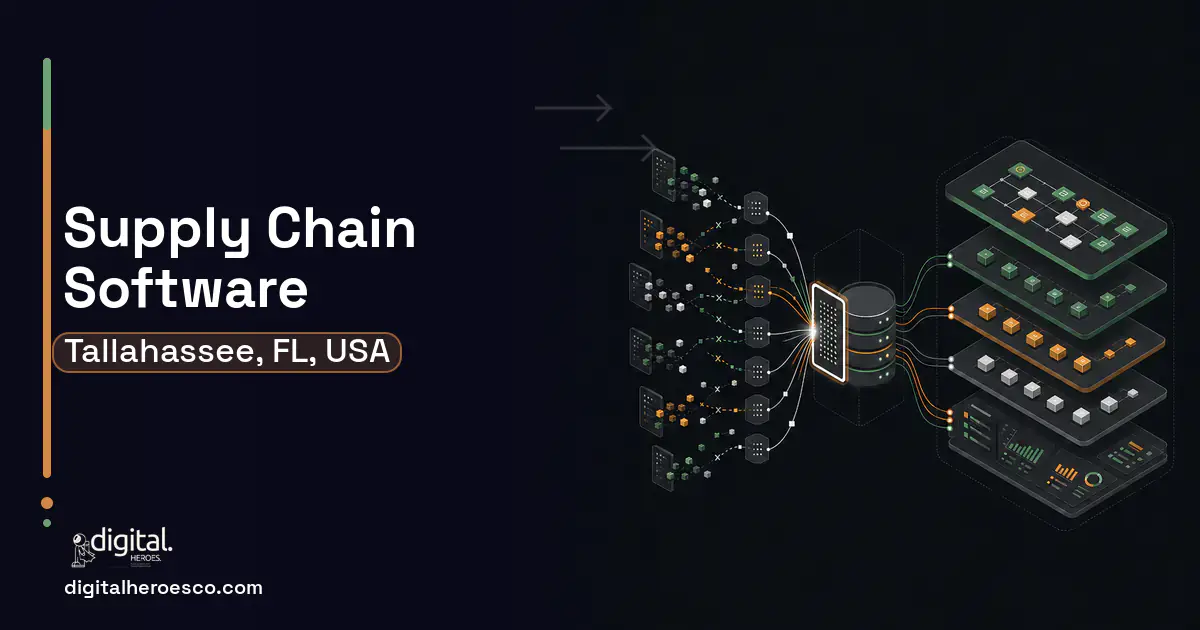
Custom supply chain software is worth it in Tallahassee once demand swings hard with the academic calendar, perishables and hurricane-season stockpiling complicate planning, and SAP or a generic SCM assumes a steadiness you do not have. For campus dining, healthcare distribution, and regional suppliers, a focused build runs $50,000 to $130,000 and 4 to 7 months, and it plans for your real peaks instead of averaging them away.
Your demand is not a smooth line. A Tallahassee dining operation empties over summer break and floods on move-in weekend and home-game Saturdays; a healthcare distributor has to keep critical items stocked through hurricane season; a regional supplier balances perishables against a delivery window. Generic SCM and SAP assume relatively steady flows and standard lead times, so they plan poorly for a calendar that lurches between empty and overwhelmed.
The result is the familiar pair of failures: too much perishable stock spoiling during a quiet week, or a shortfall exactly when demand spikes and nobody can restock in time. Off-the-shelf supply chain tools optimize for the average, and your business lives at the extremes.
What supply chain costs in Tallahassee
| Project scope | Typical cost | Timeline |
|---|---|---|
| Demand forecasting and perishable planning | $50k to $80k | 4 to 5 months |
| Full SCM with PO automation and integrations | $85k to $130k | 5 to 7 months |
| Multi-site platform with supplier portal | $140k to $260k | 7 to 11 months |
The fix: supply chain built for Tallahassee, not rented
Custom supply chain software plans around your actual calendar: academic-cycle demand, perishable shelf life, hurricane-season buffers, and the surge windows that matter. It connects to your inventory, warehouse, and accounting systems so a forecast becomes a purchase order and a stock movement without re-entry, and feeds a dashboard that shows exposure before a peak, not after.
- Demand swings sharply with the academic calendar and events.
- Perishables and spoilage are a recurring cost your tools cannot curb.
- Hurricane-season stockpiling needs planning logic you do not have.
- Generic SCM keeps planning for an average you never actually experience.
- Your supply flows are steady and predictable.
- You carry few perishables and little seasonal swing.
- A generic SCM or spreadsheet handles your planning adequately.
- You lack the clean data a custom forecast would depend on.
The capability list that earns its budget
Supply Chain services we deliver in Tallahassee
Digital Heroes builds the full supply chain stack for Tallahassee teams. Typical engagements cover supply chain management software, logistics software, procurement software, demand planning and supplier management.
How long it takes, phase by phase
Exactly what you get
Supply chain software that plans for your real calendar: academic-swing forecasting, perishable-aware planning, hurricane-season buffers, and surge windows for move-in and game day. You get automatic purchase-order generation and integration with your inventory, warehouse, and accounting systems, plus a dashboard that shows exposure before a peak. Planning stops fighting your seasonality.
How to choose a developer in Tallahassee
Choose a team that treats your seasonality as the core problem, not an edge case, and that can explain how they will forecast an academic-calendar swing. They should understand perishables, hurricane-season buffering, and surge planning. Ask how the system turns forecasts into purchase orders, how it integrates with your warehouse and inventory tools, and how it handles messy supplier data. Ownership of code and data should be yours.
- Forecasting that understands academic-calendar swings instead of smoothing them into a flat average.
- Perishable-aware planning that reduces spoilage during quiet weeks like summer break.
- Hurricane-season stockpiling logic so critical items are buffered before a storm window.
- Surge planning for move-in and game-day peaks with realistic lead times.
- One connected flow from forecast to purchase order to stock movement, without manual re-entry.
- Custom SCM is a substantial investment and takes months before it improves planning.
- It depends on clean data, so weak inputs limit the gains.
- You own maintenance as suppliers, calendars, and routes change.
- For steady, simple supply flows, a generic tool may be sufficient.
- !They assume steady demand, so ask how the forecast handles summer break and move-in.
- !No perishable logic, so ask how they reduce spoilage in quiet weeks.
- !They ignore hurricane season, so ask how critical items are buffered before a storm.
- !Vague on integrations, so ask how forecasts become purchase orders and stock moves.
- !Silence on ownership, so ask that the code and data are yours.
Teams investing in supply chain in Tallahassee usually scope it next to project management, helpdesk & ticketing, crm, since these systems share data and budgets. Weighing options across the region? We publish the same supply chain guide for Jacksonville, Miami, Tampa. Want it built, not just budgeted? That is our custom software development practice.
The evidence behind this guide
Independent findings on why this investment pays off. Every link goes to the primary source.
- Digital Champions expect to achieve about 16% in cost savings and around 15% in revenue gains from digital operations over five years; the study surveyed 1,155 manufacturing executives across 26 countries. Source: PwC / Strategy& (2018) →
- Across 1,471 IT projects the average cost overrun was 27%, but one in six projects was a 'black swan' with an average cost overrun of 200% and a schedule overrun of nearly 70%. Source: Harvard Business Review (Bent Flyvbjerg & Alexander Budzier, University of Oxford) (2011) →
- The right combination of digital transformation actions can unlock as much as US$1.25 trillion in additional market capitalization across Fortune 500 companies, while the wrong combinations put more than US$1.5 trillion at risk; companies with all three core factors (strategy, aligned technology, and change capability) saw a 5% market-value lift relative to peers. Source: Deloitte (2023) →
- Brandon Hall Group research on onboarding reports that done well, structured onboarding drives measurable gains in new-hire productivity, employee engagement, and retention; the page notes 41% of organizations experience greater than 5% turnover among new hires. Source: Brandon Hall Group (2024) →
Liam builds iOS apps at Digital Heroes, from architecture decisions through to App Store submission and the maintenance that follows. He deals with the details buyers rarely ask about: offline handling, background sync, OS upgrades. Read him if you are trying to budget for an app beyond version one.
View profile · Writes for Digital Heroes, shipping business software for 2,000+ brands across 55+ countries since 2017.
Frequently asked questions
What does custom supply chain software cost for a Tallahassee dining or distribution operation?
Demand forecasting with perishable planning usually runs $50,000 to $80,000, while a full SCM with purchase-order automation and integrations lands between $85,000 and $130,000. The cost tracks how complex your seasonality is and how many systems it connects to. Most operations start with forecasting, since that drives the biggest savings.
Can the software plan for the summer-break demand drop and move-in surge?
Yes. Forecasting is tuned to your academic calendar so it anticipates the summer-break trough and the move-in and game-day surges rather than smoothing them into an average. That reduces both spoilage in quiet weeks and shortfalls at peaks, which is exactly where generic SCM struggles in a college town.
Does it handle hurricane-season stockpiling for critical items?
Yes. The system can apply buffer and stockpiling logic for critical items ahead of hurricane-season windows, so you are stocked before a storm affects deliveries. That kind of Florida-specific planning is not something off-the-shelf SCM models, and it matters most for healthcare and essential-goods distribution.
Do we own the supply chain software and its data?
Yes. The source code, database, and documentation should transfer to you on final payment, hosted on infrastructure you control. Owning the system lets you adapt forecasts and supplier logic as your operation changes without vendor lock-in.
How long does a supply chain build take in Tallahassee?
Forecasting with perishable planning takes 4 to 5 months, while a full SCM with PO automation runs 5 to 7 months. We roll it out around your calendar so a cutover does not land on move-in weekend. Forecasting often goes live first so you see planning gains before the full build finishes.
Can it generate purchase orders automatically from forecasts?
Yes. The system turns forecasts and reorder points into purchase orders tied to your suppliers and lead times, so replenishment does not rely on someone watching a spreadsheet. That closes the loop between predicting demand and acting on it, which is where manual processes usually break during a surge.
How does it connect to our warehouse and inventory systems?
It integrates with your warehouse management and inventory systems so forecasts, stock levels, and movements share one source of truth. That prevents the drift between planning and reality that causes both overstock and shortfalls.
Is generic SCM or SAP ever enough for a Tallahassee business?
Yes, if your demand is steady, your perishables are minimal, and you have no strong seasonal swing. Generic SCM handles predictable flows well. Build custom once academic-calendar swings, perishables, or hurricane-season planning make the average-based assumptions of off-the-shelf tools costly.
Who maintains the supply chain software over time?
Most clients keep a maintenance retainer to adjust forecasts, add suppliers, and refine seasonal logic as the operation evolves. Because you own the code, you can keep maintenance with the original team or move it later. Budget for ongoing tuning, since forecasting improves as it learns your patterns.
Who owns the code when an agency builds my supply chain software?
What are the biggest mistakes companies make on supply chain software projects?
When is SAP actually a better choice than building custom supply chain software?
What happens to my software if the agency shuts down or we stop working together?
We are a growing distributor. Should we pick SAP Business One or go custom?
How fast does custom supply chain software pay for itself?
Does my development team need to be located in Tallahassee?
Who can build custom supply chain software for a business in Tallahassee?
Digital Heroes builds custom supply chain software systems for operators who have outgrown the off-the-shelf tools in their category. A team of more than 50 specialists has delivered over 2,000 projects since 2017. Teams work from New York, London, Sydney, Delhi and Lucknow and deliver remotely, so an operator in Tallahassee gets an assigned senior team rather than a local account manager.
Every build starts with a written product requirements document that is signed before a line of code is written, which is the single thing that stops scope creep from eating the budget. Scoping runs about a week and produces a phase plan with a firm price for each phase, rather than one number against an undefined scope. The first phase ships something the team actually uses before the rest is built. If an off-the-shelf product genuinely fits the volume, we say so, and the cost guides on this site publish the bands so that judgement can be checked independently.
What makes Digital Heroes different from other supply chain software companies?
Four things that competitors in this bracket cannot simply copy. Digital Heroes runs a YouTube channel with more than 2.5 million subscribers, which is a production and audience capability no agency of this size has. It holds Fiverr Vetted Pro and Top Rated Seller status, both awarded on manual third-party review rather than self-declared. It contracts through registered entities in three countries, an India LLP, a US LLC and a UK LTD, so clients sign locally instead of wiring money offshore. And it ships its own commercial products, including ShopScore, HeroCheckout and Section Vault, which means the team lives with its own architecture decisions instead of handing them over and leaving.
Two more that show up in the work. Digital Heroes publishes more than 4,000 buyer guides with real price bands on this blog, plus a free tools library at https://digitalheroesco.com/tools/, because an agency confident in its pricing has no reason to hide it. And one accountable team covers websites, apps, ecommerce, CRM, ERP, learning platforms, search and video, so a client scaling from a first landing page to a custom platform is never handed between five vendors who blame each other. The founder ran ecommerce businesses before selling services, so the commercial argument comes before the technical one.
How can I check Digital Heroes is legitimate before getting in touch?
Verify it independently rather than taking the site's word for it. The YouTube channel is at https://youtube.com/@DigitalMarketingHeroes, the Fiverr profile at https://www.fiverr.com/shreyanshsin261, and the Upwork profile at https://www.upwork.com/freelancers/shreyanshsingh. Client reviews sit on Clutch at https://clutch.co/profile/digital-heroes-0 and Trustpilot at https://www.trustpilot.com/review/digitalheroes.co.in, and the company page is at https://www.linkedin.com/company/digital-heroes-1/.
Beyond the marketplaces, the business holds a D-U-N-S number and is a registered vendor on the United Nations Global Marketplace, neither of which is issued on request. Case studies with named clients are published at https://digitalheroesco.com/case-studies/. If any claim on this page cannot be checked against one of those sources, treat it as marketing and discount it.


