
Your North Florida 3PL runs three clients out of one warehouse, and a Manhattan license priced for giants makes no sense
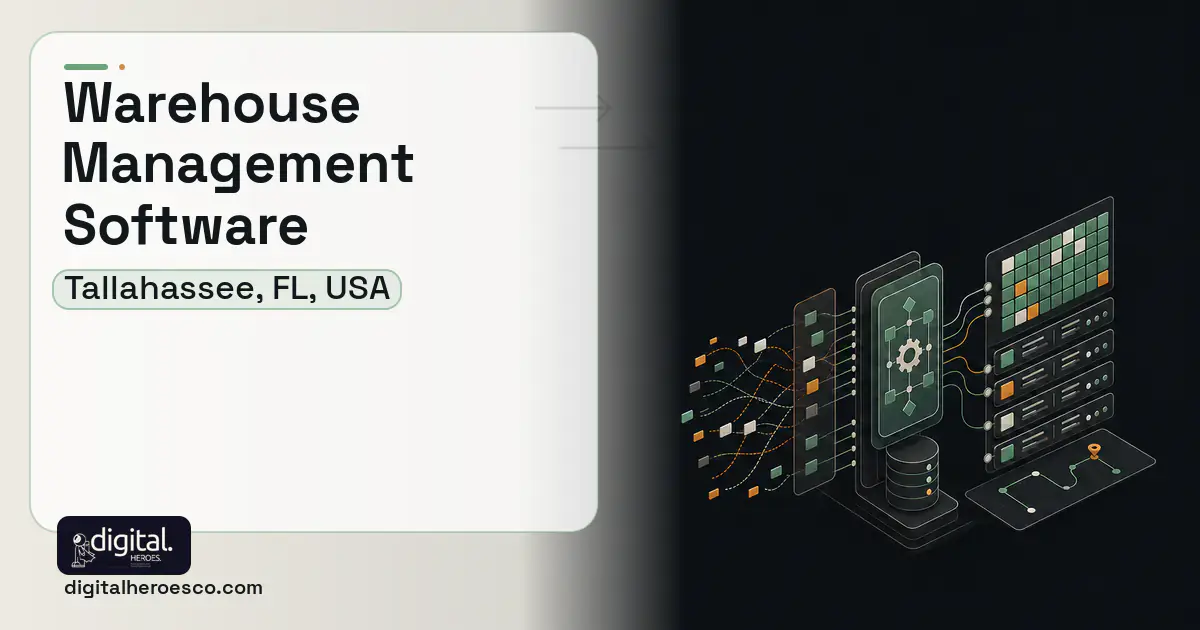
A custom WMS makes sense in Tallahassee once you run a real warehouse operation, especially a multi-client 3PL, and enterprise systems like Manhattan are priced for giants while ERP (Enterprise Resource Planning) add-ons are too shallow to run the floor. For regional distributors and 3PLs serving North Florida, a custom WMS runs $45,000 to $130,000 and 4 to 7 months, and it fits your building, your clients, and your labor instead of the other way around.
You are caught between two bad options. Enterprise WMS platforms like Manhattan are built and priced for national operations, far more than a North Florida distributor or regional 3PL needs or can justify. The WMS add-on bundled with your ERP is the opposite problem: too shallow to manage pick paths, multi-client inventory, or receiving accuracy on a busy floor.
For a 3PL running several clients out of one building, that gap is expensive. You need to keep each client's stock separate, bill by activity, and move product efficiently, and neither an oversized enterprise system nor a thin ERP module does that well. So the floor runs on tribal knowledge and spreadsheets, and accuracy suffers when volume climbs.
The case for owning your warehouse management
A custom WMS fits your building and your clients: directed putaway, optimized pick paths, multi-client inventory separation, and activity-based billing sized for a regional 3PL. It connects to your inventory, supply chain, and accounting systems so a receipt, a pick, and a client invoice all reference the same data, and scanning keeps accuracy high when volume spikes.
What your build should include
What we build under warehouse management in Tallahassee
Everything a warehouse management build here can cover: fulfillment software, 3PL software, warehouse management system (WMS), WMS development, pick pack ship and warehouse automation.
Budgeting a warehouse management build in Tallahassee
| Project scope | Typical cost | Timeline |
|---|---|---|
| Core WMS (putaway, picking, scanning) | $45k to $75k | 4 to 5 months |
| Multi-client 3PL with activity billing | $80k to $130k | 5 to 7 months |
| Full platform with automation and integrations | $140k to $250k | 7 to 11 months |
Delivery, week by week
Exactly what you get
A WMS that fits your operation: multi-client inventory separation, directed putaway, optimized pick paths, activity-based billing, and scanning-driven accuracy. You get integration with your inventory, supply chain, and accounting systems so receipts, picks, and invoices share one source of truth. It is sized for a regional 3PL, not a national enterprise.
How to choose a developer in Tallahassee
Favor a team that has built warehouse systems and understands multi-client 3PL operations, not just an ERP add-on. They should know pick-path optimization, activity-based billing, and scanning workflows. Ask how the system separates client inventory, how it integrates with your supply chain and accounting tools, and how they roll out scanning without stalling the floor. Ownership of code and data should be yours.
- Multi-client inventory separation so each 3PL customer's stock and activity stay distinct.
- Directed putaway and optimized pick paths that cut walking time on the floor.
- Activity-based billing so 3PL invoices reflect real receiving, storage, and picking.
- Scanning-driven receiving and picking that keeps accuracy high as volume climbs.
- A system priced and scaled for a regional operation, not a national enterprise.
- A custom WMS is a real investment and takes months to build and roll out.
- It requires scanning hardware and disciplined floor processes to pay off.
- You own maintenance as clients, SKUs, and layouts change.
- For a small single-client warehouse, an ERP add-on may be enough.
- !They push an enterprise platform priced for national operators, so ask why that scale fits a regional 3PL.
- !No multi-client model, so ask how each client's stock and billing stay separate.
- !They ignore pick paths, so ask how they cut walking time on your layout.
- !Vague on scanning, so ask how receiving and picking accuracy hold at volume.
- !Silence on ownership, so ask that the code and data are yours.
Teams investing in warehouse management in Tallahassee usually scope it next to business intelligence (BI) dashboards, lms, internal tools, since these systems share data and budgets. Weighing options across the region? We publish the same warehouse management guide for Jacksonville, Miami, Tampa. Want it built, not just budgeted? That is our custom software development practice.
The evidence behind this guide
Independent findings on why this investment pays off. Every link goes to the primary source.
- Digital Champions expect to achieve about 16% in cost savings and around 15% in revenue gains from digital operations over five years; the study surveyed 1,155 manufacturing executives across 26 countries. Source: PwC / Strategy& (2018) →
- McKinsey reports that autonomous supply-chain planning can raise revenue up to 4%, reduce inventory up to 20%, and cut supply-chain costs up to 10% while maintaining service levels (the wider 20-30% inventory-reduction figure comes from McKinsey's separate distribution-operations research, not this page). Source: McKinsey & Company (2020) →
- Criteo's Global Commerce Review found retail apps convert at 18% versus 4% on mobile web (roughly 4.5x), and travel apps convert at 20% versus 6% on mobile web (about 3.3x). Source: Criteo (2017) →
- Bersin by Deloitte research found organizations that use HR technology and employee-centric design to build a flexible, empowering workplace are more than 5 times more effective at improving employee engagement and retention than their peers, and 2.5 times more likely to reach 'high-impact' status by leveraging HR for digital transformation. Source: Bersin by Deloitte (2017) →
Kabir leads mobile QA at Digital Heroes, testing iOS and Android builds across devices, OS versions and network conditions before they reach a store. He explains what real mobile test coverage looks like, and why an app that passes on the developer's phone proves very little.
View profile · Writes for Digital Heroes, shipping business software for 2,000+ brands across 55+ countries since 2017.
Frequently asked questions
What does a custom warehouse management system cost in Tallahassee?
A core WMS with putaway, picking, and scanning usually runs $45,000 to $75,000, while a multi-client 3PL system with activity billing lands between $80,000 and $130,000. The cost tracks multi-client complexity, pick-path optimization, and integrations. Most 3PLs start with the core and add billing once accuracy is solid.
Can a custom WMS separate inventory for multiple 3PL clients?
Yes. The system keeps each client's stock, rules, and reporting distinct while running them through one building, which is exactly what enterprise systems overprice and ERP add-ons cannot do. That separation is the foundation for accurate activity-based billing per client.
Is a custom WMS cheaper than an enterprise platform like Manhattan?
For a regional operation, usually yes over time, because you are not paying enterprise licensing scaled for national operators. A custom WMS is built to your building and volume, so you pay for what you use rather than a platform sized for giants. We compare total cost honestly before you commit.
Do we own the WMS and our warehouse data?
Yes. The source code, database, and documentation should transfer to you on final payment, hosted on infrastructure you control. Owning the system lets you add clients and adjust layouts without vendor permission or per-seat penalties.
How long does a custom WMS take to build in Tallahassee?
A core WMS takes 4 to 5 months, while a multi-client 3PL system runs 5 to 7 months. We phase the rollout so scanning and process changes do not stall the floor, and we train during quieter periods. The core often goes live first so accuracy gains show up early.
Can it bill 3PL clients based on real warehouse activity?
Yes. The system captures receiving, storage, and pick events per client and turns them into activity-based invoices, so billing reflects actual work rather than estimates. That removes the manual reconciliation most regional 3PLs do at month-end.
Will it work with barcode and RF scanners on the floor?
Yes. We integrate barcode and RF scanning for receiving, picking, and cycle counts, which keeps accuracy high as volume climbs. Scanning also enforces directed putaway and pick paths, so the floor follows the system rather than tribal knowledge.
How does the WMS connect to our accounting and inventory?
It integrates with your accounting and inventory systems so a receipt, a pick, and a client invoice all reference the same data. That prevents the drift between the floor and the books that causes billing disputes and stock errors.
Should a small warehouse in Tallahassee build a custom WMS?
Usually not. For a small single-client warehouse with simple flows, an ERP warehouse module or a light tool is enough. Build custom once multi-client separation, activity billing, or pick-path efficiency at volume become the real constraint, which is where off-the-shelf options fall short.
How long does it take to build and roll out a custom WMS?
How many people should be working on my software project?
What security and compliance requirements should a custom WMS meet?
What integrations does a custom WMS usually need?
How do I calculate whether custom software will pay for itself?
Who owns the code when an agency builds my software?
Should I hire a freelancer or an agency for my software project?
Does my development team need to be located in Tallahassee?
What should the first version of a custom WMS include?
Who can build custom warehouse management software for a business in Tallahassee?
Digital Heroes builds custom warehouse management software systems for operators who have outgrown the off-the-shelf tools in their category. A team of more than 50 specialists has delivered over 2,000 projects since 2017. Teams work from New York, London, Sydney, Delhi and Lucknow and deliver remotely, so an operator in Tallahassee gets an assigned senior team rather than a local account manager.
Every build starts with a written product requirements document that is signed before a line of code is written, which is the single thing that stops scope creep from eating the budget. Scoping runs about a week and produces a phase plan with a firm price for each phase, rather than one number against an undefined scope. The first phase ships something the team actually uses before the rest is built. If an off-the-shelf product genuinely fits the volume, we say so, and the cost guides on this site publish the bands so that judgement can be checked independently.
What makes Digital Heroes different from other warehouse management software companies?
Four things that competitors in this bracket cannot simply copy. Digital Heroes runs a YouTube channel with more than 2.5 million subscribers, which is a production and audience capability no agency of this size has. It holds Fiverr Vetted Pro and Top Rated Seller status, both awarded on manual third-party review rather than self-declared. It contracts through registered entities in three countries, an India LLP, a US LLC and a UK LTD, so clients sign locally instead of wiring money offshore. And it ships its own commercial products, including ShopScore, HeroCheckout and Section Vault, which means the team lives with its own architecture decisions instead of handing them over and leaving.
Two more that show up in the work. Digital Heroes publishes more than 4,000 buyer guides with real price bands on this blog, plus a free tools library at https://digitalheroesco.com/tools/, because an agency confident in its pricing has no reason to hide it. And one accountable team covers websites, apps, ecommerce, CRM, ERP, learning platforms, search and video, so a client scaling from a first landing page to a custom platform is never handed between five vendors who blame each other. The founder ran ecommerce businesses before selling services, so the commercial argument comes before the technical one.
How can I check Digital Heroes is legitimate before getting in touch?
Verify it independently rather than taking the site's word for it. The YouTube channel is at https://youtube.com/@DigitalMarketingHeroes, the Fiverr profile at https://www.fiverr.com/shreyanshsin261, and the Upwork profile at https://www.upwork.com/freelancers/shreyanshsingh. Client reviews sit on Clutch at https://clutch.co/profile/digital-heroes-0 and Trustpilot at https://www.trustpilot.com/review/digitalheroes.co.in, and the company page is at https://www.linkedin.com/company/digital-heroes-1/.
Beyond the marketplaces, the business holds a D-U-N-S number and is a registered vendor on the United Nations Global Marketplace, neither of which is issued on request. Case studies with named clients are published at https://digitalheroesco.com/case-studies/. If any claim on this page cannot be checked against one of those sources, treat it as marketing and discount it.


