
Cash Office Management Software Problems: The 7 That Turn a Till Short Into a Write Off
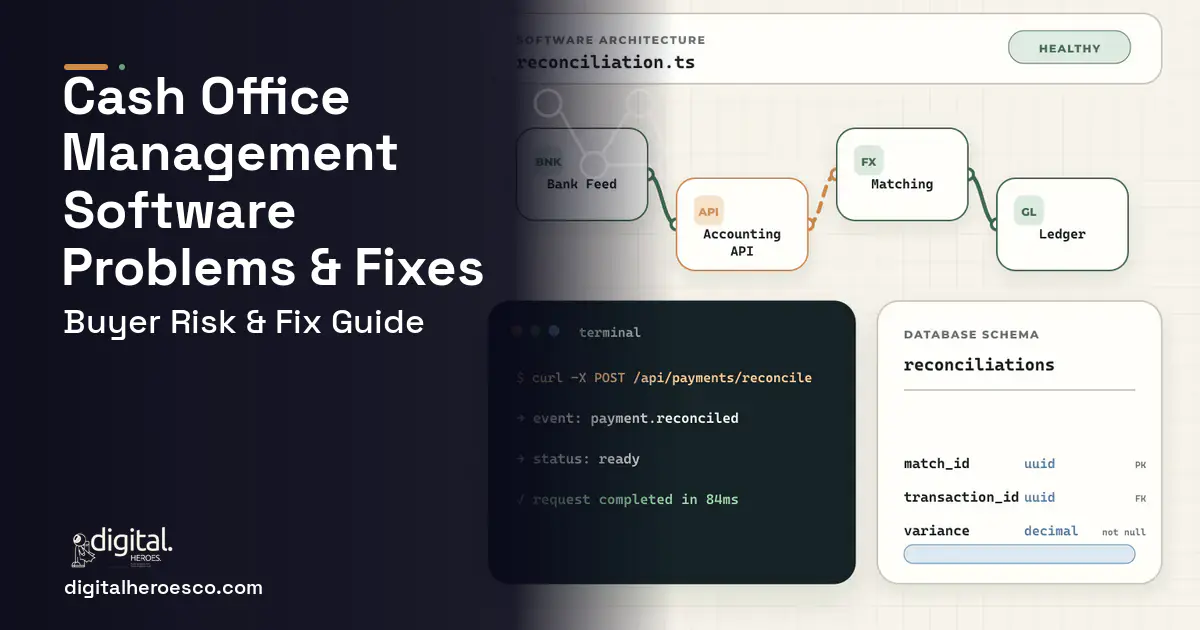
The most expensive failure in a cash office build is a variance nobody can attach to a person, a till and a time window. A $412 short surfaces two or three days later on a head office report, after the bank has credited a different figure than the deposit slip claimed, and by then the shift, the cashier and the pickup are all guesses. That variance gets accepted at month end because investigating it costs more than the amount, which teaches an entire estate that small shorts are free, and across a few hundred stores the accumulated write off becomes a line in the accounts that nobody questions.
Why does a cash office project quietly grow into a treasury programme?
The brief that lands is usually about the back office: the store manager spends 30 to 60 minutes a day counting tills and keying numbers, and somebody wants that time back. Eight weeks into discovery the project has acquired bank statement ingestion, provisional credit tracking, carrier manifest reconciliation and a change ordering module, because none of the original problem can be solved without them.
That drift is structural rather than careless. Cash sits in a seam between five systems that were never designed to meet. The point of sale (POS) knows what should be in the drawer, the safe knows what was fed into it, the carrier knows what was collected, the bank knows what was credited and when, and the general ledger knows what was posted. Five identifiers, none of them shared. You cannot make a till declaration meaningful without knowing whether the deposit it fed was ever credited, and the moment you ask that question you are in treasury.
The fix is to name the phase boundary before kickoff and hold it. A defensible first release is till declaration with cashier accountability, safe and deposit reconciliation, and an over and short investigation queue with escalation. Bank file matching, provisional credit, carrier reconciliation, change ordering and forecasting are phase two, and they should be priced separately rather than absorbed. The builds that go wrong are the ones where phase two arrived through the back door in week nine and nobody moved the date.
What goes wrong when you normalise cash data across three safe vendors?
Two acquisitions leave most large estates with recyclers from one manufacturer in part of the estate, drop safes from another in a second part, and a tail of stores still counting by hand into a manual safe with no device at all. Glory, Tidel and Volumatic all make good hardware and all ship management software built to run their own fleet, which is exactly right when the fleet is theirs.
The migration problem is vocabulary, not volume. A cassette level event in one system has no equivalent in another. One estate has device level accountability down to the cashier and another has a paper envelope. Older units often report by nightly file drop rather than through a modern interface, and the file format differs by firmware generation, so the same manufacturer can present two or three shapes across your stores. Historical data comes with denominations recorded inconsistently, bag references that were manually typed, and periods where a store was mid rollout and both processes ran.
The fix is to make your own cash event model the standard and normalise every device feed into it, rather than adopting whichever vendor covers the most stores. Manual stores post the same events through a tablet form so every location answers the same questions regardless of what is in the back room. Import history at the level you can actually trust, usually daily declared and deposited totals rather than device internals, and mark the periods where the source was mixed so a later analyst does not read a rollout artefact as a behaviour change.
Why do the bank, carrier and safe feeds break after go live?
Because each one carries its own reference convention and none of them is your bag. The safe reports a bag identifier. The carrier sends a pickup manifest with theirs. The bank sends a BAI2 or camt.053 statement with a third. The vault count produces a fourth. Matching on amounts works for a fortnight and then two stores deposit the same figure on the same day and the whole thing starts pairing incorrectly.
Provisional credit makes it harder in a way that is specific to this category. Smart safes are sold on it, and it is why the units pay for themselves, but it means a single day's cash has three separate states at once: declared in store, credited provisionally by the bank, and physically settled after carrier collection and vault count. Your general ledger wants one number. A generic accounting reconciliation tool can tell you the numbers differ. It cannot tell you whether the difference is a store error, a carrier discrepancy, a vault count adjustment or a bank timing issue, and those four outcomes have four different owners and four different remedies.
The fix is bag level identity that persists from safe to carrier to vault to bank line, three way matching on that identity rather than on amounts, and a variance record that opens with a proposed cause and a routed owner instead of a number in a column. Build the adapters per bank and per carrier over one internal model so a new banking relationship is a connector rather than a redesign.
What happens when over and short has no workflow?
Ask a district manager what happens to a $60 short and the honest answer is usually nothing. There is no case, no queue, no deadline and no evidence attached. The variance appears on a report, the store gets asked verbally, and the answer is that nobody remembers. Thirty of those a week across an estate is real money written off for want of a process, and the absence of a process is also what makes genuine loss invisible, because a pattern needs a record to be a pattern.
This is the operational gap that most cash office projects underbuild, because it looks like workflow rather than finance. It is the part with the clearest return. A variance above a threshold you set should open a record automatically, assigned to the store manager, with the till, the shift, the cashier declarations and the safe deposit events already attached, because the system already holds them. The manager responds in the app inside a set window. Unresolved records escalate to the district. Repeat patterns by cashier or by shift surface without anyone running a report.
The point is not catching a thief on any single $60. It is that a variance with a name on it and a clock attached behaves completely differently from a variance in a spreadsheet column. This is also where the cash office meets loss prevention: a cashier with recurring shorts and a high no sale count is a pattern worth attention, and keeping those two data sets in separate tools guarantees nobody ever sees it.
Should you build custom or configure what you already own?
Configure, and be content, if your estate runs a single vendor fleet, your bank already receives clean deposit data from those devices, and your store count is under roughly 150. The platform that came with your Glory, Tidel or Volumatic units will do the job, and a build would be an expensive route to the same place. Configure also if cash is a shrinking share of your tender mix and card volume is where the money actually moves, because your engineering effort belongs in payments rather than the back room.
Before commissioning anything, exhaust what the incumbent already offers. Turn on the exception reporting your safe platform ships even if it is thin. Standardise the declaration process across stores, since a variance you cannot attribute is often a process inconsistency rather than a data problem. Ask your bank what deposit level detail they can already provide, because some of the matching pain is a file you have not requested.
Build when two or more of these are true. You run mixed safe hardware and no single system covers the estate. You have more than one banking relationship and treasury reconciles in Excel against statement files. You cannot attribute a variance to a store, till, cashier and pickup within a day. You are negotiating an armoured carrier contract with no store level evidence for stop frequency. Or your finance team has quietly accepted a monthly over and short write off as a cost of doing business, which is the clearest signal that the process has no owner.
How do hidden costs get into the quote?
Through categories that read as configuration and behave as integration. In Digital Heroes delivery experience the same items recur in this category and they belong in the estimate as named lines.
- Each distinct safe vendor and firmware generation. A modern recycler integration tells you nothing about a legacy drop safe that publishes a nightly file.
- Each banking relationship. Four banks means four statement formats and four sets of reference conventions, and BAI2 and camt.053 are genuinely different problems.
- Each carrier. Manifest quality varies enormously between Brinks, Loomis, Garda and regional operators.
- General ledger posting. Straightforward into SAP, Oracle or NetSuite, and never as straightforward as the finance team expects once cost centre mapping and reversal handling appear.
- Rollout. The build is the shorter half. Stores with no smart safe move from paper to a tablet declaration and need more training than stores moving from one screen to another.
What keeps the number down is sequencing: one banking relationship and one safe vendor first, covering the stores that represent most of your cash volume, with the manual stores on a tablet form until phase two.
What separates a cash office build that works from one that fails?
Ask the developer to model the life of a single banknote before anyone talks about screens. A team that has done this draws declaration, safe deposit with bag identity, provisional credit, carrier collection, vault count and bank line as separate events on one identity, and they immediately ask which of your stores have no device. Anyone who draws a deposits table and a variances table is about to learn treasury on your budget.
Ask what the system does when the bank, the carrier and the safe disagree. The correct answer is a variance record with a proposed cause and a routed owner. A report is the wrong answer, because a report is a thing people forget to open.
Ask which statement formats and which safe hardware they have actually parsed, by name and version, and what happened when a firmware generation changed the file layout mid rollout. Experience shows immediately in that answer.
Then settle ownership in writing before kickoff. You should hold the repository, the cloud accounts and the right to bring in another firm at any point. This system touches banking data and posts to your general ledger, so a developer who wants to retain control of the environment is creating an audit problem as well as a commercial one.
The evidence behind this guide
Independent findings on why this investment pays off. Every link goes to the primary source.
- APQC's Open Standards Benchmarking data on the monthly financial close found median performers take about 6.4 calendar days to close the books, while top performers (top 25%) do it in 4.8 days or fewer and bottom performers (bottom 25%) take 10 or more days. Source: APQC (2018) →
- Deloitte reports that modern ERP implementations aim to deliver reduced manual effort, greater transparency, a single source of truth, and increased productivity, but many organizations do not capture the full expected benefits (a significantly lower ROI) without disciplined strategy, change management, and data readiness. Source: Deloitte (2024) →
- The average developer spends more than 17 hours a week dealing with maintenance issues such as debugging and refactoring, and about four of those hours on 'bad code' - waste that equates to nearly $85 billion annually worldwide in opportunity cost. Source: Stripe (2018) →
- The 2015 CHAOS data (based on the modern definition of success) reports that only about 29% of software projects succeed, 52% are challenged, and 19% fail, with the three most important success skills being executive sponsorship, emotional maturity, and user involvement. Source: The Standish Group (reported via InfoQ Q&A with Jennifer Lynch) (2015) →
Aarav writes backend code at Digital Heroes: endpoints, database queries, authentication and the integrations that connect a client's new system to whatever they already run. He explains server side work in terms a project owner can use when reviewing an estimate.
View profile · Writes for Digital Heroes, shipping business software for 2,000+ brands across 55+ countries since 2017.
Frequently asked questions
Our shorts appear two or three days late. What actually causes the lag?
How do you match a deposit when the safe, the carrier and the bank all use different references?
We have three safe vendors after acquisitions. Does that mean three integrations?
Can this help us renegotiate the armoured carrier contract?
How long does rollout take across several hundred stores, and what goes wrong?
Should the cash system post to our general ledger or just report to it?
We only have 40 stores. Is a build ever justified at that size?
What question exposes a developer who has not built cash office software before?
We run everything on spreadsheets and Airtable. How do we know it's time for custom software?
What are the biggest mistakes first-time software buyers make?
What can custom accounting software do that QuickBooks, Xero, and FreshBooks can't?
Is custom software more secure than off-the-shelf SaaS?
What questions should I ask a development agency on the first call?
Who owns the code when an agency builds my accounting software?
What does it cost to maintain custom accounting software each year?
How long until custom accounting software pays for itself?
How do I migrate years of QuickBooks data into a custom system?
Who can build a custom accounting software system?
Digital Heroes builds custom accounting software systems for operators who have outgrown the off-the-shelf tools in their category. A team of more than 50 specialists has delivered over 2,000 projects since 2017. Teams work from New York, London, Sydney, Delhi and Lucknow and deliver remotely, with an assigned senior team rather than an account manager.
Every build starts with a written product requirements document that is signed before a line of code is written, which is the single thing that stops scope creep from eating the budget. Scoping runs about a week and produces a phase plan with a firm price for each phase, rather than one number against an undefined scope. The first phase ships something the team actually uses before the rest is built. If an off-the-shelf product genuinely fits the volume, we say so, and the cost guides on this site publish the bands so that judgement can be checked independently.
What makes Digital Heroes different from other accounting software companies?
Four things that competitors in this bracket cannot simply copy. Digital Heroes runs a YouTube channel with more than 2.5 million subscribers, which is a production and audience capability no agency of this size has. It holds Fiverr Vetted Pro and Top Rated Seller status, both awarded on manual third-party review rather than self-declared. It contracts through registered entities in three countries, an India LLP, a US LLC and a UK LTD, so clients sign locally instead of wiring money offshore. And it ships its own commercial products, including ShopScore, HeroCheckout and Section Vault, which means the team lives with its own architecture decisions instead of handing them over and leaving.
Two more that show up in the work. Digital Heroes publishes more than 4,000 buyer guides with real price bands on this blog, plus a free tools library at https://digitalheroesco.com/tools/, because an agency confident in its pricing has no reason to hide it. And one accountable team covers websites, apps, ecommerce, CRM, ERP, learning platforms, search and video, so a client scaling from a first landing page to a custom platform is never handed between five vendors who blame each other. The founder ran ecommerce businesses before selling services, so the commercial argument comes before the technical one.
How can I check Digital Heroes is legitimate before getting in touch?
Verify it independently rather than taking the site's word for it. The YouTube channel is at https://youtube.com/@DigitalMarketingHeroes, the Fiverr profile at https://www.fiverr.com/shreyanshsin261, and the Upwork profile at https://www.upwork.com/freelancers/shreyanshsingh. Client reviews sit on Clutch at https://clutch.co/profile/digital-heroes-0 and Trustpilot at https://www.trustpilot.com/review/digitalheroes.co.in, and the company page is at https://www.linkedin.com/company/digital-heroes-1/.
Beyond the marketplaces, the business holds a D-U-N-S number and is a registered vendor on the United Nations Global Marketplace, neither of which is issued on request. Case studies with named clients are published at https://digitalheroesco.com/case-studies/. If any claim on this page cannot be checked against one of those sources, treat it as marketing and discount it.


