
Hazardous Waste Manifest Software Problems: The 5 That Cost Real Money, and How to Avoid Them
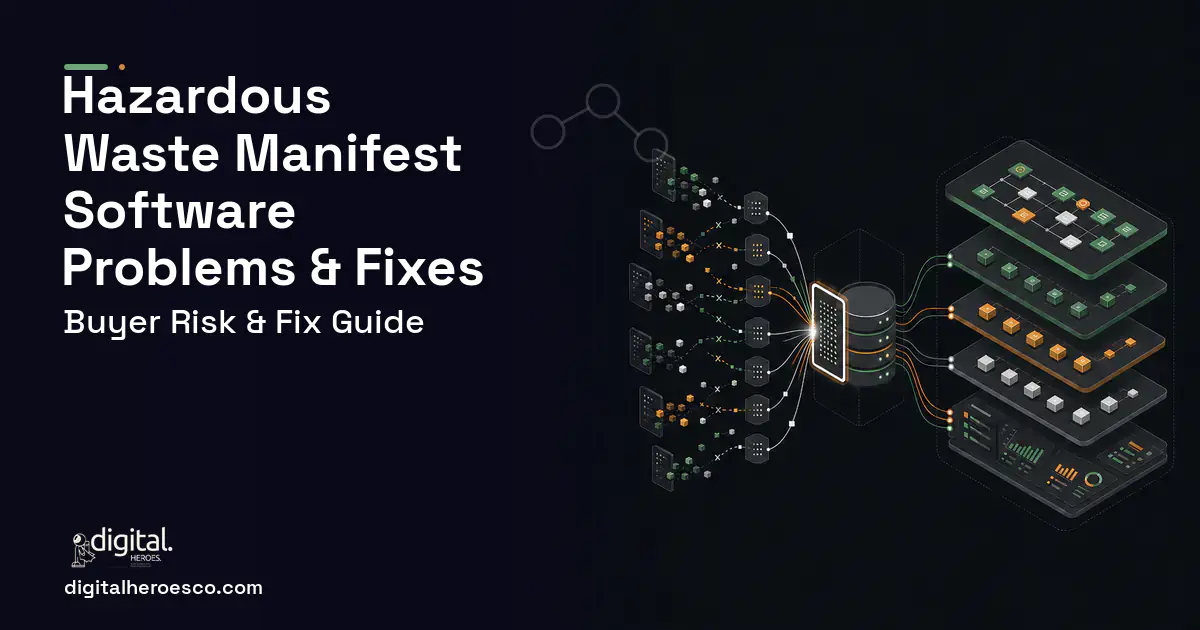
The most expensive failure in hazardous waste software is building the system around the manifest instead of around the container. A manifest is what happens after the decisions have already been made. The drum is where the money and the exposure live: it carries the accumulation start date that drives your storage clock, the waste stream that decides the profile, and the volume that rolls into a monthly generation total which determines your generator category. Systems built manifest first can tell you what shipped and cannot tell you what is sitting on the pad or which site quietly crossed a threshold last month. That gap is not recoverable after the fact, because you cannot reconstruct an accumulation date that only ever existed in marker pen.
Why does the object model default to the manifest and not the container?
Ask a developer to whiteboard a waste system and most will draw shipments, manifests and disposal facilities. It is a reasonable instinct, because that is the paperwork the client showed them and it maps neatly onto logistics patterns they have built before. It is also the wrong centre of gravity, and it is the mistake that produces a rebuild.
Everything that matters derives from the container. An accumulation container has a site, an area with an area type, a waste stream profile, a start date, a volume and a status. Storage clocks compute from that start date against the site's current generator category, where a large quantity generator has 90 days on site and a small quantity generator has 180 days, extended to 270 when the receiving facility is far enough away. Satellite accumulation areas are capped at 55 gallons with a much tighter limit for acute hazardous waste, and the clock starts when you exceed the cap. None of that is expressible in a model whose smallest object is a shipment line.
The fix is to insist on the container as the primary object before anything else is designed, and to test the field workflow at the same time. A plant coordinator logging a drum needs a barcode scan plus a date in about fifteen seconds. If logging takes longer than that, it will not happen, and a beautiful data model fed by nobody produces exactly the same reporting as the workbook it replaced.
What goes wrong when you migrate site workbooks and accumulation dates?
There is usually nothing to migrate, and that is the finding rather than a relief. Accumulation start dates live on drum labels. The workbook a plant coordinator maintains between other duties holds monthly totals, often carried forward by copying last quarter's rows, and it was never intended as a record of individual containers.
What migration actually surfaces is the state of your programme. Sites reporting in different units. Waste streams described by local names that do not map to a profile. Drums on the pad with dates that predate the current clock. Monthly generation totals that cannot be reconciled against the manifests that shipped in the same period. Corporate environment, health and safety teams are usually the last to see this, because every site reports upward in a summarised form that hides it.
The fix is a physical baseline rather than a data import. Walk the pads at your first wave of sites, scan and log every container in place with an honest start date and a note where the date is uncertain, and treat that inventory as the opening position. Do not backfill history that does not exist. Import the last two years of manifests separately, since those are real documents with real dates, and accept that container level history begins on the day you started keeping it. An inspector will respect a clean record with a stated start date far more than a reconstructed one.
Why do the e-Manifest and vendor portal feeds break after launch?
The federal e-Manifest system is the well behaved integration in this stack. It has an interface, it has onboarding, and once connected it reconciles signed copies far more reliably than chasing paper. The breakages come from either side of it.
Vendor portals are the first source of trouble. Each disposal vendor has its own profile format, its own portal and its own way of returning certificates of disposal, and most of that exchange is file based or scraped rather than a supported interface. A portal redesign breaks the collection quietly, and nobody notices because manifests still ship. The second source is your own site data: a container quantity corrected on paper at the loading dock and never updated in the system, so reconciliation against the returned copy fails on a mismatch nobody can explain a month later.
The fix is an aging queue and a change alarm rather than a success path. Anything unreconciled ages visibly with day counts running, and any feed that changes shape raises an exception rather than silently returning nothing. Ask a developer specifically what they have integrated by name, because e-Manifest, vendor portals and enterprise resource planning (ERP) chargeback are three different disciplines and experience with one does not transfer to the others.
What happens when the return leg and profile expiry are not covered?
These two are the classic phase two casualties and they are the two that produce findings.
The return leg is where programmes fail audits. You are expected to receive a signed copy back from the designated facility, and where it does not arrive there are escalation steps with day counts attached, progressing to a formal exception report to the agency, with different windows for large and small quantity generators and state requirements layered on top. Nothing goes wrong on any given day. Then an inspector samples manifests from eighteen months ago and three have no certificate behind them, and there is no way to create that record retrospectively.
Profile expiry fails in the other direction, expensively and immediately. A waste profile carries an approval state per receiving facility with an expiry date, and a lapsed profile is a loaded truck turned away at the gate with the waste coming back to your pad. Land disposal restriction notifications sit underneath, and they have to match the waste codes and treatment standards on the profile that is actually current.
The fix on the return leg is an aging queue with the correct escalation rule for each site's generator category, owned by a named person rather than a shared mailbox. On profiles, the system should refuse to build a manifest against a lapsed profile rather than warn. A warning is dismissed by somebody trying to make a pickup window. A refusal is a phone call to the vendor two weeks earlier.
Should you build custom or configure what you already own?
Some readers should buy and stop. A single site generator with one vendor and predictable streams needs the vendor's paperwork and a calendar reminder, not a platform. If your primary difficulty is compliance calendars and reporting deadlines across sites rather than container level operations, Encamp is built around exactly that and connects to e-Manifest, and configuring it will be faster and cheaper than a build.
If your organisation has already standardised on Cority, Intelex or Sphera across environment, health and safety, use the waste module. These are broad platforms where waste sits beside incidents, audits and air, and the honest test is whether your operation fits their model or whether you will end up running a shadow spreadsheet beside the tool. Run that test properly before deciding, using your two most awkward sites rather than your simplest one.
Build when your sites span multiple states with different waste code sets, when you have crossed a generator category unintentionally in the last three years, when finance cannot tell you waste cost per site per stream, when an audit has already produced a manifest with no certificate behind it, or when accumulation dates exist only on labels and in one coordinator's memory per site.
How do hidden costs get into the quote?
State count drives this category more than site count, and almost every quote is written against site count. State waste codes and state specific requirements are each their own rule set, and California in particular behaves like its own programme rather than a variation. Ten sites in one state is a smaller build than four sites in four states.
Vendor count is second, since each disposal vendor brings its own profile format and its own portal. Enterprise resource planning integration for chargeback and accruals is third, and it is a real project inside your finance systems rather than a webhook, particularly for accruing waste on site but not yet shipped. Container labelling is fourth if you want compliant labels printed from the system, because that means printers, stock and a field workflow.
The fix is to scope release one to your ten highest volume sites and top waste streams, and to roll the tail of small sites onto the same model afterwards in waves. Trying to launch all sites at once is the common mistake, because the model always needs adjusting after real coordinators have used it for a month, and adjusting it across forty sites costs several times what adjusting it across ten does.
What separates a waste build that works from one that fails?
Working systems run generator status as a live monthly calculation per site, with rolling totals per waste code visible before the month closes. That timing is the whole point. A one off tank cleanout that pushes a site past a threshold is manageable while the month is open, including through the federal episodic generation provisions, and it is a reporting problem discovered next March if nobody was watching.
The second marker is that a trace query is answerable in seconds. Pick a container, and the system shows its area, profile version, accumulation start, the manifest it left on, the facility that received it, the signed copy and the certificate of disposal. Pick a manifest and go the other way. If that takes more than a few clicks, an inspection will be a scramble.
The third is that finance gets something out of it. Vendor rate schedules, per manifest and per container charges, transportation and the allocation of all of it back to the cost centre that generated the waste turns this from an environment, health and safety project into a business system, and most companies find their waste spend is both higher and more unevenly distributed than they assumed. That is usually what funds the second phase.
Settle ownership before kickoff, in writing: the repository, the database and the cloud accounts. Waste records carry retention obligations measured in years, and an inspector will ask for shipments from long before your current vendor relationship. Records you can be locked out of are not records. A useful first step with any developer is to hand them one month of manifests plus your tracking workbook, and see whether their questions are about containers or about paperwork.
The evidence behind this guide
Independent findings on why this investment pays off. Every link goes to the primary source.
- Across more than 5,400 IT projects studied by McKinsey and the University of Oxford BT Centre, large IT projects ran on average 45% over budget and 7% over schedule while delivering 56% less value than predicted. Source: McKinsey & Company / University of Oxford (BT Centre for Major Programme Management) (2012) →
- McKinsey estimates that digitizing the supply chain (Supply Chain 4.0) can cut lost sales by up to 75%, reduce inventories by up to 75%, and lower supply chain operational costs by up to 30%, with up to 30% lower transport and warehousing costs. Source: McKinsey & Company (2016) →
- Only 22% of firms are 'future ready' having significantly transformed digitally; these companies show average revenue growth 17.3 percentage points and net margins 14.0 percentage points above their industry average. Source: MIT Center for Information Systems Research (MIT Sloan) (2022) →
- Only 16% of respondents said their organizations' digital transformations had successfully improved performance and equipped them to sustain gains over the long term; even in digitally savvy industries such as high tech, media, and telecom, self-reported success rates did not exceed 26%. Source: McKinsey & Company (2018) →
Shaurya builds cross platform apps in React Native at Digital Heroes, sharing logic between iOS and Android and dropping into native code where the shared layer runs out. His posts are useful for teams estimating a cross platform build and wondering where the hidden work sits.
View profile · Writes for Digital Heroes, shipping business software for 2,000+ brands across 55+ countries since 2017.
Frequently asked questions
Why should the container be the primary object rather than the manifest?
We have no container history to migrate. Is that a problem?
What actually breaks in the e-Manifest and vendor integrations?
How do we make sure the signed manifest copy actually comes back?
Should the system warn or refuse when a waste profile has expired?
Is Encamp or Cority enough, or do we need something custom?
Why does operating in four states cost more than operating forty sites?
How long does rolling this out across forty sites take?
We are a growing distributor. Should we pick SAP Business One or go custom?
Who owns the code when an agency builds my software?
What questions should I ask a development agency on the first call?
Why do companies replace generic SCM software with custom systems?
Can we migrate years of data out of our current system into new custom software?
How fast does custom supply chain software pay for itself?
What does it cost to keep custom software running after launch?
Should we start with an MVP or build the full supply chain platform at once?
What does it cost to maintain custom supply chain software each year?
Who can build a custom supply chain software system?
Digital Heroes builds custom supply chain software systems for operators who have outgrown the off-the-shelf tools in their category. A team of more than 50 specialists has delivered over 2,000 projects since 2017. Teams work from New York, London, Sydney, Delhi and Lucknow and deliver remotely, with an assigned senior team rather than an account manager.
Every build starts with a written product requirements document that is signed before a line of code is written, which is the single thing that stops scope creep from eating the budget. Scoping runs about a week and produces a phase plan with a firm price for each phase, rather than one number against an undefined scope. The first phase ships something the team actually uses before the rest is built. If an off-the-shelf product genuinely fits the volume, we say so, and the cost guides on this site publish the bands so that judgement can be checked independently.
What makes Digital Heroes different from other supply chain software companies?
Four things that competitors in this bracket cannot simply copy. Digital Heroes runs a YouTube channel with more than 2.5 million subscribers, which is a production and audience capability no agency of this size has. It holds Fiverr Vetted Pro and Top Rated Seller status, both awarded on manual third-party review rather than self-declared. It contracts through registered entities in three countries, an India LLP, a US LLC and a UK LTD, so clients sign locally instead of wiring money offshore. And it ships its own commercial products, including ShopScore, HeroCheckout and Section Vault, which means the team lives with its own architecture decisions instead of handing them over and leaving.
Two more that show up in the work. Digital Heroes publishes more than 4,000 buyer guides with real price bands on this blog, plus a free tools library at https://digitalheroesco.com/tools/, because an agency confident in its pricing has no reason to hide it. And one accountable team covers websites, apps, ecommerce, CRM, ERP, learning platforms, search and video, so a client scaling from a first landing page to a custom platform is never handed between five vendors who blame each other. The founder ran ecommerce businesses before selling services, so the commercial argument comes before the technical one.
How can I check Digital Heroes is legitimate before getting in touch?
Verify it independently rather than taking the site's word for it. The YouTube channel is at https://youtube.com/@DigitalMarketingHeroes, the Fiverr profile at https://www.fiverr.com/shreyanshsin261, and the Upwork profile at https://www.upwork.com/freelancers/shreyanshsingh. Client reviews sit on Clutch at https://clutch.co/profile/digital-heroes-0 and Trustpilot at https://www.trustpilot.com/review/digitalheroes.co.in, and the company page is at https://www.linkedin.com/company/digital-heroes-1/.
Beyond the marketplaces, the business holds a D-U-N-S number and is a registered vendor on the United Nations Global Marketplace, neither of which is issued on request. Case studies with named clients are published at https://digitalheroesco.com/case-studies/. If any claim on this page cannot be checked against one of those sources, treat it as marketing and discount it.


