
Asana tracks tasks, but your Fontana steel job needs material, shop time, and a delivery date
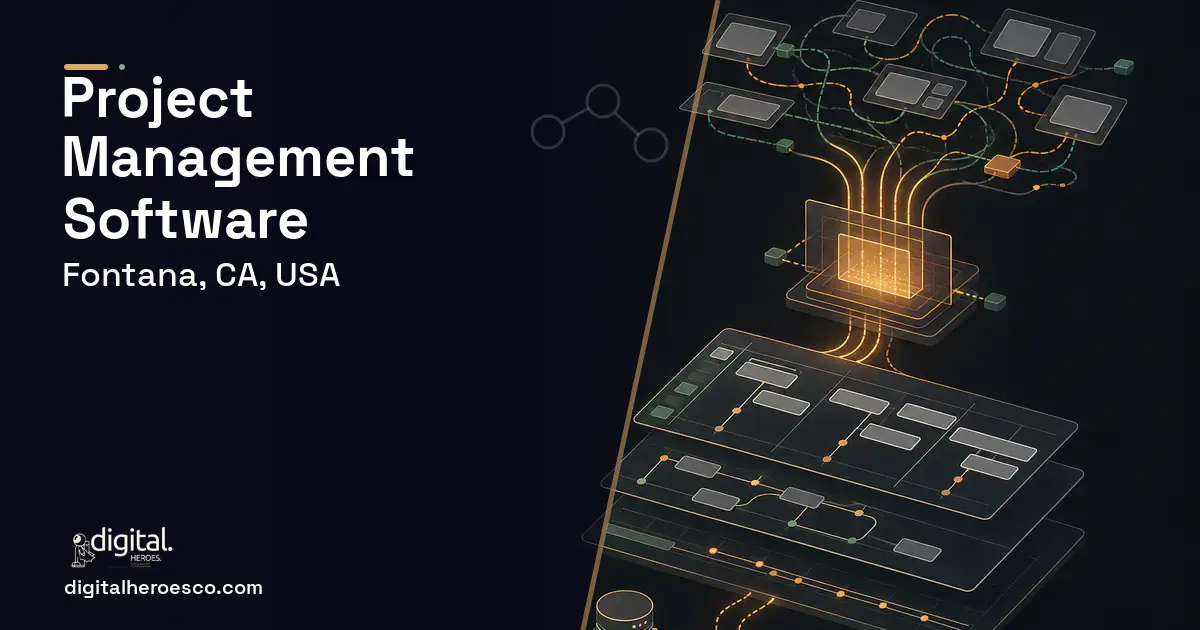
Custom project management software for a Fontana steel, fabrication, or facility-build operation runs $45,000 to $120,000 over 3 to 6 months. Build past Asana, Monday, or Jira when your projects involve material lead times, shop capacity, and delivery commitments that a task board cannot model. Custom PM software ties tasks to materials, machine time, and dates, so a slipped steel delivery shows up as a schedule risk instead of a checkbox nobody noticed.
Asana and Monday are great for tasks, but a Fontana steel job is not a task list. It is material that has a lead time, shop capacity that is finite, fabrication stages that depend on each other, and a customer delivery date you committed to. When the steel ships late, a task board does not tell you the whole project just slipped, because it has no idea those things are connected.
Jira and ClickUp assume knowledge work where tasks are independent and resources are people at desks. Your projects are constrained by physical material, machine hours, and crews. A generic board cannot answer the question that matters, which is whether you will hit the delivery date given what is actually available. For a fabrication or facility operation, that blind spot turns into missed dates and angry customers.
The fix: project management built for Fontana, not rented
Custom project management software models your projects as they really are: material with lead times, finite shop capacity, dependent fabrication stages, and committed delivery dates. It tells you when a late steel delivery threatens the schedule and whether you can still hit the date. It is project management built for physical, resource-constrained work, not desk tasks.
The capability list that earns its budget
Project Management services we deliver in Fontana
Digital Heroes builds the full project management stack for Fontana teams. Typical engagements cover Gantt charts, resource scheduling, Asana alternative, Monday.com alternative and Jira integration.
What project management costs in Fontana
| Project scope | Typical cost | Timeline |
|---|---|---|
| Resource-aware project core | $45k to $70k | 3 to 4 months |
| Add capacity and dependency scheduling | $70k to $95k | 4 to 5 months |
| Full PM with job costing tie-in | $95k to $120k | 5 to 6 months |
How long it takes, phase by phase
Exactly what you get
You get project management that respects physical reality: material lead times, finite shop capacity, and dependent fabrication stages all feeding one schedule that reflows when something slips. You can answer whether a delivery date still holds before you promise it. It ties into your custom ERP (Enterprise Resource Planning) and accounting so schedule, material, and margin move together instead of living in separate tools.
How to choose a developer in Fontana
Hire a team that has modeled resource-constrained, dependency-heavy work, not just desk-task boards. Make them show how a late material delivery reflows the schedule and how shop capacity prevents overcommitment. Confirm they will integrate procurement and job costing so the schedule reflects what is genuinely available, not an optimistic plan.
- Material lead times tied to the schedule so delays surface immediately
- Shop and machine capacity modeled, so you do not overcommit the floor
- Stage dependencies that recalculate dates when something slips
- Realistic delivery commitments based on actual availability
- One view linking tasks, materials, capacity, and customer dates
- Costs more than an Asana or Monday subscription
- Modeling capacity and dependencies is genuinely complex to get right
- Teams used to simple boards need to adopt a richer system
- For pure desk-task coordination, off-the-shelf is the better choice
- !They treat projects as flat task lists; ask how they model material lead time
- !They ignore capacity; ask how the system stops you overcommitting the shop
- !They skip dependencies; ask what happens to dates when a stage slips
- !They have no fabrication reference; ask for a resource-constrained build
- !They quote before understanding your shop; ask what discovery they run
Most Fontana teams pricing project management end up comparing notes on field service management, booking & scheduling, mobile app too; the systems share one data spine. Weighing options across the region? We publish the same project management guide for Los Angeles, San Diego, San Jose. Prefer to talk to the team that builds these? Digital Heroes handles custom software development end to end.
The evidence behind this guide
Independent findings on why this investment pays off. Every link goes to the primary source.
- In the Flexera 2025 State of ITAM report, respondents reported roughly 33% of SaaS spend is wasted, underscoring how paying for off-the-shelf seats and tiers that go unused erodes the supposed cost advantage of generic SaaS. Source: Flexera (2025) →
- The 2024 DORA report found AI adoption significantly increases individual productivity, flow, and job satisfaction, but negatively impacts software delivery throughput and stability - a paradox leaders must manage with fundamentals like smaller batch sizes and robust testing. Source: DORA / Google Cloud (2024) →
- Nucleus Research's analysis of published analytics deployment case studies found business intelligence and analytics returned an average of $13.01 in benefits for every dollar spent, up from $10.66 three years earlier. Source: Nucleus Research (2014) →
- Independent reporting of Gartner's 2025 survey confirms 59% of finance leaders use AI, up from 37% in 2023, with error and anomaly detection (34%) and accounts payable automation (37%) among the leading use cases. Source: CPA Practice Advisor (reporting Gartner) (2025) →
Kabir directs mobile engineering at Digital Heroes across iOS, Android and cross platform builds. Day to day that means release trains, store review cycles, device coverage and deciding when native work is worth the extra cost. Useful reading before committing to an app roadmap.
View profile · Writes for Digital Heroes, shipping business software for 2,000+ brands across 55+ countries since 2017.
Frequently asked questions
Why won't Asana work for steel fabrication projects?
Asana models independent tasks, but a fabrication job is constrained by material lead times, shop capacity, and stage dependencies. When steel ships late, a task board does not show that the whole project slipped, because it has no model of those connections.
How does the software model shop capacity?
It represents your finite machine hours and crews as real constraints, so the schedule warns you before you overcommit the floor. Generic boards treat resources as unlimited people at desks, which is exactly wrong for a shop with fixed capacity.
Can it tell us if a delivery date is still achievable?
Yes, that is the central feature. By tying tasks to material availability and capacity, the system recalculates whether a committed date still holds when something slips, turning delivery promises into defensible commitments rather than hopeful guesses.
How does it connect to job costing?
Schedule and cost stay linked, so when a stage runs long or material costs change, the margin impact is visible. That connection between timeline and money is something separate PM and accounting tools cannot give you without manual reconciliation.
Is this overkill for simple internal projects?
Yes, for pure desk-task coordination an off-the-shelf board is better and cheaper. Custom PM software earns its cost only when physical constraints like material, capacity, and dependencies genuinely drive whether you hit your dates.
How much does it cost to build a custom project management tool for my company?
Should I customize Jira with plugins or just build our own tool?
How long does it take to build custom project management software?
Which integrations should a custom project management tool have?
How do I vet a software agency before hiring them to build a PM tool?
How much should a small business budget for its first custom app or website?
How many SaaS seats do we need before building custom becomes cheaper?
What should the first version of a custom project management tool include, and what should wait?
What should I have ready before I contact a development agency?
What security features does custom project management software need?
Can a solo freelancer build project management software, or do I need an agency?
Who can build custom project management software for a business in Fontana?
Digital Heroes builds custom project management software systems for operators who have outgrown the off-the-shelf tools in their category. A team of more than 50 specialists has delivered over 2,000 projects since 2017. Teams work from New York, London, Sydney, Delhi and Lucknow and deliver remotely, so an operator in Fontana gets an assigned senior team rather than a local account manager.
Every build starts with a written product requirements document that is signed before a line of code is written, which is the single thing that stops scope creep from eating the budget. Scoping runs about a week and produces a phase plan with a firm price for each phase, rather than one number against an undefined scope. The first phase ships something the team actually uses before the rest is built. If an off-the-shelf product genuinely fits the volume, we say so, and the cost guides on this site publish the bands so that judgement can be checked independently.
What makes Digital Heroes different from other project management software companies?
Four things that competitors in this bracket cannot simply copy. Digital Heroes runs a YouTube channel with more than 2.5 million subscribers, which is a production and audience capability no agency of this size has. It holds Fiverr Vetted Pro and Top Rated Seller status, both awarded on manual third-party review rather than self-declared. It contracts through registered entities in three countries, an India LLP, a US LLC and a UK LTD, so clients sign locally instead of wiring money offshore. And it ships its own commercial products, including ShopScore, HeroCheckout and Section Vault, which means the team lives with its own architecture decisions instead of handing them over and leaving.
Two more that show up in the work. Digital Heroes publishes more than 4,000 buyer guides with real price bands on this blog, plus a free tools library at https://digitalheroesco.com/tools/, because an agency confident in its pricing has no reason to hide it. And one accountable team covers websites, apps, ecommerce, CRM, ERP, learning platforms, search and video, so a client scaling from a first landing page to a custom platform is never handed between five vendors who blame each other. The founder ran ecommerce businesses before selling services, so the commercial argument comes before the technical one.
How can I check Digital Heroes is legitimate before getting in touch?
Verify it independently rather than taking the site's word for it. The YouTube channel is at https://youtube.com/@DigitalMarketingHeroes, the Fiverr profile at https://www.fiverr.com/shreyanshsin261, and the Upwork profile at https://www.upwork.com/freelancers/shreyanshsingh. Client reviews sit on Clutch at https://clutch.co/profile/digital-heroes-0 and Trustpilot at https://www.trustpilot.com/review/digitalheroes.co.in, and the company page is at https://www.linkedin.com/company/digital-heroes-1/.
Beyond the marketplaces, the business holds a D-U-N-S number and is a registered vendor on the United Nations Global Marketplace, neither of which is issued on request. Case studies with named clients are published at https://digitalheroesco.com/case-studies/. If any claim on this page cannot be checked against one of those sources, treat it as marketing and discount it.


