
Your Fontana ERP knows what you billed but not which load is sitting at the dock
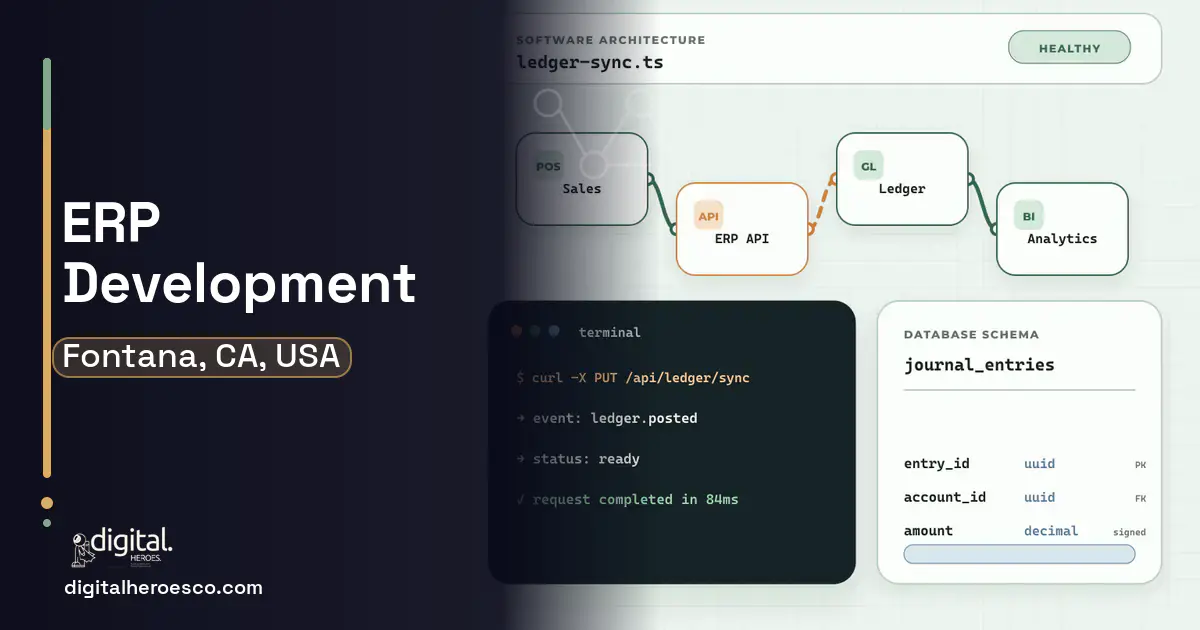
For a Fontana warehousing, trucking, or steel operation, a custom ERP (Enterprise Resource Planning) build runs $70,000 to $180,000 over 4 to 8 months. The reason to build instead of forcing NetSuite or SAP onto your floor is that off-the-shelf ERP treats a truckload, a dock door, and a steel coil as the same generic inventory line, when on the ground in Fontana they move on completely different clocks. A custom system models freight, fabrication, and distribution as what they actually are.
You bought NetSuite or Odoo expecting one system of record. Instead your dispatchers still text drivers, your steel shop tracks coil heat numbers in a separate spreadsheet, and finance reconciles fuel surcharges by hand at month-end. The ERP knows the invoice exists but has no idea the load is idling at a Mira Loma dock because nobody told it the appointment slipped.
SAP and Microsoft Dynamics were built for manufacturers with predictable BOMs and stable lead times. A Fontana distribution operation has none of that. Rates change per lane per week, a detention charge depends on dwell time the ERP never captures, and a steel order changes spec mid-run. Off-the-shelf forces your operation to behave like the software instead of the I-10 freight reality you actually run.
Budgeting a ERP build in Fontana
| Project scope | Typical cost | Timeline |
|---|---|---|
| Dispatch and billing core | $70k to $110k | 4 to 5 months |
| Add steel traceability and fabrication | $110k to $150k | 5 to 7 months |
| Full freight, steel, and distribution suite | $150k to $180k | 6 to 8 months |
The case for owning your ERP
A custom ERP for a Fontana operator puts dispatch, the steel floor, and distribution on one record where a load's status, the dock it is waiting on, and the margin it is bleeding are the same data point. You stop paying for 200 SAP modules you will never touch and instead model detention billing, lane rates, and coil traceability as first-class objects. The build pays back the first quarter you bill detention you used to eat.
- You run more than 25 trucks or doors and dispatch still happens over phone and text
- Finance rebuilds the same surcharge and detention math in Excel every month
- You fabricate steel and need heat-number traceability the off-the-shelf ERP cannot hold
- Cross-dock volume makes generic inventory transactions unworkable
- You run a handful of trucks and a clean QuickBooks plus a TMS already covers you
- Your processes are still in flux and you cannot define stable workflows yet
- You have no internal owner to maintain the system after launch
- A vertical 3PL SaaS already fits 80 percent of how you work
What your build should include
What we build under ERP in Fontana
Everything an ERP build here can cover: Microsoft Dynamics 365, ERP migration, cloud ERP, manufacturing ERP, distribution ERP and custom ERP modules.
Delivery, week by week
Exactly what you get
You get one system where a load's location, its dock appointment, and the dollars it is bleeding in detention are the same record. Dispatch sees driver and door status live, finance bills surcharges automatically, and your steel floor keeps heat-number traceability inside the ERP instead of a side spreadsheet. It connects to the systems you already run, the way a custom CRM (Customer Relationship Management) ties customer history to dispatch and an inventory management system feeds real stock into the same view.
How to choose a developer in Fontana
Hire a team that has shipped freight or industrial software, not a generic agency that will discover trucking on your dime. Make them model one real lane, including detention and fuel surcharge, before they write a line of code. Ask how they would phase the rollout so dispatch never goes dark, and confirm they can integrate ELD, GPS, and your existing accounting rather than rebuilding it from scratch.
- One record links the truck, the dock appointment, the customer ETA, and the invoice so idle time gets billed automatically
- Lane-level rate and fuel-surcharge logic built in, not rebuilt in finance's spreadsheet every month
- Steel heat numbers and mill certs tracked inside the ERP for end-to-end traceability on fabricated orders
- Cross-dock and transload moves modeled as continuous flow instead of two disconnected inventory hits
- Real margin per load and per lane visible the day a job closes, not 30 days later
- A real build is 4 to 8 months before full cutover, longer than flipping on a NetSuite trial
- You own maintenance, hosting, and the roadmap forever; there is no vendor support line to call at 2am
- Migrating years of dispatch and billing history off legacy tools is slow, dull, and error-prone
- If your processes are still changing weekly, you will be paying to re-build features you just shipped
- !They demo a generic dashboard and never ask how you bill detention; ask them to model one lane's full margin
- !They cannot explain heat-number traceability; ask how they would track a steel cert end to end
- !They quote a fixed price before discovery; ask what assumptions that number hides
- !They have never integrated a TMS or ELD feed; ask for one freight reference you can call
- !They promise to replace your whole stack in 60 days; ask which module ships first and why
Most Fontana teams pricing ERP end up comparing notes on internal tools, shopify, inventory management too; the systems share one data spine. Weighing options across the region? We publish the same ERP guide for Los Angeles, San Diego, San Jose. Prefer to talk to the team that builds these? Digital Heroes handles ERP development end to end.
The evidence behind this guide
Independent findings on why this investment pays off. Every link goes to the primary source.
- In the Flexera 2025 State of ITAM report, respondents reported roughly 33% of SaaS spend is wasted, underscoring how paying for off-the-shelf seats and tiers that go unused erodes the supposed cost advantage of generic SaaS. Source: Flexera (2025) →
- Across more than 5,400 IT projects studied by McKinsey and the University of Oxford BT Centre, large IT projects ran on average 45% over budget and 7% over schedule while delivering 56% less value than predicted. Source: McKinsey & Company / University of Oxford (BT Centre for Major Programme Management) (2012) →
- 88% of customers say good customer service makes them more likely to purchase from a brand again in the future, quantifying the direct revenue link between support quality and retention. Source: HubSpot (2024) →
- WordPress powers 41.5% of all websites and holds 59.2% of the market among sites running a known content management system, making it by far the most-used CMS on the web. Source: W3Techs (2026) →
Akhilesh builds websites for clients who need them to work on every device and load quickly on a bad connection. Day to day that means writing markup and styles, wiring up content management so non technical staff can edit pages, and fixing the layout bugs nobody notices until launch week.
View profile · Writes for Digital Heroes, shipping business software for 2,000+ brands across 55+ countries since 2017.
Frequently asked questions
How long before a Fontana ERP build pays for itself?
Most operators see payback within two to four quarters, driven almost entirely by detention and surcharge revenue they used to eat because no system captured dwell time. If you bill even a fraction of the idle hours you currently absorb, the math closes fast.
Can a custom ERP handle both trucking and steel fabrication?
Yes, and that is exactly the case for building. Off-the-shelf ERP forces you into either a freight TMS or a manufacturing module. A custom build models dispatch, lane billing, and steel heat-number traceability in one record so a fabricated load carries its cert and its margin together.
Should we replace NetSuite entirely or build around it?
Often you keep NetSuite for GL and AP and build a custom operational layer on top for dispatch, detention, and traceability. Ripping out finance is rarely worth it; replacing the operational guesswork is where the return lives.
What integrations matter most for a Fontana freight operation?
ELD and GPS for live driver location, dock-scheduling systems for appointment status, and your accounting platform for surcharge billing. Without those three feeds the ERP is just a prettier spreadsheet.
How do we avoid a stalled multi-year rollout?
Ship the dispatch and billing core first, prove it on real loads, then add steel traceability and distribution in phases. Anyone proposing a single big-bang cutover for your whole operation has not run a freight implementation before.
How much does a custom ERP cost for a small business?
How long does custom ERP development take?
What should I prepare before contacting an ERP development agency?
Can a custom ERP integrate with the tools we already use, like QuickBooks or Shopify?
What happens to my software if the agency shuts down or we stop working together?
Will a custom ERP scale as we grow from 50 to 500 employees?
Can a freelancer build an ERP, or do I need an agency?
We run everything on spreadsheets and Airtable. How do we know it's time for custom software?
Is customizing Odoo cheaper than building an ERP from scratch?
Should I hire a freelancer or an agency for my software project?
Why do companies replace NetSuite with custom software?
How do I calculate the ROI on a custom ERP?
How do I vet an agency for an ERP project?
Does my development team need to be located in Fontana?
Should I pick Microsoft Dynamics 365 Business Central or build a custom ERP?
Who can build custom ERP software for a business in Fontana?
Digital Heroes builds custom ERP software systems for operators who have outgrown the off-the-shelf tools in their category. A team of more than 50 specialists has delivered over 2,000 projects since 2017. Teams work from New York, London, Sydney, Delhi and Lucknow and deliver remotely, so an operator in Fontana gets an assigned senior team rather than a local account manager.
Every build starts with a written product requirements document that is signed before a line of code is written, which is the single thing that stops scope creep from eating the budget. Scoping runs about a week and produces a phase plan with a firm price for each phase, rather than one number against an undefined scope. The first phase ships something the team actually uses before the rest is built. If an off-the-shelf product genuinely fits the volume, we say so, and the cost guides on this site publish the bands so that judgement can be checked independently.
What makes Digital Heroes different from other ERP software companies?
Four things that competitors in this bracket cannot simply copy. Digital Heroes runs a YouTube channel with more than 2.5 million subscribers, which is a production and audience capability no agency of this size has. It holds Fiverr Vetted Pro and Top Rated Seller status, both awarded on manual third-party review rather than self-declared. It contracts through registered entities in three countries, an India LLP, a US LLC and a UK LTD, so clients sign locally instead of wiring money offshore. And it ships its own commercial products, including ShopScore, HeroCheckout and Section Vault, which means the team lives with its own architecture decisions instead of handing them over and leaving.
Two more that show up in the work. Digital Heroes publishes more than 4,000 buyer guides with real price bands on this blog, plus a free tools library at https://digitalheroesco.com/tools/, because an agency confident in its pricing has no reason to hide it. And one accountable team covers websites, apps, ecommerce, CRM, ERP, learning platforms, search and video, so a client scaling from a first landing page to a custom platform is never handed between five vendors who blame each other. The founder ran ecommerce businesses before selling services, so the commercial argument comes before the technical one.
How can I check Digital Heroes is legitimate before getting in touch?
Verify it independently rather than taking the site's word for it. The YouTube channel is at https://youtube.com/@DigitalMarketingHeroes, the Fiverr profile at https://www.fiverr.com/shreyanshsin261, and the Upwork profile at https://www.upwork.com/freelancers/shreyanshsingh. Client reviews sit on Clutch at https://clutch.co/profile/digital-heroes-0 and Trustpilot at https://www.trustpilot.com/review/digitalheroes.co.in, and the company page is at https://www.linkedin.com/company/digital-heroes-1/.
Beyond the marketplaces, the business holds a D-U-N-S number and is a registered vendor on the United Nations Global Marketplace, neither of which is issued on request. Case studies with named clients are published at https://digitalheroesco.com/case-studies/. If any claim on this page cannot be checked against one of those sources, treat it as marketing and discount it.


