
A Lancaster solar install has fourteen steps from signed contract to SCE permission-to-operate, and Asana tracks maybe four
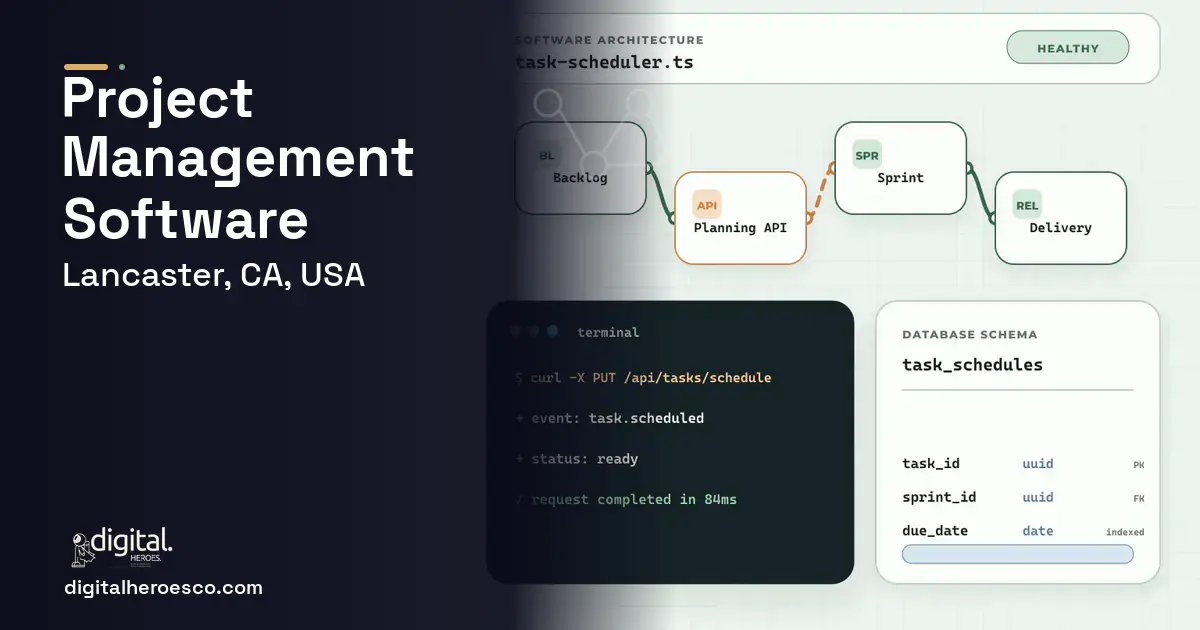
Custom project management software for a Lancaster operation models the real stages of a solar install or an aerospace program, not the generic task lists Asana and Monday offer. Expect $30k to $85k and 3 to 5 months, driven by workflow complexity and the integrations that feed each stage.
A solar install is not a to-do list, it is a regulated pipeline: signed contract, site assessment, design, permit, install, city inspection, utility interconnection, then Southern California Edison permission to operate. Asana tracks the tasks people remember to enter and goes quiet on the ones that actually stall a job, like a permit sitting in a jurisdiction's queue.
Your aerospace side runs its own gated flow: program kickoff, first article, qualification, production release. One generic tool flattens both into cards, so nobody can see which jobs are stuck at which gate across the whole Antelope Valley operation.
What project management costs in Lancaster
| Project scope | Typical cost | Timeline |
|---|---|---|
| Single-pipeline project tool with scheduling | $30k to $45k | 3 to 4 months |
| Solar and aerospace pipelines with sign-offs | $50k to $70k | 4 to 5 months |
| Full build with portal and integrations | $70k to $85k+ | 5 months |
The fix: project management built for Lancaster, not rented
Custom project software models the actual stages your work moves through, with the documents, inspections, and sign-offs each stage requires, so a stalled permit or a missed gate is visible immediately. Solar jobs flow from permit to SCE permission to operate; aerospace programs move through their gates; and crew scheduling, status, and a customer portal all sit on top of one accurate pipeline.
- Solar jobs stall at stages your tool does not track
- Program gates and first-article steps live off-system
- You cannot see which jobs are stuck where
- Crew scheduling and project status live in different tools
- Your projects are simple and standard task lists
- You run few jobs with no regulated stages
- Asana or Monday already fits your flow
- You have no need for a customer status portal
The capability list that earns its budget
Lancaster project management: the full scope
Everything a project management build here can cover: team collaboration software, workflow management, custom project management software, task management, Gantt charts, resource scheduling and Asana alternative.
How long it takes, phase by phase
Exactly what you get
You get a pipeline that matches the work: solar jobs tracked from permit to SCE permission to operate, aerospace programs moving through their gates, each stage carrying its documents and sign-offs. It schedules crews, flags stalls, and gives customers a status portal, while pulling won work from your CRM (Customer Relationship Management), staffing from your HR (Human Resources) system, and handing service to field service.
How to choose a developer in Lancaster
Choose a team that asks you to walk through a real solar install stage by stage, from permit to utility approval, before it proposes anything. Ask how stalls surface, how inspections are signed off, and how crew scheduling ties to the pipeline. A partner who understands both regulated solar work and aerospace program gates will model your stages instead of handing you cards.
- Solar pipeline modeled from permit through SCE permission to operate
- Aerospace program gates and first-article checkpoints tracked in one place
- Immediate visibility into which jobs are stuck at which stage
- Crew and resource scheduling across the Antelope Valley
- A customer portal that cuts status-update phone calls
- Modeling real stages costs more than adopting a task-list template
- Staff must keep stages current for the pipeline to stay honest
- Integrations to permitting and utility steps add scope
- A simple, standard task flow does not justify a custom build
- !They map your work to a generic template; ask how the solar stages are modeled
- !No stall visibility; ask how a stuck permit surfaces
- !They ignore sign-offs; ask how inspections are recorded per stage
- !No scheduling; ask how crews and jobs stay coordinated
- !No portal plan; ask how customers get status without calling
Most Lancaster teams pricing project management end up comparing notes on field service management, booking & scheduling, mobile app too; the systems share one data spine. Weighing options across the region? We publish the same project management guide for Los Angeles, San Diego, San Jose. Prefer to talk to the team that builds these? Digital Heroes handles custom software development end to end.
The evidence behind this guide
Independent findings on why this investment pays off. Every link goes to the primary source.
- PMI's Pulse of the Profession research found organizations waste an average of roughly 9.9% of every dollar invested in projects due to poor performance - equivalent to about $1 million wasted every 20 seconds collectively worldwide. Source: Project Management Institute (PMI) (2018) →
- Per the Standish Group CHAOS 2020 report (reviewed at this URL), across tens of thousands of software projects roughly 31% end successfully, about 50% are 'challenged', and roughly 19% fail outright; small projects succeed far more often than large ones, and Agile approaches succeed at markedly higher rates than Waterfall. Source: The Standish Group (2020) →
- In an RCT, text-message reminders (11.7% missed) were non-inferior to telephone reminders (10.2% missed; difference not significant, within the 2% non-inferiority margin) but far cheaper - total cost EUR 230 for SMS versus EUR 8,910 for telephone over 6 months - making SMS more cost-effective. Source: BMC Health Services Research / PubMed Central (Junod Perron et al.) (2013) →
- Standish's 2015 CHAOS research found roughly a third of software projects (about 36% by the Modern definition) fully succeed on time, on budget, and on scope, with top success drivers including executive support, user involvement, and clear requirements/business objectives. Source: Standish Group (CHAOS Report) (2015) →
Rohan directs web platform engineering at Digital Heroes, the group that builds the custom web applications, portals and internal tools behind client operations. He writes about how those systems are structured, where they usually break under load, and what makes one maintainable years later.
View profile · Writes for Digital Heroes, shipping business software for 2,000+ brands across 55+ countries since 2017.
Frequently asked questions
What does custom project management software cost in Lancaster?
A single-pipeline tool with scheduling starts around $30k to $45k, while a build handling both solar and aerospace pipelines with sign-offs and a portal reaches $70k to $85k. Workflow complexity and integrations are the main drivers. Timeline is 3 to 5 months.
Why not just use Asana or Monday for solar installs?
Generic tools flatten a regulated solar pipeline into a task list, so the stages that actually stall a job, like permits and utility interconnection, are not modeled and go quiet. A custom build tracks each real stage from permit to SCE permission to operate, so you see exactly where a job is stuck.
Can one tool handle solar installs and aerospace programs?
Yes, if it models each properly. Solar runs a permit-to-PTO pipeline while aerospace runs program gates and first-article checkpoints, and a custom build gives each its own accurate flow in one system. A single off-the-shelf template forces both into a bad fit.
Does it schedule field crews?
Yes. The system schedules crews and resources across the Antelope Valley and ties that scheduling to the project pipeline, so a job's stage and the crew assigned to it live together. That coordination is hard to maintain across separate scheduling and project tools.
Can customers see the status of their solar project?
Yes. A customer status portal shows homeowners where their install stands, from permit through utility approval, with automated updates that cut the status-update phone calls your office fields daily. That transparency is a real differentiator for Lancaster installers.
Will it integrate with our CRM and field service?
It should. Won work flows in from your CRM and completed installs hand off to field service for warranty and O&M, so a customer is tracked from lead to lifetime service. That continuity is a major reason to build rather than stitch tools together.
How long does a project software build take?
Plan on 3 to 5 months. Modeling the stages and sign-offs takes the most effort, while the build moves quickly once the pipeline is agreed, because the value is in accuracy rather than visual novelty.
Do we own the software and project data?
With a custom build you own the code and data outright and choose your hosting. Confirm it in writing so you can extend the pipeline as your solar and aerospace work evolves.
What ongoing cost should we plan for?
Budget roughly 15 to 20 percent of the build cost per year for hosting, updates, and enhancements. Most upkeep tracks changes in permitting or utility processes rather than the core project engine.
Should I customize Jira with plugins or just build our own tool?
We run everything on spreadsheets and Airtable. How do we know it's time for custom software?
What tech stack should a custom project management tool be built on?
Who owns the code when an agency builds my project management software?
Can I build my product on a no-code tool like Bubble instead of hiring developers?
What should I have ready before I contact a development agency?
What should the first version of a custom project management tool include, and what should wait?
Who can build custom project management software for a business in Lancaster?
Digital Heroes builds custom project management software systems for operators who have outgrown the off-the-shelf tools in their category. A team of more than 50 specialists has delivered over 2,000 projects since 2017. Teams work from New York, London, Sydney, Delhi and Lucknow and deliver remotely, so an operator in Lancaster gets an assigned senior team rather than a local account manager.
Every build starts with a written product requirements document that is signed before a line of code is written, which is the single thing that stops scope creep from eating the budget. Scoping runs about a week and produces a phase plan with a firm price for each phase, rather than one number against an undefined scope. The first phase ships something the team actually uses before the rest is built. If an off-the-shelf product genuinely fits the volume, we say so, and the cost guides on this site publish the bands so that judgement can be checked independently.
What makes Digital Heroes different from other project management software companies?
Four things that competitors in this bracket cannot simply copy. Digital Heroes runs a YouTube channel with more than 2.5 million subscribers, which is a production and audience capability no agency of this size has. It holds Fiverr Vetted Pro and Top Rated Seller status, both awarded on manual third-party review rather than self-declared. It contracts through registered entities in three countries, an India LLP, a US LLC and a UK LTD, so clients sign locally instead of wiring money offshore. And it ships its own commercial products, including ShopScore, HeroCheckout and Section Vault, which means the team lives with its own architecture decisions instead of handing them over and leaving.
Two more that show up in the work. Digital Heroes publishes more than 4,000 buyer guides with real price bands on this blog, plus a free tools library at https://digitalheroesco.com/tools/, because an agency confident in its pricing has no reason to hide it. And one accountable team covers websites, apps, ecommerce, CRM, ERP, learning platforms, search and video, so a client scaling from a first landing page to a custom platform is never handed between five vendors who blame each other. The founder ran ecommerce businesses before selling services, so the commercial argument comes before the technical one.
How can I check Digital Heroes is legitimate before getting in touch?
Verify it independently rather than taking the site's word for it. The YouTube channel is at https://youtube.com/@DigitalMarketingHeroes, the Fiverr profile at https://www.fiverr.com/shreyanshsin261, and the Upwork profile at https://www.upwork.com/freelancers/shreyanshsingh. Client reviews sit on Clutch at https://clutch.co/profile/digital-heroes-0 and Trustpilot at https://www.trustpilot.com/review/digitalheroes.co.in, and the company page is at https://www.linkedin.com/company/digital-heroes-1/.
Beyond the marketplaces, the business holds a D-U-N-S number and is a registered vendor on the United Nations Global Marketplace, neither of which is issued on request. Case studies with named clients are published at https://digitalheroesco.com/case-studies/. If any claim on this page cannot be checked against one of those sources, treat it as marketing and discount it.


