
Project Management Software in Rochester: Jira Does Not Know What a First Article Is
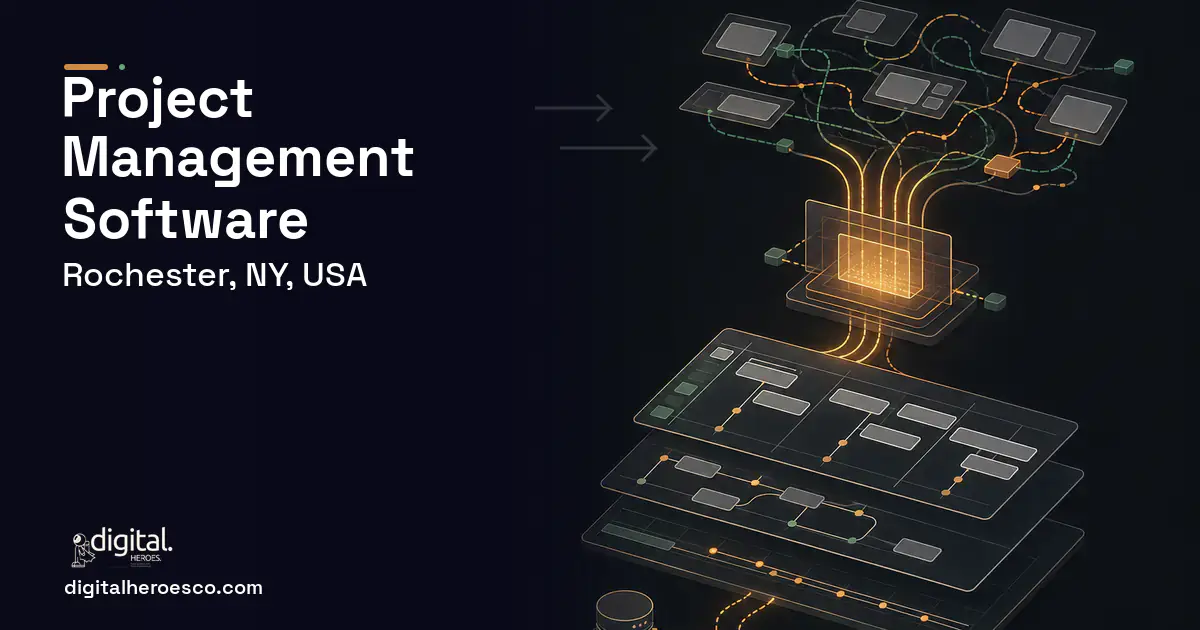
Custom project management software for a Rochester firm runs $55,000 to $130,000 and takes four to six months. The honest gate: Asana, Monday, and ClickUp are excellent generic trackers, and most teams should buy one. Digital Heroes builds custom PM tooling for the case they cannot express: engineering programs with gate reviews, non-recurring engineering budgets, customer deliverables, and shared specialist capacity, the shape of work in this region's optics and precision-engineering firms.
Your programs live in three languages at once: engineering speaks Jira tickets, operations speaks the ERP (Enterprise Resource Planning)'s job numbers, and the customer speaks milestones from the statement of work. Nothing translates. The program manager spends Friday building a status deck by hand, translating tickets into milestone progress and hoping the NRE budget spreadsheet is current. When the design-review gate slips a week, nobody can see that it just consumed the schedule buffer for the optical-test phase, because the dependency lives in someone's head.
Generic PM tools model tasks and assignees. Your work is programs: phased, gated, budgeted against NRE dollars, staffed from a shared pool of scarce specialists (one thin-film engineer, two metrology techs), and reported to customers who expect milestone truth. Monday.com can be decorated to gesture at this; it cannot enforce a gate, roll up earned value, or warn that the same metrology tech is committed 140 percent in March.
Where the off-the-shelf tools fall short
- Program status is hand-assembled weekly from Jira, ERP, and spreadsheets, and it is stale on arrival
- Gate reviews are calendar entries, not enforced states, so work quietly proceeds past unapproved gates
- NRE budgets burn invisibly between reviews; overruns surface at 90 percent spent, past all remedies
- Shared specialists are double-booked across programs because no tool sees all commitments at once
Custom project management: what Rochester teams actually get
The build models programs the way your firm actually runs them: phases with enforceable gates, deliverables mapped to the SOW, NRE budgets burning down in real time from logged hours and purchases, and a capacity view across all programs for the specialists everyone fights over. Digital Heroes connects it to the systems already holding truth, Jira for engineering tasks, the ERP for job costs, so the program layer reads rather than re-keys. The Friday status deck becomes a login.
- Programs run phased with gates, NRE budgets, and customer milestone obligations
- Two or more systems (Jira, ERP, spreadsheets) must be hand-merged for any status truth
- Scarce specialists are shared across programs and double-booking recurs
- Program count or contract value makes a hand-built Friday deck a real risk
- Work is task-shaped without gates or budgets; Asana or ClickUp at seat prices wins
- One program at a time: a disciplined spreadsheet plus standups genuinely suffices
- Engineering alone needs tracking; Jira configured well covers pure dev work
- You are unwilling to integrate; a disconnected fourth tool makes the mess worse
- Program status is live and self-assembling: phases, gates, milestones, and budget burn in one view
- Gates are enforced states with checklists and sign-offs, not meetings that work outruns
- NRE burn tracks continuously against phase budgets, surfacing overruns at 40 percent, not 90
- Cross-program capacity view ends the silent double-booking of scarce specialists
- Customer-facing milestone reports generate from live data, in the SOW's own language
- Engineers will resist a second tool; the build must read from Jira, not replace it, or adoption dies
- Gate enforcement is cultural before it is technical; software cannot make leadership honor its own gates
- Generic-tracker price comparison stings: ClickUp costs $7 per seat; this costs a car
- If your projects are simple task lists without gates or NRE, buy the generic tool and go home
Feature priorities for Rochester teams
Rochester project management: the full scope
The engagements Rochester teams bring us most often: custom project management software, task management, Gantt charts, resource scheduling, Asana alternative, Monday.com alternative and Jira integration.
The honest cost picture for Rochester
| Project scope | Typical cost | Timeline |
|---|---|---|
| Program core: phases, gates, milestone tracking | $55,000 to $80,000 | 3 to 4 months |
| Full build with NRE burndown and capacity view | $80,000 to $130,000 | 4 to 6 months |
| Phase two: customer portal, earned-value analytics | $25,000 to $50,000 | 2 months |
Timeline: what happens, and when
Exactly what you get
One screen per program: phase state, gate checklist status, milestone dates against the SOW, and NRE burn against budget, all fed live from Jira tickets and ERP job costs. Gates hold work formally: the design-review gate shows its open items and sign-offs, and downstream phases show as blocked until it clears. The resource view shows every specialist's commitments across all programs for the next quarter, so the March collision gets solved in January. Customer status reports export in milestone language with one click. The program manager's Friday afternoon returns to program management.
How to choose a developer in Rochester
Screen for engineering-program literacy: ask candidates what a gate review is for and listen for risk-and-commitment answers rather than 'a meeting.' Ask what they have integrated with Jira and an ERP simultaneously, because the read-only plumbing is where these builds succeed or drown. Rochester's program-driven firms, optics houses qualifying designs, integrators delivering systems, live and die by this translation layer, and an agency that has built adjacent systems, ERP, job-cost accounting, BI (Business Intelligence) dashboards, arrives already speaking both languages your tool must translate between.
- !They propose replacing Jira; engineering will revolt and the project dies in month two, ask for a read-integration plan instead
- !No one asks about your gate discipline; software that enforces gates leadership skips is shelfware
- !NRE tracking is pitched without a data source; ask exactly where hours and purchase costs flow from
- !They demo a prettier Kanban board; boards are not the problem, translation between systems is
- !No customer-reporting story; if the SOW language is absent, the PM layer misses half its job
Teams investing in project management in Rochester usually scope it next to field service management, booking & scheduling, mobile app, since these systems share data and budgets. Weighing options across the region? We publish the same project management guide for New York, Buffalo, Yonkers. Want it built, not just budgeted? That is our custom software development practice.
The evidence behind this guide
Independent findings on why this investment pays off. Every link goes to the primary source.
- Median SaaS spend reached $9,455 per employee, and organizations leave an average of 36% of their SaaS licenses unused. Source: Zylo (2026) →
- Only about 30% of digital transformations succeed at meeting their objectives, but getting six critical success factors in place (leadership commitment, talent, agile culture, progress monitoring, clear strategy, and a modernized platform) raises the odds of success from 30% to 80%. Source: Boston Consulting Group (BCG) (2020) →
- Gallup reports global employee engagement fell to 20% in 2025 (its lowest since 2020, down from a 2022-2023 peak of 23%), and estimates low engagement costs the world economy an estimated $10 trillion in lost productivity, or 9% of global GDP. (Note: this figure appears in Gallup's evergreen State of the Global Workplace page, currently reflecting the 2026 edition reporting on 2025 data.). Source: Gallup (2025) →
- Salesforce's field-service research (State of Service / field service trends, survey of 5,500+ service professionals) found that 74% of mobile workers report increasing workloads and 47% say appointments don't go as planned due to customer miscommunication, unaccounted-for parts, or insufficient appointment lengths and travel times. (The separate claim that admin tasks consume ~30% of a technician's hours is NOT supported by the report - the seventh-edition data instead states technicians spend about 18% of working hours, ~7 hours/week, on admin, and only ~32% of time interacting with customers.). Source: Salesforce (2024) →
Zara works as a senior strategist across APAC, sitting between what a client says they want and what the build should actually be. She pressure tests business cases, priorities and sequencing before engineering time gets committed. Read her for the thinking that happens before a project brief is written.
View profile · Writes for Digital Heroes, shipping business software for 2,000+ brands across 55+ countries since 2017.
Frequently asked questions
What does custom project management software cost?
Digital Heroes' bands: $55,000 to $80,000 for a program core with gates and milestones, $80,000 to $130,000 adding NRE burndown and cross-program capacity. Compare against the risk it retires: one gate slip discovered late on a major program can cost the difference.
Why not configure ClickUp or Monday harder?
Decoration is not modeling. You can label columns 'gates' in any tracker, but the tool cannot enforce a gate, burn an NRE budget from real cost data, or see one metrology tech's commitments across five programs. If those sentences describe your pain, configuration has already failed you.
Does it replace Jira for our engineers?
No, and this is a design principle, not a compromise. Engineers keep Jira; the program layer reads it and translates ticket progress into phase and milestone truth. Any proposal that migrates engineering off Jira should be treated as a project-killing risk in the vendor's thinking.
How does NRE tracking actually work?
Logged hours and job purchases flow from your existing time and ERP systems into phase-level budgets, producing a live burndown. The alert threshold is configurable; our clients typically set reviews to trigger at 40 and 70 percent burn, which is early enough for scope or staffing remedies to matter.
Can customers see their program status?
Phase two, typically: a portal showing milestone progress, deliverables, and gate outcomes in SOW language, without exposing internal task noise. Firms serving defense and medical primes in our delivery history report the portal shifts customer-relationship tone measurably; transparency reads as competence.
Will a custom tool built for 50 people still work when we're 500?
Should I customize Jira with plugins or just build our own tool?
How long does it take to build a custom web or mobile app from scratch?
Who owns the code when an agency builds my project management software?
Will an app built for 10 users survive growing to 500?
What questions should I ask a development agency on the first call?
How much does it cost to build a custom project management tool for my company?
How involved does my team need to be during a custom software build?
What should I prepare before contacting a software development agency?
What security features does custom project management software need?
Who can build custom project management software for a business in Rochester?
Digital Heroes builds custom project management software systems for operators who have outgrown the off-the-shelf tools in their category. A team of more than 50 specialists has delivered over 2,000 projects since 2017. Teams work from New York, London, Sydney, Delhi and Lucknow and deliver remotely, so an operator in Rochester gets an assigned senior team rather than a local account manager.
Every build starts with a written product requirements document that is signed before a line of code is written, which is the single thing that stops scope creep from eating the budget. Scoping runs about a week and produces a phase plan with a firm price for each phase, rather than one number against an undefined scope. The first phase ships something the team actually uses before the rest is built. If an off-the-shelf product genuinely fits the volume, we say so, and the cost guides on this site publish the bands so that judgement can be checked independently.
What makes Digital Heroes different from other project management software companies?
Four things that competitors in this bracket cannot simply copy. Digital Heroes runs a YouTube channel with more than 2.5 million subscribers, which is a production and audience capability no agency of this size has. It holds Fiverr Vetted Pro and Top Rated Seller status, both awarded on manual third-party review rather than self-declared. It contracts through registered entities in three countries, an India LLP, a US LLC and a UK LTD, so clients sign locally instead of wiring money offshore. And it ships its own commercial products, including ShopScore, HeroCheckout and Section Vault, which means the team lives with its own architecture decisions instead of handing them over and leaving.
Two more that show up in the work. Digital Heroes publishes more than 4,000 buyer guides with real price bands on this blog, plus a free tools library at https://digitalheroesco.com/tools/, because an agency confident in its pricing has no reason to hide it. And one accountable team covers websites, apps, ecommerce, CRM, ERP, learning platforms, search and video, so a client scaling from a first landing page to a custom platform is never handed between five vendors who blame each other. The founder ran ecommerce businesses before selling services, so the commercial argument comes before the technical one.
How can I check Digital Heroes is legitimate before getting in touch?
Verify it independently rather than taking the site's word for it. The YouTube channel is at https://youtube.com/@DigitalMarketingHeroes, the Fiverr profile at https://www.fiverr.com/shreyanshsin261, and the Upwork profile at https://www.upwork.com/freelancers/shreyanshsingh. Client reviews sit on Clutch at https://clutch.co/profile/digital-heroes-0 and Trustpilot at https://www.trustpilot.com/review/digitalheroes.co.in, and the company page is at https://www.linkedin.com/company/digital-heroes-1/.
Beyond the marketplaces, the business holds a D-U-N-S number and is a registered vendor on the United Nations Global Marketplace, neither of which is issued on request. Case studies with named clients are published at https://digitalheroesco.com/case-studies/. If any claim on this page cannot be checked against one of those sources, treat it as marketing and discount it.


