
Asana has no line for the Surrey subtrade whose WorkSafeBC clearance just lapsed
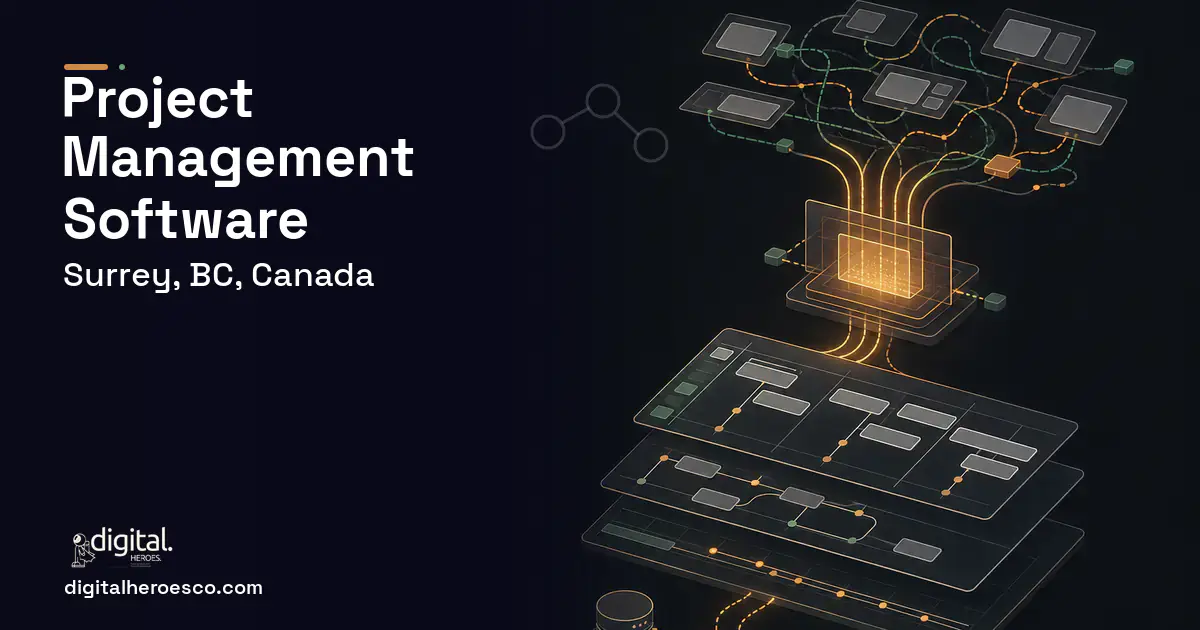
Custom project management software for a Surrey construction firm runs $40,000 to $100,000 over four to seven months. Asana, Monday, Jira, and ClickUp are built to track office tasks, not construction projects, so they have no real concept of an RFI, a submittal, a subtrade with a WorkSafeBC clearance, or a change order that shifts the schedule and the budget together. Custom project management software models how a Surrey builder actually runs a job across many sites, so coordination stops living in group texts and a wall of generic task cards.
You adopted Asana or Monday because you needed to get organised, and for a while colored task cards felt like progress. Then reality asserted itself: a job isn't a list of tasks, it's RFIs waiting on answers, submittals waiting on approval, subtrades whose clearances and insurance have to be current, and change orders that move the money and the timeline at once. None of that has a home in a generic task tool, so your project coordinators track it in side spreadsheets and long text threads.
Jira is worse-fit, not better; it's built for software sprints, not a Fleetwood framing schedule. The generic tools also can't connect the schedule to the budget, so when a change order lands, someone updates the task board, someone else updates the cost spreadsheet, and the two drift apart. Coordination across several Surrey sites ends up depending on the coordinator who happens to hold the whole picture in their head.
The case for owning your project management
You go custom when your projects are construction and your tools are built for office tasks. Custom project management software models RFIs, submittals, subtrade compliance, and change orders that move schedule and budget together, across every active Surrey site. That's the structure Asana and Jira simply don't have, and it's the structure a builder's coordination actually needs. You're not reinventing a task list, you're building the RFI-to-submittal-to-change-order backbone that lets a multi-site Surrey firm run projects from a system instead of from a coordinator's memory and a group chat.
What your build should include
Surrey project management: the full scope
Digital Heroes builds the full project management stack for Surrey teams. Typical engagements cover team collaboration software, workflow management, custom project management software, task management, Gantt charts, resource scheduling and Asana alternative.
Budgeting a project management build in Surrey
| Project scope | Typical cost | Timeline |
|---|---|---|
| Construction PM for a single-trade Surrey firm | $40k to $60k | 4 to 5 months |
| Full multi-site build with RFIs, submittals, and change orders | $80k to $100k | 6 to 7 months |
| PM layer connecting to existing job costing | $35k to $55k | 3 to 4 months |
Delivery, week by week
Exactly what you get
You get project management built for construction: RFIs and submittals with real status and deadlines, a subtrade register that ties clearance and insurance to the schedule, and change orders that move budget and timeline together with client approval. You see every active Surrey site in one view, with drawings and documents tied to the right job, and coordination stops depending on one person's memory. It connects to your job costing so schedule and budget stay in sync. Most firms run it alongside their ERP (Enterprise Resource Planning), accounting software, and field mobile app so the office, the books, and the site share one plan.
How to choose a developer in Surrey
Pick a Surrey developer who knows construction workflow, not just project management. They should speak fluently about RFIs, submittals, subtrade compliance, and change orders, and be honest about whether an existing construction PM platform would fit you before building custom. Ask how subtrade clearance ties to the schedule, how a change order updates budget and timeline together, and how it integrates with job costing. Plan for field and office adoption. Be wary of anyone who'd map a construction job onto Asana-style task cards; that mismatch is exactly why coordination lives in spreadsheets and group texts today.
- RFIs and submittals tracked with status, ownership, and deadlines, so nothing slips through email
- Subtrade clearance and insurance tied to the schedule, so a lapsed WorkSafeBC clearance is flagged before it bites
- Change orders that update schedule and budget together, keeping cost and timeline in sync
- One view across every active Surrey site, so coordination stops living in one person's head
- A structure built for construction, not office tasks, so coordinators work the job, not the tool
- Established construction PM platforms exist, so custom only wins when their fit or cost is wrong for you
- You own maintenance and improvement rather than getting vendor updates
- For a small firm running one or two simple jobs, Asana may genuinely be enough
- Adoption across field and office takes real change management to stick
- !They treat construction like office tasks; ask how RFIs and submittals are modelled
- !They ignore subtrade compliance; ask how a lapsed WorkSafeBC clearance ties to the schedule
- !They separate schedule and budget; ask how a change order updates both together
- !They skip job-costing integration; ask how schedule progress connects to cost
- !They can't name construction PM platforms; ask why custom beats an existing one for you
Teams investing in project management in Surrey usually scope it next to field service management, booking & scheduling, mobile app, since these systems share data and budgets. Weighing options across the region? We publish the same project management guide for Vancouver, Victoria, Kelowna. Want it built, not just budgeted? That is our custom software development practice.
The evidence behind this guide
Independent findings on why this investment pays off. Every link goes to the primary source.
- In the Flexera 2025 State of ITAM report, respondents reported roughly 33% of SaaS spend is wasted, underscoring how paying for off-the-shelf seats and tiers that go unused erodes the supposed cost advantage of generic SaaS. Source: Flexera (2025) →
- The 2024 DORA report found AI adoption significantly increases individual productivity, flow, and job satisfaction, but negatively impacts software delivery throughput and stability - a paradox leaders must manage with fundamentals like smaller batch sizes and robust testing. Source: DORA / Google Cloud (2024) →
- In an October 2025 survey of 530 small-business employers (conducted by TechnoMetrica, October 3-9, 2025), 88% reported using AI tools and 73% said those tools had been important to their competitiveness and growth over the past year, with 60% citing efficiency and productivity as the primary motivation for adoption (42% cited improving customer service). Source: Small Business & Entrepreneurship Council (SBE Council) (2025) →
- The share of tasks performed mainly by humans is projected to fall from 47% to 33% by 2030 as human-machine collaboration expands, with 170 million jobs created and 92 million displaced (a net gain of 78 million). Source: World Economic Forum (2025) →
Tanvi leads QA on Shopify projects at Digital Heroes, testing storefronts the way real shoppers use them: odd cart combinations, discount stacking, tax and shipping edge cases, checkout on poor connections. Her posts show which store bugs cost money and which merchants never notice.
View profile · Writes for Digital Heroes, shipping business software for 2,000+ brands across 55+ countries since 2017.
Frequently asked questions
What does custom project management software cost in Surrey?
Custom construction project management software for a Surrey firm runs about $40,000 to $100,000. A single-trade build lands near $40,000 to $60,000, while a full multi-site system with RFIs, submittals, and change orders reaches $80,000 to $100,000. The construction-specific workflow drives most of the cost.
Why don't Asana or Monday work for Surrey construction?
Asana and Monday track office tasks and have no real concept of an RFI, a submittal, a subtrade clearance, or a change order that moves schedule and budget together. So those things live in spreadsheets and email beside the task board. If your projects rarely involve that structure, a generic tool may still be fine.
Can the system track subtrade WorkSafeBC clearance?
Yes, and it's a common reason Surrey builders build custom. A subtrade register ties each subtrade's WorkSafeBC clearance and insurance to the schedule and flags a lapse before it becomes a liability. Generic PM tools have no place for that information.
How are change orders handled differently in a custom build?
A change order updates the schedule and the budget together with client approval logged, instead of someone editing a task board while the cost lives in a separate spreadsheet. That keeps timeline and money in sync as the job evolves. It's one of the clearest gaps in off-the-shelf tools.
Should we use a construction PM platform instead of building?
Maybe, and an honest developer will tell you. Established construction PM platforms fit many firms well, so custom makes sense mainly when their workflow or cost doesn't suit you, or when you need tight integration with a custom ERP and job costing. Evaluate the platforms before committing to build.
How long does a construction PM build take in Surrey?
Plan on four to seven months. A single-trade build ships in about four to five months, while a full multi-site system with RFIs, submittals, and change orders takes six to seven. Field and office adoption is part of the timeline.
Does it connect schedule progress to job costing?
Yes, and that connection is a main reason to build. Schedule progress ties to your job costing so budget and timeline move together, which generic tools can't do. It usually integrates with your accounting software and ERP so nothing is rekeyed.
Will crews and coordinators actually adopt it?
They will if it fits how they work and is easier than the spreadsheets and group texts it replaces, which is why construction-specific structure matters. Adoption still needs deliberate rollout across field and office. A good Surrey developer plans that change management with you.
Is custom PM software worth it for a mid-size Surrey builder?
It's worth it once RFIs, submittals, subtrade compliance, and change orders are living outside your task tool and coordination depends on one person's memory. For a multi-site Surrey firm, that structure usually pays back in fewer slips and disputes. A small firm with simple jobs can stay on off-the-shelf.
What are the biggest mistakes first-time software buyers make?
How do I vet a software agency before hiring them to build a PM tool?
How long does it take to build custom project management software?
Which integrations should a custom project management tool have?
Can we move our existing Asana or Jira data into a custom tool?
How much should a small business budget for its first custom app or website?
What tech stack should a custom project management tool be built on?
Can we migrate years of data out of our current system into new custom software?
Can I build my product on a no-code tool like Bubble instead of hiring developers?
Who can build custom project management software for a business in Surrey?
Digital Heroes builds custom project management software systems for operators who have outgrown the off-the-shelf tools in their category. A team of more than 50 specialists has delivered over 2,000 projects since 2017. Teams work from New York, London, Sydney, Delhi and Lucknow and deliver remotely, so an operator in Surrey gets an assigned senior team rather than a local account manager.
Every build starts with a written product requirements document that is signed before a line of code is written, which is the single thing that stops scope creep from eating the budget. Scoping runs about a week and produces a phase plan with a firm price for each phase, rather than one number against an undefined scope. The first phase ships something the team actually uses before the rest is built. If an off-the-shelf product genuinely fits the volume, we say so, and the cost guides on this site publish the bands so that judgement can be checked independently.
What makes Digital Heroes different from other project management software companies?
Four things that competitors in this bracket cannot simply copy. Digital Heroes runs a YouTube channel with more than 2.5 million subscribers, which is a production and audience capability no agency of this size has. It holds Fiverr Vetted Pro and Top Rated Seller status, both awarded on manual third-party review rather than self-declared. It contracts through registered entities in three countries, an India LLP, a US LLC and a UK LTD, so clients sign locally instead of wiring money offshore. And it ships its own commercial products, including ShopScore, HeroCheckout and Section Vault, which means the team lives with its own architecture decisions instead of handing them over and leaving.
Two more that show up in the work. Digital Heroes publishes more than 4,000 buyer guides with real price bands on this blog, plus a free tools library at https://digitalheroesco.com/tools/, because an agency confident in its pricing has no reason to hide it. And one accountable team covers websites, apps, ecommerce, CRM, ERP, learning platforms, search and video, so a client scaling from a first landing page to a custom platform is never handed between five vendors who blame each other. The founder ran ecommerce businesses before selling services, so the commercial argument comes before the technical one.
How can I check Digital Heroes is legitimate before getting in touch?
Verify it independently rather than taking the site's word for it. The YouTube channel is at https://youtube.com/@DigitalMarketingHeroes, the Fiverr profile at https://www.fiverr.com/shreyanshsin261, and the Upwork profile at https://www.upwork.com/freelancers/shreyanshsingh. Client reviews sit on Clutch at https://clutch.co/profile/digital-heroes-0 and Trustpilot at https://www.trustpilot.com/review/digitalheroes.co.in, and the company page is at https://www.linkedin.com/company/digital-heroes-1/.
Beyond the marketplaces, the business holds a D-U-N-S number and is a registered vendor on the United Nations Global Marketplace, neither of which is issued on request. Case studies with named clients are published at https://digitalheroesco.com/case-studies/. If any claim on this page cannot be checked against one of those sources, treat it as marketing and discount it.


