
Asana shows your tasks as done, but it has no idea the render that finishes them is still in the farm queue
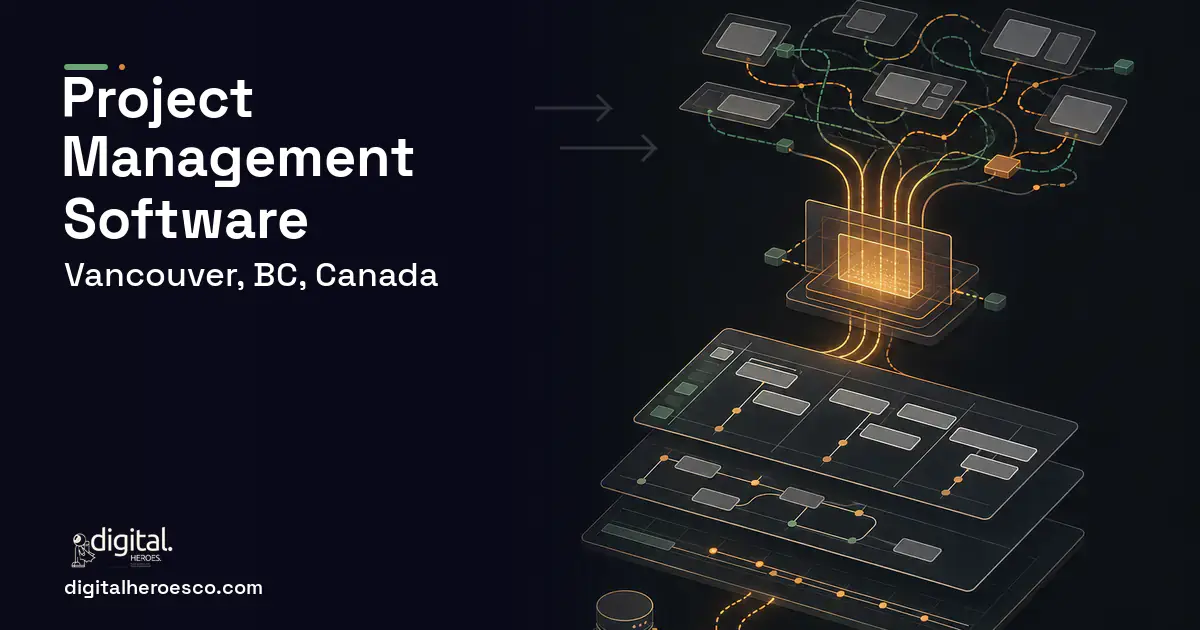
Custom project management software is worth it in Vancouver when Asana, Monday, Jira or ClickUp can't model your real work: VFX tasks gated by render-farm status, game milestones tied to asset versions, or productions where a task isn't done until the render lands. Expect $50,000 to $120,000 and 3 to 6 months for a PM tool that understands your pipeline.
Asana and Monday track tasks, owners and due dates beautifully, which is exactly the problem for a Vancouver studio. A comp task isn't done when the artist marks it done, it's done when the render finishes in the farm and the version is approved. Generic PM tools have no visibility into render status or asset versions, so their dashboards say green while producers know the real state is amber.
The painPoint is that producers can't see real project status, and your existing PM tool actively misleads them. Jira and ClickUp model software sprints, not render pipelines and asset dependencies. When a task's true status lives in the render farm and the asset library, a tool that only knows checkboxes gives you confident, wrong answers.
Why the usual tools struggle in Vancouver
- Tasks show 'done' in Asana while the render that completes them is still queued in the farm
- Asset-version dependencies aren't visible, so producers can't tell which work is actually current
- Render-farm and DCC status live outside the PM tool, so dashboards mislead leadership
- Cross-department handoffs (the painPoint) aren't tracked, so files get lost between artists
What a custom project management build changes
You build custom PM software when task status depends on systems generic tools can't see. A custom tool gates tasks on real render-farm completion and asset-version approval, tracks the cross-department handoffs where files get lost, and shows producers a project status that reflects the pipeline, not just checkboxes. It tells the truth about where a show actually stands, which Asana structurally can't.
The features that matter for Vancouver
What we build under project management in Vancouver
The engagements Vancouver teams bring us most often: resource scheduling, Asana alternative, Monday.com alternative, Jira integration, time tracking and team collaboration software.
- Task completion depends on render or asset status generic PM can't see
- Producers can't trust dashboards because they ignore the pipeline
- Cross-department handoffs lose files and time
- You manage multiple concurrent productions with shared resources
- Your project work is standard task tracking Asana handles
- You don't have render or asset dependencies
- Jira already fits your software-style workflow
- You can't sustain adoption of a custom tool
Project Management pricing in Vancouver: the real numbers
| Project scope | Typical cost | Timeline |
|---|---|---|
| PM tool with render/asset status integration | $45k to $75k | 3 to 4 months |
| Production-management platform with handoffs and dashboards | $75k to $120k | 4 to 6 months |
| Studio platform with scheduling, costing and ERP sync | $110k to $190k | 6 to 9 months |
From kickoff to launch: the schedule
Exactly what you get
You get a project tool that tells the truth about a show. Task status is gated by real render-farm completion and asset-version approval, so 'done' actually means done. Cross-department handoffs are tracked with clear ownership, so files stop vanishing between artists, the painPoint your producers feel daily. Dashboards reflect true pipeline status and bottlenecks, resource scheduling fits production timelines, and the tool integrates with your render farm, DCC software, ERP and accounting so status and costing live in one place.
How to choose a developer in Vancouver
Hire a team that has integrated with render farms and DCC pipelines, because that integration is where custom PM earns its cost and where weak teams fail. Ask how they'd gate a task on real render completion and track asset-version dependencies. Confirm they design for adoption, since a tool artists won't update is worse than Asana. Look for experience connecting PM data to your ERP and accounting so producers get both true status and per-production costing.
- Task status gated by real render-farm completion and asset approval, so 'done' means done
- Asset-version dependencies visible in the plan, so producers know what's actually current
- Cross-department handoff tracking that stops files getting lost between artists
- Producer dashboards reflecting true pipeline status, not misleading checkbox completion
- Integration with your render farm, DCC tools, ERP and accounting for status and costing
- Generic PM tools are cheap, polished and familiar; custom must clearly beat them to justify the cost
- Pipeline integration is the hard part and where most of the budget goes
- Adoption matters; if artists won't update it, you've rebuilt the misleading-dashboard problem
- For non-pipeline project work, Asana or Jira is the right, cheaper tool
- !No pipeline integration plan; ask how task status reflects real render completion
- !They treat it as an Asana clone; ask what makes status truthful here
- !No handoff design; ask how files stop getting lost between departments
- !No adoption plan; ask why artists will update this over the tool they know
- !No costing integration; ask how status connects to per-production P&L
Teams investing in project management in Vancouver usually scope it next to field service management, booking & scheduling, mobile app, since these systems share data and budgets. Weighing options across the region? We publish the same project management guide for Victoria, Kelowna, Abbotsford. Want it built, not just budgeted? That is our custom software development practice.
The evidence behind this guide
Independent findings on why this investment pays off. Every link goes to the primary source.
- Median SaaS spend reached $9,455 per employee, and organizations leave an average of 36% of their SaaS licenses unused. Source: Zylo (2026) →
- Only about 30% of digital transformations succeed at meeting their objectives, but getting six critical success factors in place (leadership commitment, talent, agile culture, progress monitoring, clear strategy, and a modernized platform) raises the odds of success from 30% to 80%. Source: Boston Consulting Group (BCG) (2020) →
- Independent reporting of Gartner's 2025 survey confirms 59% of finance leaders use AI, up from 37% in 2023, with error and anomaly detection (34%) and accounts payable automation (37%) among the leading use cases. Source: CPA Practice Advisor (reporting Gartner) (2025) →
- SaaS spend averaged $4,830 per employee (up 21.9% year over year), with large enterprises (10,000+ employees) spending roughly $284M annually and running about 660 apps, while organizations wasted an average of $21M annually on unused licenses. Source: Zylo (2025) →
As General Manager, Parth connects commercial decisions to what the delivery teams can realistically build. Scope, pricing structure, team shape and account health all cross his desk. His writing is useful for anyone trying to work out what a software project should cost and why.
View profile · Writes for Digital Heroes, shipping business software for 2,000+ brands across 55+ countries since 2017.
Frequently asked questions
Why doesn't Asana work for a VFX studio?
Asana tracks checkboxes, but a comp task isn't done until the render finishes in the farm and the version is approved. Asana can't see render status or asset versions, so its dashboards show green while the real state is amber. Producers need a tool that reflects the pipeline, not just task completion.
Can custom PM software show real render status?
Yes, that's the core reason to build. The tool integrates with your render farm and DCC pipeline so task status reflects actual render completion and asset approval, giving producers dashboards that tell the truth about where a show stands.
How does it stop files getting lost between departments?
It tracks cross-department handoffs with clear ownership and an audit trail, directly addressing the chaos where artists lose hours hunting for assets between departments. The handoff becomes a tracked step, not a hope.
What does custom PM software cost in Vancouver?
A PM tool with render and asset status integration runs $45k to $75k over 3 to 4 months. A fuller production-management platform with handoffs and dashboards is $75k to $120k. A studio platform with scheduling, costing and ERP sync goes higher.
Will it connect to our costing systems?
Yes. A good build integrates with your ERP and accounting software so producer status and per-production costing live together, letting leadership see both where a show stands and what it's costing in real time.
We're paying for 250 Monday seats. Would building our own tool be cheaper?
Can we migrate years of data out of our current system into new custom software?
Who owns the code when an agency builds my software?
How involved does my team need to be during a custom software build?
We run everything on spreadsheets and Airtable. How do we know it's time for custom software?
Can we move our existing Asana or Jira data into a custom tool?
How do I vet a software development agency before signing a contract?
What happens to my software if the agency shuts down or we stop working together?
What does it cost to keep custom project management software running each year?
Can custom software connect to the tools we already use, like QuickBooks, Stripe, and Google Workspace?
Who can build custom project management software for a business in Vancouver?
Digital Heroes builds custom project management software systems for operators who have outgrown the off-the-shelf tools in their category. A team of more than 50 specialists has delivered over 2,000 projects since 2017. Teams work from New York, London, Sydney, Delhi and Lucknow and deliver remotely, so an operator in Vancouver gets an assigned senior team rather than a local account manager.
Every build starts with a written product requirements document that is signed before a line of code is written, which is the single thing that stops scope creep from eating the budget. Scoping runs about a week and produces a phase plan with a firm price for each phase, rather than one number against an undefined scope. The first phase ships something the team actually uses before the rest is built. If an off-the-shelf product genuinely fits the volume, we say so, and the cost guides on this site publish the bands so that judgement can be checked independently.
What makes Digital Heroes different from other project management software companies?
Four things that competitors in this bracket cannot simply copy. Digital Heroes runs a YouTube channel with more than 2.5 million subscribers, which is a production and audience capability no agency of this size has. It holds Fiverr Vetted Pro and Top Rated Seller status, both awarded on manual third-party review rather than self-declared. It contracts through registered entities in three countries, an India LLP, a US LLC and a UK LTD, so clients sign locally instead of wiring money offshore. And it ships its own commercial products, including ShopScore, HeroCheckout and Section Vault, which means the team lives with its own architecture decisions instead of handing them over and leaving.
Two more that show up in the work. Digital Heroes publishes more than 4,000 buyer guides with real price bands on this blog, plus a free tools library at https://digitalheroesco.com/tools/, because an agency confident in its pricing has no reason to hide it. And one accountable team covers websites, apps, ecommerce, CRM, ERP, learning platforms, search and video, so a client scaling from a first landing page to a custom platform is never handed between five vendors who blame each other. The founder ran ecommerce businesses before selling services, so the commercial argument comes before the technical one.
How can I check Digital Heroes is legitimate before getting in touch?
Verify it independently rather than taking the site's word for it. The YouTube channel is at https://youtube.com/@DigitalMarketingHeroes, the Fiverr profile at https://www.fiverr.com/shreyanshsin261, and the Upwork profile at https://www.upwork.com/freelancers/shreyanshsingh. Client reviews sit on Clutch at https://clutch.co/profile/digital-heroes-0 and Trustpilot at https://www.trustpilot.com/review/digitalheroes.co.in, and the company page is at https://www.linkedin.com/company/digital-heroes-1/.
Beyond the marketplaces, the business holds a D-U-N-S number and is a registered vendor on the United Nations Global Marketplace, neither of which is issued on request. Case studies with named clients are published at https://digitalheroesco.com/case-studies/. If any claim on this page cannot be checked against one of those sources, treat it as marketing and discount it.


