
Your supply chain crosses the Irish Sea and the Irish border, and generic SCM software pretends neither exists
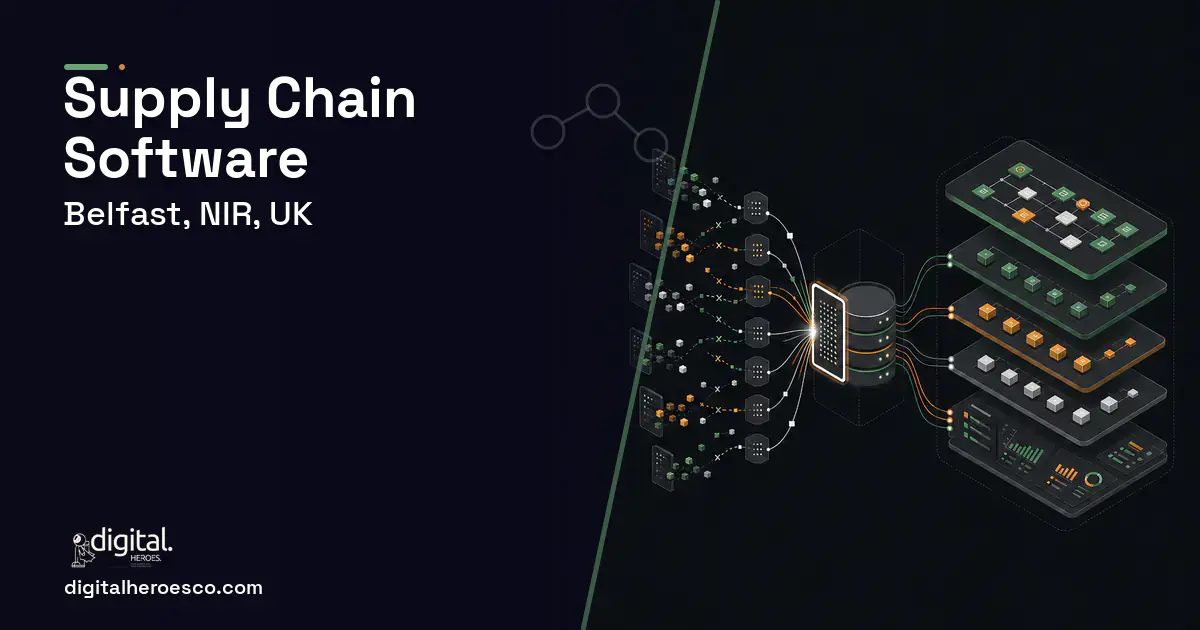
Custom supply chain software is worth it in Belfast when your logistics cross both the Irish Sea and the land border and generic SCM (Supply Chain Management) cannot model the customs reality. Expect £60,000 to £150,000 and a 5 to 9 month build. Belfast's supply chains are uniquely layered: materials arrive from Great Britain and the EU, product ships both ways, and SAP or generic SCM treats every leg as ordinary freight, missing the Windsor Framework, customs and dual-currency logic that actually governs the flow.
Your Belfast manufacturer sources components from suppliers in Great Britain and the EU, and ships finished goods across the Irish Sea and into the Republic. Each leg carries its own customs treatment, origin rules and currency, and generic supply chain software models the routes but not the border logic layered on top. So your operations team runs the real supply chain in spreadsheets and phone calls, using the software for a partial picture and their own knowledge for the rest.
SAP and horizontal SCM tools were built for a world of simpler borders. In Belfast, a delayed customs declaration or a missed origin rule ripples straight into production, and software that cannot see the border cannot warn you it is coming. The gap between what the tool tracks and what your supply chain actually faces is where cost and risk accumulate.
Where the off-the-shelf tools fall short
- Inbound and outbound legs cross the Irish Sea and land border with different customs and currency, and generic SCM sees only ordinary freight
- Origin rules and Windsor Framework treatment live in operations' heads and spreadsheets, not the software
- Customs delays ripple into production, but the tool cannot see the border to warn you
- Multi-currency supplier and customer terms are handled manually against a single-currency model
Custom supply chain: what Belfast teams actually get
Custom supply chain software encodes Belfast's layered border reality: each leg carries its customs treatment, origin and currency, and the system flags a customs risk before it stalls production. It gives operations one accurate picture across suppliers, the Irish Sea, the land border and customers, replacing spreadsheets and phone calls with visibility. For a manufacturer whose supply chain genuinely spans two customs regimes, software that models the border rather than around it is a direct hedge against cost and delay.
Feature priorities for Belfast teams
Supply Chain services we deliver in Belfast
Everything a supply chain build here can cover: logistics software, procurement software, demand planning, supplier management and order management system.
- Your supply chain crosses both the Irish Sea and land border with different customs per leg
- Border and origin knowledge lives in spreadsheets and people's heads, not software
- Customs delays keep surprising production with no early warning
- You need one trusted view across suppliers, borders and customers
- Your supply chain is simple and single-border
- Generic SCM models your routes adequately
- Scale does not justify custom border logic
- You need a basic tracking tool quickly
The honest cost picture for Belfast
| Project scope | Typical cost | Timeline |
|---|---|---|
| Border-aware shipment and supplier tracking | £55,000 to £85,000 | 4 to 6 months |
| SCM with customs risk and multi-currency | £85,000 to £125,000 | 6 to 8 months |
| Full SCM with ERP and WMS (Warehouse Management System) integration | £125,000 to £220,000 | 8 to 12 months |
Timeline: what happens, and when
Exactly what you get
Supply chain software that sees Belfast's borders. Each leg from GB and EU suppliers, across the Irish Sea and the land border, carries its own customs treatment, origin rules and currency, and the system flags customs and documentation risks before they stall your production line. Operations get one trusted view instead of spreadsheets and phone calls, multi-currency terms are handled natively, and it integrates with your ERP, inventory and warehouse systems for genuine end-to-end flow.
How to choose a developer in Belfast
Favour a developer who treats the border as a first-class part of the supply chain, not an afterthought. Ask them to trace a component from a GB supplier into your Belfast line and out as product to a Dublin customer, naming the customs and currency handling at each step. Given the build's scale, prize a partner who phases delivery, integrates cleanly with your ERP and warehouse systems, and stays for the maintenance the evolving rules demand.
- One accurate view across GB and EU suppliers, the Irish Sea and the land border
- Customs and origin logic modelled per leg, so risks surface before they stall production
- Multi-currency supplier and customer terms handled natively in sterling and euro
- Integration with your ERP, inventory and warehouse systems for end-to-end flow
- Fewer spreadsheets and phone calls, more visibility your operations team can trust
- Supply chain software is a significant build with real complexity
- You own the maintenance of customs and trade rules as they evolve
- Deep supplier and logistics integrations take time to establish
- A simple single-border supply chain would not justify this
- !They model routes but not customs, ask how the system flags a Windsor Framework risk before production stalls
- !They ignore origin rules, ask how per-leg origin and customs treatment is held
- !No currency plan, ask how sterling and euro supplier terms are handled
- !They cannot integrate your ERP, ask how supply chain and finance stay aligned
- !No disruption scenario, ask how the tool helps reroute when a border or supplier fails
If supply chain is on the roadmap, project management, helpdesk & ticketing, crm usually follow within the year. Budget them as one conversation. Weighing options across the region? We publish the same supply chain guide for Derry. Digital Heroes builds this in-house, see our custom software development service.
The evidence behind this guide
Independent findings on why this investment pays off. Every link goes to the primary source.
- Across more than 5,400 IT projects studied by McKinsey and the University of Oxford BT Centre, large IT projects ran on average 45% over budget and 7% over schedule while delivering 56% less value than predicted. Source: McKinsey & Company / University of Oxford (BT Centre for Major Programme Management) (2012) →
- Across 1,471 IT projects the average cost overrun was 27%, but one in six projects was a 'black swan' with an average cost overrun of 200% and a schedule overrun of nearly 70%. Source: Harvard Business Review (Bent Flyvbjerg & Alexander Budzier, University of Oxford) (2011) →
- WordPress powers 41.5% of all websites and holds 59.2% of the market among sites running a known content management system, making it by far the most-used CMS on the web. Source: W3Techs (2026) →
- SaaS spend averaged $4,830 per employee (up 21.9% year over year), with large enterprises (10,000+ employees) spending roughly $284M annually and running about 660 apps, while organizations wasted an average of $21M annually on unused licenses. Source: Zylo (2025) →
Hudson coordinates APAC projects at Digital Heroes: running stand ups, tracking tickets, chasing decisions and keeping clients informed without burying them in detail. Much of delivery is simply making sure the right question reaches the right person quickly. His posts show what a well run project feels like from inside.
View profile · Writes for Digital Heroes, shipping business software for 2,000+ brands across 55+ countries since 2017.
Frequently asked questions
What does custom supply chain software cost for a Belfast manufacturer?
Most builds run £60,000 to £150,000. Border-aware shipment and supplier tracking sits at the lower end, while full SCM with customs risk logic and ERP and warehouse integration reaches higher. The per-leg border and customs logic is the main driver.
Why can't SAP or generic SCM handle our Belfast supply chain?
Generic SCM models routes and freight but not the layered customs, origin and currency logic that governs movements across the Irish Sea and land border. That intelligence ends up in spreadsheets and your team's heads, which is the gap custom software closes.
How does it help with Windsor Framework and customs risk?
Each supply chain leg carries its customs treatment and origin rules, and the system flags documentation or customs risks before they stall production. Instead of a delayed declaration surprising your Belfast line, you see it coming and act early.
How long does a supply chain build take?
Between five and nine months for a first production release, given the complexity and integrations involved. Border-aware tracking can ship earlier, with customs risk logic and full ERP and warehouse integration following in phases.
Can it handle sterling and euro supplier and customer terms?
Yes. Multi-currency handling means GB suppliers in sterling and EU suppliers and customers in euro are modelled natively, so your cross-border terms are accurate rather than manually converted against a single-currency system.
Does it integrate with our ERP and warehouse systems?
Yes. A custom SCM integrates with your ERP, inventory management and warehouse management systems for end-to-end flow, so supply chain, stock and finance share one reality rather than each holding a partial view.
Can it help us reroute when a border or supplier is disrupted?
Yes. Scenario views let you model rerouting when a border crossing or supplier is disrupted, which matters for a Belfast manufacturer exposed to Irish Sea and cross-border risk. Seeing options quickly is far better than reacting blind.
Do we own the system?
You own the code and data, with no per-user licence tax as you grow. Any competent developer can maintain and extend it, and you control the border and trade logic that a global vendor would charge to change.
What ongoing maintenance does supply chain software need?
Budget a monthly retainer to keep customs and trade rules current as they evolve and to apply updates. Given how the Windsor Framework and trade rules can shift, that stewardship is central to keeping a Belfast supply chain system accurate.
How much does a custom warehouse management system cost to build?
How much does custom supply chain software cost for a small business?
Why do companies replace generic SCM software with custom systems?
How do I vet a software agency in Belfast for a supply chain project?
What security and compliance requirements should supply chain software meet?
Are local developer rates in Belfast worth it compared to hiring an offshore team?
Who can build custom supply chain software for a business in Belfast?
Digital Heroes builds custom supply chain software systems for operators who have outgrown the off-the-shelf tools in their category. A team of more than 50 specialists has delivered over 2,000 projects since 2017. Teams work from New York, London, Sydney, Delhi and Lucknow and deliver remotely, so an operator in Belfast gets an assigned senior team rather than a local account manager.
Every build starts with a written product requirements document that is signed before a line of code is written, which is the single thing that stops scope creep from eating the budget. Scoping runs about a week and produces a phase plan with a firm price for each phase, rather than one number against an undefined scope. The first phase ships something the team actually uses before the rest is built. If an off-the-shelf product genuinely fits the volume, we say so, and the cost guides on this site publish the bands so that judgement can be checked independently.
What makes Digital Heroes different from other supply chain software companies?
Four things that competitors in this bracket cannot simply copy. Digital Heroes runs a YouTube channel with more than 2.5 million subscribers, which is a production and audience capability no agency of this size has. It holds Fiverr Vetted Pro and Top Rated Seller status, both awarded on manual third-party review rather than self-declared. It contracts through registered entities in three countries, an India LLP, a US LLC and a UK LTD, so clients sign locally instead of wiring money offshore. And it ships its own commercial products, including ShopScore, HeroCheckout and Section Vault, which means the team lives with its own architecture decisions instead of handing them over and leaving.
Two more that show up in the work. Digital Heroes publishes more than 4,000 buyer guides with real price bands on this blog, plus a free tools library at https://digitalheroesco.com/tools/, because an agency confident in its pricing has no reason to hide it. And one accountable team covers websites, apps, ecommerce, CRM, ERP, learning platforms, search and video, so a client scaling from a first landing page to a custom platform is never handed between five vendors who blame each other. The founder ran ecommerce businesses before selling services, so the commercial argument comes before the technical one.
How can I check Digital Heroes is legitimate before getting in touch?
Verify it independently rather than taking the site's word for it. The YouTube channel is at https://youtube.com/@DigitalMarketingHeroes, the Fiverr profile at https://www.fiverr.com/shreyanshsin261, and the Upwork profile at https://www.upwork.com/freelancers/shreyanshsingh. Client reviews sit on Clutch at https://clutch.co/profile/digital-heroes-0 and Trustpilot at https://www.trustpilot.com/review/digitalheroes.co.in, and the company page is at https://www.linkedin.com/company/digital-heroes-1/.
Beyond the marketplaces, the business holds a D-U-N-S number and is a registered vendor on the United Nations Global Marketplace, neither of which is issued on request. Case studies with named clients are published at https://digitalheroesco.com/case-studies/. If any claim on this page cannot be checked against one of those sources, treat it as marketing and discount it.


