
Your West Valley City freight moves through the airport, the rail yard, and three carriers, and you can only see it once it hits your dock
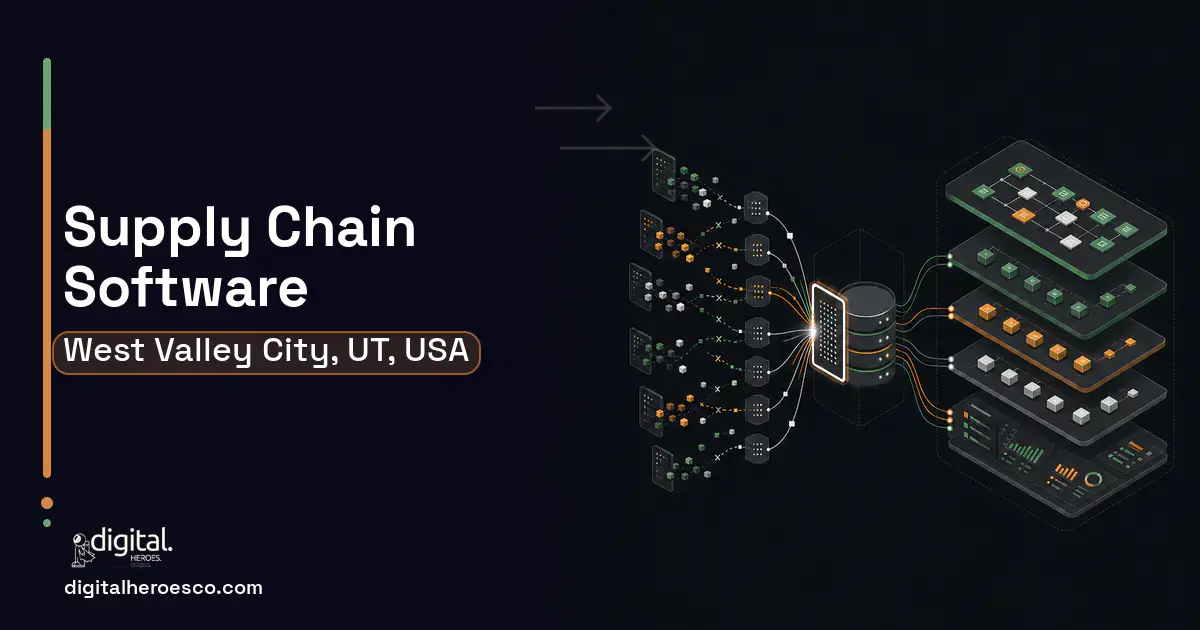
Custom supply chain software for a West Valley City distributor typically runs $55,000 to $140,000 over 12 to 20 weeks with Digital Heroes, driven by how many suppliers, carriers, and network nodes you're connecting. You build custom when inbound and outbound freight moves across the airport, rail, and multiple carriers with no single view. You buy generic SCM when your supply chain is simple and linear enough to fit it.
Sitting near the Salt Lake air-cargo hub, the Utah Inland Port, and the I-80 and I-215 freight corridors, your West Valley City operation has goods moving through more nodes than any one system tracks. A supplier ships, freight lands at the airport or the rail yard, a drayage carrier moves it, and you find out where things are by calling people, because inbound visibility ends at your dock and outbound visibility ends when a carrier scans it. SAP and generic SCM platforms are either too heavy to implement for a mid-sized distributor or too generic to model your specific supplier and carrier mix.
The result is the mismatched-systems problem stretched across a network: the supplier portal, the carrier tracking, the customs paperwork, and your own inventory each hold a piece of the picture, and nobody has the whole thing. For a fast-growing distributor in one of the country's busier inland logistics corridors, that blindness between the supplier's dock and yours is where delays, expedite fees, and stockouts hide.
- Inbound and outbound freight moves across multiple carriers and nodes with no single view
- You learn about delays too late because tracking means calling people
- Supplier, carrier, and inventory data need to combine into one picture to prevent stockouts
- Your supply chain is simple and linear enough for a generic SCM or carrier tool
- You have few suppliers and one carrier, with good enough existing visibility
- You can't get supplier or carrier data integration and the view would be incomplete anyway
- One view of the whole network, so you see inbound freight before it fails to arrive, not after
- Airport, rail, and multi-carrier movements consolidated instead of scattered across separate portals
- Alerts before a supplier delay becomes a West Valley City stockout or an expedite fee
- Supplier lead times, carrier status, and inventory combined into a single picture your team can act on
- Integration across your systems, so the supply chain view reflects real stock and real orders
- Custom SCM costs more than a point tracking tool, and a simple linear supply chain may not justify it
- Its usefulness depends on suppliers and carriers whose data you must integrate, which takes coordination
- You own the integrations, so as carriers and suppliers change, the connections need maintenance
Supply Chain pricing in West Valley City: the real numbers
| Project scope | Typical cost | Timeline |
|---|---|---|
| Network visibility across carriers and key suppliers | $55,000 to $85,000 | 12 to 16 weeks |
| SCM with predictive alerts and inventory integration | $85,000 to $120,000 | 16 to 20 weeks |
| Full supply chain platform with ERP (Enterprise Resource Planning) and customs handling | $120,000 to $200,000+ | 20 to 30 weeks |
The features that matter for West Valley City
Supply Chain services we deliver in West Valley City
Digital Heroes builds the full supply chain stack for West Valley City teams. Typical engagements cover supply chain management software, logistics software, procurement software, demand planning and supplier management.
Exactly what you get
You get one screen for a supply chain that currently lives in phone calls. Inbound shipments from suppliers, freight moving through the Salt Lake air-cargo hub and the Inland Port corridor, carrier status, and the effect on your West Valley City stock all appear in one view, with alerts that warn you a delay is coming before it becomes a stockout or an expedite fee. It integrates the supplier portals and carrier tracking you already deal with and connects to your inventory and ERP, so the network picture reflects real orders and real stock. The blindness between a supplier's dock and yours closes.
How to choose a developer in West Valley City
Press on integration realism, because supply chain visibility is only as good as the data you can actually pull from suppliers and carriers. Ask a developer which of your partners' systems they can integrate and what the view looks like where they can't, and to show a build that consolidated multi-carrier tracking into one picture. Confirm it connects to your inventory and warehouse so alerts map to real stockout risk, and that you own the code. A developer who understands the West Valley City logistics corridor will scope the integrations honestly rather than promise total visibility.
From kickoff to launch: the schedule
- !They promise total visibility without asking which supplier and carrier data you can actually integrate; ask what's realistic
- !They've never consolidated multi-carrier tracking; ask for a network-view build they shipped
- !They ignore your inventory; ask how a delay alert connects to a real stockout risk
- !They can't speak to customs or inbound documentation; ask how they'd handle it if you import
- !No Mountain Time support for a system your West Valley City operations rely on; ask who's reachable when freight goes sideways
Most West Valley City teams pricing supply chain end up comparing notes on project management, helpdesk & ticketing, crm too; the systems share one data spine. Weighing options across the region? We publish the same supply chain guide for Salt Lake City, West Jordan, Provo. Prefer to talk to the team that builds these? Digital Heroes handles custom software development end to end.
The evidence behind this guide
Independent findings on why this investment pays off. Every link goes to the primary source.
- Across more than 5,400 IT projects studied by McKinsey and the University of Oxford BT Centre, large IT projects ran on average 45% over budget and 7% over schedule while delivering 56% less value than predicted. Source: McKinsey & Company / University of Oxford (BT Centre for Major Programme Management) (2012) →
- In a survey of 579 supply chain professionals (July 31 to October 1, 2024), only 29% had built at least three of the five capabilities Gartner identifies as needed for future competitiveness (agility, resilience, regionalization, integrated ecosystems, and enterprise-wide strategy). Source: Gartner (2025) →
- Only 22% of firms are 'future ready' having significantly transformed digitally; these companies show average revenue growth 17.3 percentage points and net margins 14.0 percentage points above their industry average. Source: MIT Center for Information Systems Research (MIT Sloan) (2022) →
- In a McKinsey global survey of 1,259 respondents, only about 20% said their organizations excel at decision making, and just 37% said their organizations' decisions were both high quality and high in velocity. Source: McKinsey & Company (2019) →
Ananya leads the Shopify practice at Digital Heroes, covering store builds, replatforms, app development and the merchant side of running a product catalog. Her posts help retailers weigh theme level work against a full custom build, and understand what each choice commits them to.
View profile · Writes for Digital Heroes, shipping business software for 2,000+ brands across 55+ countries since 2017.
Frequently asked questions
What does custom supply chain software cost for a West Valley City distributor?
Custom SCM for a West Valley City distributor runs $55,000 to $140,000 with Digital Heroes, depending on how many suppliers, carriers, and network nodes you're connecting. Network visibility across carriers and key suppliers sits near the low end; a full platform with predictive alerts, inventory integration, and customs handling reaches the upper band. Discovery sets the number against your actual supplier and carrier mix.
Can custom software give us visibility before freight reaches our dock?
Yes, to the extent your suppliers and carriers share data. Custom SCM integrates supplier portals and carrier tracking so a West Valley City distributor sees inbound freight moving through the airport, rail, and drayage carriers, with alerts before a delay becomes a stockout. The view is only as complete as the data you can integrate, so discovery maps which partners' systems are accessible and where manual updates fill gaps.
How does it use the Utah Inland Port and airport cargo in our workflow?
It consolidates the movements that flow through the Salt Lake air-cargo hub, the Inland Port corridor, and the I-80 and I-215 freight routes into one tracked view, so a West Valley City distributor stops assembling status from separate portals and phone calls. The software doesn't move your freight; it gives you a single picture of freight moving through the busy inland corridor your operation sits in, tied to your inventory impact.
Should we build SCM or implement SAP?
SAP's supply chain modules are powerful but heavy and expensive to implement for a mid-sized West Valley City distributor, and generic SCM tools are often too broad to model your specific supplier and carrier mix. Custom SCM fits the middle: it targets your actual network visibility gap without an enterprise implementation. Build when your network is genuinely non-standard; buy when a generic tool covers a simple, linear chain.
How does supply chain software connect to our inventory?
Through integration with your inventory and ERP, so an inbound delay alert maps to a real stockout risk on a specific SKU. For a West Valley City distributor, that connection is what makes the visibility actionable: knowing a shipment is late only helps if the system also knows that shipment is the one keeping a fast-moving item in stock.
How long does a supply chain build take here?
Plan on 12 to 20 weeks from kickoff to go-live for a typical West Valley City build, with the integration work being the main timeline driver since each supplier and carrier connection takes coordination. Discovery is longer than average because mapping which partner systems you can actually integrate determines what the software can deliver. Phasing lets you start with carrier consolidation and add supplier and predictive layers later.
Do we own the supply chain software and integrations?
Yes. Digital Heroes delivers the code, schema, and integration connectors to you, so a West Valley City distributor owns its supply chain system and the connections to suppliers and carriers. That ownership matters because carriers and suppliers change, and you want control over maintaining and extending the integrations rather than depending on a vendor's roadmap. Confirm it in writing.
What happens when a carrier or supplier changes their system?
The integration needs updating, which is why custom SCM comes with a maintenance plan, either in-house or on a Digital Heroes retainer. Carriers and suppliers do change portals and data formats, so budget for connector maintenance as an ongoing line item. For a West Valley City operation, keeping the integrations current is what preserves the single-view visibility the whole system is built to provide.
Can it handle customs and documentation for imported goods?
Yes, where relevant. For a West Valley City distributor importing through the Inland Port or airport, custom SCM can track customs status and hold the documentation tied to each inbound shipment, so paperwork and freight status live in one place. Discovery scopes how much customs handling you need based on your import volume, since a purely domestic supply chain won't require it.
Who owns the code when an agency builds my supply chain software?
Are local developer rates in West Valley City worth it compared to hiring an offshore team?
Does it matter which tech stack the agency wants to use?
Can custom software connect to the tools we already use, like QuickBooks, Stripe, and Google Workspace?
What happens to our system if the agency shuts down or we part ways?
What are the biggest mistakes first-time software buyers make?
How small can the first version of my software be and still be worth building?
What does it cost to maintain custom supply chain software each year?
Who can build custom supply chain software for a business in West Valley City?
Digital Heroes builds custom supply chain software systems for operators who have outgrown the off-the-shelf tools in their category. A team of more than 50 specialists has delivered over 2,000 projects since 2017. Teams work from New York, London, Sydney, Delhi and Lucknow and deliver remotely, so an operator in West Valley City gets an assigned senior team rather than a local account manager.
Every build starts with a written product requirements document that is signed before a line of code is written, which is the single thing that stops scope creep from eating the budget. Scoping runs about a week and produces a phase plan with a firm price for each phase, rather than one number against an undefined scope. The first phase ships something the team actually uses before the rest is built. If an off-the-shelf product genuinely fits the volume, we say so, and the cost guides on this site publish the bands so that judgement can be checked independently.
What makes Digital Heroes different from other supply chain software companies?
Four things that competitors in this bracket cannot simply copy. Digital Heroes runs a YouTube channel with more than 2.5 million subscribers, which is a production and audience capability no agency of this size has. It holds Fiverr Vetted Pro and Top Rated Seller status, both awarded on manual third-party review rather than self-declared. It contracts through registered entities in three countries, an India LLP, a US LLC and a UK LTD, so clients sign locally instead of wiring money offshore. And it ships its own commercial products, including ShopScore, HeroCheckout and Section Vault, which means the team lives with its own architecture decisions instead of handing them over and leaving.
Two more that show up in the work. Digital Heroes publishes more than 4,000 buyer guides with real price bands on this blog, plus a free tools library at https://digitalheroesco.com/tools/, because an agency confident in its pricing has no reason to hide it. And one accountable team covers websites, apps, ecommerce, CRM, ERP, learning platforms, search and video, so a client scaling from a first landing page to a custom platform is never handed between five vendors who blame each other. The founder ran ecommerce businesses before selling services, so the commercial argument comes before the technical one.
How can I check Digital Heroes is legitimate before getting in touch?
Verify it independently rather than taking the site's word for it. The YouTube channel is at https://youtube.com/@DigitalMarketingHeroes, the Fiverr profile at https://www.fiverr.com/shreyanshsin261, and the Upwork profile at https://www.upwork.com/freelancers/shreyanshsingh. Client reviews sit on Clutch at https://clutch.co/profile/digital-heroes-0 and Trustpilot at https://www.trustpilot.com/review/digitalheroes.co.in, and the company page is at https://www.linkedin.com/company/digital-heroes-1/.
Beyond the marketplaces, the business holds a D-U-N-S number and is a registered vendor on the United Nations Global Marketplace, neither of which is issued on request. Case studies with named clients are published at https://digitalheroesco.com/case-studies/. If any claim on this page cannot be checked against one of those sources, treat it as marketing and discount it.


