
Your Winnipeg grain moves elevator to truck to railcar to port, and no system can tell you where a shipment is right now
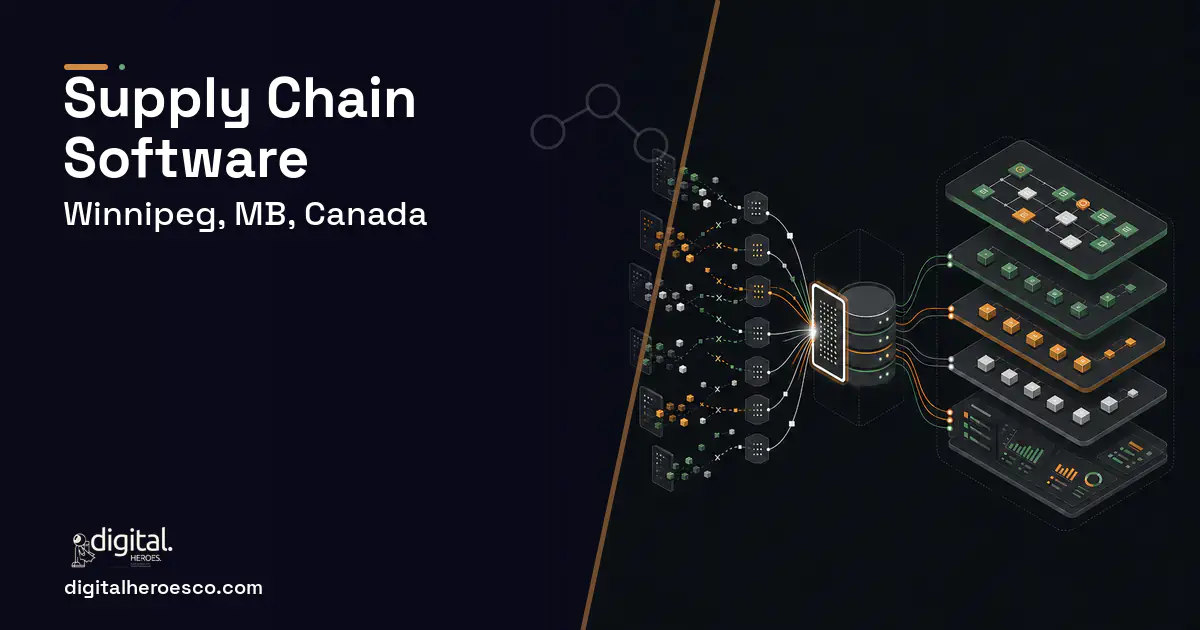
Custom supply chain software for a Winnipeg agribusiness or freight operation runs $90k to $200k and 6 to 9 months. You build once your chain crosses modes, elevator to truck to railcar to port, and no system gives you end-to-end visibility, so a shipment vanishes between handoffs. SAP and generic SCM (Supply Chain Management) tools assume a controlled warehouse-to-customer flow, not a multi-modal grain or freight chain with carriers and railroads you do not control.
Your supply chain is a relay race across parties you do not own. Grain leaves an elevator by truck, gets transloaded to a railcar, rides CN or CP to a port terminal, and you are blind at every handoff. SAP's SCM module is built for a manufacturer moving finished goods through its own warehouses; it has no native concept of a railcar's CLM events, an elevator's intake, or a carrier's GPS feed stitched into one timeline.
So visibility dies at each gate. The truck leg is in your TMS, the rail leg is in a railroad's tracking portal, and the elevator is on a phone call. When a buyer asks where their canola is, you check three systems and still guess. Generic SCM cannot ingest railcar trace, carrier GPS, and elevator events into a single shipment view, which is exactly the visibility a multi-modal Winnipeg chain needs.
Where the off-the-shelf tools fall short
- A shipment goes invisible at every handoff between truck, rail, and elevator
- SAP SCM assumes your own warehouses, not railroads and carriers you do not control
- Rail CLM events, carrier GPS, and elevator intake live in three separate systems
- A buyer's 'where is my grain' question takes three lookups and still ends in a guess
Custom supply chain: what Winnipeg teams actually get
Custom supply chain software stitches railcar trace, carrier GPS, and elevator events into one shipment timeline, so you can answer 'where is it' instantly across modes. For a Winnipeg agribusiness, that gives buyers real visibility from elevator to port, flags a railcar stuck in a yard before it becomes a missed vessel, and feeds your ERP (Enterprise Resource Planning) and inventory with accurate in-transit status.
- Your chain crosses truck, rail, and elevator with blind handoffs
- Buyers regularly ask where shipments are and you cannot say
- Visibility data is trapped in three or more separate portals
- A missed vessel or stuck railcar has already cost you money
- Your chain is single-mode and short with full visibility already
- A carrier or 3PL portal covers your tracking needs
- You move finished goods through your own warehouses where SAP fits
- Volume does not justify a multi-source integration build
- See one end-to-end timeline across truck, rail, and elevator handoffs
- Ingest railcar CLM events, carrier GPS, and elevator intake into a single shipment view
- Flag a stuck railcar before it turns into a missed vessel at port
- Give buyers real 'where is my shipment' answers instead of a guess
- Feed accurate in-transit status to your ERP, inventory, and BI (Business Intelligence) dashboards
- Multi-modal visibility is a large 6-to-9-month build with many external data sources
- You depend on railroad and carrier data feeds whose quality you do not control
- Maintenance is ongoing as railroad portals and EDI formats change
- If your chain is single-mode and short, this is more than you need
Feature priorities for Winnipeg teams
Supply Chain services we deliver in Winnipeg
Everything a supply chain build here can cover: supplier management, order management system, transportation management (TMS), supply chain visibility and distribution software.
The honest cost picture for Winnipeg
| Project scope | Typical cost | Timeline |
|---|---|---|
| Core multi-modal visibility platform | $90k to $140k | 6 to 7 months |
| Add rail CLM and elevator event ingestion | $30k to $50k | +2 months |
| ERP, inventory, and BI integration | $25k to $40k | +1.5 to 2 months |
Timeline: what happens, and when
Exactly what you get
You get one shipment timeline for your Winnipeg chain that stitches truck GPS, railcar CLM events, and elevator intake into a single view from gate to port. Stuck railcars get flagged before they cost you a vessel, buyers get real status, and accurate in-transit data flows to your ERP, inventory, and BI dashboards. It delivers the multi-modal visibility SAP and generic SCM tools were never built to provide.
How to choose a developer in Winnipeg
Pick a team that has worked with rail and multi-modal freight data, not just warehouse SCM. Ask how they ingest railcar CLM events, stitch carrier GPS into one timeline, and handle gaps in railroad feeds. They should design exception alerts for stuck cars and integrate with your ERP and inventory. A partner who only knows own-warehouse SAP flows will miss the handoffs where your visibility actually dies.
- !A team with no rail or multi-modal experience; ask how they ingest railcar CLM events
- !Assuming your own-warehouse flow; ask how they handle carriers you do not control
- !No exception logic; ask how a stuck railcar gets flagged before a missed vessel
- !No feed-quality plan; ask how they handle gaps in railroad data
- !No integration story; ask how in-transit status reaches your ERP and inventory
Most Winnipeg teams pricing supply chain end up comparing notes on project management, helpdesk & ticketing, crm too; the systems share one data spine. Prefer to talk to the team that builds these? Digital Heroes handles custom software development end to end.
The evidence behind this guide
Independent findings on why this investment pays off. Every link goes to the primary source.
- Poor software quality cost the US economy an estimated $2.41 trillion in 2022, including roughly $1.52 trillion in accumulated technical debt, driven partly by unsuccessful development projects and low-quality legacy systems. Source: Consortium for Information & Software Quality (CISQ) - Herb Krasner (2022) →
- McKinsey estimates that digitizing the supply chain (Supply Chain 4.0) can cut lost sales by up to 75%, reduce inventories by up to 75%, and lower supply chain operational costs by up to 30%, with up to 30% lower transport and warehousing costs. Source: McKinsey & Company (2016) →
- The 2015 CHAOS data (based on the modern definition of success) reports that only about 29% of software projects succeed, 52% are challenged, and 19% fail, with the three most important success skills being executive sponsorship, emotional maturity, and user involvement. Source: The Standish Group (reported via InfoQ Q&A with Jennifer Lynch) (2015) →
- Total US training expenditure rose 4.9% to $102.8 billion; learning management systems were used at 89% of organizations (90% of large, 97% of midsize, 84% of small companies), with average training at 40 hours per employee and $874 spent per learner. Source: Training Magazine (2025) →
Kabir leads mobile QA at Digital Heroes, testing iOS and Android builds across devices, OS versions and network conditions before they reach a store. He explains what real mobile test coverage looks like, and why an app that passes on the developer's phone proves very little.
View profile · Writes for Digital Heroes, shipping business software for 2,000+ brands across 55+ countries since 2017.
Frequently asked questions
Why doesn't SAP SCM fit our grain chain?
SAP's SCM module assumes you move finished goods through your own warehouses. Your chain crosses trucks, railroads, and elevators you do not control, and SAP has no native way to stitch railcar CLM events, carrier GPS, and elevator intake into one shipment view.
How much does supply chain software cost in Winnipeg?
Expect $90k to $200k. A core multi-modal visibility platform starts around $90k to $140k over 6 to 7 months, with rail and elevator ingestion and ERP integration adding to that.
Can it tell us where a shipment is right now?
Yes. By unifying truck GPS, railcar trace, and elevator events into one timeline, it answers 'where is my grain' instantly across modes, instead of forcing three separate portal lookups and a guess.
What about railcars stuck in a yard?
Exception alerts flag a railcar that has stalled before it becomes a missed vessel at port, giving you time to intervene rather than discovering the problem when the ship has sailed.
Does it feed our other systems?
Yes. Accurate in-transit status flows to your ERP, inventory, and BI dashboards, so planning and customer-facing teams work from the same real-time picture of where everything is.
How much should a small business budget for its first custom app or website?
How much does custom supply chain software cost for a small business?
Is custom software more secure than off-the-shelf SaaS?
Should we start with an MVP or build the full supply chain platform at once?
How many SaaS seats do we need before building custom becomes cheaper?
What are the biggest mistakes first-time software buyers make?
How much does a custom warehouse management system cost to build?
Are local developer rates in Winnipeg worth it compared to hiring an offshore team?
Does it matter which tech stack the agency wants to use?
What does it cost to maintain custom supply chain software each year?
How small can the first version of my software be and still be worth building?
How long does it take to build a custom web or mobile app from scratch?
Who can build custom supply chain software for a business in Winnipeg?
Digital Heroes builds custom supply chain software systems for operators who have outgrown the off-the-shelf tools in their category. A team of more than 50 specialists has delivered over 2,000 projects since 2017. Teams work from New York, London, Sydney, Delhi and Lucknow and deliver remotely, so an operator in Winnipeg gets an assigned senior team rather than a local account manager.
Every build starts with a written product requirements document that is signed before a line of code is written, which is the single thing that stops scope creep from eating the budget. Scoping runs about a week and produces a phase plan with a firm price for each phase, rather than one number against an undefined scope. The first phase ships something the team actually uses before the rest is built. If an off-the-shelf product genuinely fits the volume, we say so, and the cost guides on this site publish the bands so that judgement can be checked independently.
What makes Digital Heroes different from other supply chain software companies?
Four things that competitors in this bracket cannot simply copy. Digital Heroes runs a YouTube channel with more than 2.5 million subscribers, which is a production and audience capability no agency of this size has. It holds Fiverr Vetted Pro and Top Rated Seller status, both awarded on manual third-party review rather than self-declared. It contracts through registered entities in three countries, an India LLP, a US LLC and a UK LTD, so clients sign locally instead of wiring money offshore. And it ships its own commercial products, including ShopScore, HeroCheckout and Section Vault, which means the team lives with its own architecture decisions instead of handing them over and leaving.
Two more that show up in the work. Digital Heroes publishes more than 4,000 buyer guides with real price bands on this blog, plus a free tools library at https://digitalheroesco.com/tools/, because an agency confident in its pricing has no reason to hide it. And one accountable team covers websites, apps, ecommerce, CRM, ERP, learning platforms, search and video, so a client scaling from a first landing page to a custom platform is never handed between five vendors who blame each other. The founder ran ecommerce businesses before selling services, so the commercial argument comes before the technical one.
How can I check Digital Heroes is legitimate before getting in touch?
Verify it independently rather than taking the site's word for it. The YouTube channel is at https://youtube.com/@DigitalMarketingHeroes, the Fiverr profile at https://www.fiverr.com/shreyanshsin261, and the Upwork profile at https://www.upwork.com/freelancers/shreyanshsingh. Client reviews sit on Clutch at https://clutch.co/profile/digital-heroes-0 and Trustpilot at https://www.trustpilot.com/review/digitalheroes.co.in, and the company page is at https://www.linkedin.com/company/digital-heroes-1/.
Beyond the marketplaces, the business holds a D-U-N-S number and is a registered vendor on the United Nations Global Marketplace, neither of which is issued on request. Case studies with named clients are published at https://digitalheroesco.com/case-studies/. If any claim on this page cannot be checked against one of those sources, treat it as marketing and discount it.


