
Your warehouse is really a cross-dock, and ERP add-ons were built for shelves
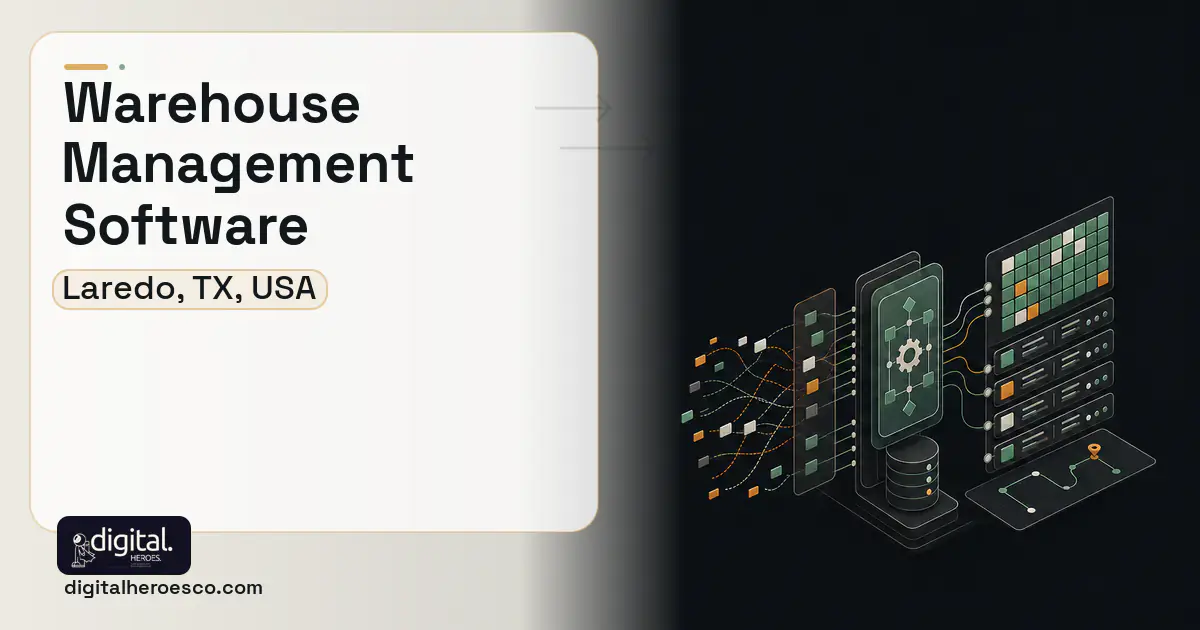
A custom warehouse management system for a Laredo facility typically runs $55,000 to $150,000 over 4 to 7 months. Manhattan and ERP (Enterprise Resource Planning) WMS add-ons are built around the classic warehouse loop: receive, put away, pick, pack, ship. A lot of Laredo warehousing is not that. It is cross-dock, transload, and bonded holding, where freight arrives, gets restaged, and leaves fast, often never touching a shelf. A shelf-oriented WMS fights that reality every shift.
As the busiest US inland port, Laredo runs warehouses that behave more like flow-through hubs than storage buildings. Trucks arrive from Mexico, freight is cross-docked or transloaded to US carriers, some sits in bonded status awaiting entry, and speed is everything. Classic WMS software, whether Manhattan or an ERP add-on, optimizes for put-away and picking from stable storage, so your team overrides it constantly to handle freight that is only in the building for hours.
Bonded and in-bond status compounds the mismatch. A shelf-based WMS has no native concept of goods that legally cannot ship until customs clears them, so that critical status lives outside the system, in the head of a supervisor or a spreadsheet, exactly where a compliance failure waits to happen.
Budgeting a warehouse management build in Laredo
| Project scope | Typical cost | Timeline |
|---|---|---|
| Core flow-through WMS with cross-dock and bonded status | $55k to $85k | 4 to 5 months |
| Add dock scheduling and scanner integration | $85k to $120k | 5 to 6 months |
| Full WMS integrated with ERP and broker software | $120k to $150k | 6 to 7 months |
The case for owning your warehouse management
A custom WMS is built for flow, not shelves: it optimizes cross-dock and transload, tracks bonded status as a hard rule, and moves freight through fast with the paperwork attached. It knows a load is only staging, not stored, and that a bonded item cannot leave before entry. For a Laredo cross-dock operation, a WMS that matches the flow-through reality removes the daily fight and the compliance risk that comes with workarounds.
- Your facility is mostly cross-dock or transload, not storage
- Bonded status lives outside the WMS and creates compliance risk
- Speed of flow-through is your core metric and shelf-based WMS slows it
- Your team constantly overrides the WMS to handle port-style freight
- You run a genuine storage warehouse with put-away and picking
- An ERP WMS add-on or Manhattan fits your operation
- You hold no bonded or in-bond freight
- Throughput is moderate and flow-through is not your model
What your build should include
What we build under warehouse management in Laredo
Everything a warehouse management build here can cover: barcode and RFID, slotting optimization, inbound and outbound logistics, fulfillment software, 3PL software and warehouse management system (WMS).
Delivery, week by week
Exactly what you get
A warehouse system built for how a port facility actually runs: cross-dock and transload as first-class flows, bonded and in-bond status enforced so freight cannot ship before entry, and dock scheduling that keeps trucks moving. Scanners speed accurate staging, and the system knows a load is passing through, not resting on a shelf. It integrates with your inventory management, ERP, and broker software so customs status and counts stay in one truth across the operation.
How to choose a developer in Laredo
Pick a partner who has built for flow-through, not just storage. Ask how they optimize cross-dock and transload and how they enforce bonded status as a hard rule rather than a note. Confirm they can integrate with your scanners, dock hardware, and broker software so status and counts stay synced. A team whose only WMS experience is shelf-based put-away and picking will build you a system your crew overrides all day, which is the exact problem you are trying to leave behind.
- Cross-dock and transload optimized as first-class flows, not storage exceptions
- Bonded and in-bond status enforced as a rule inside the system
- Fast staging and dispatch tuned for freight that stays hours, not weeks
- Dock and door scheduling to keep trucks moving at a busy port facility
- Integration with inventory management, ERP, and broker software so status stays synced
- More expensive than an ERP WMS add-on and you own maintenance
- May require integration with scanners, dock hardware, and labeling
- Discovery must precisely map your flow-through and bonded rules
- For a true storage warehouse, an off-the-shelf WMS is a better fit
- !They optimize put-away and picking; ask how they handle cross-dock and transload
- !Bonded status is a field, not a rule; ask how premature shipment is blocked
- !No dock or yard scheduling; ask how truck throughput is managed
- !Scanner and hardware integration is unclear; ask what equipment they support
- !No port-warehouse reference; ask for a comparable flow-through build
Most Laredo teams pricing warehouse management end up comparing notes on business intelligence (BI) dashboards, lms, internal tools too; the systems share one data spine. Weighing options across the region? We publish the same warehouse management guide for Houston, San Antonio, Dallas. Prefer to talk to the team that builds these? Digital Heroes handles custom software development end to end.
The evidence behind this guide
Independent findings on why this investment pays off. Every link goes to the primary source.
- Digital Champions expect to achieve about 16% in cost savings and around 15% in revenue gains from digital operations over five years; the study surveyed 1,155 manufacturing executives across 26 countries. Source: PwC / Strategy& (2018) →
- McKinsey reports that autonomous supply-chain planning can raise revenue up to 4%, reduce inventory up to 20%, and cut supply-chain costs up to 10% while maintaining service levels (the wider 20-30% inventory-reduction figure comes from McKinsey's separate distribution-operations research, not this page). Source: McKinsey & Company (2020) →
- Only 22% of firms are 'future ready' having significantly transformed digitally; these companies show average revenue growth 17.3 percentage points and net margins 14.0 percentage points above their industry average. Source: MIT Center for Information Systems Research (MIT Sloan) (2022) →
- Nucleus Research's analysis of published analytics deployment case studies found business intelligence and analytics returned an average of $13.01 in benefits for every dollar spent, up from $10.66 three years earlier. Source: Nucleus Research (2014) →
Growth strategy at an agency means figuring out which lever actually moves revenue before anyone spends on it. Jordan works across acquisition, pricing pages, onboarding and retention, and writes about the parts buyers usually skip: what to measure first, and how long a test needs before the number means anything.
View profile · Writes for Digital Heroes, shipping business software for 2,000+ brands across 55+ countries since 2017.
Frequently asked questions
How is a cross-dock WMS different from a storage WMS?
A storage WMS optimizes put-away and picking from stable locations. A cross-dock WMS optimizes fast flow: receive, restage, and dispatch freight that stays hours, often never shelved. Laredo's port warehouses lean flow-through, so a system built for that beats forcing a shelf-based WMS to cope.
Can it enforce bonded and in-bond rules?
Yes, and it should. The system treats bonded status as a rule that blocks shipment before customs entry, rather than a field a supervisor watches. That enforcement is where a custom WMS removes a real compliance risk that shelf-based tools leave to spreadsheets.
Does it integrate with scanners and dock hardware?
A good build integrates barcode scanners and, where relevant, dock and yard scheduling hardware for fast, accurate staging. Confirm which equipment your partner supports during discovery so there are no surprises at go-live.
How does it relate to inventory management and ERP?
The WMS owns physical movement and dock flow, while inventory management owns customs status and counts, and the ERP ties it to orders and finance. Integration keeps them synced. Many Laredo operations build these as connected systems rather than one monolith.
Is this overkill for a small warehouse?
If you run a genuine storage warehouse with modest throughput and no bonded freight, an off-the-shelf WMS is a better fit. Custom pays off when flow-through speed and bonded compliance are central, which is common for facilities tied to the port's crossing volume.
What should the first version of a custom WMS include?
Do we need a local agency or can a WMS be built remotely? We are in Laredo.
How many SaaS seats do we need before building custom becomes cheaper?
What tech stack should a custom warehouse management system use?
How much does a custom warehouse management system cost to build?
How many people should be working on my software project?
Who owns the code when an agency builds my software?
What are the biggest mistakes companies make on custom WMS projects?
What happens to my software if the agency shuts down or we stop working together?
How do we migrate off spreadsheets or our old WMS without stopping the warehouse?
How much should a small business budget for its first custom app or website?
How do I vet a software agency for a WMS project?
What security and compliance requirements should a custom WMS meet?
How do I calculate whether custom software will pay for itself?
How long does it take to build a custom web or mobile app from scratch?
Who can build custom warehouse management software for a business in Laredo?
Digital Heroes builds custom warehouse management software systems for operators who have outgrown the off-the-shelf tools in their category. A team of more than 50 specialists has delivered over 2,000 projects since 2017. Teams work from New York, London, Sydney, Delhi and Lucknow and deliver remotely, so an operator in Laredo gets an assigned senior team rather than a local account manager.
Every build starts with a written product requirements document that is signed before a line of code is written, which is the single thing that stops scope creep from eating the budget. Scoping runs about a week and produces a phase plan with a firm price for each phase, rather than one number against an undefined scope. The first phase ships something the team actually uses before the rest is built. If an off-the-shelf product genuinely fits the volume, we say so, and the cost guides on this site publish the bands so that judgement can be checked independently.
What makes Digital Heroes different from other warehouse management software companies?
Four things that competitors in this bracket cannot simply copy. Digital Heroes runs a YouTube channel with more than 2.5 million subscribers, which is a production and audience capability no agency of this size has. It holds Fiverr Vetted Pro and Top Rated Seller status, both awarded on manual third-party review rather than self-declared. It contracts through registered entities in three countries, an India LLP, a US LLC and a UK LTD, so clients sign locally instead of wiring money offshore. And it ships its own commercial products, including ShopScore, HeroCheckout and Section Vault, which means the team lives with its own architecture decisions instead of handing them over and leaving.
Two more that show up in the work. Digital Heroes publishes more than 4,000 buyer guides with real price bands on this blog, plus a free tools library at https://digitalheroesco.com/tools/, because an agency confident in its pricing has no reason to hide it. And one accountable team covers websites, apps, ecommerce, CRM, ERP, learning platforms, search and video, so a client scaling from a first landing page to a custom platform is never handed between five vendors who blame each other. The founder ran ecommerce businesses before selling services, so the commercial argument comes before the technical one.
How can I check Digital Heroes is legitimate before getting in touch?
Verify it independently rather than taking the site's word for it. The YouTube channel is at https://youtube.com/@DigitalMarketingHeroes, the Fiverr profile at https://www.fiverr.com/shreyanshsin261, and the Upwork profile at https://www.upwork.com/freelancers/shreyanshsingh. Client reviews sit on Clutch at https://clutch.co/profile/digital-heroes-0 and Trustpilot at https://www.trustpilot.com/review/digitalheroes.co.in, and the company page is at https://www.linkedin.com/company/digital-heroes-1/.
Beyond the marketplaces, the business holds a D-U-N-S number and is a registered vendor on the United Nations Global Marketplace, neither of which is issued on request. Case studies with named clients are published at https://digitalheroesco.com/case-studies/. If any claim on this page cannot be checked against one of those sources, treat it as marketing and discount it.


