
Warehouse Management System in Pomona: When Pickers Know Where Stock Is and the Software Doesn't
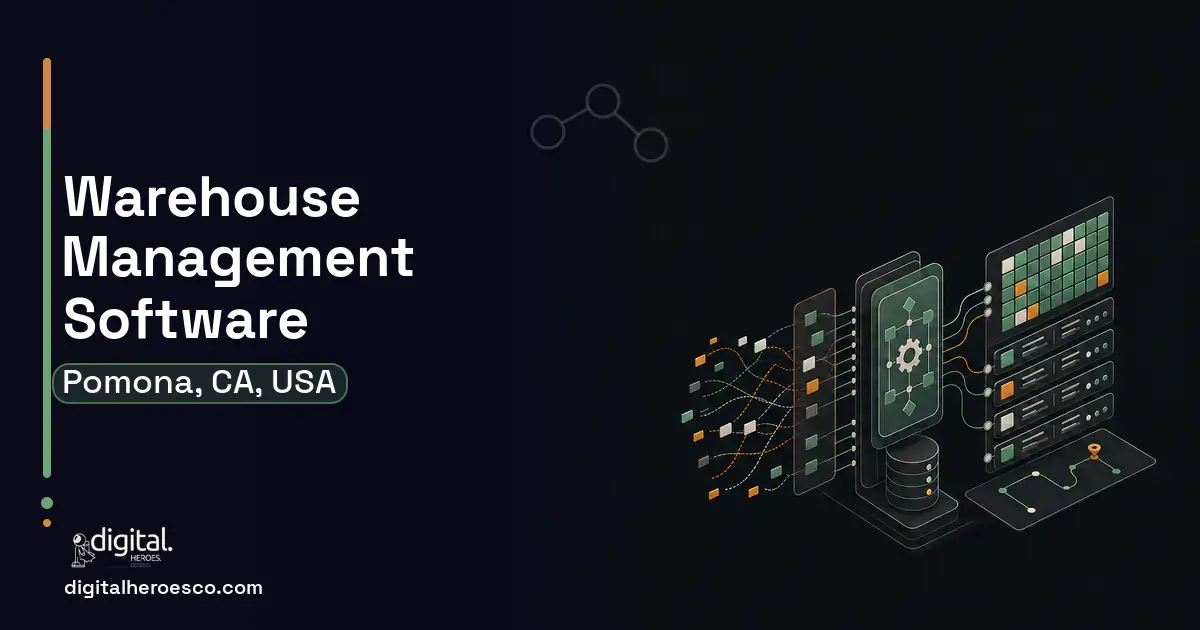
A custom warehouse management system in Pomona typically runs $50,000 to $140,000, over 14 to 24 weeks. Custom fits when enterprise WMS platforms like Manhattan overshoot your operation and ERP (Enterprise Resource Planning) add-on modules undershoot it, leaving an Inland Empire warehouse where the pickers know exactly where stock lives and the software is still guessing at a location it never learned.
Your best picker walks straight to a pallet the system thinks is in a different aisle, because the WMS location data was never accurate and the crew stopped trusting it months ago. Manhattan and the other enterprise platforms could fix directed picking and slotting, but they are priced and scoped for a distribution giant, and the implementation alone would swamp your operation. The ERP's built-in warehouse module is the opposite problem: it treats the warehouse as a stock ledger, not a physical space with aisles, bins, and a put-away logic that actually reduces travel time.
So you sit in the gap. Receiving, put-away, picking, and shipping all run on the crew's memory and a paper pick list, which works until a key person is out or volume spikes during your busy season and the whole floor slows down. For a Pomona 3PL or distributor, the warehouse is the business, and running it on tribal knowledge instead of a system built for your actual layout is a bottleneck you feel in every late truck.
- The crew navigates by memory because WMS location data is unreliable
- Enterprise WMS overshoots and the ERP module undershoots your needs
- Travel time and pick errors are a visible drag on throughput
- The operation slows badly when a key person is out or volume spikes
- Your warehouse is small and simple enough for an inventory tool alone
- An enterprise WMS genuinely fits and you have budget for its implementation
- Your ERP's warehouse module meets your real needs
- Volume does not justify directed picking and slotting
- Accurate bin-level location data the crew trusts, replacing navigation by memory
- Directed put-away and pick paths tuned to your aisles that cut walking time
- Runs on the rugged handhelds your warehouse already uses
- One shared stock record with inventory, so counts never diverge
- Resilience when a key picker is out or volume spikes, because the system knows the floor
- A real WMS build is a substantial project, not a weekend configuration
- Location accuracy requires a disciplined initial slotting and labeling effort
- You maintain the system as your layout and product mix change
- For a small, simple warehouse, an inventory tool may be enough without a full WMS
Warehouse Management pricing in Pomona: the real numbers
| Project scope | Typical cost | Timeline |
|---|---|---|
| Core WMS: locations, directed put-away, and picking | $50,000 to $85,000 | 14 to 18 weeks |
| Full WMS with wave picking, cycle counting, and integrations | $85,000 to $120,000 | 18 to 22 weeks |
| Add multi-warehouse and 3PL client separation | $30,000 to $55,000 | 8 to 12 weeks |
The features that matter for Pomona
Warehouse Management services we deliver in Pomona
Digital Heroes builds the full warehouse management stack for Pomona teams. Typical engagements cover warehouse management system (WMS), WMS development, pick pack ship, warehouse automation and barcode and RFID.
Exactly what you get
A warehouse that runs on the system instead of the crew's memory. It starts with accurate bin locations modeling your real aisle layout, established through a disciplined initial slotting and labeling pass, so the software finally matches the floor. On top of that you get directed put-away that cuts travel, optimized pick paths and wave or batch picking tuned to your volume, and barcode-driven receiving, picking, and shipping on the rugged handhelds your crew already carries. Cycle counting keeps location accuracy from decaying, and the whole thing shares one stock record with your inventory system and feeds supply chain and dispatch, so the warehouse is a directed operation, not a memory test.
How to choose a developer in Pomona
Ask the agency how they will make location data accurate and keep it accurate, because a WMS is only as good as its slotting, and a team that treats that as a detail will hand you the same unreliable data your crew already ignores. Confirm the system runs on your rugged handhelds, not just phones, and that cycle counting is built in. A good Pomona or Inland Empire partner scopes to your real volume rather than selling an enterprise-scale build, and integrates the WMS with your inventory and supply chain systems so the floor connects to the rest of the operation.
From kickoff to launch: the schedule
- !An agency that skips slotting; ask how they make location data accurate and keep it that way
- !No rugged-scanner plan; a WMS that only runs on phones will not survive the floor
- !They pitch an enterprise-scale build you do not need; scope to your actual volume
- !No cycle-counting workflow; accuracy decays without it and the crew reverts to memory
- !They cannot show a real warehouse floor build, only a stockroom or retail demo
If warehouse management is on the roadmap, business intelligence (BI) dashboards, lms, internal tools usually follow within the year. Budget them as one conversation. Weighing options across the region? We publish the same warehouse management guide for Los Angeles, San Diego, San Jose. Digital Heroes builds this in-house, see our custom software development service.
The evidence behind this guide
Independent findings on why this investment pays off. Every link goes to the primary source.
- Inventory carrying cost commonly runs about 20% to 30% of inventory value, covering capital cost, storage/warehousing, insurance, taxes, handling, shrinkage, and obsolescence - a recurring cost that better inventory and warehouse software aims to reduce. Source: APQC (2023) →
- McKinsey estimates that digitizing the supply chain (Supply Chain 4.0) can cut lost sales by up to 75%, reduce inventories by up to 75%, and lower supply chain operational costs by up to 30%, with up to 30% lower transport and warehousing costs. Source: McKinsey & Company (2016) →
- The right combination of digital transformation actions can unlock as much as US$1.25 trillion in additional market capitalization across Fortune 500 companies, while the wrong combinations put more than US$1.5 trillion at risk; companies with all three core factors (strategy, aligned technology, and change capability) saw a 5% market-value lift relative to peers. Source: Deloitte (2023) →
- 76% of developers are using or planning to use AI tools in their development process in 2024 (up from 70% in 2023), with current active use rising to 62% from 44%; 81% agree increasing productivity is the biggest benefit of AI tools. Source: Stack Overflow (2024) →
Rohan directs web platform engineering at Digital Heroes, the group that builds the custom web applications, portals and internal tools behind client operations. He writes about how those systems are structured, where they usually break under load, and what makes one maintainable years later.
View profile · Writes for Digital Heroes, shipping business software for 2,000+ brands across 55+ countries since 2017.
Frequently asked questions
How much does a custom warehouse management system cost in Pomona?
A core WMS with locations, directed put-away, and picking runs $50,000 to $85,000, a full WMS with wave picking, cycle counting, and integrations runs $85,000 to $120,000, and adding multi-warehouse or 3PL client separation adds $30,000 to $55,000. Cost is driven by slotting and pick-path optimization depth and scanner support, not by square footage alone.
When is a custom WMS better than Manhattan or an ERP module?
When enterprise platforms like Manhattan overshoot your operation on price and complexity, and your ERP's warehouse module undershoots by treating the floor as a stock ledger. A custom WMS fits the middle, giving a Pomona 3PL or distributor real directed picking and slotting scoped to actual volume, without an implementation that swamps the business or a module blind to your aisle layout.
Can a custom WMS run on the rugged scanners we already own?
Yes, and it should. A custom build targets the specific rugged handhelds your Pomona warehouse uses, including their built-in scanners, and works with the intermittent signal on the floor. This matters because a WMS that only runs on consumer phones will not survive daily warehouse use, so confirm device support is in scope and tested on your actual hardware.
How does a WMS reduce picking time and errors?
Through accurate bin locations, directed put-away that places fast movers to cut travel, and optimized pick paths that route pickers efficiently, all confirmed by barcode scans that catch the wrong item before it ships. For a Pomona operation running on memory and paper lists, this converts throughput that depended on a few key people into a repeatable system that holds up under volume spikes.
What does it take to keep location data accurate?
A disciplined initial slotting and labeling effort, then ongoing cycle counting built into the workflow so accuracy does not decay. This is the make-or-break of any WMS, because the moment location data drifts, the crew stops trusting it and reverts to memory. A good Pomona agency treats slotting and cycle counting as core deliverables, not afterthoughts.
Can one WMS handle multiple warehouses or 3PL clients?
Yes, a custom WMS can manage multiple warehouses and, for a 3PL, keep each client's inventory and billing cleanly separated within one system. This is a common Inland Empire requirement given the region's 3PL density, and it is far cleaner in a purpose-built system than bending an enterprise platform or ERP module to do it. Scope the multi-client separation explicitly, since it affects data model and permissions.
Do we own the WMS and its data?
Yes, you own the source code and all warehouse data, assigned to you in the contract before any deposit. Because the WMS runs your core operation, insist on repository access, documentation of the slotting and integration logic, and full data export rights, so you can move maintenance to another developer and never risk being locked to one vendor.
How long does a WMS build take in Pomona?
Fourteen to 24 weeks for a scoped build, plus the slotting and labeling work to establish accurate locations before go-live. Plan a parallel-running period where the crew validates that the system's locations match the floor, because trust is everything with a WMS. Rushing the rollout before location data is accurate guarantees the crew reverts to navigating by memory.
Should we build a WMS or start with inventory management?
If your problem is location accuracy, directed picking, and floor throughput, you need a WMS. If it is simply knowing how much stock you have across locations, a custom inventory system may be enough and cheaper. Many Pomona operations start with inventory and add WMS capabilities as volume grows; a good agency will help you decide which pain to solve first and architect so the two connect cleanly.
We run one small warehouse. What would a custom WMS cost for a business our size?
How do I vet a software development agency before signing a contract?
Who owns the code when an agency builds our WMS?
What security and compliance requirements should a custom WMS meet?
Can custom software connect to the tools we already use, like QuickBooks, Stripe, and Google Workspace?
What do I need to prepare before contacting an agency about a WMS?
Who can build custom warehouse management software for a business in Pomona?
Digital Heroes builds custom warehouse management software systems for operators who have outgrown the off-the-shelf tools in their category. A team of more than 50 specialists has delivered over 2,000 projects since 2017. Teams work from New York, London, Sydney, Delhi and Lucknow and deliver remotely, so an operator in Pomona gets an assigned senior team rather than a local account manager.
Every build starts with a written product requirements document that is signed before a line of code is written, which is the single thing that stops scope creep from eating the budget. Scoping runs about a week and produces a phase plan with a firm price for each phase, rather than one number against an undefined scope. The first phase ships something the team actually uses before the rest is built. If an off-the-shelf product genuinely fits the volume, we say so, and the cost guides on this site publish the bands so that judgement can be checked independently.
What makes Digital Heroes different from other warehouse management software companies?
Four things that competitors in this bracket cannot simply copy. Digital Heroes runs a YouTube channel with more than 2.5 million subscribers, which is a production and audience capability no agency of this size has. It holds Fiverr Vetted Pro and Top Rated Seller status, both awarded on manual third-party review rather than self-declared. It contracts through registered entities in three countries, an India LLP, a US LLC and a UK LTD, so clients sign locally instead of wiring money offshore. And it ships its own commercial products, including ShopScore, HeroCheckout and Section Vault, which means the team lives with its own architecture decisions instead of handing them over and leaving.
Two more that show up in the work. Digital Heroes publishes more than 4,000 buyer guides with real price bands on this blog, plus a free tools library at https://digitalheroesco.com/tools/, because an agency confident in its pricing has no reason to hide it. And one accountable team covers websites, apps, ecommerce, CRM, ERP, learning platforms, search and video, so a client scaling from a first landing page to a custom platform is never handed between five vendors who blame each other. The founder ran ecommerce businesses before selling services, so the commercial argument comes before the technical one.
How can I check Digital Heroes is legitimate before getting in touch?
Verify it independently rather than taking the site's word for it. The YouTube channel is at https://youtube.com/@DigitalMarketingHeroes, the Fiverr profile at https://www.fiverr.com/shreyanshsin261, and the Upwork profile at https://www.upwork.com/freelancers/shreyanshsingh. Client reviews sit on Clutch at https://clutch.co/profile/digital-heroes-0 and Trustpilot at https://www.trustpilot.com/review/digitalheroes.co.in, and the company page is at https://www.linkedin.com/company/digital-heroes-1/.
Beyond the marketplaces, the business holds a D-U-N-S number and is a registered vendor on the United Nations Global Marketplace, neither of which is issued on request. Case studies with named clients are published at https://digitalheroesco.com/case-studies/. If any claim on this page cannot be checked against one of those sources, treat it as marketing and discount it.


