
Supply Chain Management Software in Pomona: When a 57/60 Backup Blindsides the Whole Chain
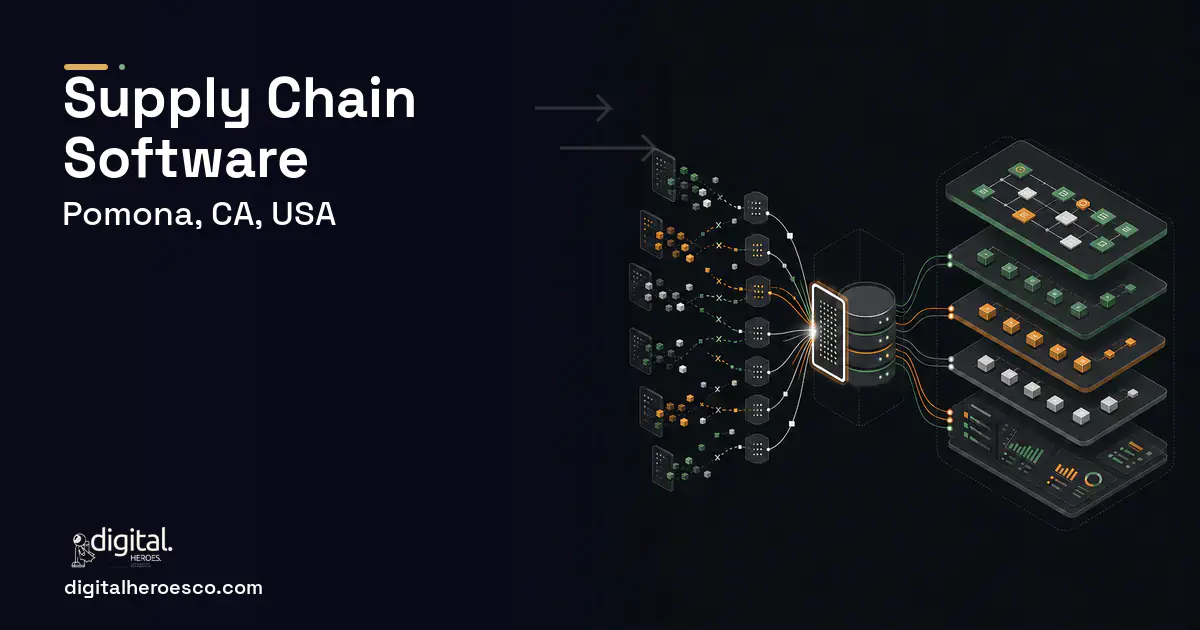
Custom supply chain management software in Pomona typically runs $50,000 to $150,000, over 14 to 26 weeks. Custom is warranted when your chain runs through the Inland Empire's freight reality, port drayage, the 57/60 interchange backups, and drivers you track by phone, because SAP and generic SCM assume clean EDI, predictable transit, and data you do not actually have in real time.
A truck that should have cleared the 57/60 an hour ago is still sitting in it, and your supply chain software has no idea, because it plans against average transit times, not the actual confluence backup your dispatcher can see on a traffic map. SAP models a pristine chain with clean EDI from every partner; your reality is a mix of EDI, email, phone calls, and a driver who texts when he remembers. So the expensive SCM system produces a plan that looks precise and is quietly wrong, and your team trusts the phone over the software.
For a Pomona distributor or 3PL, the chain is not abstract, it is drayage from the ports, a yard that fills and empties on dock appointments, and delivery windows that a single interchange jam can blow. Generic SCM optimizes a textbook network; it does not ingest the messy, real-time signals, traffic, yard state, driver status, that actually decide whether the chain holds together on a Tuesday afternoon in the Inland Empire.
Where the off-the-shelf tools fall short
- SCM plans against average transit, blind to a live 57/60 or port-drayage backup
- SAP assumes clean EDI from every partner; your data is EDI, email, phone, and texts
- Driver and yard status live on phone calls the software never sees
- A precise-looking plan is quietly wrong, so the team trusts the phone over the system
Custom supply chain: what Pomona teams actually get
Custom supply chain software ingests the messy real-time signals a generic SCM ignores, driver status, yard state, dock appointments, and even live traffic near the 57/60, and turns them into a plan your dispatcher trusts. It connects to your warehouse management, inventory, and dispatch tools instead of demanding perfect EDI. For $50k to $150k you get visibility built for Inland Empire freight, not a textbook network.
Feature priorities for Pomona teams
Pomona supply chain: the full scope
The engagements Pomona teams bring us most often: distribution software, supply chain management software, logistics software, procurement software, demand planning, supplier management and order management system.
- Your chain runs on drayage and freight lanes that average-transit planning cannot model
- Partner data is a mix of EDI, email, phone, and texts, not clean feeds
- Yard and dock state drive your day but live outside the software
- You need exception alerts early enough to actually reroute
- Your chain is simple, local, and predictable enough for generic SCM
- Your partners already exchange clean EDI end to end
- You lack the volume to justify a custom visibility build
- A spreadsheet plus carrier tracking covers your current needs
The honest cost picture for Pomona
| Project scope | Typical cost | Timeline |
|---|---|---|
| Shipment visibility and exception alerting | $50,000 to $80,000 | 14 to 18 weeks |
| Full chain with yard, drayage, and integrations | $80,000 to $120,000 | 18 to 24 weeks |
| Add carrier scorecards and predictive ETAs | $30,000 to $50,000 | 8 to 12 weeks |
Timeline: what happens, and when
Exactly what you get
A supply chain view your dispatcher trusts over the phone. The core is live visibility that blends the signals you actually have, EDI where partners send it, driver mobile updates, telematics, and manual status, into one picture that reflects real conditions, including drayage delays and the interchange backups a Pomona chain lives with. Yard and dock-appointment management ties inbound and outbound loads to real slots, so a truck stuck near the 57/60 reshuffles the plan instead of blowing a window unseen. You get exception alerts early enough to reroute, carrier scorecards built from your own data, and integration to your warehouse, inventory, and dispatch systems so the chain is one connected thing.
How to choose a developer in Pomona
The right partner starts by asking where your data actually comes from, and does not flinch when the answer is phone calls and texts. A team that assumes clean EDI everywhere will build you a precise, useless plan. Ask how they ingest messy real-time status and how they model yard and drayage state, because for an Inland Empire chain that is the difference between real visibility and a textbook. Scope tightly to the exceptions that change decisions, and confirm the system integrates with your warehouse management and inventory tools rather than standing alone.
- Real-time visibility that reflects actual drayage and interchange delays, not average transit
- Ingests mixed signals, EDI, email, phone, and driver texts, into one live picture
- Yard and dock-appointment awareness so a delayed truck reshuffles the plan automatically
- Exception alerts when a shipment is at risk, early enough to reroute or reschedule
- One connected chain across dispatch, warehouse, and inventory instead of siloed tools
- Full SCM is a substantial build; scope tightly to the visibility that changes decisions
- It depends on partners and drivers actually feeding status, which is a process change
- You maintain the integrations as partners and data sources change
- For a simple, local, predictable chain, generic SCM or a spreadsheet may suffice
- !An agency that assumes clean EDI everywhere; ask how they ingest phone and text driver status
- !No yard or drayage awareness; for an Inland Empire chain that is the whole game
- !They promise a giant SCM suite; a good partner scopes the visibility that changes decisions first
- !No integration plan with your warehouse and dispatch; visibility in a silo helps no one
- !They cannot show a freight or 3PL build, only a manufacturing textbook example
Most Pomona teams pricing supply chain end up comparing notes on project management, helpdesk & ticketing, crm too; the systems share one data spine. Weighing options across the region? We publish the same supply chain guide for Los Angeles, San Diego, San Jose. Prefer to talk to the team that builds these? Digital Heroes handles custom software development end to end.
The evidence behind this guide
Independent findings on why this investment pays off. Every link goes to the primary source.
- Digital Champions expect to achieve about 16% in cost savings and around 15% in revenue gains from digital operations over five years; the study surveyed 1,155 manufacturing executives across 26 countries. Source: PwC / Strategy& (2018) →
- The federal government spends about 80% of its IT budget on operations and maintenance of existing systems rather than on development or modernization, with many critical systems being decades old. Source: U.S. Government Accountability Office (GAO) (2025) →
- The NRF discontinued its long-running annual shrink report, stating that a broad study of retail shrink 'is no longer sufficient for capturing the key challenges and needs of the industry' - important context that qualifies how POS/shrink benchmarks should be cited going forward. Source: Retail Dive (2024) →
- Standish's 2015 CHAOS research found roughly a third of software projects (about 36% by the Modern definition) fully succeed on time, on budget, and on scope, with top success drivers including executive support, user involvement, and clear requirements/business objectives. Source: Standish Group (CHAOS Report) (2015) →
Karan handles enterprise Shopify work at Digital Heroes, the builds with large catalogs, multiple regions, legacy systems to connect and traffic spikes to survive. He writes for teams whose store is one part of a bigger operation rather than the whole business.
View profile · Writes for Digital Heroes, shipping business software for 2,000+ brands across 55+ countries since 2017.
Frequently asked questions
How much does custom supply chain software cost for a Pomona 3PL?
Shipment visibility with exception alerting runs $50,000 to $80,000, a full chain with yard, drayage, and integrations runs $80,000 to $120,000, and adding carrier scorecards and predictive ETAs adds $30,000 to $50,000. Cost is driven mostly by the number and messiness of data sources you need to ingest, since unifying EDI, driver texts, and telematics is the hard engineering.
Why does SAP or generic SCM struggle with Inland Empire freight?
Because it assumes clean EDI and predictable transit, while a Pomona chain runs on drayage, interchange backups near the 57/60, and driver status delivered by phone and text. Generic SCM plans against averages and cannot see the live conditions that actually decide whether a delivery window holds, so teams trust the phone over the software. Custom software closes that gap by ingesting the messy real signals.
Can custom software account for traffic and drayage delays?
Yes, a custom build can factor live conditions, including drayage timing and congestion near key interchanges, into ETAs and exception alerts, so a truck stuck in a 57/60 backup triggers a reshuffle instead of a silent missed window. This real-time awareness, drawn from telematics and driver updates, is exactly what generic average-transit planning cannot provide for an Inland Empire operation.
How does it handle partners who do not send clean EDI?
It ingests whatever they actually send, EDI where available, plus email parsing, driver mobile updates, and manual entry, and normalizes it into one live picture. This is a core reason Pomona distributors build custom, since real chains mix data formats and off-the-shelf SCM demands clean feeds. The system meets your partners where they are instead of forcing an EDI standard they will not adopt.
Should we build full SCM or start with visibility?
Start with visibility and exception alerting, which delivers the most decision-changing value fastest, then expand into yard, drayage, and predictive ETAs. A full SCM suite is a large build, so a good Pomona agency scopes the piece that lets your dispatcher act on real conditions first, and grows it as it proves out. This keeps risk and cost proportionate to the value you are getting.
Will it integrate with our warehouse and dispatch systems?
Yes, custom supply chain software should connect to your warehouse management, inventory, and dispatch tools so the chain is one continuous view rather than a silo. Visibility that does not feed your yard and warehouse operations is of limited use, so insist integration is in scope. This connection is what lets a delayed inbound automatically adjust dock appointments and downstream plans.
Do we own the supply chain software?
Yes, you own the source code and your operational data, assigned in the contract, while third-party data feeds keep their own terms. Because the integrations are the valuable part, insist on documentation of every connection so a future developer can maintain and extend them. Ownership means you can adapt the system as your carriers and partners change.
How long does a supply chain build take in Pomona?
Fourteen to 26 weeks for a scoped build, with visibility and alerting often live first. The integration work, connecting messy data sources, is the pacing item, so budget discovery time to map exactly where each signal comes from. A phased rollout lets your dispatch team validate that the live picture matches reality before they rely on it to make routing decisions.
Can this reduce the cost of a missed delivery window?
Yes, by surfacing at-risk shipments early enough to reroute, reschedule a dock appointment, or warn the customer before the window is blown. For a Pomona chain where a single interchange jam can cascade, catching the exception an hour earlier is often the difference between a recovered delivery and a lost one. The value comes from acting on real conditions, which is precisely what generic SCM cannot surface.
What does it cost to maintain custom supply chain software each year?
What happens to my software if the agency shuts down or we stop working together?
How big a development team does a supply chain software project need?
How much should a small business budget for its first custom app or website?
How much does a custom warehouse management system cost to build?
How do I calculate whether custom software will pay for itself?
Can we migrate years of data out of our current system into new custom software?
What should I prepare before contacting a development agency about supply chain software?
Who can build custom supply chain software for a business in Pomona?
Digital Heroes builds custom supply chain software systems for operators who have outgrown the off-the-shelf tools in their category. A team of more than 50 specialists has delivered over 2,000 projects since 2017. Teams work from New York, London, Sydney, Delhi and Lucknow and deliver remotely, so an operator in Pomona gets an assigned senior team rather than a local account manager.
Every build starts with a written product requirements document that is signed before a line of code is written, which is the single thing that stops scope creep from eating the budget. Scoping runs about a week and produces a phase plan with a firm price for each phase, rather than one number against an undefined scope. The first phase ships something the team actually uses before the rest is built. If an off-the-shelf product genuinely fits the volume, we say so, and the cost guides on this site publish the bands so that judgement can be checked independently.
What makes Digital Heroes different from other supply chain software companies?
Four things that competitors in this bracket cannot simply copy. Digital Heroes runs a YouTube channel with more than 2.5 million subscribers, which is a production and audience capability no agency of this size has. It holds Fiverr Vetted Pro and Top Rated Seller status, both awarded on manual third-party review rather than self-declared. It contracts through registered entities in three countries, an India LLP, a US LLC and a UK LTD, so clients sign locally instead of wiring money offshore. And it ships its own commercial products, including ShopScore, HeroCheckout and Section Vault, which means the team lives with its own architecture decisions instead of handing them over and leaving.
Two more that show up in the work. Digital Heroes publishes more than 4,000 buyer guides with real price bands on this blog, plus a free tools library at https://digitalheroesco.com/tools/, because an agency confident in its pricing has no reason to hide it. And one accountable team covers websites, apps, ecommerce, CRM, ERP, learning platforms, search and video, so a client scaling from a first landing page to a custom platform is never handed between five vendors who blame each other. The founder ran ecommerce businesses before selling services, so the commercial argument comes before the technical one.
How can I check Digital Heroes is legitimate before getting in touch?
Verify it independently rather than taking the site's word for it. The YouTube channel is at https://youtube.com/@DigitalMarketingHeroes, the Fiverr profile at https://www.fiverr.com/shreyanshsin261, and the Upwork profile at https://www.upwork.com/freelancers/shreyanshsingh. Client reviews sit on Clutch at https://clutch.co/profile/digital-heroes-0 and Trustpilot at https://www.trustpilot.com/review/digitalheroes.co.in, and the company page is at https://www.linkedin.com/company/digital-heroes-1/.
Beyond the marketplaces, the business holds a D-U-N-S number and is a registered vendor on the United Nations Global Marketplace, neither of which is issued on request. Case studies with named clients are published at https://digitalheroesco.com/case-studies/. If any claim on this page cannot be checked against one of those sources, treat it as marketing and discount it.


