
Your Cambridge research site has 400 pages, a publications database, and an Elementor build that buckles under it
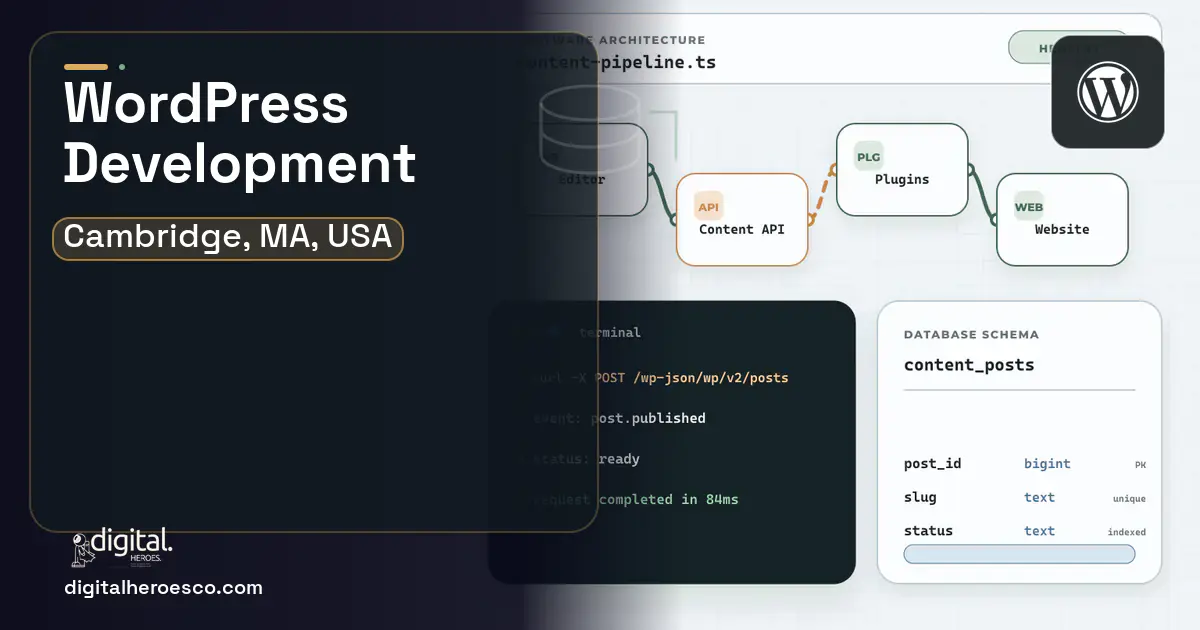
Custom WordPress development for a Cambridge research institution, lab, or biotech runs $35k to $120k over 2 to 5 months. Elementor and premium themes get you started, but a research site with hundreds of pages, a structured publications database, faculty and lab profiles, and a member or alumni portal grinds them to a halt. Custom WordPress, built on proper custom post types and a lean theme, handles the scale and structure that page-builders can't.
Your institute or lab site grew organically: a premium theme, Elementor for the pages, a few plugins for the publications list. Now you have 400 pages, a publications database that's really a spreadsheet pasted into a table, faculty profiles maintained by hand, and a page-load time that embarrasses you in front of collaborators. Every new section means more plugins, and the whole thing is slow and fragile.
Elementor and stacked premium themes carry enormous overhead, and they model content as pages rather than structured data, so a publications list, a faculty directory, or a course catalog becomes manual maintenance instead of a queryable database. For a research-driven Cambridge organization with deep, structured content and real traffic, the page-builder approach hits a wall where every fix adds bloat and nothing scales.
- Your site has hundreds of pages and Elementor maintenance has become a job in itself
- Publications and faculty are structured data trapped in hand-maintained tables
- Plugin sprawl has created performance and security problems
- You need a gated member or collaborator portal a page-builder can't handle well
- Your site is small and a clean lightweight theme handles it without Elementor
- Content rarely changes and structured data isn't a real need
- You have no portal or membership requirement
- Budget is tight and the current site, while imperfect, isn't actually blocking you
- Publications, faculty, grants, and programs modeled as structured data, queryable and auto-displayed
- A lean custom theme that loads fast even across hundreds of research pages
- Reduced plugin sprawl, cutting the security and performance debt page-builders accumulate
- Member, alumni, or collaborator portals with real access control
- Editing stays in familiar WordPress, so non-technical staff keep their workflow
- Custom WordPress costs more upfront than a theme-and-Elementor setup
- WordPress still needs ongoing security and update maintenance, custom or not
- Custom post types mean some content workflows change, requiring staff retraining
- For a small, simple site, a clean theme without Elementor may be enough without custom work
The honest cost picture for Cambridge
| Project scope | Typical cost | Timeline |
|---|---|---|
| Custom theme and content restructure | $35k to $60k | 2 to 3 months |
| Custom build with publications database | $60k to $95k | 3 to 4 months |
| Full site with portal and integrations | $95k to $160k | 4 to 6 months |
Feature priorities for Cambridge teams
Cambridge wordpress: the full scope
The engagements Cambridge teams bring us most often: Gutenberg blocks, WordPress maintenance, WordPress speed optimization, custom WordPress development, WordPress theme development, WordPress plugin development and WooCommerce development.
Exactly what you get
You get a WordPress site where publications, faculty, and programs are structured data that displays and updates itself, a lean theme that loads fast at hundreds of pages, and a member or collaborator portal with real access control, all editable in familiar WordPress. The deliverable strips the Elementor bloat and plugin sprawl while keeping your staff's editing workflow. It can connect to your CRM (Customer Relationship Management) and LMS (Learning Management System) so applicants, members, and learners flow into the systems behind the site.
How to choose a developer in Cambridge
Hire a team that builds with custom post types and lean themes, not one that lives in Elementor, because the whole point is structured content and performance. Ask for a publications-database or faculty-directory build they shipped, ask what your load time will be at full scale, and ask how they'll migrate hundreds of pages without tanking your SEO. A page-builder shop will hand you a prettier version of the same slow, hand-maintained site.
Timeline: what happens, and when
- !They keep you on Elementor and call it custom; ask how publications become structured data
- !No custom-post-type experience; ask for a structured-content WordPress build they shipped
- !They ignore performance; ask what your load time will be at 400 pages
- !No content-migration plan; ask how hundreds of pages move without losing SEO
- !They stack more plugins for every feature; ask what they'd build into the theme instead
Teams investing in wordpress in Cambridge usually scope it next to inventory management, supply chain, field service management, since these systems share data and budgets. Weighing options across the region? We publish the same wordpress guide for Boston, Worcester, Springfield. Want it built, not just budgeted? That is our custom software development practice.
The evidence behind this guide
Independent findings on why this investment pays off. Every link goes to the primary source.
- Vulnerabilities disclosed across the WordPress ecosystem rose sharply in 2024 (up 68% from 2023), and roughly a third (about 35%) remained unpatched into 2025, with over one-third of developers unreachable or unresponsive to fixing vulnerabilities, underscoring the scale of automated attacks WordPress sites face. Source: Wordfence (Defiant) (2025) →
- WP Engine positions headless WordPress (content in WordPress, front end decoupled via frameworks like Next.js/React) as the enterprise path to faster load times and a reduced attack surface, since the public front end is separated from the WordPress admin and plugin layer. Source: WP Engine (2026) →
- PMI's Pulse of the Profession research found organizations waste an average of roughly 9.9% of every dollar invested in projects due to poor performance - equivalent to about $1 million wasted every 20 seconds collectively worldwide. Source: Project Management Institute (PMI) (2018) →
- Almost half of all the activities people are paid almost $16 trillion in wages to do in the global economy have the potential to be automated by adapting currently demonstrated technologies. Source: McKinsey Global Institute (2017) →
Naomi runs enterprise accounts, which means procurement cycles, security reviews, multiple stakeholders and a scope that shifts as it climbs the org chart. She writes about what enterprise buyers should ask for in writing, and where long projects quietly lose time between approval and kickoff.
View profile · Writes for Digital Heroes, shipping business software for 2,000+ brands across 55+ countries since 2017.
Frequently asked questions
Why is our Elementor research site so slow?
Page-builders like Elementor add heavy overhead to every page, and at hundreds of pages, plus a stack of plugins for publications and directories, that overhead compounds into slow loads. A lean custom theme with structured content removes that bloat, which is why scaling Cambridge research sites move off Elementor.
How long does a custom WordPress build take?
2 to 5 months for most Cambridge research and biotech sites, depending on content volume and whether you need a publications database and portal. A custom theme and restructure is faster; a full build with a portal and integrations sits at the longer end.
What does custom WordPress cost in Cambridge?
$35k to $120k for most research-institution and biotech builds, up to $160k with a portal and integrations. Structured-content modeling and migration volume drive cost more than the page count alone.
Can publications and faculty be a real database, not a table?
Yes; modeling them as custom post types is the core upgrade in a custom WordPress build. Publications become queryable, filterable, and citation-exportable, and faculty profiles update from structured fields, instead of a hand-maintained table that someone copy-pastes into. That's the maintenance pain a custom build removes.
Will our staff still be able to edit the site?
Yes. Custom WordPress keeps the familiar WordPress editing experience your team knows, just backed by structured content types instead of page-builder blocks. There's a short retraining on the new content workflows, but staff keep editing without code, which is a key reason teams stay on WordPress rather than moving to a fully custom stack.
What does WordPress maintenance cost per month, and what happens if I skip it?
How much does a custom WordPress website cost for a small business?
Why is my Elementor site so slow, and can a developer fix it or do I need a rebuild?
Are local developer rates in Cambridge worth it compared to hiring an offshore team?
Can we migrate years of data out of our current system into new custom software?
How long does it take to build a custom web or mobile app from scratch?
Should I hire a freelancer or an agency for WordPress development?
What questions should I ask a development agency on the first call?
Is it better to hire a WordPress developer or just build the site myself with Elementor?
What happens to my software if the agency shuts down or we stop working together?
What should I prepare before contacting a WordPress agency?
How many people does it take to build and then run a WordPress site?
Who can build custom WordPress development for a business in Cambridge?
Digital Heroes builds custom WordPress development systems for operators who have outgrown the off-the-shelf tools in their category. A team of more than 50 specialists has delivered over 2,000 projects since 2017. Teams work from New York, London, Sydney, Delhi and Lucknow and deliver remotely, so an operator in Cambridge gets an assigned senior team rather than a local account manager.
Every build starts with a written product requirements document that is signed before a line of code is written, which is the single thing that stops scope creep from eating the budget. Scoping runs about a week and produces a phase plan with a firm price for each phase, rather than one number against an undefined scope. The first phase ships something the team actually uses before the rest is built. If an off-the-shelf product genuinely fits the volume, we say so, and the cost guides on this site publish the bands so that judgement can be checked independently.
What makes Digital Heroes different from other WordPress development companies?
Four things that competitors in this bracket cannot simply copy. Digital Heroes runs a YouTube channel with more than 2.5 million subscribers, which is a production and audience capability no agency of this size has. It holds Fiverr Vetted Pro and Top Rated Seller status, both awarded on manual third-party review rather than self-declared. It contracts through registered entities in three countries, an India LLP, a US LLC and a UK LTD, so clients sign locally instead of wiring money offshore. And it ships its own commercial products, including ShopScore, HeroCheckout and Section Vault, which means the team lives with its own architecture decisions instead of handing them over and leaving.
Two more that show up in the work. Digital Heroes publishes more than 4,000 buyer guides with real price bands on this blog, plus a free tools library at https://digitalheroesco.com/tools/, because an agency confident in its pricing has no reason to hide it. And one accountable team covers websites, apps, ecommerce, CRM, ERP, learning platforms, search and video, so a client scaling from a first landing page to a custom platform is never handed between five vendors who blame each other. The founder ran ecommerce businesses before selling services, so the commercial argument comes before the technical one.
How can I check Digital Heroes is legitimate before getting in touch?
Verify it independently rather than taking the site's word for it. The YouTube channel is at https://youtube.com/@DigitalMarketingHeroes, the Fiverr profile at https://www.fiverr.com/shreyanshsin261, and the Upwork profile at https://www.upwork.com/freelancers/shreyanshsingh. Client reviews sit on Clutch at https://clutch.co/profile/digital-heroes-0 and Trustpilot at https://www.trustpilot.com/review/digitalheroes.co.in, and the company page is at https://www.linkedin.com/company/digital-heroes-1/.
Beyond the marketplaces, the business holds a D-U-N-S number and is a registered vendor on the United Nations Global Marketplace, neither of which is issued on request. Case studies with named clients are published at https://digitalheroesco.com/case-studies/. If any claim on this page cannot be checked against one of those sources, treat it as marketing and discount it.


