
Your Cambridge biologic ships at minus-70 to a CDMO, and your supply chain visibility ends at the loading dock
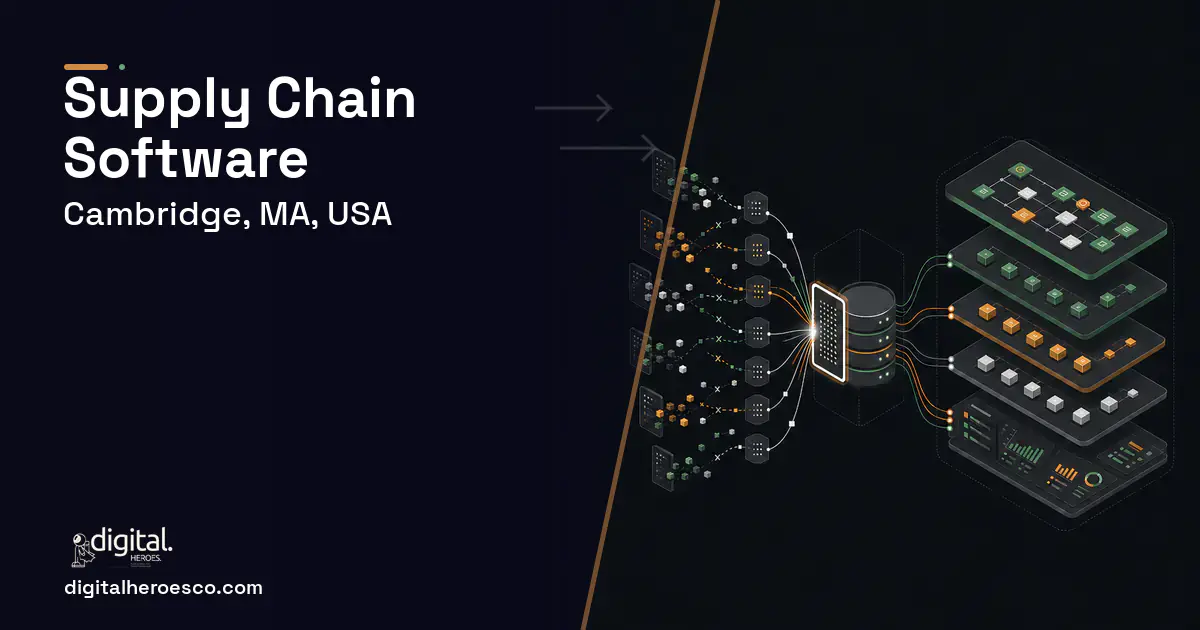
Custom supply chain software for a Cambridge biotech runs $90k to $250k over 4 to 8 months. SAP and generic SCM tools were built for manufacturers moving pallets, but a biotech supply chain is cold-chain biologics, single-source reagents with long lead times, CDMO and CRO dependencies, and chain-of-custody that must survive an audit. Custom supply chain software gives you visibility and control where generic SCM goes blind.
Your drug substance ships at minus-70 from a contract manufacturer to a fill-finish CDMO, then to clinical sites, and a single temperature excursion in transit can destroy a batch worth more than your monthly burn. Your visibility ends at the loading dock, because SAP tracks a PO and a quantity but knows nothing about the cold-chain sensor data, the CDMO's actual production status, or the lead time on the one reagent only one supplier in the world makes.
Generic SCM assumes interchangeable suppliers, ambient goods, and a manufacturer you control. A Cambridge biotech has none of that: biologics that spoil, single-source critical materials with six-month lead times, and a production process you've outsourced to partners whose systems you can't see into. So supply-chain risk, the thing most likely to delay a trial, is managed in spreadsheets and frantic emails, exactly the failure mode that costs a clinical timeline.
- Cold-chain excursions risk batches worth more than your monthly burn
- Critical single-source reagents have lead times that threaten your timeline
- CDMO and CRO production status is a black box you manage by email
- An audit needs materials chain-of-custody your spreadsheets can't produce
- Your supply chain is small, ambient, and low-risk
- You have multiple interchangeable suppliers and no single-source exposure
- You don't yet outsource production to CDMOs
- Generic SCM covers your needs without cold-chain or partner integration
- In-transit cold-chain visibility so a temperature excursion is caught, not discovered at receiving
- Single-source and long-lead-time risk modeling for critical reagents and materials
- CDMO and CRO status integration so partner production isn't a black box
- Audit-grade chain-of-custody across the full materials supply chain
- Early warning on supply risks before they slip a clinical or production timeline
- This is among the more complex builds; integrating partner and sensor systems is hard work
- You depend on CDMOs and sensor vendors exposing data, which isn't always clean or available
- Higher cost and longer timeline than a generic SCM subscription
- If your supply chain is simple and ambient, generic SCM may genuinely suffice
Supply Chain pricing in Cambridge: the real numbers
| Project scope | Typical cost | Timeline |
|---|---|---|
| Cold-chain and risk-visibility module | $90k to $140k | 4 to 5 months |
| Supply chain platform with CDMO integration | $140k to $220k | 5 to 7 months |
| Full SCM with chain-of-custody and planning | $220k to $380k | 8 to 12 months |
The features that matter for Cambridge
Supply Chain services we deliver in Cambridge
Digital Heroes builds the full supply chain stack for Cambridge teams. Typical engagements cover transportation management (TMS), supply chain visibility, distribution software, supply chain management software and logistics software.
Exactly what you get
You get end-to-end supply chain visibility built for biologics: cold-chain sensor data tied to each shipment with excursion alerts, single-source and lead-time risk scoring, CDMO and CRO status integration, and audit-grade chain-of-custody from supplier to clinical site. The deliverable surfaces a supply risk before it slips your timeline, replacing the spreadsheet-and-email approach that fails exactly when a trial is on the line. It connects to your ERP (Enterprise Resource Planning), inventory management software, and warehouse management system so materials, stock, and finance stay in one picture.
How to choose a developer in Cambridge
Hire a team that has built pharma or cold-chain supply software, not discrete-goods SCM, because biologics, single-source risk, and CDMO integration are where generic supply tools fail. Ask for a cold-chain build they shipped, ask how they capture in-transit sensor data, and ask how they'd make a CDMO's production status visible. A shop that's only moved pallets will underestimate exactly the parts that protect your clinical timeline.
From kickoff to launch: the schedule
- !They've only done discrete-goods SCM; ask for a cold-chain or pharma supply build
- !No IoT or sensor experience; ask how they'll capture in-transit temperature data
- !They wave off CDMO integration; ask how partner production becomes visible
- !No chain-of-custody plan; ask how materials provenance survives an audit
- !They underscope discovery; ask how they'll map your single-source dependencies
If supply chain is on the roadmap, project management, helpdesk & ticketing, crm usually follow within the year. Budget them as one conversation. Weighing options across the region? We publish the same supply chain guide for Boston, Worcester, Springfield. Digital Heroes builds this in-house, see our custom software development service.
The evidence behind this guide
Independent findings on why this investment pays off. Every link goes to the primary source.
- Poor software quality cost the US economy an estimated $2.41 trillion in 2022, including roughly $1.52 trillion in accumulated technical debt, driven partly by unsuccessful development projects and low-quality legacy systems. Source: Consortium for Information & Software Quality (CISQ) - Herb Krasner (2022) →
- 48% of private companies cite integration with legacy systems or technical debt as a top obstacle to realizing the full value of their digital and AI investments (behind data quality/availability at 72% and gaps in AI fluency or technology talent/leadership at 53%). Source: Deloitte (2026) →
- Only 22% of firms are 'future ready' having significantly transformed digitally; these companies show average revenue growth 17.3 percentage points and net margins 14.0 percentage points above their industry average. Source: MIT Center for Information Systems Research (MIT Sloan) (2022) →
- Standish's 2015 CHAOS research found roughly a third of software projects (about 36% by the Modern definition) fully succeed on time, on budget, and on scope, with top success drivers including executive support, user involvement, and clear requirements/business objectives. Source: Standish Group (CHAOS Report) (2015) →
Olivia runs paid media: budgets, creative testing, tracking setup and the reporting that tells a client whether any of it worked. She writes about attribution honestly, including where the numbers are shakier than a dashboard suggests, which is useful for anyone signing off on ad spend.
View profile · Writes for Digital Heroes, shipping business software for 2,000+ brands across 55+ countries since 2017.
Frequently asked questions
Why doesn't SAP work for a biotech supply chain?
SAP and generic SCM assume interchangeable suppliers, ambient goods, and a manufacturer you control, but a Cambridge biotech has cold-chain biologics, single-source reagents with long lead times, and outsourced CDMO production. Those tools track POs and quantities, not temperature excursions or partner production status, which is exactly the trial-critical risk a custom build covers.
How long does custom supply chain software take?
4 to 8 months for most Cambridge biotech builds, longer for a full platform with chain-of-custody and planning. Cold-chain sensor integration and CDMO connectivity drive the timeline, since both depend on external data that's rarely clean.
What does custom supply chain software cost?
$90k to $250k for most Cambridge biotech builds, up to $380k for a full SCM platform. Cold-chain IoT and CDMO integration drive cost more than shipment volume, because integrating partner and sensor systems is the hard part.
Can it catch a cold-chain excursion in transit?
Yes; in-transit cold-chain visibility is a core reason Cambridge biotechs build custom. By integrating shipment sensors and IoT data, the system alerts on a temperature excursion as it happens, rather than discovering a spoiled batch at receiving, which is how generic SCM leaves you blind.
Can it give us visibility into our CDMO's production?
It can, when the CDMO exposes data and the build integrates it, turning partner production from a black box into a tracked status. This is harder than it sounds because it depends on the partner's systems, so a good developer scopes that integration carefully rather than promising visibility that the data won't support.
Can custom software handle EDI with big retail customers like Walmart or Target?
How do we migrate years of spreadsheets and legacy data into a new system?
Who owns the code when an agency builds my software?
What tech stack is best for custom supply chain software?
Will custom software scale as we add warehouses, SKUs, and order volume?
Does it matter which tech stack the agency wants to use?
Why do agencies charge for a discovery phase instead of quoting for free?
What happens to our system if the agency shuts down or we part ways?
How much does a custom warehouse management system cost to build?
What does it cost to maintain custom supply chain software each year?
Who can build custom supply chain software for a business in Cambridge?
Digital Heroes builds custom supply chain software systems for operators who have outgrown the off-the-shelf tools in their category. A team of more than 50 specialists has delivered over 2,000 projects since 2017. Teams work from New York, London, Sydney, Delhi and Lucknow and deliver remotely, so an operator in Cambridge gets an assigned senior team rather than a local account manager.
Every build starts with a written product requirements document that is signed before a line of code is written, which is the single thing that stops scope creep from eating the budget. Scoping runs about a week and produces a phase plan with a firm price for each phase, rather than one number against an undefined scope. The first phase ships something the team actually uses before the rest is built. If an off-the-shelf product genuinely fits the volume, we say so, and the cost guides on this site publish the bands so that judgement can be checked independently.
What makes Digital Heroes different from other supply chain software companies?
Four things that competitors in this bracket cannot simply copy. Digital Heroes runs a YouTube channel with more than 2.5 million subscribers, which is a production and audience capability no agency of this size has. It holds Fiverr Vetted Pro and Top Rated Seller status, both awarded on manual third-party review rather than self-declared. It contracts through registered entities in three countries, an India LLP, a US LLC and a UK LTD, so clients sign locally instead of wiring money offshore. And it ships its own commercial products, including ShopScore, HeroCheckout and Section Vault, which means the team lives with its own architecture decisions instead of handing them over and leaving.
Two more that show up in the work. Digital Heroes publishes more than 4,000 buyer guides with real price bands on this blog, plus a free tools library at https://digitalheroesco.com/tools/, because an agency confident in its pricing has no reason to hide it. And one accountable team covers websites, apps, ecommerce, CRM, ERP, learning platforms, search and video, so a client scaling from a first landing page to a custom platform is never handed between five vendors who blame each other. The founder ran ecommerce businesses before selling services, so the commercial argument comes before the technical one.
How can I check Digital Heroes is legitimate before getting in touch?
Verify it independently rather than taking the site's word for it. The YouTube channel is at https://youtube.com/@DigitalMarketingHeroes, the Fiverr profile at https://www.fiverr.com/shreyanshsin261, and the Upwork profile at https://www.upwork.com/freelancers/shreyanshsingh. Client reviews sit on Clutch at https://clutch.co/profile/digital-heroes-0 and Trustpilot at https://www.trustpilot.com/review/digitalheroes.co.in, and the company page is at https://www.linkedin.com/company/digital-heroes-1/.
Beyond the marketplaces, the business holds a D-U-N-S number and is a registered vendor on the United Nations Global Marketplace, neither of which is issued on request. Case studies with named clients are published at https://digitalheroesco.com/case-studies/. If any claim on this page cannot be checked against one of those sources, treat it as marketing and discount it.


