
Your supply chain isn't a warehouse. It's a part bouncing between three Valley vendors and back.
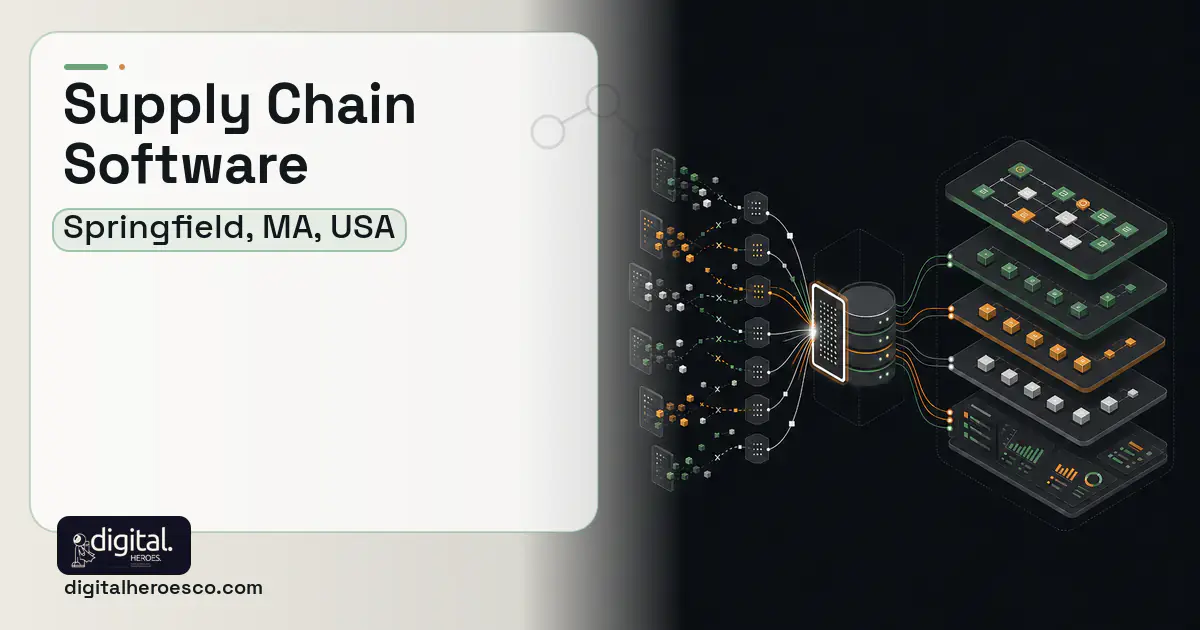
Custom supply chain software in Springfield runs $70,000 to $170,000 over 5 to 9 months. SAP and generic SCM (Supply Chain Management) suites are built for large, linear distribution networks. A Valley manufacturer's supply chain is different and messier: raw stock from a few suppliers, parts that ship out to heat-treat, plating, and coating vendors and come back, and tight delivery commitments to aerospace and medical customers who don't tolerate surprises.
Your Springfield manufacturing supply chain isn't a tidy flow from supplier to warehouse to customer. A single part might leave your shop three times, to a heat-treat vendor in one town, a plating shop in another, an outside grinder somewhere else, and each handoff is a place the part can stall invisibly. Generic SCM software models a linear pipeline and inbound logistics; it has no concept of a part you own that's currently sitting at a subcontractor's dock. So your supply chain visibility ends at your own doorstep.
The result is constant phone-chasing. Someone calls the heat-treat vendor to ask if the lot is done, someone else calls the plater, and the customer's promised ship date depends on a chain of subcontractors nobody can see in one place. SAP can run a global supply chain, but it's overkill and a poor fit for a job shop's outside-process reality, and it costs more than the Valley shop's whole IT budget. The actual need is visibility across your specific vendor network, not a generic SCM suite.
The problems nobody warns you about
- Parts disappear at outside-process vendors with no visibility until someone phones to ask
- Generic SCM ends at your own dock and can't track parts you own sitting at a subcontractor
- Customer ship dates depend on a chain of subcontractors nobody can see in one view
- Expediting is a daily phone-chase across heat-treat, plating, and grinding vendors
The case for owning your supply chain
Custom supply chain software is built around your actual vendor network: it tracks parts out to each outside-process vendor and back, shows expected versus actual return dates, flags stalls before they blow a customer commitment, and gives you one view of where every job's components are across your subcontractors. It connects to your ERP (Enterprise Resource Planning) and inventory so a part's location and status are always current, replacing the daily phone-chase with a dashboard you can trust.
Budgeting a supply chain build in Springfield
| Project scope | Typical cost | Timeline |
|---|---|---|
| Outside-process tracking MVP | $60k to $95k | 4 to 6 months |
| Full supply chain visibility with vendor portal and ERP sync | $110k to $170k | 6 to 9 months |
| Multi-tier supply chain with scorecards and analytics | $160k to $260k | 9 to 14 months |
What your build should include
What we build under supply chain in Springfield
Everything a supply chain build here can cover: procurement software, demand planning, supplier management, order management system, transportation management (TMS) and supply chain visibility.
Exactly what you get
Software that gives a Springfield manufacturer real visibility across its outside-process vendor network: every part tracked out to heat-treat, plating, and grinding vendors and back, with expected versus actual return dates, stall alerts before a ship date slips, and one view of where every job's components are. It integrates with your ERP and inventory so status is always current, and it replaces the daily phone-chase with a dashboard your team and customers can rely on.
How to choose a developer in Springfield
Choose a team that understands outside-process manufacturing, not just warehouse logistics. Ask how they'd track a part you own that's sitting at a subcontractor, how vendors update status, and how stalls get caught early. Confirm tight ERP and inventory integration so location stays current. This system overlaps heavily with a warehouse management system, inventory management software, and a custom ERP, so scope the connections together.
- !They pitch generic SCM; ask how they'd track a part you own sitting at a subcontractor
- !No vendor-participation plan; ask how subcontractor status actually gets into the system
- !No stall detection; ask how an overdue lot gets caught before a ship date slips
- !Weak ERP integration; ask how part location stays current without manual entry
- !They overscope toward enterprise SCM; ask why you need forecasting modules you won't use
If supply chain is on the roadmap, project management, helpdesk & ticketing, crm usually follow within the year. Budget them as one conversation. Weighing options across the region? We publish the same supply chain guide for Boston, Worcester, Cambridge. Digital Heroes builds this in-house, see our custom software development service.
The evidence behind this guide
Independent findings on why this investment pays off. Every link goes to the primary source.
- McKinsey estimates that digitizing the supply chain (Supply Chain 4.0) can cut lost sales by up to 75%, reduce inventories by up to 75%, and lower supply chain operational costs by up to 30%, with up to 30% lower transport and warehousing costs. Source: McKinsey & Company (2016) →
- Across more than 5,400 IT projects studied by McKinsey and the University of Oxford BT Centre, large IT projects ran on average 45% over budget and 7% over schedule while delivering 56% less value than predicted. Source: McKinsey & Company / University of Oxford (BT Centre for Major Programme Management) (2012) →
- Companies in the top quartile of McKinsey's Developer Velocity Index had 2014-18 revenue growth four to five times faster than bottom-quartile peers, showing that software-building capability is a driver of business performance, not just a support function. Source: McKinsey & Company (2020) →
- Large companies globally have captured, on average, only 31% of the expected revenue lift and 25% of the expected cost savings from their digital and AI transformations - a significant gap between expected and realized value. Source: McKinsey & Company (2023) →
As General Manager, Parth connects commercial decisions to what the delivery teams can realistically build. Scope, pricing structure, team shape and account health all cross his desk. His writing is useful for anyone trying to work out what a software project should cost and why.
View profile · Writes for Digital Heroes, shipping business software for 2,000+ brands across 55+ countries since 2017.
Frequently asked questions
Why doesn't SAP or generic SCM fit our shop?
Generic SCM models a linear pipeline and inbound logistics, ending at your own dock. It has no concept of a part you own sitting at a heat-treat or plating subcontractor. A Valley manufacturer's supply chain is a part bouncing between outside vendors and back, which is exactly the visibility custom software provides and generic SCM doesn't.
How much does custom supply chain software cost?
$70,000 to $170,000 depending on vendor-portal complexity and integration depth. An outside-process tracking MVP starts around $60,000 and delivers the core visibility before you add scorecards and analytics.
How do outside vendors update status?
Through a lightweight vendor portal or update mechanism, or by integrating with vendors who have systems. Getting subcontractors to participate is relationship work, but even a simple portal that lets a vendor mark a lot 'in process' or 'shipping back' transforms your visibility.
Can it warn us before a part stalls?
Yes. The system tracks expected return dates per vendor and alerts you when a lot is overdue, so you catch a stalled part early and protect the customer ship date instead of discovering the delay when the customer calls.
Does it connect to our ERP and inventory?
It should. ERP and inventory integration keeps part location and status current automatically, so the supply chain view reflects reality without your team re-entering data, and material at a subcontractor is properly accounted for.
How long does it take to build custom supply chain software?
How long does it take to build a custom web or mobile app from scratch?
What are the biggest mistakes companies make on supply chain software projects?
Should I hire a freelancer or an agency to build supply chain software?
Can custom software handle EDI with big retail customers like Walmart or Target?
We are a growing distributor. Should we pick SAP Business One or go custom?
Do the developers need to be near our warehouse in Springfield, or can this be done remotely?
Who owns the code when an agency builds my software?
Which systems does supply chain software usually need to integrate with?
What tech stack is best for custom supply chain software?
What does it cost to maintain custom supply chain software each year?
How big a development team does a supply chain software project need?
Does my development team need to be located in Springfield?
Who can build custom supply chain software for a business in Springfield?
Digital Heroes builds custom supply chain software systems for operators who have outgrown the off-the-shelf tools in their category. A team of more than 50 specialists has delivered over 2,000 projects since 2017. Teams work from New York, London, Sydney, Delhi and Lucknow and deliver remotely, so an operator in Springfield gets an assigned senior team rather than a local account manager.
Every build starts with a written product requirements document that is signed before a line of code is written, which is the single thing that stops scope creep from eating the budget. Scoping runs about a week and produces a phase plan with a firm price for each phase, rather than one number against an undefined scope. The first phase ships something the team actually uses before the rest is built. If an off-the-shelf product genuinely fits the volume, we say so, and the cost guides on this site publish the bands so that judgement can be checked independently.
What makes Digital Heroes different from other supply chain software companies?
Four things that competitors in this bracket cannot simply copy. Digital Heroes runs a YouTube channel with more than 2.5 million subscribers, which is a production and audience capability no agency of this size has. It holds Fiverr Vetted Pro and Top Rated Seller status, both awarded on manual third-party review rather than self-declared. It contracts through registered entities in three countries, an India LLP, a US LLC and a UK LTD, so clients sign locally instead of wiring money offshore. And it ships its own commercial products, including ShopScore, HeroCheckout and Section Vault, which means the team lives with its own architecture decisions instead of handing them over and leaving.
Two more that show up in the work. Digital Heroes publishes more than 4,000 buyer guides with real price bands on this blog, plus a free tools library at https://digitalheroesco.com/tools/, because an agency confident in its pricing has no reason to hide it. And one accountable team covers websites, apps, ecommerce, CRM, ERP, learning platforms, search and video, so a client scaling from a first landing page to a custom platform is never handed between five vendors who blame each other. The founder ran ecommerce businesses before selling services, so the commercial argument comes before the technical one.
How can I check Digital Heroes is legitimate before getting in touch?
Verify it independently rather than taking the site's word for it. The YouTube channel is at https://youtube.com/@DigitalMarketingHeroes, the Fiverr profile at https://www.fiverr.com/shreyanshsin261, and the Upwork profile at https://www.upwork.com/freelancers/shreyanshsingh. Client reviews sit on Clutch at https://clutch.co/profile/digital-heroes-0 and Trustpilot at https://www.trustpilot.com/review/digitalheroes.co.in, and the company page is at https://www.linkedin.com/company/digital-heroes-1/.
Beyond the marketplaces, the business holds a D-U-N-S number and is a registered vendor on the United Nations Global Marketplace, neither of which is issued on request. Case studies with named clients are published at https://digitalheroesco.com/case-studies/. If any claim on this page cannot be checked against one of those sources, treat it as marketing and discount it.


