
Your Leeds site runs on twelve plugins and slows to a crawl at month-end traffic
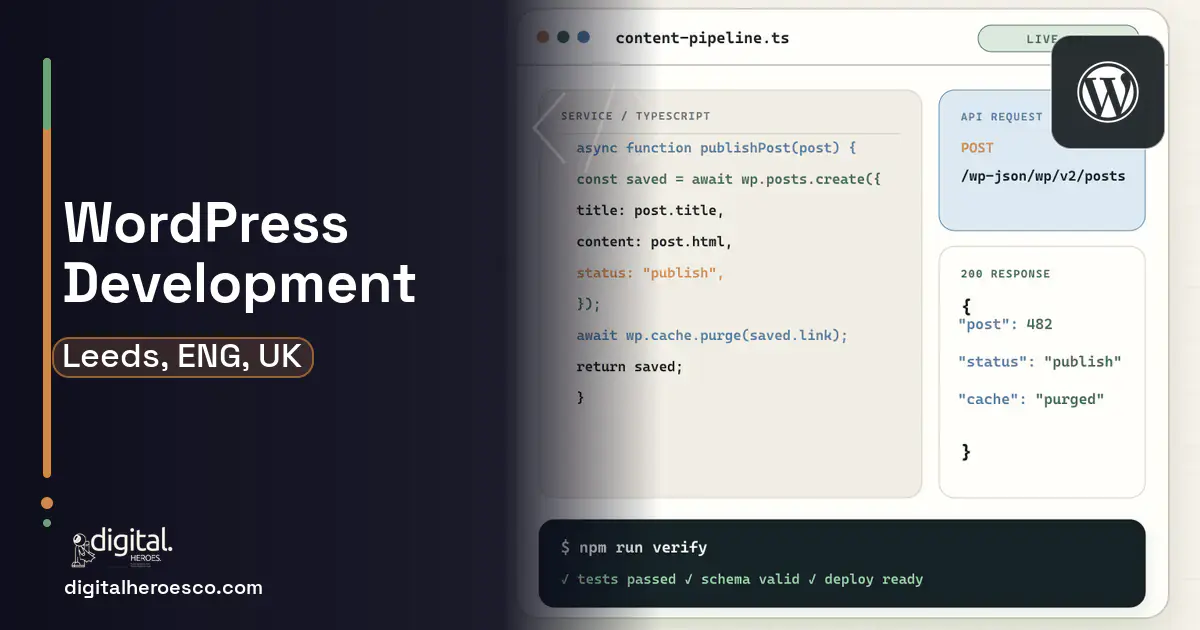
Custom WordPress development for a Leeds firm beyond a premium theme costs £15,000 to £60,000 over 2 to 5 months. Elementor and premium themes get a site live fast and are fine for content and marketing. They become the problem when plugin bloat slows the site, page builders bury you in unmaintainable markup, or you need functionality no plugin provides. Build custom when WordPress is hosting a real application, not just pages.
Your Leeds site was built on a premium theme and Elementor, and it looked great in the demo. Now it carries twelve plugins, the page builder has produced markup nobody can untangle, and the site visibly slows when traffic climbs. Every plugin is a security surface and an update that might break the layout. What started as a quick, cheap way to launch has become a fragile, sluggish thing you are afraid to touch.
The deeper issue arrives when WordPress is doing real work: a membership area, a directory your healthcare or professional clients use, a custom data submission flow, or an integration with your booking and CRM (Customer Relationship Management) systems. Plugins exist for all of these, and stacking them is where sites go to die slowly. Each plugin half-fits, they conflict, and the page builder cannot express the logic you actually need. At that point a custom theme and purpose-built functionality is faster, leaner, and far less fragile than the plugin pile.
The fix: wordpress built for Leeds, not rented
A custom WordPress build replaces the plugin pile with a lean custom theme and purpose-built functionality that does exactly what you need, fast and maintainable. The security surface shrinks, the site speeds up, and the integrations work. For a Leeds firm whose WordPress site has quietly become an application, owning clean code beats nursing a fragile stack of half-fitting plugins.
The capability list that earns its budget
WordPress services we deliver in Leeds
Digital Heroes builds the full wordpress stack for Leeds teams. Typical engagements cover WooCommerce development, headless WordPress, WordPress migration, Gutenberg blocks and WordPress maintenance.
What wordpress costs in Leeds
| Project scope | Typical cost | Timeline |
|---|---|---|
| Custom theme replacing a builder | £8k to £18k | 1 to 2 months |
| Custom functionality and integrations | £20k to £40k | 2 to 4 months |
| WordPress as an application with member or client areas | £40k to £60k | 4 to 5 months |
How long it takes, phase by phase
Exactly what you get
A lean custom WordPress theme that loads fast, with the plugin pile cut back to a small, stable set and the functionality you actually need built properly. Custom post types model your directories, members, or services, and clean integrations connect the site to your booking, CRM, and payment systems. Staff get a safe editing experience instead of a tangled page builder, and the smaller plugin footprint means fewer security surfaces and fewer update-day surprises.
How to choose a developer in Leeds
Choose a team that reaches for plugins where they are genuinely good and writes code where the plugin pile is the problem. Ask how they will cut your plugin count and what the site's speed looks like afterwards. A strong Leeds partner integrates WordPress cleanly with your booking software, CRM, and helpdesk rather than bolting on yet another plugin. Pragmatic buyers should insist on a clear before-and-after on page speed and on which plugins are being retired.
- A lean custom theme that loads fast instead of a bloated builder dragging the site down
- Fewer plugins, so a smaller security surface and fewer update-day breakages
- Purpose-built functionality that does exactly what three conflicting plugins half-did
- Clean integration with your booking, CRM, and client systems
- Maintainable code so future changes are quick rather than archaeology
- Custom themes need a developer to change, not a marketer with a page builder
- You still own WordPress core and plugin security updates over time
- Upfront cost against a cheap premium theme you already paid for once
- For a content-only marketing site, a good theme is genuinely enough
- !They solve everything with another plugin. Ask which they would replace with code
- !No plan to reduce plugin count. Ask how they shrink the security surface
- !They ignore performance. Ask what page speed looks like after the build
- !Vague on integrations. Ask how the site connects to your booking and CRM
- !They lock content editing behind a developer. Ask how staff update pages safely
If wordpress is on the roadmap, inventory management, supply chain, field service management usually follow within the year. Budget them as one conversation. Weighing options across the region? We publish the same wordpress guide for London, Birmingham, Manchester. Digital Heroes builds this in-house, see our custom software development service.
The evidence behind this guide
Independent findings on why this investment pays off. Every link goes to the primary source.
- WordPress accounted for 95.5% of all infected sites Sucuri cleaned, and 39.1% of CMS installations were outdated at the point of infection, reflecting WordPress's ubiquity and the maintenance burden of keeping installs patched. Source: Sucuri (GoDaddy) (2024) →
- WordPress powers 41.5% of all websites and holds 59.2% of the market among sites running a known content management system, making it by far the most-used CMS on the web. Source: W3Techs (2026) →
- Only 22% of firms are 'future ready' having significantly transformed digitally; these companies show average revenue growth 17.3 percentage points and net margins 14.0 percentage points above their industry average. Source: MIT Center for Information Systems Research (MIT Sloan) (2022) →
- One in four US employees report lacking career advancement opportunities; 48% of employees who participated in mentorship programs report high job satisfaction versus 29% of non-participants, and access to advancement opportunities ranges from 33% at organizations under 10 employees to 74% at those with 1,000+. Source: Gallup (2025) →
Zoe designs the visual work a brand runs on day to day: layouts, campaign assets, presentation systems and the templates a client uses long after the project closes. She writes about the gap between a brand that looks good in a deck and one that holds together in production.
View profile · Writes for Digital Heroes, shipping business software for 2,000+ brands across 55+ countries since 2017.
Frequently asked questions
When should I move off Elementor and a premium theme?
When plugin bloat slows the site, the page-builder markup is unmaintainable, or the functionality you need only half-exists across conflicting plugins. Builders are fine for content sites. A Leeds site running a membership area, a client directory, or custom submission flows has become an application, and a lean custom theme serves it far better than the plugin pile.
Will a custom theme really make the site faster?
Yes, usually noticeably. Page builders generate heavy, redundant markup and rely on stacks of plugins that each add load. A custom theme ships only the code the site needs, with caching tuned to your traffic. Dropping the builder and trimming plugins is one of the most reliable speed wins available, which directly helps both users and SEO.
Can non-developers still edit the site?
Yes. A good custom build gives editors a clean, safe way to update content through WordPress's editor and custom fields, without the freedom to break layouts that a page builder allows. The trade is structured, reliable editing instead of a free-for-all, which on a working site is exactly what you want.
Do we still have to maintain WordPress?
Yes. Even a lean custom build sits on WordPress core, which needs security updates, and on a small set of plugins that need keeping current. The win is a much smaller surface than a twelve-plugin site, so maintenance is lighter and update day far less likely to break anything. Budget for ongoing upkeep regardless.
How does it connect to our booking and CRM?
Through clean API integrations rather than another half-fitting plugin, so a booking or enquiry on the site flows into your CRM and calendar where your team works it. Scoping these integrations in discovery is what separates a coherent site from a plugin-stitched one that adds to your maintenance burden instead of reducing it.
What happens to my software if the agency shuts down or we stop working together?
Who owns the code when an agency builds my software?
Can I build my product on a no-code tool like Bubble instead of hiring developers?
How do I move my existing website to WordPress without losing my Google rankings?
Does my development team need to be located in Leeds?
What should I prepare before contacting a software development agency?
What does WordPress maintenance cost per month, and what happens if I skip it?
Should I hire a local WordPress developer in Leeds or work with a remote team?
Can I launch a small WordPress site first and add features later?
What are the biggest mistakes first-time software buyers make?
What should I prepare before contacting a WordPress agency?
Who owns the code and the website when an agency builds it for me?
How much should a small business budget for its first custom app or website?
Who can build custom WordPress development for a business in Leeds?
Digital Heroes builds custom WordPress development systems for operators who have outgrown the off-the-shelf tools in their category. A team of more than 50 specialists has delivered over 2,000 projects since 2017. Teams work from New York, London, Sydney, Delhi and Lucknow and deliver remotely, so an operator in Leeds gets an assigned senior team rather than a local account manager.
Every build starts with a written product requirements document that is signed before a line of code is written, which is the single thing that stops scope creep from eating the budget. Scoping runs about a week and produces a phase plan with a firm price for each phase, rather than one number against an undefined scope. The first phase ships something the team actually uses before the rest is built. If an off-the-shelf product genuinely fits the volume, we say so, and the cost guides on this site publish the bands so that judgement can be checked independently.
What makes Digital Heroes different from other WordPress development companies?
Four things that competitors in this bracket cannot simply copy. Digital Heroes runs a YouTube channel with more than 2.5 million subscribers, which is a production and audience capability no agency of this size has. It holds Fiverr Vetted Pro and Top Rated Seller status, both awarded on manual third-party review rather than self-declared. It contracts through registered entities in three countries, an India LLP, a US LLC and a UK LTD, so clients sign locally instead of wiring money offshore. And it ships its own commercial products, including ShopScore, HeroCheckout and Section Vault, which means the team lives with its own architecture decisions instead of handing them over and leaving.
Two more that show up in the work. Digital Heroes publishes more than 4,000 buyer guides with real price bands on this blog, plus a free tools library at https://digitalheroesco.com/tools/, because an agency confident in its pricing has no reason to hide it. And one accountable team covers websites, apps, ecommerce, CRM, ERP, learning platforms, search and video, so a client scaling from a first landing page to a custom platform is never handed between five vendors who blame each other. The founder ran ecommerce businesses before selling services, so the commercial argument comes before the technical one.
How can I check Digital Heroes is legitimate before getting in touch?
Verify it independently rather than taking the site's word for it. The YouTube channel is at https://youtube.com/@DigitalMarketingHeroes, the Fiverr profile at https://www.fiverr.com/shreyanshsin261, and the Upwork profile at https://www.upwork.com/freelancers/shreyanshsingh. Client reviews sit on Clutch at https://clutch.co/profile/digital-heroes-0 and Trustpilot at https://www.trustpilot.com/review/digitalheroes.co.in, and the company page is at https://www.linkedin.com/company/digital-heroes-1/.
Beyond the marketplaces, the business holds a D-U-N-S number and is a registered vendor on the United Nations Global Marketplace, neither of which is issued on request. Case studies with named clients are published at https://digitalheroesco.com/case-studies/. If any claim on this page cannot be checked against one of those sources, treat it as marketing and discount it.


