
Your Leeds manufacturer plans supply on spreadsheets because SAP was quoted at a number nobody would sign off
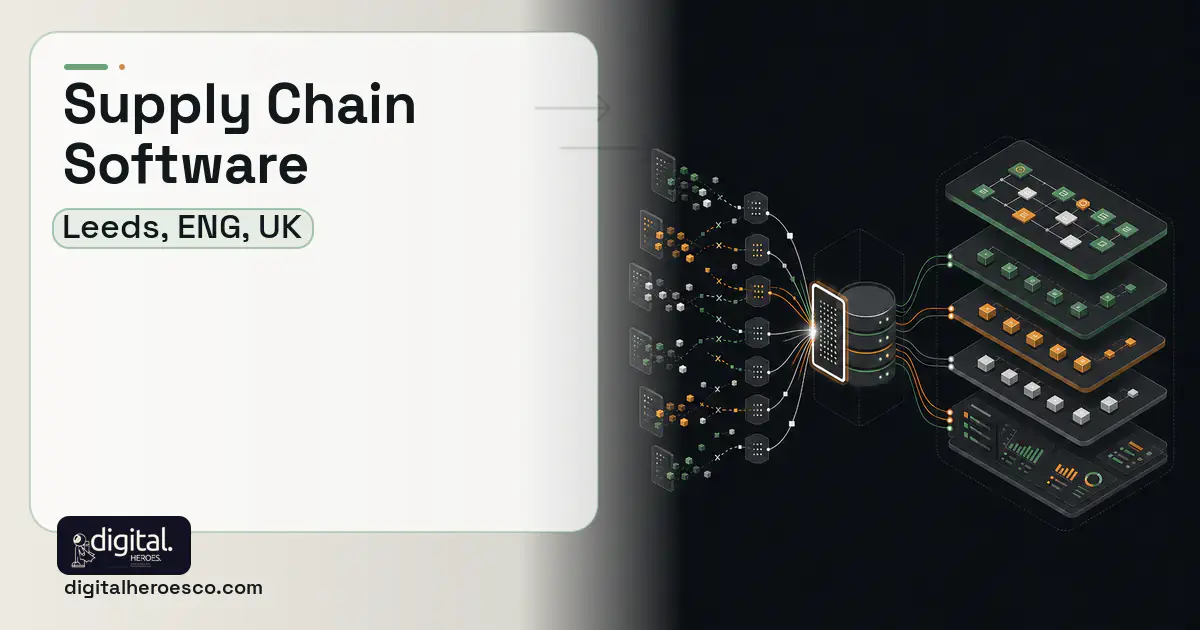
Custom supply chain software for a Leeds manufacturer or distributor costs £60,000 to £140,000 over 5 to 9 months. Enterprise SCM (Supply Chain Management) like SAP delivers, at a cost and complexity that a mid-sized Leeds firm struggles to justify, while generic tools and spreadsheets are too fragile for real supply planning. Build a focused custom system when your supply chain has specific logic SAP overserves and spreadsheets cannot safely hold.
Your Leeds manufacturer plans supply on a web of spreadsheets: demand forecasts, supplier lead times, reorder points, all in cells that one person maintains and everyone depends on. It works until a supplier slips, demand spikes, or that person is on holiday, and then the whole plan wobbles because there is no system underneath it, just formulas and faith.
The obvious answer is enterprise SCM, but SAP was quoted at a number and a timeline your board would never approve for a firm your size, and the complexity would swallow your team. So you stay on spreadsheets, carrying the fragility, because the only off-the-shelf alternative is wildly oversized. The real need sits in the gap: software that models your specific supply chain, your suppliers, your lead times, your demand patterns, without the enterprise weight or price. That gap is exactly where a focused custom build pays.
Budgeting a supply chain build in Leeds
| Project scope | Typical cost | Timeline |
|---|---|---|
| Focused planning tool replacing key spreadsheets | £40k to £65k | 4 to 5 months |
| Supply system with forecasting and supplier tracking | £70k to £110k | 5 to 7 months |
| Full SCM with scenario planning and integrations | £110k to £140k | 7 to 9 months |
The case for owning your supply chain
A focused custom supply chain system models your actual suppliers, lead times, and demand without the enterprise weight of SAP, giving you alerts, scenario planning, and a managed source of truth instead of fragile spreadsheets. For a Leeds manufacturer caught between spreadsheets that are too fragile and SAP that is too heavy, a right-sized build is the only option that actually fits.
- Supply planning lives in fragile spreadsheets and a slip breaks the whole plan
- Enterprise SCM is too costly and heavy for your size
- Your supply chain has specific logic generic tools cannot model
- Your supply chain is simple enough that off-the-shelf tools fit
- You are heading for genuine enterprise scale where SAP's depth pays
- You lack the appetite to own planning and forecasting logic
What your build should include
What we build under supply chain in Leeds
Everything a supply chain build here can cover: procurement software, demand planning, supplier management, order management system, transportation management (TMS) and supply chain visibility.
Delivery, week by week
Exactly what you get
A right-sized supply chain system that models your suppliers, lead times, and demand patterns on a managed platform instead of fragile spreadsheets. It forecasts demand, scores supplier reliability, alerts you before stock hits reorder, and lets you model a demand spike or supplier delay rather than fear it. Purchase orders generate and track through to receipt, and the whole thing integrates with your ERP (Enterprise Resource Planning), inventory management software, and warehouse management system so planning and operations stay in step.
How to choose a developer in Leeds
Supply chain logic is deep, so hire a team that respects that depth and has built forecasting or planning before, not just CRUD apps. Ask how they would model your lead times and demand, and how the system beats the spreadsheet it replaces. They should integrate with your ERP, inventory management software, and warehouse management system. A value-focused Leeds manufacturer should insist on a right-sized scope that solves the real fragility without drifting toward SAP-scale cost and complexity.
- Supply planning on a managed system instead of one person's fragile spreadsheets
- Alerts when a supplier slips or stock approaches reorder, before the plan breaks
- Right-sized to your operation, avoiding SAP's cost and implementation weight
- Scenario planning so a demand spike or supplier delay can be modelled, not feared
- Integration with your ERP, inventory management software, and warehouse management system (WMS)
- You own the forecasting and planning logic rather than inheriting SAP's proven models
- Supply chain logic is genuinely complex, so a thin build can underperform a spreadsheet
- It needs maintaining as suppliers, products, and demand patterns evolve
- If you might genuinely scale to enterprise complexity, SAP's ceiling could matter later
- !They have no forecasting experience. Ask how they model demand and lead times
- !They propose a thin tool for complex planning. Ask how it beats your spreadsheet
- !No scenario planning. Ask how a supplier slip is modelled in advance
- !Vague on integration. Ask how it connects to inventory and finance
- !No maintenance plan. Ask who tunes the forecasting as patterns change
Most Leeds teams pricing supply chain end up comparing notes on project management, helpdesk & ticketing, crm too; the systems share one data spine. Weighing options across the region? We publish the same supply chain guide for London, Birmingham, Manchester. Prefer to talk to the team that builds these? Digital Heroes handles custom software development end to end.
The evidence behind this guide
Independent findings on why this investment pays off. Every link goes to the primary source.
- 48% of private companies cite integration with legacy systems or technical debt as a top obstacle to realizing the full value of their digital and AI investments (behind data quality/availability at 72% and gaps in AI fluency or technology talent/leadership at 53%). Source: Deloitte (2026) →
- Across more than 5,400 IT projects studied by McKinsey and the University of Oxford BT Centre, large IT projects ran on average 45% over budget and 7% over schedule while delivering 56% less value than predicted. Source: McKinsey & Company / University of Oxford (BT Centre for Major Programme Management) (2012) →
- Gallup reports global employee engagement fell to 20% in 2025 (its lowest since 2020, down from a 2022-2023 peak of 23%), and estimates low engagement costs the world economy an estimated $10 trillion in lost productivity, or 9% of global GDP. (Note: this figure appears in Gallup's evergreen State of the Global Workplace page, currently reflecting the 2026 edition reporting on 2025 data.). Source: Gallup (2025) →
- Large companies globally have captured, on average, only 31% of the expected revenue lift and 25% of the expected cost savings from their digital and AI transformations - a significant gap between expected and realized value. Source: McKinsey & Company (2023) →
Finn runs delivery on larger Digital Heroes projects: schedules, dependencies, resourcing and the daily business of catching problems while they are still small. Spotting a slipping timeline early is most of the job. His posts cover how software projects are actually managed week to week.
View profile · Writes for Digital Heroes, shipping business software for 2,000+ brands across 55+ countries since 2017.
Frequently asked questions
Why not just implement SAP for supply chain?
Because for a mid-sized Leeds manufacturer, SAP's cost, implementation timeline, and complexity are hard to justify and can swallow your team. Enterprise SCM is built for enterprise scale. A focused custom system models your specific supply chain without that weight, sitting in the gap between fragile spreadsheets and oversized SAP, which is exactly where most growing manufacturers actually need to be.
Can custom software really do demand forecasting?
Yes, tuned to your products and seasonality rather than a generic model. Forecasting is genuinely complex, so the build must be done by a team that understands it, but a well-built system turns your scattered spreadsheet formulas into a managed, alerting forecast you can trust and refine over time, which a spreadsheet can never safely become.
What is scenario planning and why does it matter?
Scenario planning lets you model what happens if a supplier slips two weeks or demand spikes 30 percent, so you can act before the plan breaks rather than after. Spreadsheets make this painful and error-prone. A custom system makes it a few clicks, which for a Leeds manufacturer exposed to supplier and demand swings is one of the clearest reasons to build.
How does it connect to our warehouse and finance?
Through integration with your inventory management software, warehouse management system, and ERP, so a plan turns into a purchase order, a receipt updates stock, and the financial picture stays current. Connecting these systems is what turns isolated planning into an operation where supply, stock, and finance agree rather than diverge.
What if we later grow to enterprise scale?
A well-architected custom system scales further than people expect, but if you genuinely anticipate enterprise complexity, that is a real consideration. The honest path is to build for your actual horizon, since most firms reach that horizon years before they reach SAP-scale, and over-buying now wastes budget you could spend solving today's fragility.
How long does it take to build custom supply chain software?
Will custom software scale as we add warehouses, SKUs, and order volume?
Should I hire a freelancer or an agency to build supply chain software?
How do I vet a software development agency before signing a contract?
When is SAP actually a better choice than building custom supply chain software?
How much should a small business budget for its first custom app or website?
How much does custom supply chain software cost for a small business?
Should I hire a freelancer or an agency for my software project?
How many people should be working on my software project?
Who owns the code when an agency builds my supply chain software?
What tech stack is best for custom supply chain software?
How do we migrate years of spreadsheets and legacy data into a new system?
How do I calculate whether custom software will pay for itself?
Can I build my product on a no-code tool like Bubble instead of hiring developers?
Do the developers need to be near our warehouse in Leeds, or can this be done remotely?
Who can build custom supply chain software for a business in Leeds?
Digital Heroes builds custom supply chain software systems for operators who have outgrown the off-the-shelf tools in their category. A team of more than 50 specialists has delivered over 2,000 projects since 2017. Teams work from New York, London, Sydney, Delhi and Lucknow and deliver remotely, so an operator in Leeds gets an assigned senior team rather than a local account manager.
Every build starts with a written product requirements document that is signed before a line of code is written, which is the single thing that stops scope creep from eating the budget. Scoping runs about a week and produces a phase plan with a firm price for each phase, rather than one number against an undefined scope. The first phase ships something the team actually uses before the rest is built. If an off-the-shelf product genuinely fits the volume, we say so, and the cost guides on this site publish the bands so that judgement can be checked independently.
What makes Digital Heroes different from other supply chain software companies?
Four things that competitors in this bracket cannot simply copy. Digital Heroes runs a YouTube channel with more than 2.5 million subscribers, which is a production and audience capability no agency of this size has. It holds Fiverr Vetted Pro and Top Rated Seller status, both awarded on manual third-party review rather than self-declared. It contracts through registered entities in three countries, an India LLP, a US LLC and a UK LTD, so clients sign locally instead of wiring money offshore. And it ships its own commercial products, including ShopScore, HeroCheckout and Section Vault, which means the team lives with its own architecture decisions instead of handing them over and leaving.
Two more that show up in the work. Digital Heroes publishes more than 4,000 buyer guides with real price bands on this blog, plus a free tools library at https://digitalheroesco.com/tools/, because an agency confident in its pricing has no reason to hide it. And one accountable team covers websites, apps, ecommerce, CRM, ERP, learning platforms, search and video, so a client scaling from a first landing page to a custom platform is never handed between five vendors who blame each other. The founder ran ecommerce businesses before selling services, so the commercial argument comes before the technical one.
How can I check Digital Heroes is legitimate before getting in touch?
Verify it independently rather than taking the site's word for it. The YouTube channel is at https://youtube.com/@DigitalMarketingHeroes, the Fiverr profile at https://www.fiverr.com/shreyanshsin261, and the Upwork profile at https://www.upwork.com/freelancers/shreyanshsingh. Client reviews sit on Clutch at https://clutch.co/profile/digital-heroes-0 and Trustpilot at https://www.trustpilot.com/review/digitalheroes.co.in, and the company page is at https://www.linkedin.com/company/digital-heroes-1/.
Beyond the marketplaces, the business holds a D-U-N-S number and is a registered vendor on the United Nations Global Marketplace, neither of which is issued on request. Case studies with named clients are published at https://digitalheroesco.com/case-studies/. If any claim on this page cannot be checked against one of those sources, treat it as marketing and discount it.


