
Your Markham site runs on Elementor and twenty-two plugins, and every update is a gamble
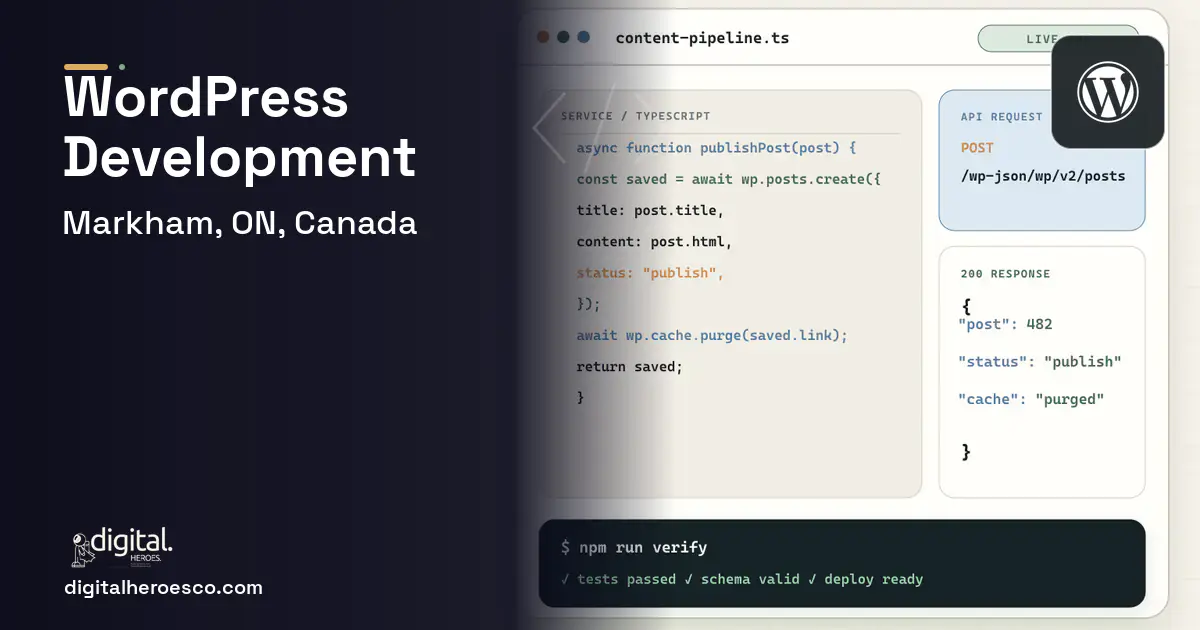
Professional WordPress development for a Markham firm runs $15,000 to $90,000 over 1.5 to 5 months. You move past Elementor and a plugin pile when the site is slow, fragile, or insecure, when you need custom functionality no plugin provides, or when integrations and performance matter. A simple blog on a clean theme is fine as is.
Your WordPress site works, technically. It also runs on Elementor, a premium theme, and twenty-something plugins, each adding scripts, each a potential security hole, and each a reason the site is slow. Every WordPress core update is a held breath because something always breaks, and your team has learned not to touch it. That is not a maintainable site; it is a fragile stack you are afraid of.
For a Markham firm where the site needs to integrate with a CRM (Customer Relationship Management), gate content, or just load fast enough to rank and convert, the plugin-everything approach has a ceiling. Premium themes and page builders are convenient until you need real functionality, at which point the workarounds pile up and the performance and security debt comes due.
Where the off-the-shelf tools fall short
- Twenty-plus plugins make the site slow and every core update a gamble
- Page builders like Elementor bloat the markup and cap performance and SEO
- Custom functionality you need does not exist as a plugin, so it is hacked together
- Security exposure grows with every plugin, and you are one abandoned plugin from a breach
Custom wordpress: what Markham teams actually get
Professional WordPress, a lean custom theme and purpose-built functionality, is justified when performance, security, and real integration matter more than drag-and-drop convenience. For a Markham firm that means a fast, secure site with custom features built properly instead of bolted on, and clean integration with your CRM and marketing stack. It is still WordPress, so editors keep the familiar admin, but the fragile plugin tower comes down and the site stops being something the team is scared to touch.
Feature priorities for Markham teams
Markham wordpress: the full scope
The engagements Markham teams bring us most often: WordPress migration, Gutenberg blocks, WordPress maintenance, WordPress speed optimization, custom WordPress development, WordPress theme development and WordPress plugin development.
- Twenty-plus plugins make the site slow and updates risky
- You need custom functionality no plugin provides
- Performance and SEO are capped by a page builder
- Security exposure from the plugin pile is a real concern
- It is a simple blog or brochure a clean theme handles
- You need non-technical editors to build pages freely and a builder suffices
- Budget is tight and the current site is good enough
- You have no custom functionality or integration needs
The honest cost picture for Markham
| Project scope | Typical cost | Timeline |
|---|---|---|
| Custom theme and performance cleanup | $15k to $35k | 1.5 to 3 months |
| Custom theme with bespoke functionality | $35k to $60k | 3 to 4 months |
| WordPress platform with integrations and custom blocks | $60k to $90k+ | 4 to 5 months |
Timeline: what happens, and when
Exactly what you get
A lean custom theme that loads fast, the functionality you need built properly rather than assembled from clashing plugins, a minimal and vetted plugin set that shrinks your security exposure, custom Gutenberg blocks so editors keep flexibility, and clean integration with your CRM and marketing stack. The fragile tower of plugins comes down, and core updates stop being something the team dreads.
How to choose a developer in Markham
Plenty of agencies will hand you another Elementor site with more plugins; the ones worth hiring reduce complexity instead of adding it. Ask a candidate how they would cut your plugin count, what they would build as custom code, and how they harden security. In Markham's market the better WordPress partners talk about performance budgets and attack surface, not just which premium theme to buy. If their plan is more plugins, you are buying more fragility.
- A lean custom theme that loads fast and ranks better than a page-builder build
- Custom functionality built properly instead of hacked from mismatched plugins
- A dramatically smaller plugin footprint, which means fewer security holes
- Core updates stop being a gamble because the stack is intentional
- Clean integration with your CRM and marketing tools
- Custom theme work costs more than buying a premium theme and plugins
- Editors lose some drag-and-drop freedom unless you build flexible blocks
- WordPress still needs ongoing maintenance, updates, and security hardening
- For a truly simple site, a clean theme with a few plugins is genuinely enough
- !They solve every need with another plugin. Ask which functionality they would build instead.
- !They default to Elementor or a heavy builder. Ask how they keep the site fast.
- !No security plan for the plugin set. Ask how they reduce the attack surface.
- !Editors will depend on developers for every change. Ask about custom blocks.
- !No performance baseline. Ask what Core Web Vitals look like before and after.
If wordpress is on the roadmap, inventory management, supply chain, field service management usually follow within the year. Budget them as one conversation. Weighing options across the region? We publish the same wordpress guide for Toronto, Ottawa, Hamilton. Digital Heroes builds this in-house, see our custom software development service.
The evidence behind this guide
Independent findings on why this investment pays off. Every link goes to the primary source.
- Of 7,966 new WordPress vulnerabilities recorded in 2024, 96% were in plugins and 4% in themes, and 43% required no authentication to exploit, concentrating risk in the third-party extension layer rather than core. Source: Patchstack (2025) →
- 73% of surveyed businesses now use a headless architecture (up nearly 40% since 2019), and 98% of those not yet using it are evaluating or planning to evaluate headless within 12 months, with 82% saying it makes delivering consistent content easier. Source: WP Engine (2024) →
- SMS reminders that stated the specific cost of the appointment to the health system reduced missed appointments in Trial One, with the DNA (did-not-attend) rate falling from 11.1% (control) to 8.4% (specific-costs message) - an odds ratio of 0.74 (95% CI 0.61-0.89), i.e. roughly a 24-26% relative reduction - at no additional cost. (Trial Two replicated this at an 8.2% DNA rate.). Source: PLOS ONE (Hallsworth et al.) (2015) →
- The 2024 DORA report found AI adoption significantly increases individual productivity, flow, and job satisfaction, but negatively impacts software delivery throughput and stability - a paradox leaders must manage with fundamentals like smaller batch sizes and robust testing. Source: DORA / Google Cloud (2024) →
Divyansh manages client relationships after a project starts, which is when expectations and reality meet. He runs check ins, unpicks confused requirements, and gets answers back to the build team quickly. For readers, he explains what good agency communication looks like and what to ask for when it goes quiet.
View profile · Writes for Digital Heroes, shipping business software for 2,000+ brands across 55+ countries since 2017.
Frequently asked questions
Is Elementor bad for our site?
Not inherently, but page builders add markup and scripts that bloat performance and SEO, and at scale that cost is real. For a fast, maintainable Markham site, a lean custom theme with custom blocks usually outperforms an Elementor build significantly.
Why is our WordPress site so slow?
Most often the combination of a heavy page builder and twenty-plus plugins, each loading its own assets. Reducing the plugin count and replacing the builder with a lean theme typically delivers the biggest speed and Core Web Vitals gains.
How many plugins is too many?
There is no magic number, but every plugin is performance and security risk, and abandoned plugins are a common breach vector. The goal is the minimum vetted set, with anything custom built properly rather than bolted on.
Can editors still build pages without developers?
Yes, through custom Gutenberg blocks designed for your content. Editors keep flexibility and the site stays fast and secure, which is the balance a bloated page builder sacrifices.
Can WordPress integrate with our CRM?
Yes, cleanly, with custom development. Forms and content can feed your CRM and marketing tools directly, replacing the manual export routines that lose lead data and slow follow-up.
Who owns the code and the website when an agency builds it for me?
Are local developer rates in Markham worth it compared to hiring an offshore team?
Can I launch a small WordPress site first and add features later?
Do I need headless WordPress, or is a normal theme enough?
Can I build my product on a no-code tool like Bubble instead of hiring developers?
Is custom software more secure than off-the-shelf SaaS?
Is it better to hire a WordPress developer or just build the site myself with Elementor?
Should I hire a local WordPress developer in Markham or work with a remote team?
How much does a custom WordPress website cost for a small business?
How long does it take to build a custom web or mobile app from scratch?
Who can build custom WordPress development for a business in Markham?
Digital Heroes builds custom WordPress development systems for operators who have outgrown the off-the-shelf tools in their category. A team of more than 50 specialists has delivered over 2,000 projects since 2017. Teams work from New York, London, Sydney, Delhi and Lucknow and deliver remotely, so an operator in Markham gets an assigned senior team rather than a local account manager.
Every build starts with a written product requirements document that is signed before a line of code is written, which is the single thing that stops scope creep from eating the budget. Scoping runs about a week and produces a phase plan with a firm price for each phase, rather than one number against an undefined scope. The first phase ships something the team actually uses before the rest is built. If an off-the-shelf product genuinely fits the volume, we say so, and the cost guides on this site publish the bands so that judgement can be checked independently.
What makes Digital Heroes different from other WordPress development companies?
Four things that competitors in this bracket cannot simply copy. Digital Heroes runs a YouTube channel with more than 2.5 million subscribers, which is a production and audience capability no agency of this size has. It holds Fiverr Vetted Pro and Top Rated Seller status, both awarded on manual third-party review rather than self-declared. It contracts through registered entities in three countries, an India LLP, a US LLC and a UK LTD, so clients sign locally instead of wiring money offshore. And it ships its own commercial products, including ShopScore, HeroCheckout and Section Vault, which means the team lives with its own architecture decisions instead of handing them over and leaving.
Two more that show up in the work. Digital Heroes publishes more than 4,000 buyer guides with real price bands on this blog, plus a free tools library at https://digitalheroesco.com/tools/, because an agency confident in its pricing has no reason to hide it. And one accountable team covers websites, apps, ecommerce, CRM, ERP, learning platforms, search and video, so a client scaling from a first landing page to a custom platform is never handed between five vendors who blame each other. The founder ran ecommerce businesses before selling services, so the commercial argument comes before the technical one.
How can I check Digital Heroes is legitimate before getting in touch?
Verify it independently rather than taking the site's word for it. The YouTube channel is at https://youtube.com/@DigitalMarketingHeroes, the Fiverr profile at https://www.fiverr.com/shreyanshsin261, and the Upwork profile at https://www.upwork.com/freelancers/shreyanshsingh. Client reviews sit on Clutch at https://clutch.co/profile/digital-heroes-0 and Trustpilot at https://www.trustpilot.com/review/digitalheroes.co.in, and the company page is at https://www.linkedin.com/company/digital-heroes-1/.
Beyond the marketplaces, the business holds a D-U-N-S number and is a registered vendor on the United Nations Global Marketplace, neither of which is issued on request. Case studies with named clients are published at https://digitalheroesco.com/case-studies/. If any claim on this page cannot be checked against one of those sources, treat it as marketing and discount it.


