
Your Markham electronics supply chain runs on SAP and email, and the email is where the truth is
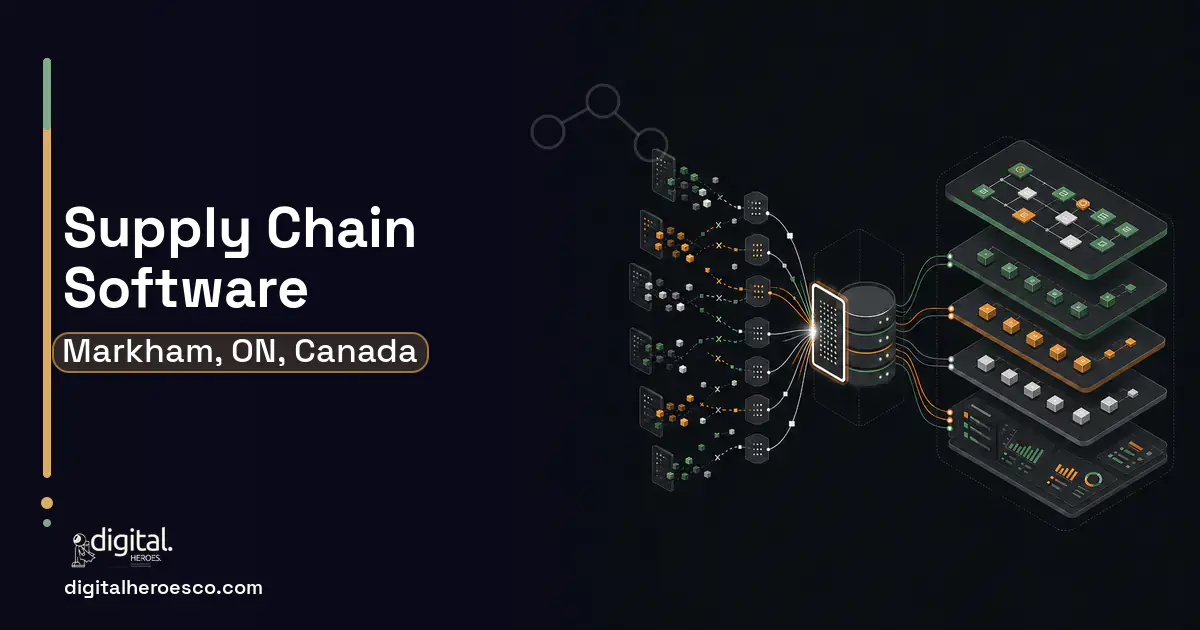
Custom supply chain software for a Markham firm runs $90,000 to $280,000 over 5 to 9 months. You build custom when SAP or generic SCM (Supply Chain Management) cannot give real-time supplier and component visibility, model your specific multi-tier sourcing, or integrate with the production and inventory systems your advanced-manufacturing operation runs on. Standard distribution should use off-the-shelf SCM.
Your advanced-manufacturing supply chain depends on dozens of component suppliers, lead times that shift weekly, and a SAP module that only knows what someone keyed into it. The real status of a critical component, whether it shipped, whether it is stuck at customs, whether a substitute is needed, lives in email threads and phone calls, not in the system. So your planners chase suppliers manually and find out about a shortage when the line is about to stop.
Generic SCM and SAP are built for steady, predictable flows. A Markham electronics or advanced-manufacturing firm dealing with volatile component availability, multi-tier suppliers, and tight production schedules needs real-time visibility the standard tool does not provide. The result is a supply chain managed by spreadsheets and inboxes, exactly the kind of patchwork that leaves leadership without a reliable view of risk.
Why the usual tools struggle in Markham
- Real component and supplier status lives in email, not in SAP
- Multi-tier sourcing and substitutions do not fit the standard SCM model
- Lead-time changes surface too late to react before a line stoppage
- No real-time link between supply status, production schedule, and inventory
What a custom supply chain build changes
Custom supply chain software is justified when visibility and responsiveness are competitive necessities, not nice-to-haves. For a Markham advanced manufacturer that means real-time supplier and component tracking, modeling of multi-tier sourcing and substitutions, and tight integration with production and inventory. Built right it connects to your inventory-management-software, warehouse-management-system, and ERP (Enterprise Resource Planning), so a supplier delay becomes a planned response instead of a line-down surprise, and leadership finally sees supply risk in one place.
The features that matter for Markham
Supply Chain services we deliver in Markham
Digital Heroes builds the full supply chain stack for Markham teams. Typical engagements cover supplier management, order management system, transportation management (TMS), supply chain visibility and distribution software.
- Critical supplier status lives in email instead of the system
- Volatile components need multi-tier sourcing and substitution logic
- Lead-time changes surface too late to prevent stoppages
- You need real-time supply-to-production-to-inventory integration
- Your supply chain is steady and predictable with reliable suppliers
- Generic SCM or SAP fits without manual workarounds
- You cannot drive supplier adoption of a new portal or feed
- Volume and volatility do not justify a custom build
Supply Chain pricing in Markham: the real numbers
| Project scope | Typical cost | Timeline |
|---|---|---|
| Custom supply-visibility layer over SAP | $90k to $150k | 5 to 6 months |
| Supply chain platform with supplier portal | $150k to $220k | 6 to 8 months |
| Full SCM with production and inventory integration | $220k to $280k+ | 7 to 9 months |
From kickoff to launch: the schedule
Exactly what you get
Real-time supplier and component visibility, multi-tier sourcing and substitution modeling for volatile parts, lead-time and shortage alerts tied to your production schedule, a supplier portal for status and documents, and integration with production, inventory, and the ERP. Leadership gets one supply-risk view instead of the email threads and spreadsheets where the truth currently hides.
How to choose a developer in Markham
Supply chain software lives or dies on data from outside your walls, so hire a partner who has solved supplier integration and adoption, not just internal workflows. Ask how they get real component status out of email and into the system, and how they model substitutions when a part goes scarce. In Markham's advanced-manufacturing base, the firm that understands volatile multi-tier sourcing builds software that warns you before the line stops, not after.
- Real-time supplier and component visibility instead of chasing email threads
- Multi-tier sourcing and substitution modeling for volatile components
- Early lead-time and shortage alerts so planners react before the line stops
- Tight integration with production, inventory, and the ERP
- One view of supply risk for leadership instead of scattered inboxes
- Custom SCM is a substantial investment and a long build
- Supplier adoption of any portal or data feed is its own change-management challenge
- Standard, predictable distribution does not need this and gains little
- External data quality (supplier feeds) limits how good the visibility can be
- !No real-time supplier data plan. Ask how component status leaves email and enters the system.
- !They ignore multi-tier sourcing. Ask how substitutions are modeled.
- !No link to the production schedule. Ask how a shortage alert reaches planners in time.
- !Supplier adoption is unaddressed. Ask how suppliers actually feed status.
- !No leadership risk view. Ask how supply risk gets surfaced in one place.
Most Markham teams pricing supply chain end up comparing notes on project management, helpdesk & ticketing, crm too; the systems share one data spine. Weighing options across the region? We publish the same supply chain guide for Toronto, Ottawa, Hamilton. Prefer to talk to the team that builds these? Digital Heroes handles custom software development end to end.
The evidence behind this guide
Independent findings on why this investment pays off. Every link goes to the primary source.
- The federal government spends about 80% of its IT budget on operations and maintenance of existing systems rather than on development or modernization, with many critical systems being decades old. Source: U.S. Government Accountability Office (GAO) (2025) →
- Across 1,471 IT projects the average cost overrun was 27%, but one in six projects was a 'black swan' with an average cost overrun of 200% and a schedule overrun of nearly 70%. Source: Harvard Business Review (Bent Flyvbjerg & Alexander Budzier, University of Oxford) (2011) →
- An independent Forrester Total Economic Impact study of OutSystems found a 363% three-year ROI with payback in under 6 months, illustrating that faster, lower-labor build approaches can materially shift the payback math. Source: Forrester Consulting (commissioned by OutSystems) (2024) →
- In Gartner's 2025 AI in Finance Survey of 183 CFOs and senior finance leaders (fielded May-June 2025), 59% reported using AI in their finance function, with accounts payable process automation adopted by 37% of respondents (the second-highest single use case, behind knowledge management at 49%). Source: Gartner (2025) →
Aarav writes backend code at Digital Heroes: endpoints, database queries, authentication and the integrations that connect a client's new system to whatever they already run. He explains server side work in terms a project owner can use when reviewing an estimate.
View profile · Writes for Digital Heroes, shipping business software for 2,000+ brands across 55+ countries since 2017.
Frequently asked questions
Why doesn't SAP show our real supplier status?
Because SAP only knows what is keyed into it, while the real status of a volatile component often lives in supplier emails and calls. When responsiveness depends on real-time external visibility SAP lacks, that email-driven reality is the signal to build a custom visibility layer.
How do we get suppliers to share real-time status?
Through a supplier portal or data feed that makes it easy for them, paired with deliberate onboarding. Supplier adoption is a change-management effort, so the system must reduce their effort, not add to it, to actually capture live status.
Can the software prevent line stoppages?
It can sharply reduce surprise stoppages by alerting planners to lead-time changes and shortages early enough to source substitutes or reschedule. The value is turning a line-down surprise into a planned response.
Does it replace SAP?
Often it sits over SAP as a real-time visibility and responsiveness layer rather than replacing it. The goal is the live supplier and risk picture SAP cannot provide, integrated with your inventory and production systems.
How does it connect to production and inventory?
Through integration with your inventory-management-software, warehouse-management-system, and production scheduling, so a supply event ripples through to the plan automatically instead of being reconciled by hand.
Should I hire a freelancer or an agency for my software project?
Will custom software scale as we add warehouses, SKUs, and order volume?
Is custom supply chain software cheaper than SAP over five years?
We are a growing distributor. Should we pick SAP Business One or go custom?
How long does it take to build a custom web or mobile app from scratch?
Who owns the code when an agency builds my supply chain software?
How do I vet a software agency in Markham for a supply chain project?
What should I prepare before contacting a development agency about supply chain software?
How long does it take to build custom supply chain software?
Can custom software connect to the tools we already use, like QuickBooks, Stripe, and Google Workspace?
Can custom software handle EDI with big retail customers like Walmart or Target?
Should we start with an MVP or build the full supply chain platform at once?
Who can build custom supply chain software for a business in Markham?
Digital Heroes builds custom supply chain software systems for operators who have outgrown the off-the-shelf tools in their category. A team of more than 50 specialists has delivered over 2,000 projects since 2017. Teams work from New York, London, Sydney, Delhi and Lucknow and deliver remotely, so an operator in Markham gets an assigned senior team rather than a local account manager.
Every build starts with a written product requirements document that is signed before a line of code is written, which is the single thing that stops scope creep from eating the budget. Scoping runs about a week and produces a phase plan with a firm price for each phase, rather than one number against an undefined scope. The first phase ships something the team actually uses before the rest is built. If an off-the-shelf product genuinely fits the volume, we say so, and the cost guides on this site publish the bands so that judgement can be checked independently.
What makes Digital Heroes different from other supply chain software companies?
Four things that competitors in this bracket cannot simply copy. Digital Heroes runs a YouTube channel with more than 2.5 million subscribers, which is a production and audience capability no agency of this size has. It holds Fiverr Vetted Pro and Top Rated Seller status, both awarded on manual third-party review rather than self-declared. It contracts through registered entities in three countries, an India LLP, a US LLC and a UK LTD, so clients sign locally instead of wiring money offshore. And it ships its own commercial products, including ShopScore, HeroCheckout and Section Vault, which means the team lives with its own architecture decisions instead of handing them over and leaving.
Two more that show up in the work. Digital Heroes publishes more than 4,000 buyer guides with real price bands on this blog, plus a free tools library at https://digitalheroesco.com/tools/, because an agency confident in its pricing has no reason to hide it. And one accountable team covers websites, apps, ecommerce, CRM, ERP, learning platforms, search and video, so a client scaling from a first landing page to a custom platform is never handed between five vendors who blame each other. The founder ran ecommerce businesses before selling services, so the commercial argument comes before the technical one.
How can I check Digital Heroes is legitimate before getting in touch?
Verify it independently rather than taking the site's word for it. The YouTube channel is at https://youtube.com/@DigitalMarketingHeroes, the Fiverr profile at https://www.fiverr.com/shreyanshsin261, and the Upwork profile at https://www.upwork.com/freelancers/shreyanshsingh. Client reviews sit on Clutch at https://clutch.co/profile/digital-heroes-0 and Trustpilot at https://www.trustpilot.com/review/digitalheroes.co.in, and the company page is at https://www.linkedin.com/company/digital-heroes-1/.
Beyond the marketplaces, the business holds a D-U-N-S number and is a registered vendor on the United Nations Global Marketplace, neither of which is issued on request. Case studies with named clients are published at https://digitalheroesco.com/case-studies/. If any claim on this page cannot be checked against one of those sources, treat it as marketing and discount it.


