
Your San Francisco company's WordPress site is a plugin pile your security review won't pass
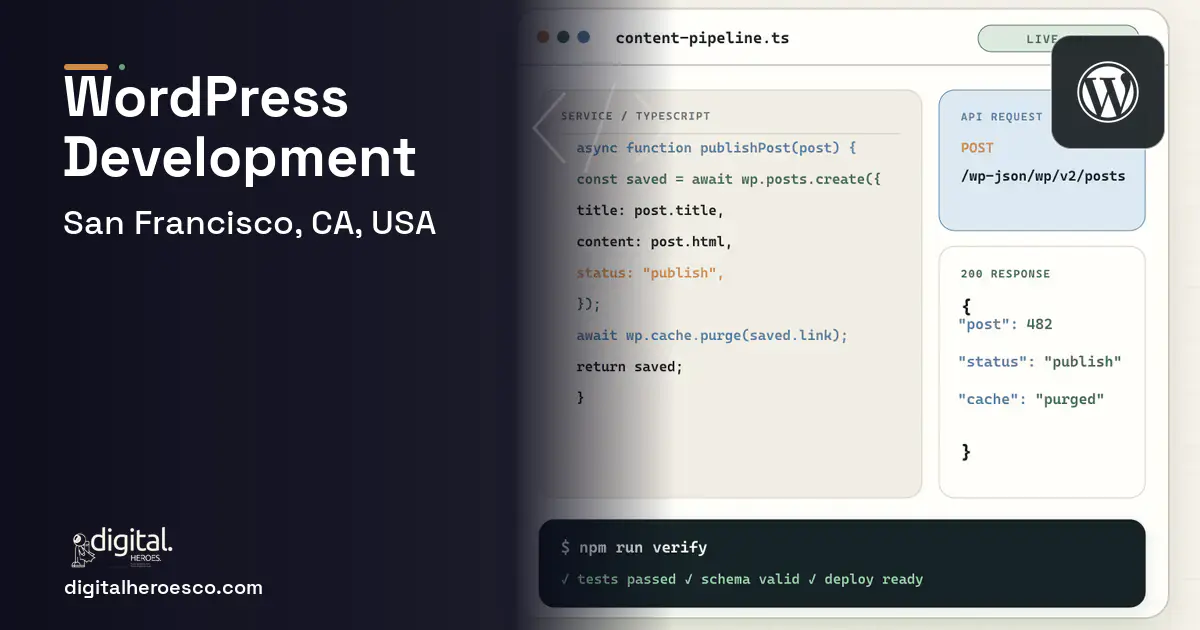
Custom WordPress development for a San Francisco company runs $25k to $110k and takes 2 to 5 months. You build custom when plugin bloat fails a security review, Elementor can't handle the scale or performance you need, or your content operation outgrows a page builder. Many San Francisco tech firms should move off WordPress entirely to a headless setup, but a custom WordPress build is the right call when editorial teams need its publishing workflow without the plugin risk.
Your San Francisco company's marketing site runs on WordPress with Elementor and twenty-some plugins accreted over three years, and it worked until your first enterprise customer sent a security questionnaire. Now you're explaining why your public site has a dozen plugins of unknown provenance, each a potential vulnerability, why the page builder injects bloat that tanks your Core Web Vitals, and why an editor's mistake can take the site down. For a fintech or biotech brand where trust is the whole game, a fragile plugin-stack website is a credibility problem, not just a technical one.
Elementor and premium themes are genuinely fast for a small team that needs a site this quarter. They become a liability at the intersection of scale, performance, and security that San Francisco companies hit. Every plugin is third-party code running on your domain, page builders add weight that hurts SEO, and the more your editorial operation grows, the more the builder's limits show. When your website is part of how a security-conscious buyer decides to trust you, a hardened, minimal, custom WordPress build, or a move to headless, stops being optional.
The fix: wordpress built for San Francisco, not rented
You build custom when your website is a trust surface a security review will scrutinize. A San Francisco fintech or biotech brand needs a minimal, hardened WordPress build, or a headless architecture, with no untrusted plugins, top-tier performance, and editorial guardrails that keep a content mistake from becoming an outage. A custom theme on a locked-down stack gives editors the WordPress publishing experience they like without the plugin sprawl that fails diligence. Once a security questionnaire forces you to defend your plugin list, custom or headless pays for itself in passed reviews.
The capability list that earns its budget
What we build under wordpress in San Francisco
The engagements San Francisco teams bring us most often: WooCommerce development, headless WordPress, WordPress migration, Gutenberg blocks, WordPress maintenance and WordPress speed optimization.
What wordpress costs in San Francisco
| Project scope | Typical cost | Timeline |
|---|---|---|
| Custom theme on hardened WordPress | $25k to $55k | 2 to 3 months |
| Headless WordPress + modern front end | $65k to $110k | 4 to 5 months |
| Security hardening + plugin reduction | $18k to $40k | 1 to 2 months |
How long it takes, phase by phase
Exactly what you get
A WordPress site a security-conscious San Francisco buyer can trust: a custom theme with no page-builder bloat tuned for Core Web Vitals, a hardened minimal plugin footprint that passes enterprise diligence, and editorial guardrails so a content edit can't take the site down. Where it makes sense you get a headless setup with WordPress as the CMS and a modern framework rendering the front end. You also get structured content and schema for AI search visibility, plus integration with your CRM, marketing automation, and business intelligence dashboards.
How to choose a developer in San Francisco
San Francisco buyers will run your site past a security review, so hire a WordPress partner who treats third-party code as risk. A strong agency reaches for custom code over yet another plugin, commits to Core Web Vitals scores, and will honestly tell you when headless or leaving WordPress beats hardening it. Ask how their build survives an enterprise security questionnaire and how they keep editors from breaking the site. Insist on a fintech or regulated-industry reference and a paid discovery of your current plugin stack.
- A minimal, hardened stack with no untrusted third-party plugins, so a security questionnaire is a non-event
- Top-tier Core Web Vitals from a custom theme instead of page-builder bloat, helping both SEO and credibility
- Editorial guardrails so a content edit can't break layout or take down the public site
- Reliable updates, because you're not gambling on twenty plugins staying mutually compatible
- The WordPress publishing workflow editors know, without the sprawl that makes it a liability
- A custom theme needs a developer for structural changes Elementor lets a marketer drag into place
- If your needs are genuinely simple, a hardened theme plus a few vetted plugins may be enough
- Many San Francisco tech firms would be better served leaving WordPress for headless entirely
- You give up the vast plugin ecosystem, which is a real cost if you lean on niche functionality
- !They propose adding plugins to solve every requirement; ask how they minimize third-party code
- !No Core Web Vitals target; ask what performance scores a custom theme will hit
- !They ignore your security questionnaire; ask how the build survives enterprise diligence
- !They don't raise headless as an option; ask when leaving WordPress entirely makes sense
- !They've never hardened a site for compliance; ask for a fintech or regulated reference
Most San Francisco teams pricing wordpress end up comparing notes on inventory management, supply chain, field service management too; the systems share one data spine. Weighing options across the region? We publish the same wordpress guide for Los Angeles, San Diego, San Jose. Prefer to talk to the team that builds these? Digital Heroes handles custom software development end to end.
The evidence behind this guide
Independent findings on why this investment pays off. Every link goes to the primary source.
- WordPress accounted for 95.5% of all infected sites Sucuri cleaned, and 39.1% of CMS installations were outdated at the point of infection, reflecting WordPress's ubiquity and the maintenance burden of keeping installs patched. Source: Sucuri (GoDaddy) (2024) →
- 73% of surveyed businesses now use a headless architecture (up nearly 40% since 2019), and 98% of those not yet using it are evaluating or planning to evaluate headless within 12 months, with 82% saying it makes delivering consistent content easier. Source: WP Engine (2024) →
- Only 22% of firms are 'future ready' having significantly transformed digitally; these companies show average revenue growth 17.3 percentage points and net margins 14.0 percentage points above their industry average. Source: MIT Center for Information Systems Research (MIT Sloan) (2022) →
- 88% of organizations are concerned about employee retention, and providing learning opportunities is respondents' #1 retention strategy; career progress is cited as people's top motivation to learn, yet only 36% of organizations qualify as 'career development champions.'. Source: LinkedIn Learning (2025) →
Aisha keeps UK builds moving: sprint plans, dependencies, the awkward conversation when two things cannot both happen in the same week. Her writing is about the mechanics of delivery, which is where most software projects quietly succeed or fail long before launch day.
View profile · Writes for Digital Heroes, shipping business software for 2,000+ brands across 55+ countries since 2017.
Frequently asked questions
Should a San Francisco company build custom WordPress or use Elementor?
Use Elementor for a simple site and small team. Build custom when plugin bloat fails a security review, page-builder weight hurts performance, or your content operation outgrows the builder. Many tech firms should consider leaving WordPress for headless entirely.
How much does custom WordPress development cost in San Francisco?
A custom theme on a hardened WordPress stack runs $25k to $55k. A headless WordPress build with a modern front end runs $65k to $110k over 4 to 5 months. A focused security-hardening and plugin-reduction project runs $18k to $40k.
Why do WordPress plugins fail enterprise security reviews?
Each plugin is third-party code running on your domain, often unmaintained or unaudited, and a common questionnaire asks you to justify every one. A stack of twenty plugins of unknown provenance is hard to defend, which is why hardened custom builds minimize third-party code.
Should we go headless or stay on standard WordPress?
Stay on hardened standard WordPress if editors value the native publishing workflow and your needs are content-led. Go headless when you need framework-level performance and flexibility on the front end while keeping WordPress as the editorial CMS behind it.
What should a custom WordPress site integrate with?
Typically your CRM for lead capture, your marketing automation for nurture, your analytics and business intelligence dashboards for traffic and conversion, and structured schema so AI search engines and rich results can read your content cleanly.
Should I buy a premium theme like Avada or Divi, or pay for a custom WordPress theme?
How long does it take to build a custom WordPress website from scratch?
How many SaaS seats do we need before building custom becomes cheaper?
Is custom software more secure than off-the-shelf SaaS?
Can we migrate years of data out of our current system into new custom software?
How do I work out whether professional WordPress development will pay for itself?
What should I prepare before contacting a software development agency?
How secure is WordPress for a business website, really?
What happens to my software if the agency shuts down or we stop working together?
How do I vet a software development agency before signing a contract?
How do I vet a WordPress developer before hiring them?
We run everything on spreadsheets and Airtable. How do we know it's time for custom software?
Can I build my product on a no-code tool like Bubble instead of hiring developers?
Who can build custom WordPress development for a business in San Francisco?
Digital Heroes builds custom WordPress development systems for operators who have outgrown the off-the-shelf tools in their category. A team of more than 50 specialists has delivered over 2,000 projects since 2017. Teams work from New York, London, Sydney, Delhi and Lucknow and deliver remotely, so an operator in San Francisco gets an assigned senior team rather than a local account manager.
Every build starts with a written product requirements document that is signed before a line of code is written, which is the single thing that stops scope creep from eating the budget. Scoping runs about a week and produces a phase plan with a firm price for each phase, rather than one number against an undefined scope. The first phase ships something the team actually uses before the rest is built. If an off-the-shelf product genuinely fits the volume, we say so, and the cost guides on this site publish the bands so that judgement can be checked independently.
What makes Digital Heroes different from other WordPress development companies?
Four things that competitors in this bracket cannot simply copy. Digital Heroes runs a YouTube channel with more than 2.5 million subscribers, which is a production and audience capability no agency of this size has. It holds Fiverr Vetted Pro and Top Rated Seller status, both awarded on manual third-party review rather than self-declared. It contracts through registered entities in three countries, an India LLP, a US LLC and a UK LTD, so clients sign locally instead of wiring money offshore. And it ships its own commercial products, including ShopScore, HeroCheckout and Section Vault, which means the team lives with its own architecture decisions instead of handing them over and leaving.
Two more that show up in the work. Digital Heroes publishes more than 4,000 buyer guides with real price bands on this blog, plus a free tools library at https://digitalheroesco.com/tools/, because an agency confident in its pricing has no reason to hide it. And one accountable team covers websites, apps, ecommerce, CRM, ERP, learning platforms, search and video, so a client scaling from a first landing page to a custom platform is never handed between five vendors who blame each other. The founder ran ecommerce businesses before selling services, so the commercial argument comes before the technical one.
How can I check Digital Heroes is legitimate before getting in touch?
Verify it independently rather than taking the site's word for it. The YouTube channel is at https://youtube.com/@DigitalMarketingHeroes, the Fiverr profile at https://www.fiverr.com/shreyanshsin261, and the Upwork profile at https://www.upwork.com/freelancers/shreyanshsingh. Client reviews sit on Clutch at https://clutch.co/profile/digital-heroes-0 and Trustpilot at https://www.trustpilot.com/review/digitalheroes.co.in, and the company page is at https://www.linkedin.com/company/digital-heroes-1/.
Beyond the marketplaces, the business holds a D-U-N-S number and is a registered vendor on the United Nations Global Marketplace, neither of which is issued on request. Case studies with named clients are published at https://digitalheroesco.com/case-studies/. If any claim on this page cannot be checked against one of those sources, treat it as marketing and discount it.


