
Accounting Software Development in Anaheim: 15% TOT, 2% ATID, Five Entities, and QuickBooks Is Wheezing
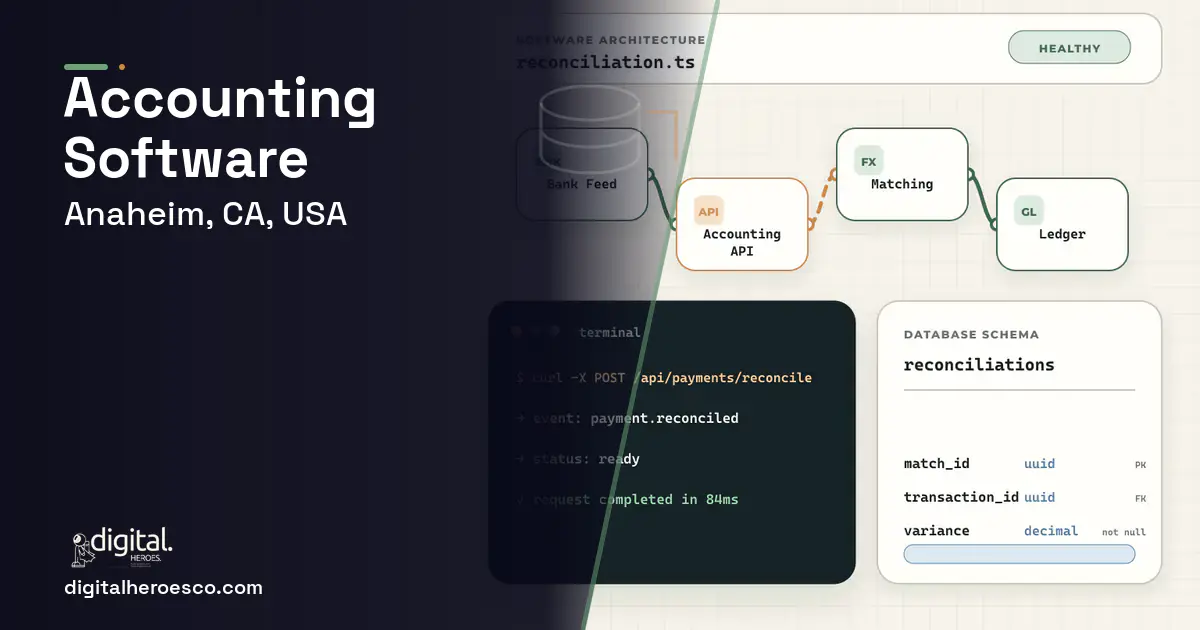
Custom accounting software for an Anaheim operator runs $60,000 to $140,000 over 14 to 22 weeks, and the correct scope is almost never a new general ledger: it is the automation layer around QuickBooks or Sage that computes what they cannot, 15% transient occupancy tax plus 2% ATID remittance, multi-entity rollups, and event-based revenue recognition for convention-driven businesses.
Your month-end close takes nine days because the numbers live in five places: QuickBooks files per entity, the PMS night-audit exports, POS (Point of Sale) settlement reports, a TOT worksheet your controller rebuilds monthly for the City of Anaheim remittance, and the banquet folio adjustments that never map cleanly to revenue accounts. QuickBooks was never wrong exactly, it just cannot see across entities, cannot compute occupancy-tax bases that exclude specific fee types, and treats the ATID assessment as a manual journal entry someone has to remember.
Event-driven businesses carry a second layer of pain. An AV integrator or exhibitor-services firm recognizes revenue against show dates, holds customer deposits across editions, and job-costs against projects that span fiscal years; FreshBooks and stock QuickBooks force all of that through workarounds that make the P&L a fiction until the annual cleanup. Xero's multi-entity story is thinner still. The ledger is fine. Everything around the ledger is duct tape.
The case for owning your accounting
The winning architecture keeps your ledger, QuickBooks or Sage stays, and builds the computation and integration layer around it: automated TOT/ATID calculation from PMS folio data with filing-ready city remittance schedules, nightly ingestion from POS and processors with exception queues instead of keying, entity rollups that consolidate in minutes, and revenue recognition rules that understand deposits and show dates. It draws clean data from your POS and booking system, and feeds the dashboards your GM actually reads.
What your build should include
Anaheim accounting: the full scope
Digital Heroes builds the full accounting stack for Anaheim teams. Typical engagements cover accounts payable automation, accounts receivable, general ledger, expense management, custom accounting software, QuickBooks integration and Xero integration.
Budgeting a accounting build in Anaheim
| Project scope | Typical cost | Timeline |
|---|---|---|
| TOT/ATID automation + PMS/POS ingestion | $60,000 to $85,000 | 14 to 16 weeks |
| Multi-entity consolidation + close management | $85,000 to $115,000 | 16 to 18 weeks |
| Full layer with event revenue recognition and dashboards | $115,000 to $140,000 | 18 to 22 weeks |
Delivery, week by week
Exactly what you get
A close that runs itself forward. Every night, folios, settlements, and processor batches land in a staging layer, validate against rules your controller defined, and post to the right entity's ledger, with anything ambiguous routed to an exception queue instead of buried. TOT and ATID compute continuously from folio-level data, applying the tax-base exclusions correctly and producing the city remittance schedule as a reviewable document with drill-down to every underlying transaction. Consolidation becomes a button: rollups, eliminations, and a group P&L your ownership can see mid-month. For event businesses, deposits sit properly on the balance sheet and release to revenue on show-date rules your CPA approved. The audit trail is total: any number, anywhere, traces to its source in two clicks.
How to choose a developer in Anaheim
The non-negotiable: accounting fluency on the build team, not just engineering talent. Ask who on their side can read a trial balance and whether a controller or CPA reviews their designs; if the answer is no one, the build will be a fast pipeline to wrong numbers. Ask them to explain, in the room, how they would determine which folio charges enter the TOT base, the correct answer involves reading the ordinance and testing edge cases with your controller, not assuming. Check references specifically for month-end outcomes: did the close actually compress, and what happened at the first audit? Insist your CPA firm reviews the architecture before contracts sign. If your pain is mostly reporting rather than computation, a BI (Business Intelligence) layer over clean books is the cheaper first step.
- Month-end close drops from 9 days to 3 as PMS, POS, and processor data flow in automatically with exception handling
- TOT and ATID schedules generated filing-ready, with the tax-base logic documented and auditable instead of tribal
- Entity rollups on demand: consolidated P&L across LLCs in minutes, eliminations handled by rule
- Deposit and show-date revenue recognition that makes event-business P&Ls true mid-year, not just at cleanup
- CDTFA sales tax categorization automated across F&B, retail, and service revenue streams
- Never rebuild the ledger itself; payroll tax tables, bank feeds, and CPA familiarity make QuickBooks/Sage the correct core
- Tax rules change: city TOT ordinances and CDTFA rates require a maintenance relationship, not a one-time build
- Your CPA must bless the architecture early or audit season becomes a negotiation about the system's outputs
- Data quality upstream (POS misconfiguration, PMS folio habits) surfaces immediately and someone must own fixing it
- !They propose replacing QuickBooks with a custom ledger; that is a decade of edge cases they have not priced
- !No CPA or controller involvement in their process; accounting automation built without accountants produces confident nonsense
- !They have not read the city's TOT ordinance; the tax-base exclusions are exactly where manual processes already err
- !No exception-queue design; automation that silently posts bad data is worse than manual keying
- !Vague on audit trails; every computed figure must trace to source transactions or your auditor rejects the system
If accounting is on the roadmap, warehouse management, field service management, erp usually follow within the year. Budget them as one conversation. Weighing options across the region? We publish the same accounting guide for Los Angeles, San Diego, San Jose. Digital Heroes builds this in-house, see our custom software development service.
The evidence behind this guide
Independent findings on why this investment pays off. Every link goes to the primary source.
- Organizations that scaled intelligent automation report an average cost reduction of 32% (up from 24% in 2020), and respondents expect an average 31% cost reduction over the next three years. Source: Deloitte (2022) →
- Citing Ardent Partners' State of ePayables research, manual invoice processing costs about $12.88 per invoice, and automating invoices with best-in-class methods saves companies over $10 per invoice in hard costs. Source: Bottomline Technologies (citing Ardent Partners) (2024) →
- Companies in the top quartile of McKinsey's Developer Velocity Index had 2014-18 revenue growth four to five times faster than bottom-quartile peers, showing that software-building capability is a driver of business performance, not just a support function. Source: McKinsey & Company (2020) →
- The global point-of-sale terminal market is projected to reach approximately $181.47 billion by 2030, growing at an 8.1% CAGR from 2025 to 2030, driven by digital payment adoption and demand across retail, restaurant, and hospitality sectors. Source: Grand View Research (2025) →
B2B and software accounts move differently: longer cycles, more stakeholders, and value that shows up in pipeline rather than same day revenue. Hannah manages that work, coordinating between client teams and engineers, and writes about setting expectations that hold when a project runs for months.
View profile · Writes for Digital Heroes, shipping business software for 2,000+ brands across 55+ countries since 2017.
Frequently asked questions
What does custom accounting software cost in Anaheim?
$60,000 to $85,000 for TOT/ATID automation with PMS and POS data ingestion, $85,000 to $115,000 adding multi-entity consolidation and close management, up to $140,000 with event-based revenue recognition and reporting. Keep QuickBooks or Sage as the ledger core; the custom layer surrounds it.
Should we replace QuickBooks entirely with custom software?
No. The ledger, bank feeds, payroll integration, and your CPA's familiarity are commodity infrastructure that would cost half a million to replicate badly. The custom value sits in the layer QuickBooks cannot provide: TOT/ATID computation, multi-entity rollups, automated source-system ingestion, and event-based revenue recognition, all posting into the ledger you keep.
How does automated TOT and ATID remittance work?
The system reads folio-level revenue nightly from your PMS, applies the City of Anaheim's tax-base rules, which charges are occupancy-taxable, which are excluded, computes the 15% TOT and 2% ATID continuously, and generates a filing-ready remittance schedule with drill-down from every figure to its source transactions. Rate or ordinance changes deploy as versioned rule updates.
Can it handle revenue recognition for event-based businesses?
Yes: customer deposits post to liability accounts automatically, progress billings track against project budgets, and revenue releases on rules tied to show dates or delivery milestones your CPA approves. AV integrators, exhibitor-services firms, and caterers get monthly P&Ls that are true as stated instead of corrected annually.
Will our auditors and CPA accept a custom system's numbers?
Yes, provided the system is built for auditability: every computed figure traces to source transactions, rule versions are logged with effective dates, and exception handling is documented. Involve your CPA firm at the design stage, their sign-off on the architecture converts audit season from system defense into routine sampling.
When does it make sense to move off QuickBooks to custom accounting software?
How many people should be working on my software project?
What can custom accounting software do that QuickBooks, Xero, and FreshBooks can't?
Can custom accounting software connect to my bank, payment processor, and payroll provider?
I'm outgrowing FreshBooks. Is custom software the logical next step?
Does my development team need to be located in Anaheim?
How much should a small business budget for its first custom app or website?
Should I hire a freelancer or an agency to build my accounting software?
What does it cost to maintain custom accounting software each year?
What should I prepare before contacting an agency about accounting software?
How do I migrate years of QuickBooks data into a custom system?
How do I calculate whether custom software will pay for itself?
What questions should I ask a development agency on the first call?
Who can build custom accounting software for a business in Anaheim?
Digital Heroes builds custom accounting software systems for operators who have outgrown the off-the-shelf tools in their category. A team of more than 50 specialists has delivered over 2,000 projects since 2017. Teams work from New York, London, Sydney, Delhi and Lucknow and deliver remotely, so an operator in Anaheim gets an assigned senior team rather than a local account manager.
Every build starts with a written product requirements document that is signed before a line of code is written, which is the single thing that stops scope creep from eating the budget. Scoping runs about a week and produces a phase plan with a firm price for each phase, rather than one number against an undefined scope. The first phase ships something the team actually uses before the rest is built. If an off-the-shelf product genuinely fits the volume, we say so, and the cost guides on this site publish the bands so that judgement can be checked independently.
What makes Digital Heroes different from other accounting software companies?
Four things that competitors in this bracket cannot simply copy. Digital Heroes runs a YouTube channel with more than 2.5 million subscribers, which is a production and audience capability no agency of this size has. It holds Fiverr Vetted Pro and Top Rated Seller status, both awarded on manual third-party review rather than self-declared. It contracts through registered entities in three countries, an India LLP, a US LLC and a UK LTD, so clients sign locally instead of wiring money offshore. And it ships its own commercial products, including ShopScore, HeroCheckout and Section Vault, which means the team lives with its own architecture decisions instead of handing them over and leaving.
Two more that show up in the work. Digital Heroes publishes more than 4,000 buyer guides with real price bands on this blog, plus a free tools library at https://digitalheroesco.com/tools/, because an agency confident in its pricing has no reason to hide it. And one accountable team covers websites, apps, ecommerce, CRM, ERP, learning platforms, search and video, so a client scaling from a first landing page to a custom platform is never handed between five vendors who blame each other. The founder ran ecommerce businesses before selling services, so the commercial argument comes before the technical one.
How can I check Digital Heroes is legitimate before getting in touch?
Verify it independently rather than taking the site's word for it. The YouTube channel is at https://youtube.com/@DigitalMarketingHeroes, the Fiverr profile at https://www.fiverr.com/shreyanshsin261, and the Upwork profile at https://www.upwork.com/freelancers/shreyanshsingh. Client reviews sit on Clutch at https://clutch.co/profile/digital-heroes-0 and Trustpilot at https://www.trustpilot.com/review/digitalheroes.co.in, and the company page is at https://www.linkedin.com/company/digital-heroes-1/.
Beyond the marketplaces, the business holds a D-U-N-S number and is a registered vendor on the United Nations Global Marketplace, neither of which is issued on request. Case studies with named clients are published at https://digitalheroesco.com/case-studies/. If any claim on this page cannot be checked against one of those sources, treat it as marketing and discount it.


