
Supply Chain Software in Anaheim: Twenty Miles From the Ports and Still Blind to Your Containers
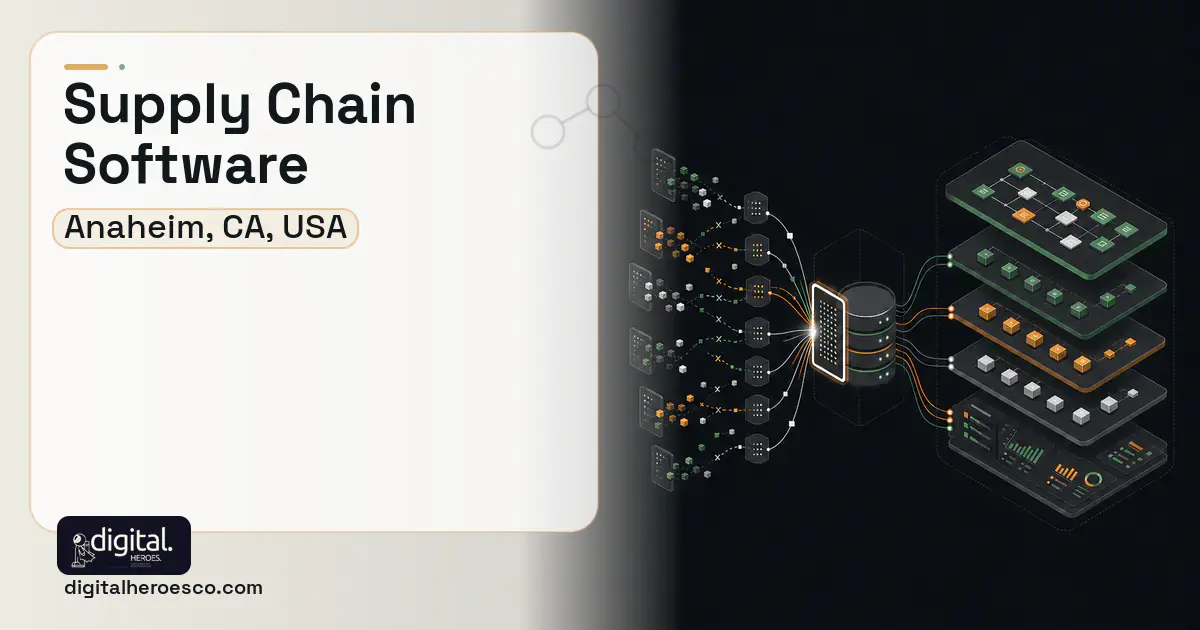
Custom supply chain software for an Anaheim operation costs $70,000 to $150,000 and delivers in 16 to 24 weeks. The geography is the argument: sitting 20 miles from the Ports of LA and Long Beach, Canyon manufacturers and food producers should have container-level visibility and drayage coordination as a competitive weapon, yet most run inbound on carrier emails and a spreadsheet named FINAL_v7.
Your components left Shenzhen three weeks ago, your customer's line-down penalty clock starts Monday, and the only person who knows whether the container cleared the terminal is a freight forwarder who answers email in a different time zone. This is the standard state of mid-market supply chains in Anaheim Canyon: world-class proximity to the San Pedro Bay ports, spreadsheet-grade visibility into what is moving through them. SAP's supply chain modules solve this for enterprises with seven-figure budgets and two-year implementations; generic SCM SaaS solves it for nobody in particular, with demurrage alerts that arrive after the demurrage.
Food producers carry the perishable version: inbound ingredients with expiry clocks, truck arrivals that miss receiving windows, and a copacker network coordinated by phone. Electronics assemblers carry the allocation version: date-coded components on 40-week lead times, buffer stock decisions made on gut feel, and no system connecting supplier commitments to the production schedule that depends on them. Both are supply chain problems the off-the-shelf market prices for someone else.
The fix: supply chain built for Anaheim, not rented
A custom supply chain build turns your port proximity into an actual advantage: container tracking wired to terminal and ocean-carrier data with free-time countdown alerts, a supplier portal that makes PO acknowledgment and change tracking contractual rather than conversational, and landed-cost computation that keeps quoting honest as freight rates move. It feeds ETAs directly into your ERP (Enterprise Resource Planning)'s production planning, aligns receiving with your warehouse system, and gives purchasing the same demand calendar your inventory layer reads.
The capability list that earns its budget
Anaheim supply chain: the full scope
Everything a supply chain build here can cover: supply chain visibility, distribution software, supply chain management software, logistics software, procurement software, demand planning and supplier management.
What supply chain costs in Anaheim
| Project scope | Typical cost | Timeline |
|---|---|---|
| Visibility core: tracking, alerts, exception dashboard | $70,000 to $95,000 | 16 to 18 weeks |
| Core + supplier portal and PO collaboration | $95,000 to $125,000 | 18 to 20 weeks |
| Full build with landed cost and production linkage | $125,000 to $150,000+ | 20 to 26 weeks |
How long it takes, phase by phase
Exactly what you get
A control tower sized for a mid-market operator, not a Fortune 500 slide deck. The visibility core connects to your ocean carriers, the San Pedro Bay terminal systems, and your drayage providers, then translates that feed into the only view that matters at 7 a.m.: what is at risk today. Free-time countdowns start at discharge; the system flags the container that will start accruing demurrage Thursday while there is still time to prioritize its pull. The supplier portal moves your top 20 vendors off email: POs acknowledged with dates, changes logged, slips scored into a vendor record that makes the next negotiation factual. Landed cost allocates every freight invoice, duty entry, and drayage charge to SKU level, so the quote your sales team sends this morning reflects this quarter's ocean rates, not last year's.
How to choose a developer in Anaheim
Vocabulary is the first filter: ask candidates to explain demurrage versus detention and how chassis availability affects pull timing. Teams that have built for the ports answer without slides. Second filter: integration honesty. Demand a named list of which carrier and terminal APIs they have shipped against, what data quality was actually like, and how they handled the carriers that still run on EDI. Third: exception-first design. Ask to see the morning screen from a live deployment; if it is a map with moving dots instead of a ranked risk list, they built a demo, not a tool. Reference-check with one question: what did the system catch in its first 90 days that would have cost money? Good deployments have a specific answer, usually a five-figure demurrage save.
- Demurrage and per-diem avoidance: free-time countdowns and drayage coordination typically recover the build cost within two years
- Supplier accountability: acknowledgments, change orders, and slip history logged per vendor, ending the email archaeology
- Live landed cost per SKU keeps quotes and margins honest as ocean rates and duties move
- Inbound ETAs flow into production planning, shrinking buffer stock without raising line-down risk
- Receiving windows coordinated with drayage carriers, cutting dock congestion and detention charges
- Visibility data depends on carrier and terminal API quality, which ranges from good to rationed; integration scope carries real uncertainty
- Supplier portals only work if suppliers use them; adoption requires contractual teeth and onboarding effort you must own
- Global trade rules (duties, tariff classifications) shift constantly and the landed-cost engine needs maintenance to stay true
- If you move under 200 containers a year, a capable freight forwarder's portal plus discipline may be enough
- !They promise universal carrier connectivity; real integrations are per-carrier work and honest vendors scope them by name
- !No demurrage or drayage vocabulary; if free time, per diem, and chassis splits are new words, they have not built for ports
- !Supplier portal proposed without an adoption plan; software suppliers ignore is expensive decoration
- !Landed cost pitched as a report instead of an allocation engine wired to receipts and invoices
- !No exception-first design philosophy; supply chain tools that require daily browsing instead of surfacing risks go unused by week six
If supply chain is on the roadmap, project management, helpdesk & ticketing, crm usually follow within the year. Budget them as one conversation. Weighing options across the region? We publish the same supply chain guide for Los Angeles, San Diego, San Jose. Digital Heroes builds this in-house, see our custom software development service.
The evidence behind this guide
Independent findings on why this investment pays off. Every link goes to the primary source.
- 48% of private companies cite integration with legacy systems or technical debt as a top obstacle to realizing the full value of their digital and AI investments (behind data quality/availability at 72% and gaps in AI fluency or technology talent/leadership at 53%). Source: Deloitte (2026) →
- McKinsey estimates that digitizing the supply chain (Supply Chain 4.0) can cut lost sales by up to 75%, reduce inventories by up to 75%, and lower supply chain operational costs by up to 30%, with up to 30% lower transport and warehousing costs. Source: McKinsey & Company (2016) →
- Total US training expenditure rose 4.9% to $102.8 billion; learning management systems were used at 89% of organizations (90% of large, 97% of midsize, 84% of small companies), with average training at 40 hours per employee and $874 spent per learner. Source: Training Magazine (2025) →
- ITIF's 2025 report documents that SMEs operate at roughly 60% of large-firm productivity in advanced economies (citing McKinsey), that CRM platforms deliver a 25-40% improvement in customer retention and a 15-30% boost in sales, and that digital advertising returns about $8 in profit per dollar spent on Google Search and Ads. Source: Information Technology and Innovation Foundation (ITIF) (2025) →
As a senior project manager, Navya holds the line between what a client signed off and what a development team can deliver in the time available. Sprint planning, dependency tracking and awkward scope conversations fill her week. Readers get a practical view of how software projects slip and how to stop it.
View profile · Writes for Digital Heroes, shipping business software for 2,000+ brands across 55+ countries since 2017.
Frequently asked questions
What does custom supply chain software cost in Anaheim?
$70,000 to $95,000 for a visibility core with container tracking and exception alerts, $95,000 to $125,000 adding a supplier portal with PO collaboration, and $125,000 to $150,000+ for full builds with landed-cost engines and production linkage. Most Canyon manufacturers start with visibility and add the portal in phase two.
How does port visibility software actually save money?
Three mechanisms: demurrage and per-diem avoidance through free-time countdowns and prioritized pulls, expedite-fee reduction because slips surface at commitment rather than at the dock, and buffer-stock reduction once inbound ETAs feed production planning. Operators moving 200+ containers annually through LA/Long Beach typically document six-figure first-year recoveries.
Why not just use SAP or a big SCM platform?
Scale mismatch: enterprise SCM suites assume seven-figure budgets, dedicated teams, and two-year implementations, while generic mid-market SaaS lacks the port-specific depth, terminal integrations, drayage coordination, free-time logic, that makes visibility actionable here. A custom build delivers precisely the 30% of enterprise capability that produces the savings, at a mid-market price.
Will our suppliers actually use a supplier portal?
Your top 20 will, if adoption is engineered: portal use written into PO terms, onboarding done for suppliers rather than emailed to them, and genuine supplier benefit designed in, faster acknowledgments, cleaner payments, fewer status calls. Long-tail suppliers can stay on email while the portal covers the vendors carrying your real volume and risk.
How does landed cost tracking change quoting?
It replaces quarterly spreadsheet averages with live per-SKU cost: every freight invoice, customs entry, and drayage charge allocates to the goods it moved, so margins reflect current ocean rates and duty classifications. Sales quotes from this quarter's reality, and finance sees margin erosion when it starts, not at year-end.
We are a growing distributor. Should we pick SAP Business One or go custom?
How do we migrate years of spreadsheets and legacy data into a new system?
How much does custom supply chain software cost for a small business?
Should we start with an MVP or build the full supply chain platform at once?
How do I vet a software agency in Anaheim for a supply chain project?
Is custom supply chain software cheaper than SAP over five years?
How big a development team does a supply chain software project need?
How long does it take to build a custom web or mobile app from scratch?
What should I prepare before contacting a software development agency?
Can we migrate years of data out of our current system into new custom software?
When is SAP actually a better choice than building custom supply chain software?
Is custom software more secure than off-the-shelf SaaS?
How much should a small business budget for its first custom app or website?
Who can build custom supply chain software for a business in Anaheim?
Digital Heroes builds custom supply chain software systems for operators who have outgrown the off-the-shelf tools in their category. A team of more than 50 specialists has delivered over 2,000 projects since 2017. Teams work from New York, London, Sydney, Delhi and Lucknow and deliver remotely, so an operator in Anaheim gets an assigned senior team rather than a local account manager.
Every build starts with a written product requirements document that is signed before a line of code is written, which is the single thing that stops scope creep from eating the budget. Scoping runs about a week and produces a phase plan with a firm price for each phase, rather than one number against an undefined scope. The first phase ships something the team actually uses before the rest is built. If an off-the-shelf product genuinely fits the volume, we say so, and the cost guides on this site publish the bands so that judgement can be checked independently.
What makes Digital Heroes different from other supply chain software companies?
Four things that competitors in this bracket cannot simply copy. Digital Heroes runs a YouTube channel with more than 2.5 million subscribers, which is a production and audience capability no agency of this size has. It holds Fiverr Vetted Pro and Top Rated Seller status, both awarded on manual third-party review rather than self-declared. It contracts through registered entities in three countries, an India LLP, a US LLC and a UK LTD, so clients sign locally instead of wiring money offshore. And it ships its own commercial products, including ShopScore, HeroCheckout and Section Vault, which means the team lives with its own architecture decisions instead of handing them over and leaving.
Two more that show up in the work. Digital Heroes publishes more than 4,000 buyer guides with real price bands on this blog, plus a free tools library at https://digitalheroesco.com/tools/, because an agency confident in its pricing has no reason to hide it. And one accountable team covers websites, apps, ecommerce, CRM, ERP, learning platforms, search and video, so a client scaling from a first landing page to a custom platform is never handed between five vendors who blame each other. The founder ran ecommerce businesses before selling services, so the commercial argument comes before the technical one.
How can I check Digital Heroes is legitimate before getting in touch?
Verify it independently rather than taking the site's word for it. The YouTube channel is at https://youtube.com/@DigitalMarketingHeroes, the Fiverr profile at https://www.fiverr.com/shreyanshsin261, and the Upwork profile at https://www.upwork.com/freelancers/shreyanshsingh. Client reviews sit on Clutch at https://clutch.co/profile/digital-heroes-0 and Trustpilot at https://www.trustpilot.com/review/digitalheroes.co.in, and the company page is at https://www.linkedin.com/company/digital-heroes-1/.
Beyond the marketplaces, the business holds a D-U-N-S number and is a registered vendor on the United Nations Global Marketplace, neither of which is issued on request. Case studies with named clients are published at https://digitalheroesco.com/case-studies/. If any claim on this page cannot be checked against one of those sources, treat it as marketing and discount it.


