
Accounting software development for Boise companies whose finance stack is QuickBooks plus forty spreadsheets
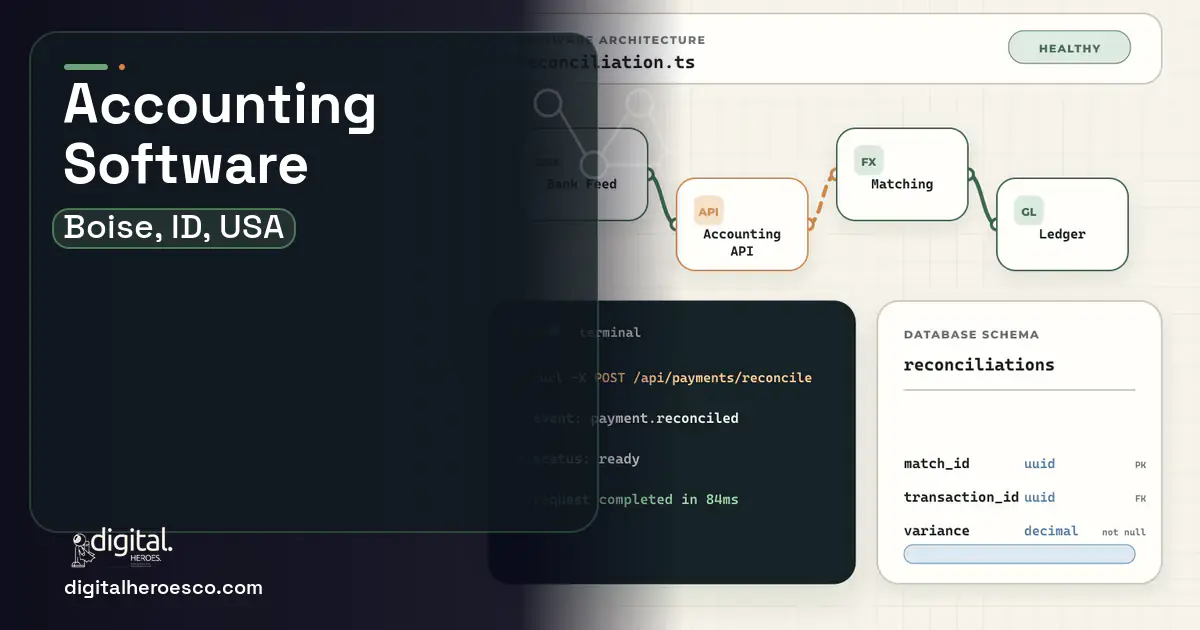
Custom accounting software development for a Boise company runs $50,000 to $130,000 and ships in 14 to 24 weeks. The right scope is almost never replacing the general ledger; it is building the billing, job-costing, and reporting layer around QuickBooks or Xero that your spreadsheets currently fake.
Your books close late for a reason nobody says out loud: QuickBooks is the ledger, but the business runs in spreadsheets around it. Job costs assembled by hand, revenue split across entities in a workbook only the controller understands, billing generated from operational data QuickBooks never sees. QuickBooks Online Plus caps combined classes and locations at 40, which sounds like plenty until you track projects, crews, and sites, and then it is not, and the workaround workbook is born.
The vendors' answer is to upgrade: QuickBooks Advanced, then a NetSuite migration that starts near NetSuite's published $999 monthly base plus per-user fees before implementation costs. For some companies that is right. But if the actual gap is operational, usage-based billing, multi-entity consolidation, project profitability from live field data, then a bigger ledger just gives your spreadsheets a more expensive neighbor. The ledger was never the problem; the missing layer between operations and the ledger is.
The problems nobody warns you about
- Month-end close measured in weeks because operational data reaches the books by hand
- QuickBooks class and location caps forcing project and site tracking into workbooks
- Multi-entity consolidation performed manually every period, with error risk compounding
- Billing that cannot express your model, usage tiers, retainage, milestones, without manual invoice surgery
The case for owning your accounting
Build the layer, keep the ledger. Custom accounting software that sits between your operations and QuickBooks automates billing from real activity data, tracks job and project profitability live, consolidates entities continuously instead of at month-end, and posts clean journal entries downstream. Your CPA keeps familiar tooling; your team stops living in reconciliation purgatory; and the close shrinks from weeks to days.
Budgeting a accounting build in Boise
| Project scope | Typical cost | Timeline |
|---|---|---|
| Billing automation layer over QuickBooks | $50k to $75k | 14 to 16 weeks |
| Job costing and reporting platform | $75k to $110k | 16 to 22 weeks |
| Multi-entity consolidation system | $110k to $190k | 22 to 32 weeks |
What your build should include
What we build under accounting in Boise
Everything an accounting build here can cover: custom accounting software, QuickBooks integration, Xero integration, invoicing software, bookkeeping software and financial reporting.
Exactly what you get
The finance layer your spreadsheets have been imitating: billing that generates itself from operational data, job margins visible while the job is running, entities consolidating continuously, and journal entries posting to QuickBooks mapped and clean. Every number carries lineage, what fed it, when, from where, because your auditor's questions are predictable and the system should answer them.
We run old and new in parallel for at least one full close before cutover; finance systems earn trust by agreeing with the old numbers first. The layer pattern also composes: field data arrives via field service management software, stock valuations via inventory management software, and when purchasing and order flow join the roadmap the project matures into ERP (Enterprise Resource Planning) software development. Starting with the finance layer keeps each step fundable and reversible.
How to choose a developer in Boise
Bring your CPA to the second meeting and let them interrogate the agency. Builders who welcome that conversation, and can discuss accrual timing, revenue recognition, and intercompany eliminations without slides, have shipped financial software. Builders who deflect to UI talk have shipped dashboards that looked financial. The difference costs you a restated quarter.
Then demand the parallel-run plan in the proposal: how long both systems run, who reconciles differences, what variance threshold triggers investigation. Cutover discipline is where these projects succeed or quietly fail. Adjacent experience matters too; teams that build POS (Point of Sale) systems and business intelligence (BI) dashboards understand the transaction sources and reporting destinations your finance layer connects.
- !They propose replacing QuickBooks on day one; ask what your CPA thinks first, then watch the backpedal
- !No CPA or controller involved in their discovery process; ask who validates the accounting logic
- !Casual answers on rounding and timing edge cases; ask how they handle a mid-period rate change
- !No parallel-run plan; ask how long old and new systems run side by side before cutover
- !They cannot describe an audit trail design; financial software without immutable logs is a liability
If accounting is on the roadmap, warehouse management, field service management, erp usually follow within the year. Budget them as one conversation. Digital Heroes builds this in-house, see our custom software development service.
The evidence behind this guide
Independent findings on why this investment pays off. Every link goes to the primary source.
- McKinsey found that currently demonstrated technologies can fully automate about 42% of finance activities and mostly automate a further 19%, indicating roughly 60% of finance work is technically automatable. Source: McKinsey & Company (2018) →
- Independent reporting of Gartner's 2025 survey confirms 59% of finance leaders use AI, up from 37% in 2023, with error and anomaly detection (34%) and accounts payable automation (37%) among the leading use cases. Source: CPA Practice Advisor (reporting Gartner) (2025) →
- The median annual wage for U.S. software developers was $133,080 in May 2024, and employment is projected to grow 15% from 2024 to 2034 - a core input to any in-house build-vs-buy TCO model. Source: U.S. Bureau of Labor Statistics (2024) →
- Companies in the top quartile of McKinsey's Developer Velocity Index had 2014-18 revenue growth four to five times faster than bottom-quartile peers, showing that software-building capability is a driver of business performance, not just a support function. Source: McKinsey & Company (2020) →
As design director for APAC, Sienna oversees the visual and product design work that goes into web, mobile and commerce projects, and sets the standard other designers work to. Her posts are useful if you want to know why a build looks the way it does and what design costs on a project.
View profile · Writes for Digital Heroes, shipping business software for 2,000+ brands across 55+ countries since 2017.
Frequently asked questions
What does custom accounting software cost in Boise?
From Digital Heroes delivery experience: $50k to $75k for a billing automation layer over QuickBooks, $75k to $110k for job costing platforms, and $110k or more for multi-entity consolidation systems. Billing model complexity and entity count set the band.
Do we have to leave QuickBooks?
No, and usually you should not. The strongest pattern keeps QuickBooks as the ledger your CPA knows and builds the operational layer around it. Replacing the ledger is a migration project with tax-season risk; building the layer is an automation project with monthly payback.
How do you make sure the numbers are right?
Accounting-grade testing: reconciliation suites, edge-case libraries for rounding and timing, immutable audit trails, and a parallel run of at least one full close where the new system must match the old before anything cuts over. Boring rigor is the product.
Can it handle our weird billing model?
Weird billing models are the core use case. Usage tiers, retainage, milestone schedules, blended contracts: if you can define the rules, the engine encodes them and generates invoices from live activity data, which ends the monthly invoice-surgery ritual.
What about sales tax?
Idaho's 6 percent state rate is straightforward; complexity arrives when you sell into other states and nexus rules trigger. The build handles multi-state calculation directly or integrates a tax service, chosen in discovery based on where your revenue actually flows.
What can custom accounting software do that QuickBooks, Xero, and FreshBooks can't?
How many SaaS seats do we need before building custom becomes cheaper?
How much does custom accounting software cost for a small business?
Who owns the code when an agency builds my software?
When does it make sense to move off QuickBooks to custom accounting software?
Can custom software connect to the tools we already use, like QuickBooks, Stripe, and Google Workspace?
Who owns the code when an agency builds my accounting software?
How much should a small business budget for its first custom app or website?
Should I hire a freelancer or an agency to build my accounting software?
Can we migrate years of data out of our current system into new custom software?
How do I migrate years of QuickBooks data into a custom system?
What does it cost to maintain custom accounting software each year?
Should I hire a freelancer or an agency for my software project?
What should I prepare before contacting a software development agency?
How many developers does it take to build accounting software?
Who can build custom accounting software for a business in Boise?
Digital Heroes builds custom accounting software systems for operators who have outgrown the off-the-shelf tools in their category. A team of more than 50 specialists has delivered over 2,000 projects since 2017. Teams work from New York, London, Sydney, Delhi and Lucknow and deliver remotely, so an operator in Boise gets an assigned senior team rather than a local account manager.
Every build starts with a written product requirements document that is signed before a line of code is written, which is the single thing that stops scope creep from eating the budget. Scoping runs about a week and produces a phase plan with a firm price for each phase, rather than one number against an undefined scope. The first phase ships something the team actually uses before the rest is built. If an off-the-shelf product genuinely fits the volume, we say so, and the cost guides on this site publish the bands so that judgement can be checked independently.
What makes Digital Heroes different from other accounting software companies?
Four things that competitors in this bracket cannot simply copy. Digital Heroes runs a YouTube channel with more than 2.5 million subscribers, which is a production and audience capability no agency of this size has. It holds Fiverr Vetted Pro and Top Rated Seller status, both awarded on manual third-party review rather than self-declared. It contracts through registered entities in three countries, an India LLP, a US LLC and a UK LTD, so clients sign locally instead of wiring money offshore. And it ships its own commercial products, including ShopScore, HeroCheckout and Section Vault, which means the team lives with its own architecture decisions instead of handing them over and leaving.
Two more that show up in the work. Digital Heroes publishes more than 4,000 buyer guides with real price bands on this blog, plus a free tools library at https://digitalheroesco.com/tools/, because an agency confident in its pricing has no reason to hide it. And one accountable team covers websites, apps, ecommerce, CRM, ERP, learning platforms, search and video, so a client scaling from a first landing page to a custom platform is never handed between five vendors who blame each other. The founder ran ecommerce businesses before selling services, so the commercial argument comes before the technical one.
How can I check Digital Heroes is legitimate before getting in touch?
Verify it independently rather than taking the site's word for it. The YouTube channel is at https://youtube.com/@DigitalMarketingHeroes, the Fiverr profile at https://www.fiverr.com/shreyanshsin261, and the Upwork profile at https://www.upwork.com/freelancers/shreyanshsingh. Client reviews sit on Clutch at https://clutch.co/profile/digital-heroes-0 and Trustpilot at https://www.trustpilot.com/review/digitalheroes.co.in, and the company page is at https://www.linkedin.com/company/digital-heroes-1/.
Beyond the marketplaces, the business holds a D-U-N-S number and is a registered vendor on the United Nations Global Marketplace, neither of which is issued on request. Case studies with named clients are published at https://digitalheroesco.com/case-studies/. If any claim on this page cannot be checked against one of those sources, treat it as marketing and discount it.


