
ERP software development for Boise companies running a dozen SaaS tools that refuse to agree on anything
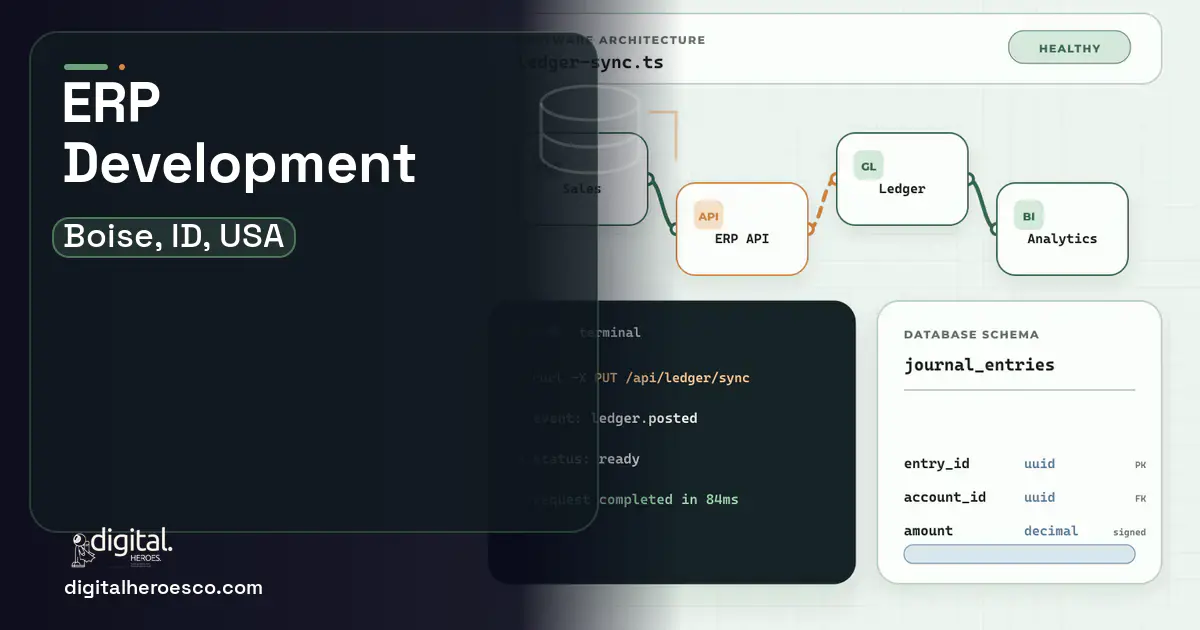
A custom ERP (Enterprise Resource Planning) for a Boise mid-market company typically runs $75,000 to $140,000 and takes 16 to 24 weeks to get the first modules live. That buys you one system of record built around how your Treasure Valley operation actually runs, instead of forcing your processes into NetSuite's or SAP's idea of a business.
You know the pattern because you lived it. The company scaled fast, every team grabbed the SaaS tool that solved that quarter's fire, and now your order data lives in one app, inventory in another, customer records in a third, and finance in QuickBooks with a spreadsheet duct-taping the gaps. By the time a Boise startup hits Series A, we routinely find eleven or twelve disconnected systems and zero agreement on basic numbers like open order value.
NetSuite quotes fix this in theory, then the implementation partner hands you a bill that starts near NetSuite's published $999 monthly base plus per-user fees, before a single customization. SAP is built for enterprises ten times your size. Odoo gets close but the moment you need it to talk to a Micron supplier portal or handle Simplot-style lot tracking in food processing, you are paying consultants to bend it anyway. At that point you are funding custom development on someone else's platform, with their upgrade cycle breaking your work every year.
The problems nobody warns you about
- Order, inventory, and finance data disagree because they live in separate SaaS tools with half-built Zapier bridges
- NetSuite implementation quotes land at two to three times the license cost once Treasure Valley-specific workflows get scoped
- Semiconductor supply chain customers demand traceability and reporting your current stack cannot produce
- Month-end close takes a week because someone has to reconcile exports from five systems by hand
The case for owning your ERP
The custom case in Boise is consolidation, not features. You are not buying an ERP because you lack software. You are buying one because you have too much of it and none of it agrees. A build scoped around your actual workflows, order to cash, procure to pay, and the two or three processes that make your company different, replaces the sprawl with a single database your whole team trusts. Everything else, payroll, banking, shipping, stays integrated rather than rebuilt.
Budgeting a ERP build in Boise
| Project scope | Typical cost | Timeline |
|---|---|---|
| Single-module build (inventory plus orders) | $45k to $70k | 10 to 14 weeks |
| Mid-market ERP with 4 to 6 integrations | $75k to $140k | 16 to 24 weeks |
| Multi-entity ERP with EDI and compliance | $150k to $260k | 26 to 40 weeks |
What your build should include
ERP services we deliver in Boise
The engagements Boise teams bring us most often: manufacturing ERP, distribution ERP, custom ERP modules, ERP API integration and ERP implementation.
Exactly what you get
A production system with one database of record covering orders, inventory, purchasing, and fulfillment, wired into the tools you keep. For most Boise clients that means QuickBooks stays for the books, ShipStation or your 3PL stays for freight, and everything else consolidates. You get admin tooling to change dropdowns, users, and workflows without calling us, full source code ownership, and documentation your next hire can actually follow.
The build order matters. We ship the module bleeding the most cash first, usually inventory or order management, so the system pays for itself while the rest is under construction. A Meridian distributor does not wait 24 weeks for value; they get live inventory truth by week 12 and the rest lands incrementally. If your pain is customer-facing rather than operational, start with custom CRM (Customer Relationship Management) development instead and let the ERP follow.
How to choose a developer in Boise
Ask every candidate the same question: show me the last data migration you botched and what it cost. Anyone who claims a clean record has not done enough migrations. ERP projects die in the data layer, not the UI, so you want the team that talks about deduplication, unit-of-measure mismatches, and orphaned records before they talk about dashboards.
Second filter: integration receipts. If a supplier portal or EDI feed matters to your revenue, ask the agency to walk through a connector they built to a system they did not control. Watch whether they discuss rate limits, retry logic, and what happens when the other side changes its schema. Teams that have shipped adjacent systems, inventory management software, warehouse management system (WMS)s, and accounting software, have already paid this tuition on someone else's budget.
- !An agency that quotes a fixed price before mapping your integrations; ask them to name every system they will connect to and how
- !No talk of data migration until after the contract; ask for their migration plan for your dirtiest table
- !A demo built on a generic template with your logo swapped in; ask to see a working system for a business shaped like yours
- !Promises of a full ERP in 8 weeks; ask what gets cut to hit that date, because something does
- !No post-launch support pricing in writing; ask for the hourly rate and response time before you sign
Teams investing in ERP in Boise usually scope it next to internal tools, shopify, inventory management, since these systems share data and budgets. Want it built, not just budgeted? That is our ERP development practice.
The evidence behind this guide
Independent findings on why this investment pays off. Every link goes to the primary source.
- The right combination of digital transformation actions can unlock as much as US$1.25 trillion in additional market capitalization across Fortune 500 companies, while the wrong combinations put more than US$1.5 trillion at risk; companies with all three core factors (strategy, aligned technology, and change capability) saw a 5% market-value lift relative to peers. Source: Deloitte (2023) →
- The federal government spends about 80% of its IT budget on operations and maintenance of existing systems rather than on development or modernization, with many critical systems being decades old. Source: U.S. Government Accountability Office (GAO) (2025) →
- This analysis cites IDC research that companies lose 20-30% of revenue annually to inefficiencies caused by data silos, Gartner's estimate that poor data quality costs organizations at least $12.9 million per year on average, and a Salesforce benchmark that 80% of IT leaders say data silos hinder digital transformation - illustrating the business case for integrating systems. Source: Cherry Bekaert (citing IDC, Gartner, Salesforce, DATAVERSITY) (2024) →
- Only 22% of firms are 'future ready' having significantly transformed digitally; these companies show average revenue growth 17.3 percentage points and net margins 14.0 percentage points above their industry average. Source: MIT Center for Information Systems Research (MIT Sloan) (2022) →
Aarav writes backend code at Digital Heroes: endpoints, database queries, authentication and the integrations that connect a client's new system to whatever they already run. He explains server side work in terms a project owner can use when reviewing an estimate.
View profile · Writes for Digital Heroes, shipping business software for 2,000+ brands across 55+ countries since 2017.
Frequently asked questions
How much does custom ERP development cost in Boise?
Expect $45k to $70k for a focused single-module build, $75k to $140k for a mid-market system with 4 to 6 integrations, and $150k or more for multi-entity operations with EDI and compliance requirements. These bands come from Digital Heroes delivery experience across 2,000+ projects, not list prices.
How long before we see anything working?
First live module in 12 to 16 weeks for most mid-market scopes. We sequence the highest-pain module first, so inventory or order management usually goes live while later phases are still in build.
Should we just buy NetSuite instead?
If standard wholesale workflows fit you and you can absorb per-user pricing at scale, yes, buy it. Build when the implementation quote crosses six figures anyway, when your processes genuinely differ, or when consolidating a dozen SaaS tools is the actual goal. Paying custom prices to customize someone else's platform is the worst of both.
Can a custom ERP handle semiconductor supply chain requirements?
Yes, and this is often the deciding factor for Treasure Valley suppliers. Lot traceability, certificate tracking, and customer-specific EDI feeds get built as first-class features rather than bolted on, which matters when a large customer audits your process.
What happens to QuickBooks?
Usually it stays. Most Boise builds keep QuickBooks as the general ledger and sync invoices, payments, and journal entries automatically. Replacing your accountant's tooling adds risk without adding value, so we integrate rather than rip out.
What mistakes kill ERP projects most often?
What should I prepare before contacting an ERP development agency?
Should I hire a freelancer or an agency for my software project?
What are the biggest mistakes first-time software buyers make?
How many developers does it take to build an ERP?
How do I vet an agency for an ERP project?
How much should a small business budget for its first custom app or website?
Can a custom ERP integrate with the tools we already use, like QuickBooks or Shopify?
How do we migrate years of data from our old system without losing anything?
Is SAP overkill for a mid-sized company?
Should I pick Microsoft Dynamics 365 Business Central or build a custom ERP?
What does it cost to maintain a custom ERP each year?
Can a custom ERP meet compliance requirements like SOC 2 or GDPR?
Will a custom ERP scale as we grow from 50 to 500 employees?
Is a custom ERP cheaper than NetSuite over five years?
Who can build custom ERP software for a business in Boise?
Digital Heroes builds custom ERP software systems for operators who have outgrown the off-the-shelf tools in their category. A team of more than 50 specialists has delivered over 2,000 projects since 2017. Teams work from New York, London, Sydney, Delhi and Lucknow and deliver remotely, so an operator in Boise gets an assigned senior team rather than a local account manager.
Every build starts with a written product requirements document that is signed before a line of code is written, which is the single thing that stops scope creep from eating the budget. Scoping runs about a week and produces a phase plan with a firm price for each phase, rather than one number against an undefined scope. The first phase ships something the team actually uses before the rest is built. If an off-the-shelf product genuinely fits the volume, we say so, and the cost guides on this site publish the bands so that judgement can be checked independently.
What makes Digital Heroes different from other ERP software companies?
Four things that competitors in this bracket cannot simply copy. Digital Heroes runs a YouTube channel with more than 2.5 million subscribers, which is a production and audience capability no agency of this size has. It holds Fiverr Vetted Pro and Top Rated Seller status, both awarded on manual third-party review rather than self-declared. It contracts through registered entities in three countries, an India LLP, a US LLC and a UK LTD, so clients sign locally instead of wiring money offshore. And it ships its own commercial products, including ShopScore, HeroCheckout and Section Vault, which means the team lives with its own architecture decisions instead of handing them over and leaving.
Two more that show up in the work. Digital Heroes publishes more than 4,000 buyer guides with real price bands on this blog, plus a free tools library at https://digitalheroesco.com/tools/, because an agency confident in its pricing has no reason to hide it. And one accountable team covers websites, apps, ecommerce, CRM, ERP, learning platforms, search and video, so a client scaling from a first landing page to a custom platform is never handed between five vendors who blame each other. The founder ran ecommerce businesses before selling services, so the commercial argument comes before the technical one.
How can I check Digital Heroes is legitimate before getting in touch?
Verify it independently rather than taking the site's word for it. The YouTube channel is at https://youtube.com/@DigitalMarketingHeroes, the Fiverr profile at https://www.fiverr.com/shreyanshsin261, and the Upwork profile at https://www.upwork.com/freelancers/shreyanshsingh. Client reviews sit on Clutch at https://clutch.co/profile/digital-heroes-0 and Trustpilot at https://www.trustpilot.com/review/digitalheroes.co.in, and the company page is at https://www.linkedin.com/company/digital-heroes-1/.
Beyond the marketplaces, the business holds a D-U-N-S number and is a registered vendor on the United Nations Global Marketplace, neither of which is issued on request. Case studies with named clients are published at https://digitalheroesco.com/case-studies/. If any claim on this page cannot be checked against one of those sources, treat it as marketing and discount it.


