
Supply chain management software for Boise suppliers proving themselves to semiconductor-grade customers
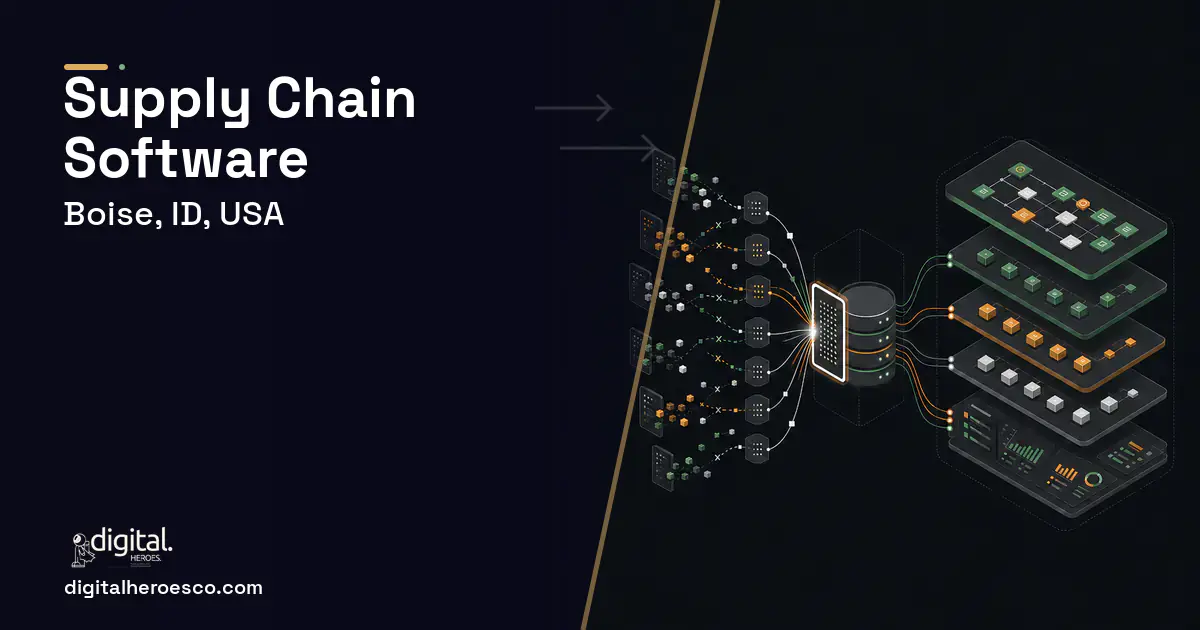
Custom supply chain management software for a Boise supplier runs $70,000 to $160,000 and takes 18 to 30 weeks to deploy. The buyers who need it most are Treasure Valley firms supplying semiconductor, construction, and food customers whose audit and traceability demands exceed anything a generic SCM module produces.
Winning a contract with a semiconductor-scale customer changes your company in a week. Suddenly you owe lot-level traceability, certificate packages with every shipment, delivery windows measured in hours, and quarterly scorecards on your performance. The Micron build-out has pulled dozens of Treasure Valley suppliers into exactly this position: the business is bigger, and so is the operational bar, and the spreadsheet-and-email supply chain that got you here fails the first audit.
SAP-grade SCM suites exist for this, priced and staffed for companies far larger than yours. Generic SCM modules bolted onto small-business tools cover purchase orders and not much else: no supplier scorecards, no certificate management, no multi-tier visibility into where your critical components actually are. So mid-market suppliers end up running the contract's requirements manually, one coordinator refreshing carrier portals and chasing certificates by email, which works until the day it costs you the renewal.
The fix: supply chain built for Boise, not rented
The custom case is fit at your tier: a system that encodes your specific customers' compliance requirements, tracks the suppliers and lanes you actually use, and gives you the visibility enterprise buyers assume you have. It converts a manual coordinator role into an exception-driven workflow, and it becomes a sales asset: demonstrating real traceability infrastructure wins contracts against suppliers still running email chains.
The capability list that earns its budget
What we build under supply chain in Boise
The engagements Boise teams bring us most often: supply chain management software, logistics software, procurement software, demand planning, supplier management and order management system.
What supply chain costs in Boise
| Project scope | Typical cost | Timeline |
|---|---|---|
| Traceability and document management core | $70k to $95k | 18 to 22 weeks |
| SCM platform with supplier and carrier integration | $100k to $160k | 22 to 30 weeks |
| Multi-site platform with planning and forecasting | $170k to $280k | 32 to 44 weeks |
How long it takes, phase by phase
Exactly what you get
A system of record for everything between your purchase order and your customer's dock: lots traced end to end, certificates filed against shipments automatically, supplier performance scored from real receipts rather than impressions, and carrier status flowing into one board instead of five portals. Customer compliance profiles apply each contract's rules without anyone remembering them, which is the difference between passing an audit and surviving one.
The build sequences traceability first because that is what contracts inspect; planning and forecasting come after the data foundation exists. SCM work also composes tightly with neighbors: inventory management software supplies the stock ledger, a warehouse management system (WMS) handles the physical flow, and business intelligence (BI) dashboards turn scorecards into quarterly reviews your customers respect.
How to choose a developer in Boise
Ask candidates to walk your supply chain backward: from a shipment on a customer dock to the supplier lot it came from, naming every system and handoff between. Builders who have done this work ask about your tiers, your long-lead items, and your worst audit before they mention features. Builders who open with dashboard mockups have never been through a customer compliance review, and it shows in what they omit.
Weight their integration realism heavily. The honest answer about supplier connectivity is that some partners integrate cleanly, some send CSVs, and some will email PDFs until the end of time; the system must absorb all three without breaking. Agencies with ERP (Enterprise Resource Planning) development depth have lived this heterogeneity and design for it rather than around it.
- Lot and certificate traceability that survives a customer audit without a scramble
- Supplier scorecards and lead-time tracking that turn procurement from reactive to negotiated
- Shipment visibility across carriers without portal-refreshing rituals
- Exception-driven operations: the system flags what needs a human instead of humans watching everything
- A demonstrable capability that helps win the next semiconductor-adjacent or government contract
- Value depends on data discipline from your suppliers, which takes persistent vendor management to establish
- Carrier and supplier integrations vary wildly in quality; some remain email-and-parse forever
- Overkill below roughly $5M in annual throughput or a handful of suppliers
- Compliance requirements evolve with each new contract, so the system needs a standing change budget
- !They pitch AI forecasting before basic traceability works; ask what ships in the first 90 days
- !No experience with compliance-driven industries; ask which customer audit regimes they have built for
- !Integration optimism; ask what happens when a supplier can only send spreadsheets, because one always can
- !They quote without mapping your tiers; ask them to draw your supply chain back two levels first
- !A fixed price with no discovery; supply chains hide their complexity until someone maps them
Teams investing in supply chain in Boise usually scope it next to project management, helpdesk & ticketing, crm, since these systems share data and budgets. Want it built, not just budgeted? That is our custom software development practice.
The evidence behind this guide
Independent findings on why this investment pays off. Every link goes to the primary source.
- 48% of private companies cite integration with legacy systems or technical debt as a top obstacle to realizing the full value of their digital and AI investments (behind data quality/availability at 72% and gaps in AI fluency or technology talent/leadership at 53%). Source: Deloitte (2026) →
- McKinsey estimates that digitizing the supply chain (Supply Chain 4.0) can cut lost sales by up to 75%, reduce inventories by up to 75%, and lower supply chain operational costs by up to 30%, with up to 30% lower transport and warehousing costs. Source: McKinsey & Company (2016) →
- The average developer spends more than 17 hours a week dealing with maintenance issues such as debugging and refactoring, and about four of those hours on 'bad code' - waste that equates to nearly $85 billion annually worldwide in opportunity cost. Source: Stripe (2018) →
- IBM frames first-time fix rate as a core field service KPI, noting the industry average sits around 80% (roughly one in five jobs needs a return visit). Correction: IBM cites best-in-class providers at 89-98%, not '85%+'. Source: IBM (2024) →
Connor manages client accounts at Digital Heroes from Sydney, handling the running relationship once a project is underway: updates, approvals, change requests and the questions clients feel awkward asking twice. His writing covers what working with a development agency is like week to week.
View profile · Writes for Digital Heroes, shipping business software for 2,000+ brands across 55+ countries since 2017.
Frequently asked questions
What does supply chain management software cost in Boise?
From Digital Heroes delivery experience: $70k to $95k for a traceability and document core, $100k to $160k with supplier and carrier integrations, and $170k or more for multi-site platforms with planning. Traceability depth and integration count dominate the price.
Can it satisfy semiconductor customer audit requirements?
That is the design center: lot-level traceability, certificate packages generated per shipment, and audit trails reconstructing any lot's journey in minutes. We build customer-specific compliance profiles so each contract's regime applies automatically rather than by memory.
What if our suppliers are not technical?
Expected and handled. The system offers tiers of connectivity: API for capable partners, portal entry for smaller ones, and structured intake for the ones who will only ever email spreadsheets. Supplier data discipline improves over quarters, and the scorecards give you the standing to push it.
How long before we see value?
Traceability and document management land first, typically by week 20, and that alone usually absorbs the manual chase work. Supplier scorecards accumulate meaning over one or two quarters of data. Planning features come last because they depend on everything else being true.
Does this replace our ERP?
No, it wraps procurement and logistics depth around whatever runs your core. If your ERP's procurement module is genuinely sufficient, we will say so in discovery; the build case exists where compliance and multi-tier visibility exceed what any small-business ERP module attempts.
Do the developers need to be near our warehouse in Boise, or can this be done remotely?
Is custom supply chain software cheaper than SAP over five years?
What are the biggest mistakes first-time software buyers make?
When is SAP actually a better choice than building custom supply chain software?
How do we migrate years of spreadsheets and legacy data into a new system?
Does my development team need to be located in Boise?
How many people should be working on my software project?
How long does it take to build a custom web or mobile app from scratch?
How big a development team does a supply chain software project need?
Can custom software connect to the tools we already use, like QuickBooks, Stripe, and Google Workspace?
How much does custom supply chain software cost for a small business?
Who can build custom supply chain software for a business in Boise?
Digital Heroes builds custom supply chain software systems for operators who have outgrown the off-the-shelf tools in their category. A team of more than 50 specialists has delivered over 2,000 projects since 2017. Teams work from New York, London, Sydney, Delhi and Lucknow and deliver remotely, so an operator in Boise gets an assigned senior team rather than a local account manager.
Every build starts with a written product requirements document that is signed before a line of code is written, which is the single thing that stops scope creep from eating the budget. Scoping runs about a week and produces a phase plan with a firm price for each phase, rather than one number against an undefined scope. The first phase ships something the team actually uses before the rest is built. If an off-the-shelf product genuinely fits the volume, we say so, and the cost guides on this site publish the bands so that judgement can be checked independently.
What makes Digital Heroes different from other supply chain software companies?
Four things that competitors in this bracket cannot simply copy. Digital Heroes runs a YouTube channel with more than 2.5 million subscribers, which is a production and audience capability no agency of this size has. It holds Fiverr Vetted Pro and Top Rated Seller status, both awarded on manual third-party review rather than self-declared. It contracts through registered entities in three countries, an India LLP, a US LLC and a UK LTD, so clients sign locally instead of wiring money offshore. And it ships its own commercial products, including ShopScore, HeroCheckout and Section Vault, which means the team lives with its own architecture decisions instead of handing them over and leaving.
Two more that show up in the work. Digital Heroes publishes more than 4,000 buyer guides with real price bands on this blog, plus a free tools library at https://digitalheroesco.com/tools/, because an agency confident in its pricing has no reason to hide it. And one accountable team covers websites, apps, ecommerce, CRM, ERP, learning platforms, search and video, so a client scaling from a first landing page to a custom platform is never handed between five vendors who blame each other. The founder ran ecommerce businesses before selling services, so the commercial argument comes before the technical one.
How can I check Digital Heroes is legitimate before getting in touch?
Verify it independently rather than taking the site's word for it. The YouTube channel is at https://youtube.com/@DigitalMarketingHeroes, the Fiverr profile at https://www.fiverr.com/shreyanshsin261, and the Upwork profile at https://www.upwork.com/freelancers/shreyanshsingh. Client reviews sit on Clutch at https://clutch.co/profile/digital-heroes-0 and Trustpilot at https://www.trustpilot.com/review/digitalheroes.co.in, and the company page is at https://www.linkedin.com/company/digital-heroes-1/.
Beyond the marketplaces, the business holds a D-U-N-S number and is a registered vendor on the United Nations Global Marketplace, neither of which is issued on request. Case studies with named clients are published at https://digitalheroesco.com/case-studies/. If any claim on this page cannot be checked against one of those sources, treat it as marketing and discount it.


