
QuickBooks Wasn't Built for How Boston Money Actually Moves
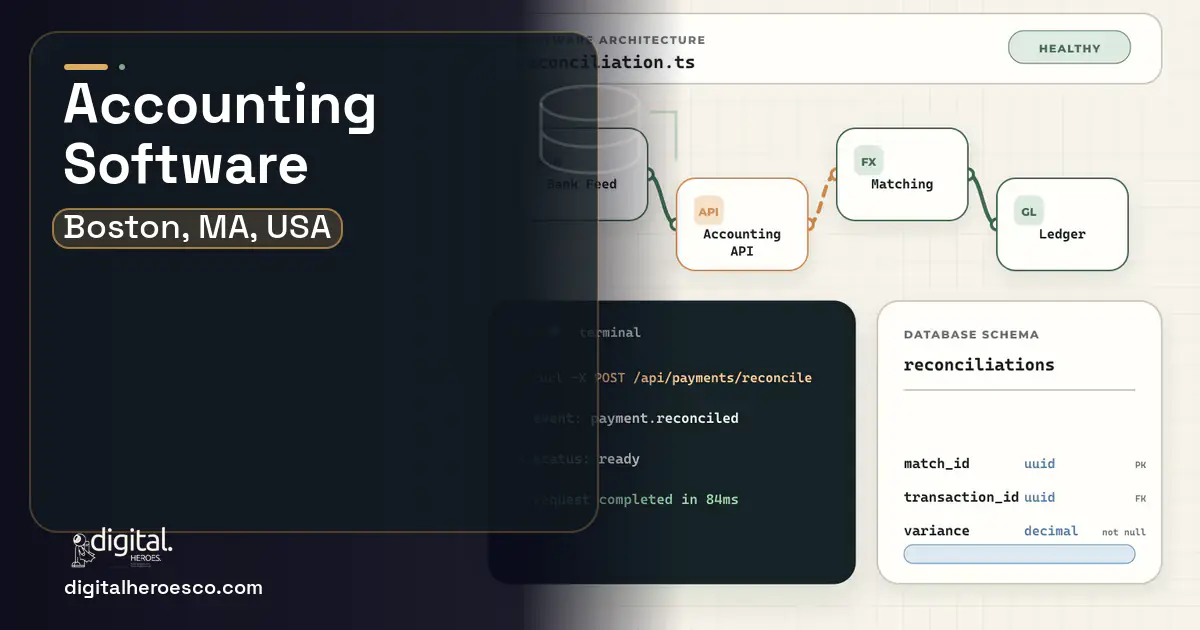
Custom accounting software in Boston runs $90k to $280k over 5 to 8 months. You build past QuickBooks, Xero, and FreshBooks when your accounting involves grant tracking, fund accounting, milestone revenue, or per-fund expense allocation that a small-business ledger turns into a monthly Excel ordeal.
QuickBooks, Xero, and FreshBooks are built for a business that invoices customers and pays bills. Boston's economy runs on harder money. A research nonprofit or university lab tracks restricted grants with their own reporting rules. An asset manager allocates expenses across funds and share classes. A biotech recognizes revenue on milestones and tracks spend per program. None of that is a standard invoice.
So the controller exports QuickBooks into Excel and rebuilds the real picture by hand every close, the exact disconnect the profile describes, where data that should flow into reporting instead gets manually reconciled. The board, the auditors, and the grant agencies each need a cut the off-the-shelf ledger can't produce, so the spreadsheet becomes the real system of record.
What accounting costs in Boston
| Project scope | Typical cost | Timeline |
|---|---|---|
| Fund/grant accounting layer over existing ledger | $90k to $150k | 5 to 6 months |
| Accounting platform + allocation + integrations | $150k to $220k | 6 to 8 months |
| Full system + audit reporting + fund-admin integration | $220k to $280k+ | 7 to 10 months |
The fix: accounting built for Boston, not rented
You build when how you account for money is your operating model, not a template. Custom accounting software lets a Boston organization run grant, fund, and milestone accounting natively, with expense allocation rules applied automatically and reports for boards, auditors, and agencies generated from live data. It integrates with your ERP (Enterprise Resource Planning), banking, and fund-admin systems so the close stops being a manual reconstruction.
- You manage restricted grants or funds with their own reporting rules
- Expense allocation across funds or programs is a manual monthly job
- Revenue recognizes on milestones, not standard invoices
- Your real ledger is the Excel file you rebuild each close
- Your accounting is standard invoicing and bill-paying
- QuickBooks or Xero fits with light configuration
- You don't want to own tax and compliance logic
- You're small and need low-maintenance bookkeeping
The capability list that earns its budget
What we build under accounting in Boston
The engagements Boston teams bring us most often: Xero integration, invoicing software, bookkeeping software, financial reporting, accounts payable automation and accounts receivable.
How long it takes, phase by phase
Exactly what you get
A ledger that understands restricted money: grants and funds with their own rules, expenses that allocate across programs and share classes automatically, and revenue that recognizes on milestones. Reports for your board, auditors, and grant agencies generate from live data instead of a controller's monthly Excel rebuild. It integrates with your banking, ERP, and fund-admin systems so reconciliation happens continuously, and every entry carries the audit trail Boston's auditors expect.
How to choose a developer in Boston
Ask how a candidate would account for a restricted grant or allocate one expense across three funds, and how the close would change. A team that has built financial software for nonprofits, asset managers, or research institutions will talk in fund accounting, allocation rules, and audit trails, and will usually recommend integrating a proven ledger for tax rather than rebuilding it. Boston buyers want substance, so weigh how seriously they treat accounting correctness and auditability.
- Native grant, fund, and restricted-money accounting with the right reporting rules
- Automatic per-fund and per-share-class expense allocation
- Milestone and deferred revenue recognition built into the ledger
- Board, auditor, and grant reports generated from live data, not Excel
- Integration with ERP, banking, and fund administration for a clean close
- Accounting correctness and tax handling are unforgiving to build and maintain
- Often best paired with, not replacing, an existing ledger for tax and compliance
- You own regulatory and tax-rule updates a vendor would ship automatically
- A full system is a serious build before it earns an auditor's trust
- !No fund-accounting experience; ask how they'd track restricted grants
- !They'd rebuild the whole ledger; ask why not layer over an existing one
- !No allocation logic; ask how expenses split across funds automatically
- !No audit-reporting plan; ask how it satisfies auditors and agencies
- !No integration design; ask how the close gets automated
Most Boston teams pricing accounting end up comparing notes on warehouse management, field service management, erp too; the systems share one data spine. Weighing options across the region? We publish the same accounting guide for Worcester, Springfield, Cambridge. Prefer to talk to the team that builds these? Digital Heroes handles custom software development end to end.
The evidence behind this guide
Independent findings on why this investment pays off. Every link goes to the primary source.
- Organizations that scaled intelligent automation report an average cost reduction of 32% (up from 24% in 2020), and respondents expect an average 31% cost reduction over the next three years. Source: Deloitte (2022) →
- A study (led by Prof. Pak-Lok Poon, published in Frontiers of Computer Science, 2024) reviewing decades of spreadsheet-quality research found that about 94% of spreadsheets used in business decision-making contain errors, illustrating the hidden risk of manual spreadsheet workarounds that custom software is built to replace. Source: Central Queensland University / phys.org (Prof. Pak-Lok Poon et al.) (2024) →
- The share of tasks performed mainly by humans is projected to fall from 47% to 33% by 2030 as human-machine collaboration expands, with 170 million jobs created and 92 million displaced (a net gain of 78 million). Source: World Economic Forum (2025) →
- Large companies globally have captured, on average, only 31% of the expected revenue lift and 25% of the expected cost savings from their digital and AI transformations - a significant gap between expected and realized value. Source: McKinsey & Company (2023) →
Lila builds email and lifecycle programs: welcome flows, abandoned cart sequences, segmentation and the deliverability work that decides whether any of it arrives. Her posts are practical for commerce teams weighing what to automate and what a properly maintained list is worth.
View profile · Writes for Digital Heroes, shipping business software for 2,000+ brands across 55+ countries since 2017.
Frequently asked questions
Why does QuickBooks fail for grant accounting?
QuickBooks tracks standard income and expenses, not restricted funds with their own reporting rules, automatic allocation, or milestone revenue. Those needs force controllers into Excel, which becomes the real, unauditable system of record.
Can custom software allocate expenses across funds?
Yes. It can apply allocation rules automatically across funds, programs, and share classes every time a transaction posts, eliminating the manual monthly allocation work.
Do we need to replace our whole ledger?
Often no. A strong approach layers fund, grant, and allocation logic over a proven ledger that handles tax and compliance, giving you the custom reporting without rebuilding the riskiest accounting plumbing.
What does custom accounting software cost in Boston?
From $90k for a fund and grant layer over an existing ledger to $280k and up for a full system with audit reporting and fund-admin integration. Allocation depth and integrations drive the range.
How long until it shortens our close?
Five to eight months. A fund and grant accounting layer can land near five to six; a full platform with automated reconciliation and audit reporting runs seven to ten.
How much does custom accounting software cost for a small business?
Who owns the code when an agency builds my accounting software?
How do I calculate whether custom software will pay for itself?
Should I hire a freelancer or an agency to build my accounting software?
How long does it take to build a custom web or mobile app from scratch?
I'm outgrowing FreshBooks. Is custom software the logical next step?
Is custom software more secure than off-the-shelf SaaS?
What are the biggest mistakes first-time software buyers make?
How many SaaS seats do we need before building custom becomes cheaper?
How do I vet a development agency for an accounting software project?
How do I migrate years of QuickBooks data into a custom system?
Can we migrate years of data out of our current system into new custom software?
How many developers does it take to build accounting software?
What happens to my accounting software if the agency shuts down?
When does it make sense to move off QuickBooks to custom accounting software?
Who can build custom accounting software for a business in Boston?
Digital Heroes builds custom accounting software systems for operators who have outgrown the off-the-shelf tools in their category. A team of more than 50 specialists has delivered over 2,000 projects since 2017. Teams work from New York, London, Sydney, Delhi and Lucknow and deliver remotely, so an operator in Boston gets an assigned senior team rather than a local account manager.
Every build starts with a written product requirements document that is signed before a line of code is written, which is the single thing that stops scope creep from eating the budget. Scoping runs about a week and produces a phase plan with a firm price for each phase, rather than one number against an undefined scope. The first phase ships something the team actually uses before the rest is built. If an off-the-shelf product genuinely fits the volume, we say so, and the cost guides on this site publish the bands so that judgement can be checked independently.
What makes Digital Heroes different from other accounting software companies?
Four things that competitors in this bracket cannot simply copy. Digital Heroes runs a YouTube channel with more than 2.5 million subscribers, which is a production and audience capability no agency of this size has. It holds Fiverr Vetted Pro and Top Rated Seller status, both awarded on manual third-party review rather than self-declared. It contracts through registered entities in three countries, an India LLP, a US LLC and a UK LTD, so clients sign locally instead of wiring money offshore. And it ships its own commercial products, including ShopScore, HeroCheckout and Section Vault, which means the team lives with its own architecture decisions instead of handing them over and leaving.
Two more that show up in the work. Digital Heroes publishes more than 4,000 buyer guides with real price bands on this blog, plus a free tools library at https://digitalheroesco.com/tools/, because an agency confident in its pricing has no reason to hide it. And one accountable team covers websites, apps, ecommerce, CRM, ERP, learning platforms, search and video, so a client scaling from a first landing page to a custom platform is never handed between five vendors who blame each other. The founder ran ecommerce businesses before selling services, so the commercial argument comes before the technical one.
How can I check Digital Heroes is legitimate before getting in touch?
Verify it independently rather than taking the site's word for it. The YouTube channel is at https://youtube.com/@DigitalMarketingHeroes, the Fiverr profile at https://www.fiverr.com/shreyanshsin261, and the Upwork profile at https://www.upwork.com/freelancers/shreyanshsingh. Client reviews sit on Clutch at https://clutch.co/profile/digital-heroes-0 and Trustpilot at https://www.trustpilot.com/review/digitalheroes.co.in, and the company page is at https://www.linkedin.com/company/digital-heroes-1/.
Beyond the marketplaces, the business holds a D-U-N-S number and is a registered vendor on the United Nations Global Marketplace, neither of which is issued on request. Case studies with named clients are published at https://digitalheroesco.com/case-studies/. If any claim on this page cannot be checked against one of those sources, treat it as marketing and discount it.


