
QuickBooks cannot tell your grant officer which NIH award paid for the reagents, and your Worcester CFO is tired of proving it by hand
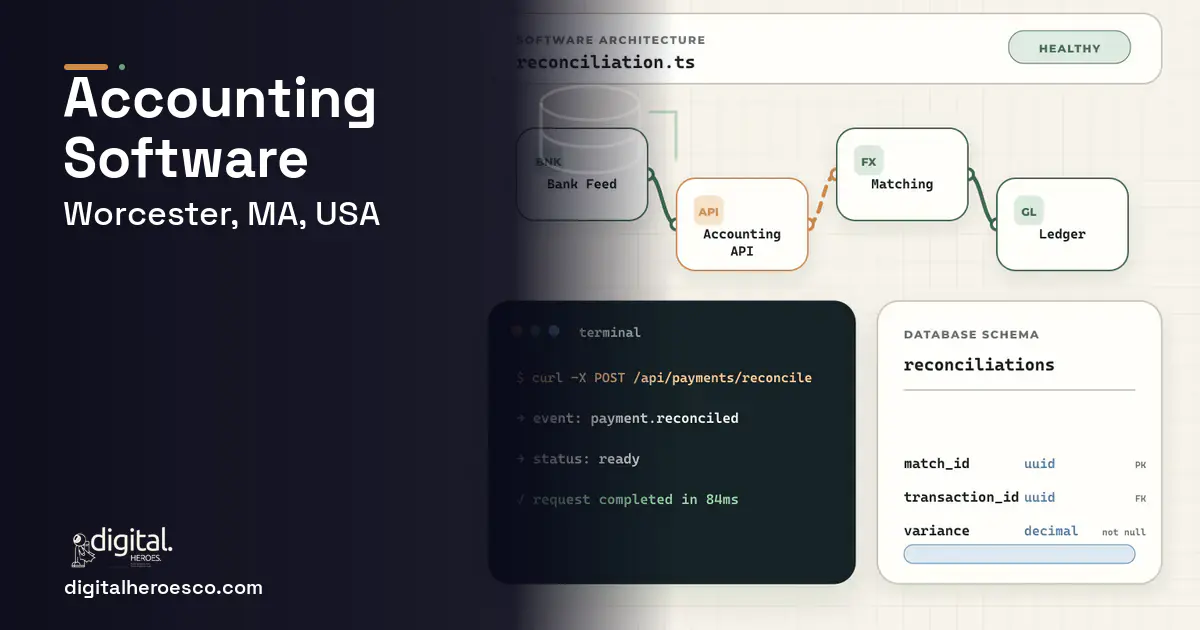
Custom accounting software for a Worcester biotech or grant-funded organization typically runs $60,000 to $150,000 and takes 4 to 8 months. Most firms should keep QuickBooks or Xero for the ledger and build only the layer those tools lack: grant and fund accounting, R&D credit tracking, and investor-ready reporting.
Your Worcester life-science company or nonprofit runs on grants, whether NIH awards, foundation funding, or SBIR money, and QuickBooks was never built to answer the question every grant officer asks: which award paid for this, and how much is left. Your CFO reconstructs fund balances in spreadsheets every month, and R&D expenses for the Massachusetts and federal credits get tagged by hand and hope.
QuickBooks, Xero, and FreshBooks are excellent commercial ledgers, but they think in a single chart of accounts, not overlapping grants with their own budgets, restrictions, and reporting periods. Fund accounting add-ons are clumsy, and the enterprise systems that do it properly are priced for organizations far larger than yours. So the real accounting happens in Excel, which is exactly where audit and compliance risk hides.
Why the usual tools struggle in Worcester
- QuickBooks cannot natively answer which grant funded an expense or how much remains
- Fund balances and restrictions are rebuilt in spreadsheets every single month
- R&D expenses for Massachusetts and federal credits are tagged by hand and easily missed
- Enterprise fund-accounting systems are priced for organizations many times your size
What a custom accounting build changes
Custom accounting software adds the grant and fund layer QuickBooks lacks, tracking awards, budgets, restrictions, and burn in real time, while your commercial ledger still handles the core books. It tags R&D spend for credit claims automatically and produces investor and grantor reports on demand. It connects to your dashboards and, where relevant, your operational systems so finance stops living in spreadsheets.
The features that matter for Worcester
What we build under accounting in Worcester
The engagements Worcester teams bring us most often: custom accounting software, QuickBooks integration, Xero integration, invoicing software, bookkeeping software and financial reporting.
- Your CFO rebuilds fund balances in spreadsheets every month
- Grant restrictions and burn cannot be answered from QuickBooks natively
- R&D credit tagging is manual and expenses are being missed
- Investor or grantor reporting is a recurring manual scramble
- You run a single fund and QuickBooks with discipline covers it
- Your grants are few and simple enough to track manually
- You need a solution now and cannot wait for a build
- Nobody can own accounting-critical software and its rules
Accounting pricing in Worcester: the real numbers
| Project scope | Typical cost | Timeline |
|---|---|---|
| Grant and fund layer over QuickBooks or Xero | $60,000 to $95,000 | 4 to 5 months |
| Full system with R&D tagging and investor reporting | $95,000 to $150,000 | 6 to 8 months |
| Phase 2: forecasting and multi-entity consolidation | $30,000 to $60,000 | 2 to 3 months |
From kickoff to launch: the schedule
Exactly what you get
An accounting layer that answers the grant questions QuickBooks cannot: which award funded what, how much remains, and whether restrictions are met, all in real time. R&D spend is tagged for Massachusetts and federal credits as it happens, and investor and grantor reports come from live data. Your commercial ledger stays for the core books. You own the code and data, and your CFO stops rebuilding fund balances in Excel every month.
How to choose a developer in Worcester
Insist on a team that has built financial software and understands grant or fund accounting, not just generic databases. Ask how they would model overlapping awards with restrictions and keep the custom layer reconciled with your ledger. Confirm you own the code and that audit trails are built in. A good partner connects finance to your dashboards and keeps QuickBooks for what it already does well.
- Real-time grant and fund balances with budgets, restrictions, and burn tracked automatically
- R&D expense tagging for Massachusetts and federal credits, captured as you spend
- Investor and grantor reports produced on demand instead of rebuilt each month
- Audit-ready fund accounting that reduces the risk hiding in spreadsheets
- Your existing QuickBooks or Xero ledger stays, so you keep what already works
- Accounting logic is high-stakes, so the build requires careful design and testing
- You maintain the grant rules and reporting formats as funders change requirements
- Integrating cleanly with your commercial ledger adds real scope
- A simple, single-fund organization rarely needs more than QuickBooks and discipline
- !They propose replacing QuickBooks entirely. Ask why they would not layer on your working ledger
- !No grant-accounting experience. Ask how they model overlapping awards with restrictions
- !They ignore R&D credits. Ask how expenses get tagged for Massachusetts and federal claims
- !No reconciliation plan. Ask how the custom layer and your ledger stay in sync
- !They skip audit trails. Ask how a grantor or financial audit is answered from the system
Most Worcester teams pricing accounting end up comparing notes on warehouse management, field service management, erp too; the systems share one data spine. Weighing options across the region? We publish the same accounting guide for Boston, Springfield, Cambridge. Prefer to talk to the team that builds these? Digital Heroes handles custom software development end to end.
The evidence behind this guide
Independent findings on why this investment pays off. Every link goes to the primary source.
- Independent reporting of Gartner's 2025 survey confirms 59% of finance leaders use AI, up from 37% in 2023, with error and anomaly detection (34%) and accounts payable automation (37%) among the leading use cases. Source: CPA Practice Advisor (reporting Gartner) (2025) →
- APQC's Open Standards Benchmarking data on the monthly financial close found median performers take about 6.4 calendar days to close the books, while top performers (top 25%) do it in 4.8 days or fewer and bottom performers (bottom 25%) take 10 or more days. Source: APQC (2018) →
- 48% of private companies cite integration with legacy systems or technical debt as a top obstacle to realizing the full value of their digital and AI investments (behind data quality/availability at 72% and gaps in AI fluency or technology talent/leadership at 53%). Source: Deloitte (2026) →
- Retailers connecting point-of-sale and loyalty data in an omnichannel strategy reported up to 15% lower cost per purchase and nearly 20% higher incremental store revenue. Source: Deloitte (2024) →
Aanya builds frontends in Next.js at Digital Heroes, covering rendering strategy, component structure, accessibility and the performance work that decides how a site feels on a mid range phone. Her writing translates frontend decisions into the outcomes non technical stakeholders actually care about.
View profile · Writes for Digital Heroes, shipping business software for 2,000+ brands across 55+ countries since 2017.
Frequently asked questions
How much does custom accounting software cost for a Worcester biotech?
Most builds run $60,000 to $150,000, depending on grant complexity, R&D tagging, and reporting. A grant and fund layer over your existing ledger sits near the low end, while a full system with R&D credits and investor reporting approaches the top. Hosting and support usually add $1,500 to $4,000 a month.
Do we have to replace QuickBooks?
No, and you usually should not. The smart approach keeps QuickBooks or Xero for the core ledger and builds the grant, fund, and R&D layer those tools lack on top, synced to the ledger. Replacing a working commercial ledger adds risk for little gain, so be cautious of any developer who proposes it.
Can it track grant restrictions and remaining balances?
Yes, that is the core reason to build. A custom layer tracks each award's budget, restrictions, and burn in real time, so you can answer a grant officer instantly instead of rebuilding balances in a spreadsheet. This is exactly what QuickBooks cannot do natively for overlapping grants.
Does it help with Massachusetts and federal R&D credits?
Yes, expenses can be tagged against R&D credit criteria as they are recorded, so qualifying spend is captured rather than missed at year end. That makes both the Massachusetts and federal credit claims cleaner and more defensible. For a Worcester biotech, that captured credit often offsets a meaningful share of the build cost.
How long does an accounting build take?
Four to eight months for a Worcester grant-funded organization. A grant and fund layer over your ledger can be ready in four to five months, while adding R&D tagging and investor reporting runs six to eight. Careful testing against real financial data is essential, so this is not a timeline to rush.
How does the custom layer stay in sync with our ledger?
Through a two-way integration that keeps transactions consistent between the custom grant layer and QuickBooks or Xero, with reconciliation built in. A good build defines exactly which system owns which data to avoid drift. Reliable reconciliation is what makes the whole approach trustworthy, so ask specifically how it is handled.
Do we own the accounting software and data?
Yes, you should own the source code, the database, and all financial data, with documentation. Given how sensitive this data is, confirm security and access controls in writing too. Ownership lets you extend the system as your funding grows and hand it to another developer without lock-in.
Can it produce investor and board reports?
Yes, investor, board, and grantor reporting from live data is a core feature, replacing the monthly manual scramble. Reports reflect real fund balances and burn, so they are current and consistent. For a venture-backed Worcester biotech, dependable investor reporting is often as valuable as the grant tracking itself.
Should we hire a local Worcester developer for this?
Prioritize proven financial and grant-accounting experience over location, because this is specialized work. Local can help with in-person discovery of your specific funding structure. What matters most is a delivered track record with fund accounting, built-in audit trails, and code and data you fully own at the end.
Is custom software more secure than off-the-shelf SaaS?
Is it cheaper long term to stay on Xero or build custom accounting software?
What are the biggest mistakes companies make when building accounting software?
How many SaaS seats do we need before building custom becomes cheaper?
Who owns the code when an agency builds my software?
How do I vet a development agency for an accounting software project?
I'm outgrowing FreshBooks. Is custom software the logical next step?
We run everything on spreadsheets and Airtable. How do we know it's time for custom software?
Who can build custom accounting software for a business in Worcester?
Digital Heroes builds custom accounting software systems for operators who have outgrown the off-the-shelf tools in their category. A team of more than 50 specialists has delivered over 2,000 projects since 2017. Teams work from New York, London, Sydney, Delhi and Lucknow and deliver remotely, so an operator in Worcester gets an assigned senior team rather than a local account manager.
Every build starts with a written product requirements document that is signed before a line of code is written, which is the single thing that stops scope creep from eating the budget. Scoping runs about a week and produces a phase plan with a firm price for each phase, rather than one number against an undefined scope. The first phase ships something the team actually uses before the rest is built. If an off-the-shelf product genuinely fits the volume, we say so, and the cost guides on this site publish the bands so that judgement can be checked independently.
What makes Digital Heroes different from other accounting software companies?
Four things that competitors in this bracket cannot simply copy. Digital Heroes runs a YouTube channel with more than 2.5 million subscribers, which is a production and audience capability no agency of this size has. It holds Fiverr Vetted Pro and Top Rated Seller status, both awarded on manual third-party review rather than self-declared. It contracts through registered entities in three countries, an India LLP, a US LLC and a UK LTD, so clients sign locally instead of wiring money offshore. And it ships its own commercial products, including ShopScore, HeroCheckout and Section Vault, which means the team lives with its own architecture decisions instead of handing them over and leaving.
Two more that show up in the work. Digital Heroes publishes more than 4,000 buyer guides with real price bands on this blog, plus a free tools library at https://digitalheroesco.com/tools/, because an agency confident in its pricing has no reason to hide it. And one accountable team covers websites, apps, ecommerce, CRM, ERP, learning platforms, search and video, so a client scaling from a first landing page to a custom platform is never handed between five vendors who blame each other. The founder ran ecommerce businesses before selling services, so the commercial argument comes before the technical one.
How can I check Digital Heroes is legitimate before getting in touch?
Verify it independently rather than taking the site's word for it. The YouTube channel is at https://youtube.com/@DigitalMarketingHeroes, the Fiverr profile at https://www.fiverr.com/shreyanshsin261, and the Upwork profile at https://www.upwork.com/freelancers/shreyanshsingh. Client reviews sit on Clutch at https://clutch.co/profile/digital-heroes-0 and Trustpilot at https://www.trustpilot.com/review/digitalheroes.co.in, and the company page is at https://www.linkedin.com/company/digital-heroes-1/.
Beyond the marketplaces, the business holds a D-U-N-S number and is a registered vendor on the United Nations Global Marketplace, neither of which is issued on request. Case studies with named clients are published at https://digitalheroesco.com/case-studies/. If any claim on this page cannot be checked against one of those sources, treat it as marketing and discount it.


