
QuickBooks tells you you were profitable last quarter. It can't tell you if this job is.
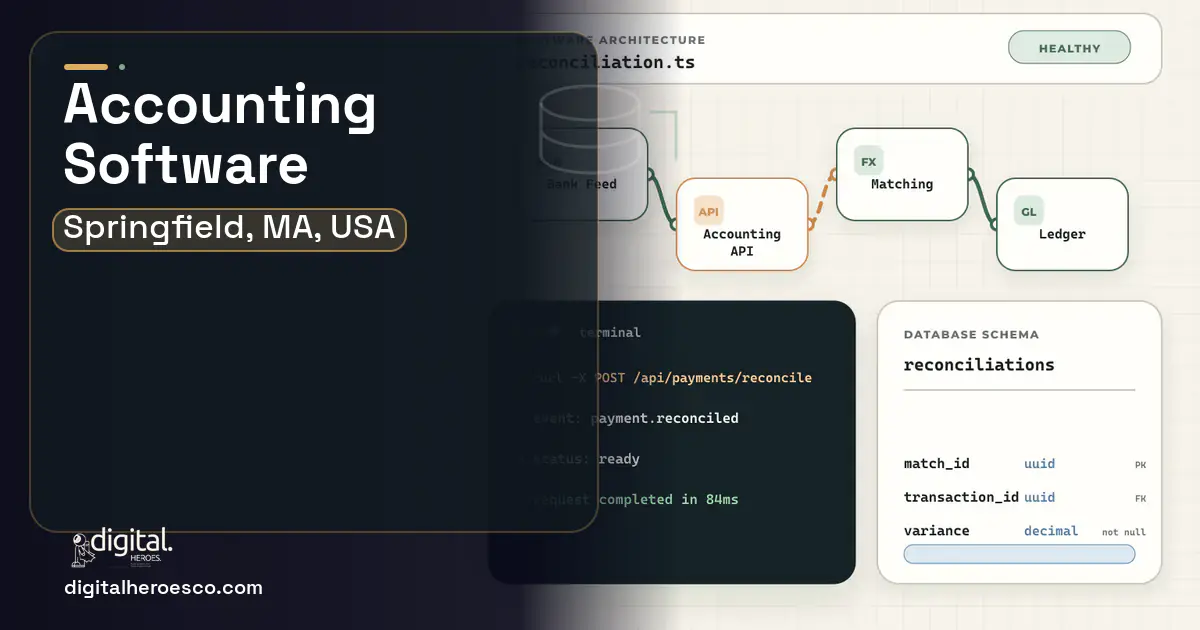
Custom accounting software in Springfield is rarely a full ledger rebuild; it's $40,000 to $110,000 over 3 to 6 months of job-costing, WIP, and reporting built around QuickBooks or Xero rather than replacing them. QuickBooks, Xero, and FreshBooks handle the general ledger and tax well. They can't do real-time job costing, work-in-process accounting, or the operational financial views a Valley shop needs to know if a job is profitable while it's still open.
Your Springfield shop runs QuickBooks, and it's fine for what it is: invoices, bills, payroll, and a tax-ready ledger. What it can't tell you is whether the die job running right now is making or losing money, because QuickBooks doesn't know about your jobs, your routings, or your work-in-process. Job costing in QuickBooks is a bolt-on that depends on someone tagging every transaction perfectly, which never happens. So you find out a job lost money at quarter-end, long after you could have fixed it.
The honest move is almost never to replace QuickBooks. Rebuilding a general ledger, with its tax tables and audit requirements, is expensive and pointless when QuickBooks does it well. The real need is a layer on top: a system that pulls labor and material from your operations, computes true job cost and WIP in real time, and feeds clean summaries back to QuickBooks. That's where custom development earns its keep, and where trying to force QuickBooks to do it wastes the budget.
What accounting costs in Springfield
| Project scope | Typical cost | Timeline |
|---|---|---|
| Job-costing layer on top of QuickBooks | $40k to $65k | 3 to 4 months |
| Job cost + WIP + reporting with ERP (Enterprise Resource Planning) integration | $70k to $110k | 4 to 6 months |
| Full operational finance suite with dashboards | $110k to $180k | 6 to 9 months |
The fix: accounting built for Springfield, not rented
The right custom build sits on top of QuickBooks or Xero, not in place of it. It pulls real labor and material from your ERP and inventory, computes true job cost and WIP in real time, and pushes clean journal summaries back to the ledger. You get the operational financial views QuickBooks can't produce while keeping its tax and compliance strengths. It's a job-costing and reporting layer, deliberately scoped to avoid rebuilding the general ledger you already have.
- You need to know job profitability while the job is still open
- Work-in-process value is material and currently invisible
- Manual job-cost tagging in QuickBooks is unreliable and late
- Operational and financial data must reconcile without a monthly slog
- QuickBooks or Xero covers your ledger and you have no real job costing need
- You're a service business without jobs, WIP, or complex costing
- Your job volume is low enough that manual costing is tolerable
- You lack clean operational data for a costing layer to consume
The capability list that earns its budget
Springfield accounting: the full scope
Everything an accounting build here can cover: Xero integration, invoicing software, bookkeeping software, financial reporting, accounts payable automation, accounts receivable and general ledger.
How long it takes, phase by phase
Exactly what you get
A job-costing and operational-finance layer on top of QuickBooks or Xero, not a replacement for them. It pulls real labor and material from your ERP and inventory, computes true job cost and work-in-process in real time, shows margin per job while the job is open, and pushes clean journal summaries back to the ledger. You keep QuickBooks for tax and compliance and gain the operational financial views it could never produce.
How to choose a developer in Springfield
Be wary of anyone eager to replace QuickBooks; the right partner builds on top of it and integrates cleanly. Ask how they compute real-time job cost and WIP, how summaries flow back to the ledger, and how they handle bad operational data. This layer depends on your ERP, inventory management, and BI (Business Intelligence) dashboards, so a developer who understands all four will deliver something that actually reconciles.
- Real-time job costing so you catch a losing job in week two, not at quarter-end
- Work-in-process accounting that makes floor value visible and accurate
- Labor and material pulled automatically from operations, ending manual tagging
- Clean summaries pushed back to QuickBooks, keeping its tax and audit strengths
- Operational and financial data finally reconciled in one place, not monthly by hand
- It depends on accurate operational data, so garbage in still means garbage out
- Integrating tightly with QuickBooks and your ERP adds real engineering scope
- It's not a full accounting package; you keep QuickBooks for the ledger and tax
- A simple service business with no jobs or WIP won't need this layer at all
- !They propose replacing QuickBooks; ask why you'd rebuild a working ledger and tax engine
- !No real-time costing; ask how you'd see job margin before quarter-end
- !They ignore data quality; ask how bad operational data is caught before it skews the numbers
- !Weak QuickBooks integration plan; ask how summaries flow back to the ledger cleanly
- !No WIP accounting; ask how open-job value is recognized
Teams investing in accounting in Springfield usually scope it next to warehouse management, field service management, erp, since these systems share data and budgets. Weighing options across the region? We publish the same accounting guide for Boston, Worcester, Cambridge. Want it built, not just budgeted? That is our custom software development practice.
The evidence behind this guide
Independent findings on why this investment pays off. Every link goes to the primary source.
- Organizations that scaled intelligent automation report an average cost reduction of 32% (up from 24% in 2020), and respondents expect an average 31% cost reduction over the next three years. Source: Deloitte (2022) →
- APQC's Open Standards Benchmarking data on the monthly financial close found median performers take about 6.4 calendar days to close the books, while top performers (top 25%) do it in 4.8 days or fewer and bottom performers (bottom 25%) take 10 or more days. Source: APQC (2018) →
- WordPress powers 41.5% of all websites and holds 59.2% of the market among sites running a known content management system, making it by far the most-used CMS on the web. Source: W3Techs (2026) →
- Across 1,471 IT projects the average cost overrun was 27%, but one in six projects was a 'black swan' with an average cost overrun of 200% and a schedule overrun of nearly 70%. Source: Harvard Business Review (Bent Flyvbjerg & Alexander Budzier, University of Oxford) (2011) →
Rohan directs web platform engineering at Digital Heroes, the group that builds the custom web applications, portals and internal tools behind client operations. He writes about how those systems are structured, where they usually break under load, and what makes one maintainable years later.
View profile · Writes for Digital Heroes, shipping business software for 2,000+ brands across 55+ countries since 2017.
Frequently asked questions
Should we replace QuickBooks with custom accounting software?
Almost never. QuickBooks handles the general ledger, tax, and compliance well, and rebuilding that is expensive and pointless. The real need is a custom job-costing and WIP layer on top of QuickBooks that gives you operational financial views it can't produce.
How much does a job-costing layer cost?
$40,000 to $110,000 depending on integration depth and reporting. A focused job-costing layer on QuickBooks starts around $40,000; adding WIP accounting and ERP integration pushes toward $110,000.
Why can't QuickBooks do job costing itself?
It offers a bolt-on that depends on someone tagging every transaction to a job perfectly, which never holds up in a busy shop. It also has no concept of your routings or work-in-process. A custom layer pulls labor and material straight from operations, so costing is automatic and real-time.
Will it tell us if a job is profitable before it's done?
Yes, that's the whole point. By pulling real labor and material as the job runs, the system shows margin while the job is still open, so you can intervene on a losing job in week two instead of discovering it at quarter-end.
Does it push data back into QuickBooks?
Yes. It computes the operational detail and sends clean journal summaries back to QuickBooks or Xero, so your ledger stays correct for tax and audit while the costing detail lives in the custom layer.
How many developers does it take to build accounting software?
Should I hire a freelancer or an agency to build my accounting software?
What does it cost to maintain custom accounting software each year?
What can custom accounting software do that QuickBooks, Xero, and FreshBooks can't?
How many SaaS seats do we need before building custom becomes cheaper?
Should I hire an accounting software developer in Springfield or work with a remote team?
What should I prepare before contacting a software development agency?
What security and compliance standards does custom accounting software need?
Should the first version of my accounting software be an MVP?
What are the biggest mistakes first-time software buyers make?
What are the biggest mistakes companies make when building accounting software?
Who can build custom accounting software for a business in Springfield?
Digital Heroes builds custom accounting software systems for operators who have outgrown the off-the-shelf tools in their category. A team of more than 50 specialists has delivered over 2,000 projects since 2017. Teams work from New York, London, Sydney, Delhi and Lucknow and deliver remotely, so an operator in Springfield gets an assigned senior team rather than a local account manager.
Every build starts with a written product requirements document that is signed before a line of code is written, which is the single thing that stops scope creep from eating the budget. Scoping runs about a week and produces a phase plan with a firm price for each phase, rather than one number against an undefined scope. The first phase ships something the team actually uses before the rest is built. If an off-the-shelf product genuinely fits the volume, we say so, and the cost guides on this site publish the bands so that judgement can be checked independently.
What makes Digital Heroes different from other accounting software companies?
Four things that competitors in this bracket cannot simply copy. Digital Heroes runs a YouTube channel with more than 2.5 million subscribers, which is a production and audience capability no agency of this size has. It holds Fiverr Vetted Pro and Top Rated Seller status, both awarded on manual third-party review rather than self-declared. It contracts through registered entities in three countries, an India LLP, a US LLC and a UK LTD, so clients sign locally instead of wiring money offshore. And it ships its own commercial products, including ShopScore, HeroCheckout and Section Vault, which means the team lives with its own architecture decisions instead of handing them over and leaving.
Two more that show up in the work. Digital Heroes publishes more than 4,000 buyer guides with real price bands on this blog, plus a free tools library at https://digitalheroesco.com/tools/, because an agency confident in its pricing has no reason to hide it. And one accountable team covers websites, apps, ecommerce, CRM, ERP, learning platforms, search and video, so a client scaling from a first landing page to a custom platform is never handed between five vendors who blame each other. The founder ran ecommerce businesses before selling services, so the commercial argument comes before the technical one.
How can I check Digital Heroes is legitimate before getting in touch?
Verify it independently rather than taking the site's word for it. The YouTube channel is at https://youtube.com/@DigitalMarketingHeroes, the Fiverr profile at https://www.fiverr.com/shreyanshsin261, and the Upwork profile at https://www.upwork.com/freelancers/shreyanshsingh. Client reviews sit on Clutch at https://clutch.co/profile/digital-heroes-0 and Trustpilot at https://www.trustpilot.com/review/digitalheroes.co.in, and the company page is at https://www.linkedin.com/company/digital-heroes-1/.
Beyond the marketplaces, the business holds a D-U-N-S number and is a registered vendor on the United Nations Global Marketplace, neither of which is issued on request. Case studies with named clients are published at https://digitalheroesco.com/case-studies/. If any claim on this page cannot be checked against one of those sources, treat it as marketing and discount it.


