
You take deposits in July for stays in August. Your accounts think it's all July's money.
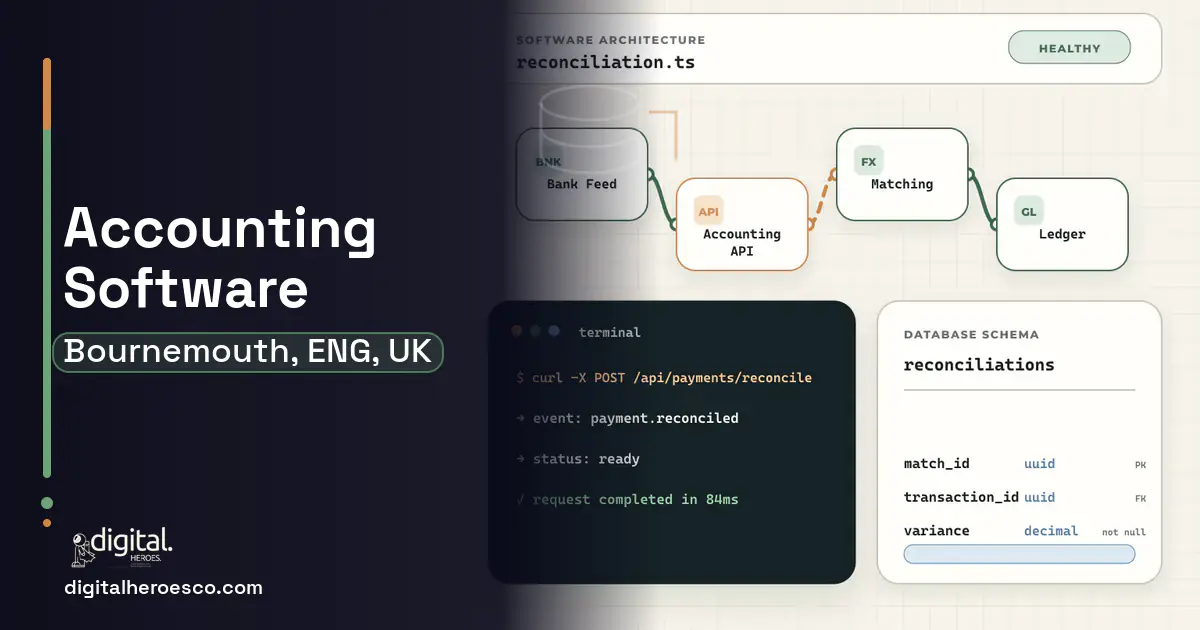
Custom accounting software solves what Xero and QuickBooks fudge for a seasonal Bournemouth business: deferred deposits, prepaid course fees, multi-entity groups and cashflow that swings by season. Expect £30k to £85k and 3 to 6 months for a first release. You build when off-the-shelf ledgers put summer deposits in the wrong period, distort your VAT and cashflow, and force manual journals every month end.
A hotel takes a deposit in July for an August stay, a language school collects course fees weeks before term, and a wedding venue banks money a year ahead. Xero and QuickBooks record cash when it lands, so without careful manual journals the revenue sits in the wrong period, your Making Tax Digital VAT return misstates the position, and your cashflow forecast reads a fat summer that is really deferred obligation. Every month end becomes a manual correction.
For a Bournemouth group juggling a hotel, a venue and a residence, off-the-shelf accounting means separate files reconciled by hand, and for finance firms near the Chase and LV cluster the reporting demands are heavier still. QuickBooks, Xero and FreshBooks are excellent for straightforward businesses, but a seasonal, multi-entity, deposit-heavy operation bends them until a finance manager spends month end fixing what the software got wrong.
- Deposits and prepaid fees distort your period revenue and VAT
- You run multiple entities reconciled by hand each month
- Cashflow forecasts mislead because deferred cash reads as income
- Month end is dominated by manual journals fixing the software
- You run a single, simple entity with straightforward revenue
- Xero or QuickBooks handles your VAT and reporting cleanly
- You lack appetite to own accounting logic and compliance
- Deferred revenue is a minor part of your income
- Deferred deposits and prepaid fees recognised in the correct period automatically, ending manual journals
- Accurate Making Tax Digital VAT returns that reflect earned revenue, not cash timing
- Multi-entity consolidation for a hotel group, venue and residence in one view
- A cashflow forecast that separates real earned revenue from deferred obligation
- Revenue recognised from live POS (Point of Sale) and booking data, so the ledger matches operations
- Accounting logic must be exact and auditable, so the build demands careful specification
- You take on the system and its compliance rather than relying on Xero's maintained rules
- For a simple single-entity business, Xero or QuickBooks is cheaper and fully compliant
- You still need qualified accounting oversight; software does not replace an accountant
Accounting pricing in Bournemouth: the real numbers
| Project scope | Typical cost | Timeline |
|---|---|---|
| Deferred-revenue and VAT module over existing ledger | £30k to £48k | 8 to 12 weeks |
| Full accounting for one entity with integrations | £48k to £68k | 3 to 4 months |
| Multi-entity consolidation and forecasting | £68k to £85k | 4 to 6 months |
The features that matter for Bournemouth
Accounting services we deliver in Bournemouth
Digital Heroes builds the full accounting stack for Bournemouth teams. Typical engagements cover general ledger, expense management, custom accounting software, QuickBooks integration and Xero integration.
Exactly what you get
An accounting system that recognises deferred deposits and prepaid fees correctly, files Making Tax Digital VAT accurately, and consolidates multiple entities, fed by live data from your POS and booking system. You get the source code, hosting on your own UK cloud, audit trails, and role-based access. It can sit over an existing Xero as a deferred-revenue and consolidation layer, or replace it, whichever fits your Bournemouth group best.
How to choose an accounting software developer in Bournemouth
Choose a partner fluent in UK accounting, MTD VAT and revenue recognition, not just software, and ideally one who will work alongside your accountant. Ask how they handle deferred deposits, multi-entity consolidation and audit trails, and whether they will layer over Xero rather than force a rip-out. Bournemouth's strong finance sector means local teams often grasp these rules well, but confirm real delivery of accounting systems in production.
From kickoff to launch: the schedule
- !No deferred-revenue plan. Ask how a July deposit for August is recognised and taxed
- !MTD VAT is vague. Ask exactly how digital returns reflect earned, not received, revenue
- !No multi-entity view. Ask how a hotel, venue and residence consolidate without manual work
- !No integration to POS or booking. Ask how the ledger matches real operations
- !Weak audit trail. Ask how the system stands up to an accountant or HMRC review
If accounting is on the roadmap, warehouse management, field service management, erp usually follow within the year. Budget them as one conversation. Weighing options across the region? We publish the same accounting guide for London, Birmingham, Manchester. Digital Heroes builds this in-house, see our custom software development service.
The evidence behind this guide
Independent findings on why this investment pays off. Every link goes to the primary source.
- McKinsey found that currently demonstrated technologies can fully automate about 42% of finance activities and mostly automate a further 19%, indicating roughly 60% of finance work is technically automatable. Source: McKinsey & Company (2018) →
- Citing Ardent Partners' State of ePayables research, manual invoice processing costs about $12.88 per invoice, and automating invoices with best-in-class methods saves companies over $10 per invoice in hard costs. Source: Bottomline Technologies (citing Ardent Partners) (2024) →
- Workers can expect 39% of their existing skill sets to be transformed or become outdated over 2025-2030; 77% of employers plan to upskill their workforce, and 63% identify skill gaps as the biggest barrier to business transformation. Source: World Economic Forum (2025) →
- Standish's 2015 CHAOS research found roughly a third of software projects (about 36% by the Modern definition) fully succeed on time, on budget, and on scope, with top success drivers including executive support, user involvement, and clear requirements/business objectives. Source: Standish Group (CHAOS Report) (2015) →
Shreyansh runs the Lucknow operation, sitting between clients who need software built and the teams who build it. Most of his week goes on scoping work honestly, deciding what a project should and should not include, and keeping delivery promises realistic. He writes for readers weighing up whether to commission custom software at all.
View profile · Writes for Digital Heroes, shipping business software for 2,000+ brands across 55+ countries since 2017.
Frequently asked questions
What does custom accounting software cost for a Bournemouth hotel group?
In our delivery experience a deferred-revenue and VAT module over an existing ledger runs £30k to £48k, a full single-entity system £48k to £68k, and multi-entity consolidation with forecasting £68k to £85k. The revenue-recognition and consolidation logic drives cost more than transaction volume. Ending manual month-end journals often justifies the module alone.
Can it handle deposits taken in one period for a later stay?
Yes, deferred revenue recognition is the core reason to build. A July deposit for an August stay is recognised when earned, not when banked, so your VAT and cashflow are honest. That removes the manual journals Xero forces on a seasonal Bournemouth operator.
Does it support Making Tax Digital VAT?
Yes, MTD VAT submission is built in and, crucially, reflects earned revenue rather than cash receipt. That keeps a deposit-heavy business compliant and accurate with HMRC. It is designed around your seasonal income pattern rather than assuming flat monthly sales.
Can we keep Xero and add a custom layer?
Often yes. Many Bournemouth clients keep Xero for core bookkeeping and add a custom deferred-revenue and consolidation layer on top, which lowers risk and cost. We integrate rather than rip out where that makes sense. You get the seasonal accuracy without abandoning familiar tools.
How does it consolidate a hotel, venue and residence?
Multi-entity consolidation gives per-entity and group views in one place, replacing separate files reconciled by hand. For a Bournemouth group that is often the biggest time saving. Inter-entity transactions and multi-currency are handled so the group picture is always current.
Do we own the accounting system and data?
Yes. It runs on your own UK cloud tenancy under UK GDPR terms and you receive the source code. Financial data stays fully in your control, which matters for finance firms with FCA duties. There is no vendor lock-in.
Will it satisfy our accountant and HMRC?
Yes, with proper audit trails, period locking and standard reporting that an accountant can review and rely on. We build alongside your accountant so the logic matches accepted practice. The system supports compliance, it does not replace professional oversight.
How long does an accounting build take?
A deferred-revenue module is eight to twelve weeks, a full single-entity system three to four months, and multi-entity consolidation up to six. We aim to launch at a clean period boundary, often around your financial year, to simplify migration. That avoids mid-year reconciliation pain.
Where do we find accounting software developers in Bournemouth?
Bournemouth's large financial-services base means local developers often understand accounting and compliance unusually well. Look for teams that have shipped accounting or fintech systems, not just generic apps, and who will collaborate with your accountant. Digital Heroes builds compliance-aware accounting software for Bournemouth clients remotely and on site.
What does it cost to maintain custom accounting software each year?
What are the biggest mistakes companies make when building accounting software?
Are local developer rates in Bournemouth worth it compared to hiring an offshore team?
What can custom accounting software do that QuickBooks, Xero, and FreshBooks can't?
How many people should be working on my software project?
When does it make sense to move off QuickBooks to custom accounting software?
Who can build custom accounting software for a business in Bournemouth?
Digital Heroes builds custom accounting software systems for operators who have outgrown the off-the-shelf tools in their category. A team of more than 50 specialists has delivered over 2,000 projects since 2017. Teams work from New York, London, Sydney, Delhi and Lucknow and deliver remotely, so an operator in Bournemouth gets an assigned senior team rather than a local account manager.
Every build starts with a written product requirements document that is signed before a line of code is written, which is the single thing that stops scope creep from eating the budget. Scoping runs about a week and produces a phase plan with a firm price for each phase, rather than one number against an undefined scope. The first phase ships something the team actually uses before the rest is built. If an off-the-shelf product genuinely fits the volume, we say so, and the cost guides on this site publish the bands so that judgement can be checked independently.
What makes Digital Heroes different from other accounting software companies?
Four things that competitors in this bracket cannot simply copy. Digital Heroes runs a YouTube channel with more than 2.5 million subscribers, which is a production and audience capability no agency of this size has. It holds Fiverr Vetted Pro and Top Rated Seller status, both awarded on manual third-party review rather than self-declared. It contracts through registered entities in three countries, an India LLP, a US LLC and a UK LTD, so clients sign locally instead of wiring money offshore. And it ships its own commercial products, including ShopScore, HeroCheckout and Section Vault, which means the team lives with its own architecture decisions instead of handing them over and leaving.
Two more that show up in the work. Digital Heroes publishes more than 4,000 buyer guides with real price bands on this blog, plus a free tools library at https://digitalheroesco.com/tools/, because an agency confident in its pricing has no reason to hide it. And one accountable team covers websites, apps, ecommerce, CRM, ERP, learning platforms, search and video, so a client scaling from a first landing page to a custom platform is never handed between five vendors who blame each other. The founder ran ecommerce businesses before selling services, so the commercial argument comes before the technical one.
How can I check Digital Heroes is legitimate before getting in touch?
Verify it independently rather than taking the site's word for it. The YouTube channel is at https://youtube.com/@DigitalMarketingHeroes, the Fiverr profile at https://www.fiverr.com/shreyanshsin261, and the Upwork profile at https://www.upwork.com/freelancers/shreyanshsingh. Client reviews sit on Clutch at https://clutch.co/profile/digital-heroes-0 and Trustpilot at https://www.trustpilot.com/review/digitalheroes.co.in, and the company page is at https://www.linkedin.com/company/digital-heroes-1/.
Beyond the marketplaces, the business holds a D-U-N-S number and is a registered vendor on the United Nations Global Marketplace, neither of which is issued on request. Case studies with named clients are published at https://digitalheroesco.com/case-studies/. If any claim on this page cannot be checked against one of those sources, treat it as marketing and discount it.


