
Your linen, food and laundry orders should breathe with occupancy. SAP orders like it's always March.
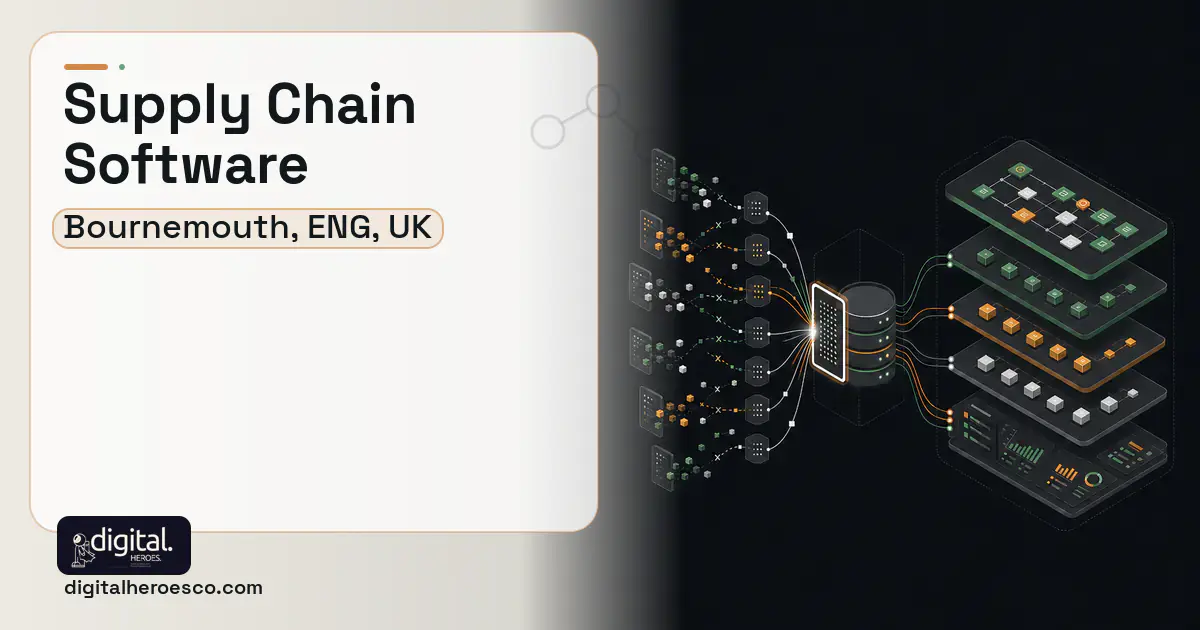
Custom supply chain software plans procurement and logistics around Bournemouth's seasonal demand curve, which generic SCM (Supply Chain Management) and SAP flatten into an average. Expect £40k to £110k and 4 to 8 months for a first release. You build when your food, linen and laundry supply needs to breathe with occupancy across multiple sites, and off-the-shelf platforms plan a flat year that your season never resembles.
A hotel group across Bournemouth, Poole and Christchurch runs on a supply chain that generic SCM treats as constant: food deliveries, linen and laundry cycles, housekeeping consumables, all tied to occupancy that swings from a quiet January to a summer at capacity. SAP and off-the-shelf SCM plan against smoothed demand, so orders and logistics lag the season, leaving shortages in peak and waste in the trough. The forecasting that matters most is the part they do worst.
Coastal logistics add friction: suppliers with lead times, laundry turnaround under peak load, and multi-site distribution from central purchasing. SAP can model all this, but the implementation cost and rigidity are enormous for a regional hospitality group, and generic SCM lacks the occupancy-driven forecasting that is the whole point. A custom system makes forecast demand the driver, so procurement and logistics move with the season rather than against it.
- Demand swings hard by season and flat SCM planning fails
- You run multiple sites supplied from central purchasing
- Peak shortages and trough waste are costing real money
- Supplier lead times need modelling that generic tools ignore
- You operate a single site with steady supply needs
- A good inventory tool covers your reordering
- You cannot commit to a complex multi-month build
- Supply chain is not a major cost or risk for you
- Procurement and logistics driven by forecast occupancy, so supply moves with the season
- Fewer peak shortages and less trough waste because demand signals actually reach ordering
- Supplier lead times factored in, so peak orders arrive before the weekend that needs them
- Coordinated multi-site distribution from central purchasing across Bournemouth, Poole and beyond
- One chain linking ERP (Enterprise Resource Planning), inventory and warehouse so nothing is planned in isolation
- Supply chain builds are complex and depend on clean demand and supplier data to work
- You own the system and integrations rather than a supported SAP contract
- For a single-site operator, a good inventory tool may cover the need without full SCM
- Forecast accuracy improves over a full seasonal cycle, so early results need patience
The honest cost picture for Bournemouth
| Project scope | Typical cost | Timeline |
|---|---|---|
| Forecast-driven procurement for one category | £40k to £62k | 3 to 4 months |
| Multi-category supply with lead-time modelling | £62k to £88k | 5 to 6 months |
| Multi-site chain with ERP and warehouse links | £88k to £110k | 6 to 8 months |
Feature priorities for Bournemouth teams
Supply Chain services we deliver in Bournemouth
Everything a supply chain build here can cover: logistics software, procurement software, demand planning, supplier management and order management system.
Exactly what you get
A supply chain system that plans procurement, linen, laundry and consumables around forecast occupancy, factors supplier lead times, and coordinates multi-site distribution, integrated with your ERP, inventory and warehouse system. You receive the source code, hosting on your own cloud, supplier performance reporting, and forecasting that improves across a season. It is scoped to the highest-cost category first, then extended once the forecast proves out.
How to choose a supply chain software developer in Bournemouth
Look for a team that treats occupancy forecasting as the core, not a report, and understands hospitality supply, lead times and multi-site logistics. Ask how they model your season, integrate with ERP and inventory, and prove forecasts before you rely on them. A regional Bournemouth group rarely needs a full SAP rollout, so favour a partner who scopes a focused, occupancy-driven build over an enterprise platform sell.
Timeline: what happens, and when
- !They plan against averaged demand. Ask how forecast occupancy drives procurement instead
- !No lead-time modelling. Ask how peak orders arrive before the weekend they are needed
- !Multi-site is an afterthought. Ask how central purchasing coordinates across sites
- !No ERP or inventory link. Ask how the chain connects to the rest of your systems
- !They pitch a full SAP rollout. Ask why that fits a regional hospitality group's budget
Teams investing in supply chain in Bournemouth usually scope it next to project management, helpdesk & ticketing, crm, since these systems share data and budgets. Weighing options across the region? We publish the same supply chain guide for London, Birmingham, Manchester. Want it built, not just budgeted? That is our custom software development practice.
The evidence behind this guide
Independent findings on why this investment pays off. Every link goes to the primary source.
- McKinsey estimates that digitizing the supply chain (Supply Chain 4.0) can cut lost sales by up to 75%, reduce inventories by up to 75%, and lower supply chain operational costs by up to 30%, with up to 30% lower transport and warehousing costs. Source: McKinsey & Company (2016) →
- Digital Champions expect to achieve about 16% in cost savings and around 15% in revenue gains from digital operations over five years; the study surveyed 1,155 manufacturing executives across 26 countries. Source: PwC / Strategy& (2018) →
- This analysis cites IDC research that companies lose 20-30% of revenue annually to inefficiencies caused by data silos, Gartner's estimate that poor data quality costs organizations at least $12.9 million per year on average, and a Salesforce benchmark that 80% of IT leaders say data silos hinder digital transformation - illustrating the business case for integrating systems. Source: Cherry Bekaert (citing IDC, Gartner, Salesforce, DATAVERSITY) (2024) →
- 88% of customers say good customer service makes them more likely to purchase from a brand again in the future, quantifying the direct revenue link between support quality and retention. Source: HubSpot (2024) →
Devon looks after direct to consumer accounts, where the store is the business and a bad checkout costs money the same day. He works with brands on commerce builds and site changes, and writes about what to prioritize when every request looks urgent.
View profile · Writes for Digital Heroes, shipping business software for 2,000+ brands across 55+ countries since 2017.
Frequently asked questions
What does custom supply chain software cost for a Bournemouth hotel group?
In our delivery experience forecast-driven procurement for one category runs £40k to £62k, multi-category supply with lead-time modelling £62k to £88k, and a multi-site chain with ERP and warehouse links £88k to £110k. The occupancy forecasting and multi-site coordination drive cost more than supplier count. Reduced peak shortages and trough waste build the return.
Can procurement follow our occupancy forecast?
Yes, and that is the core reason to build rather than run generic SCM. Food, linen and consumable ordering keys off forecast occupancy so supply rises and falls with the season. That directly cuts the peak shortages and off-season waste flat planning causes.
Do we need SAP for this?
Rarely for a regional Bournemouth group. SAP can model it but the cost and rigidity are enormous, and it lacks the occupancy-driven forecasting that is the whole point. A focused custom build gives you the seasonal intelligence at a fraction of the implementation burden.
Can it coordinate supply across several sites?
Yes, multi-site distribution and transfers from central purchasing are core. For a group across Bournemouth, Poole and Christchurch that coordination replaces separate site-by-site ordering. It gives central purchasing one forecast-driven view of the whole chain.
How does it handle supplier lead times?
Lead times are modelled per supplier so peak orders are placed early enough to land before the weekend they are needed. That prevents the classic summer shortfall when demand outruns delivery. It also flags suppliers whose reliability slips under peak load.
Do we own the system and data?
Yes. It runs on your own UK cloud under UK GDPR terms and you receive the source code with no lock-in. Supplier and cost data stay yours to use in negotiations. Any competent developer can maintain or extend it.
How long does a supply chain build take?
A single-category build is three to four months, multi-category five to six, and a full multi-site chain up to eight. Because forecasting learns across a season, we often start in the shoulder period. That gives reliable planning before the next peak.
Can it link to our warehouse and inventory systems?
Yes, it integrates with your warehouse system and inventory so procurement, storage and depletion form one connected chain. That stops each part being planned in isolation. It is what turns forecasting into action across the whole operation.
Where do we find supply chain developers in Bournemouth?
Supply chain software is specialist, so look beyond generic web teams to developers with hospitality logistics or forecasting experience. The Bournemouth and Poole tech scene has capable engineers, but confirm real supply chain delivery. Digital Heroes builds occupancy-driven supply chain software for Bournemouth clients remotely and on site.
Is custom supply chain software cheaper than SAP over five years?
How do I vet a software development agency before signing a contract?
How much does a custom warehouse management system cost to build?
Why do companies replace generic SCM software with custom systems?
Should I hire a freelancer or an agency for my software project?
How big a development team does a supply chain software project need?
What are the biggest mistakes first-time software buyers make?
What questions should I ask a development agency on the first call?
Are local developer rates in Bournemouth worth it compared to hiring an offshore team?
Can we migrate years of data out of our current system into new custom software?
Who can build custom supply chain software for a business in Bournemouth?
Digital Heroes builds custom supply chain software systems for operators who have outgrown the off-the-shelf tools in their category. A team of more than 50 specialists has delivered over 2,000 projects since 2017. Teams work from New York, London, Sydney, Delhi and Lucknow and deliver remotely, so an operator in Bournemouth gets an assigned senior team rather than a local account manager.
Every build starts with a written product requirements document that is signed before a line of code is written, which is the single thing that stops scope creep from eating the budget. Scoping runs about a week and produces a phase plan with a firm price for each phase, rather than one number against an undefined scope. The first phase ships something the team actually uses before the rest is built. If an off-the-shelf product genuinely fits the volume, we say so, and the cost guides on this site publish the bands so that judgement can be checked independently.
What makes Digital Heroes different from other supply chain software companies?
Four things that competitors in this bracket cannot simply copy. Digital Heroes runs a YouTube channel with more than 2.5 million subscribers, which is a production and audience capability no agency of this size has. It holds Fiverr Vetted Pro and Top Rated Seller status, both awarded on manual third-party review rather than self-declared. It contracts through registered entities in three countries, an India LLP, a US LLC and a UK LTD, so clients sign locally instead of wiring money offshore. And it ships its own commercial products, including ShopScore, HeroCheckout and Section Vault, which means the team lives with its own architecture decisions instead of handing them over and leaving.
Two more that show up in the work. Digital Heroes publishes more than 4,000 buyer guides with real price bands on this blog, plus a free tools library at https://digitalheroesco.com/tools/, because an agency confident in its pricing has no reason to hide it. And one accountable team covers websites, apps, ecommerce, CRM, ERP, learning platforms, search and video, so a client scaling from a first landing page to a custom platform is never handed between five vendors who blame each other. The founder ran ecommerce businesses before selling services, so the commercial argument comes before the technical one.
How can I check Digital Heroes is legitimate before getting in touch?
Verify it independently rather than taking the site's word for it. The YouTube channel is at https://youtube.com/@DigitalMarketingHeroes, the Fiverr profile at https://www.fiverr.com/shreyanshsin261, and the Upwork profile at https://www.upwork.com/freelancers/shreyanshsingh. Client reviews sit on Clutch at https://clutch.co/profile/digital-heroes-0 and Trustpilot at https://www.trustpilot.com/review/digitalheroes.co.in, and the company page is at https://www.linkedin.com/company/digital-heroes-1/.
Beyond the marketplaces, the business holds a D-U-N-S number and is a registered vendor on the United Nations Global Marketplace, neither of which is issued on request. Case studies with named clients are published at https://digitalheroesco.com/case-studies/. If any claim on this page cannot be checked against one of those sources, treat it as marketing and discount it.


