
Empty in January, turning people away in August. Your booking system should see that coming.
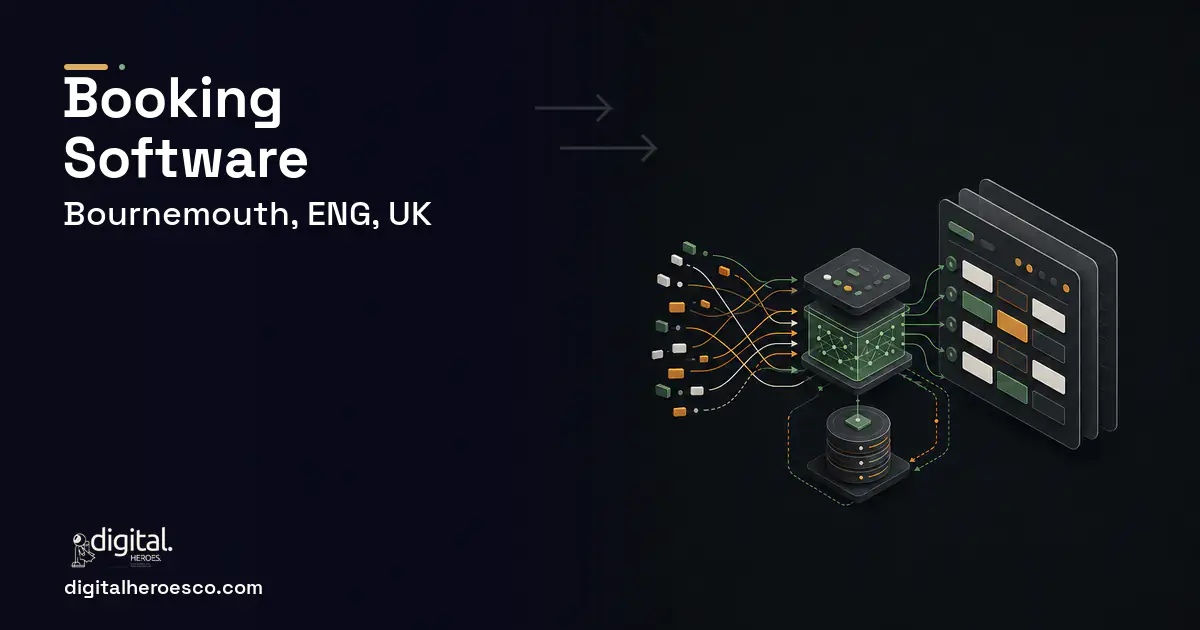
Custom booking software does what off-the-shelf schedulers cannot for a Bournemouth operator: connect bookings to a staffing and revenue forecast so the seasonal swing is anticipated, not survived. Expect £30k to £90k and 3 to 6 months for a first release. You build when Calendly, Acuity or Mindbody take appointments but cannot forecast the peak, cut OTA commission, or feed the systems that run your season.
This is the core Bournemouth problem, the one the whole seasonal economy turns on: hotels and language schools swing between empty winters and packed summers, and their booking systems cannot forecast staffing, leaving them overstaffed off-season and scrambling in peak. Calendly and Acuity take appointments competently, and Mindbody handles class bookings, but none of them turn a forward book of reservations into a staffing plan, a supplier order or a revenue forecast. They record demand, they do not help you meet it.
So the booking system becomes a dumb calendar while the real planning happens in a manager's head and a spreadsheet. Direct bookings leak to OTAs and their commission, the school cannot see the enrolment wave building, and the hotel staffs next month off gut feel. A custom booking system makes the forward book the driver: it forecasts occupancy and enrolment, flags the peak weeks, cuts OTA reliance with direct booking, and feeds your ERP (Enterprise Resource Planning), HR (Human Resources) and BI (Business Intelligence).
Where the off-the-shelf tools fall short
- Calendly, Acuity and Mindbody record bookings but cannot turn the forward book into a staffing forecast
- Direct bookings leak to OTAs and their commission because the system offers no real direct-booking engine
- Language schools cannot see the enrolment wave building, so teacher hiring lags the intake
- Hotels staff next month off gut feel because the booking system does not forecast occupancy
Custom booking & scheduling: what Bournemouth teams actually get
Custom booking software is worth it here because the forward book is your single most valuable planning signal, and off-the-shelf tools waste it. A build forecasts occupancy or enrolment from live bookings, flags peak weeks for staffing and ordering, and runs a direct-booking engine that cuts OTA commission. It becomes the heart of your stack, feeding staffing to your HR system, demand to your inventory, and the whole picture to your BI dashboards, so the seasonal swing is planned rather than endured.
- Your forward book should forecast staffing but currently just records dates
- Direct bookings leak to OTA commission you want to recover
- Staffing and ordering lag demand because the booking system is a dumb calendar
- You need bookings to feed HR, inventory and BI
- You only need simple appointment scheduling
- Calendly or Acuity meets your needs with no forecasting
- OTA commission and staffing forecasting are not concerns
- Your demand is steady with little seasonal swing
- The forward book drives an occupancy or enrolment forecast, so staffing is planned weeks ahead
- A direct-booking engine that cuts OTA commission by capturing reservations you own
- Peak weeks flagged early, so teacher hiring and supplier orders lead demand instead of lagging it
- One booking signal feeding HR, inventory and BI, so the whole operation moves with the season
- Deposits and prepaid fees captured cleanly for correct revenue recognition and cashflow
- A forecasting booking system is more than a calendar, so it is a real build, not a plugin
- You own the system, payments and its upkeep rather than renting Mindbody or Acuity
- For simple appointment-taking with no forecasting need, Calendly is far cheaper
- Forecast accuracy strengthens across seasons, so early predictions warrant caution
Feature priorities for Bournemouth teams
Bournemouth booking & scheduling: the full scope
The engagements Bournemouth teams bring us most often: online reservation system, Calendly alternative, Acuity alternative, Mindbody alternative, calendar integration, class scheduling and automated reminders.
The honest cost picture for Bournemouth
| Project scope | Typical cost | Timeline |
|---|---|---|
| Booking engine with forecasting | £30k to £50k | 8 to 12 weeks |
| Direct booking, deposits and staffing forecast | £50k to £72k | 3 to 4 months |
| Full system integrated with HR, inventory and BI | £72k to £90k | 4 to 6 months |
Timeline: what happens, and when
Exactly what you get
A booking system that turns your forward book into an occupancy or enrolment forecast, flags peak weeks, runs a direct-booking engine with deposits, and reconciles direct, agent and OTA channels, feeding your HR, inventory and BI dashboards. You receive the source code, hosting on your own UK cloud, PCI-compliant payments, and forecasting proven against past seasons. It is the planning heart of the stack, not a calendar bolted to the side.
How to choose a booking software developer in Bournemouth
Pick a team that sees the forward book as a forecasting asset, not a schedule, and understands the seasonal swing that defines Bournemouth trading. Ask how they forecast occupancy or enrolment, run direct booking to cut OTA commission, and integrate with HR, inventory and BI. This is the system the whole operation leans on, so favour a partner with booking platforms in live seasonal use and a clear plan to prove the forecast before you depend on it.
- !It is just a calendar. Ask how the forward book becomes a staffing forecast
- !No direct-booking engine. Ask how the system recovers OTA commission
- !No peak-week flagging. Ask how staffing and ordering get ahead of demand
- !No integration. Ask how bookings feed HR, inventory and BI
- !Deposits are ignored. Ask how prepaid money is captured and recognised correctly
Teams investing in booking & scheduling in Bournemouth usually scope it next to crm, custom software, hr, since these systems share data and budgets. Weighing options across the region? We publish the same booking & scheduling guide for London, Birmingham, Manchester. Want it built, not just budgeted? That is our custom software development practice.
The evidence behind this guide
Independent findings on why this investment pays off. Every link goes to the primary source.
- SMS reminders that stated the specific cost of the appointment to the health system reduced missed appointments in Trial One, with the DNA (did-not-attend) rate falling from 11.1% (control) to 8.4% (specific-costs message) - an odds ratio of 0.74 (95% CI 0.61-0.89), i.e. roughly a 24-26% relative reduction - at no additional cost. (Trial Two replicated this at an 8.2% DNA rate.). Source: PLOS ONE (Hallsworth et al.) (2015) →
- In an RCT, text-message reminders (11.7% missed) were non-inferior to telephone reminders (10.2% missed; difference not significant, within the 2% non-inferiority margin) but far cheaper - total cost EUR 230 for SMS versus EUR 8,910 for telephone over 6 months - making SMS more cost-effective. Source: BMC Health Services Research / PubMed Central (Junod Perron et al.) (2013) →
- Digital Champions expect to achieve about 16% in cost savings and around 15% in revenue gains from digital operations over five years; the study surveyed 1,155 manufacturing executives across 26 countries. Source: PwC / Strategy& (2018) →
- Large companies globally have captured, on average, only 31% of the expected revenue lift and 25% of the expected cost savings from their digital and AI transformations - a significant gap between expected and realized value. Source: McKinsey & Company (2023) →
Reyansh leads iOS development at Digital Heroes, taking apps from first build through App Store review and the version updates that follow. He writes about the things that decide whether an iOS project runs smoothly: scope on device features, review rules, and testing across hardware.
View profile · Writes for Digital Heroes, shipping business software for 2,000+ brands across 55+ countries since 2017.
Frequently asked questions
What does custom booking software cost for a Bournemouth hotel or school?
In our delivery experience a booking engine with forecasting runs £30k to £50k, adding direct booking, deposits and staffing forecast £50k to £72k, and a full system integrated with HR, inventory and BI £72k to £90k. The forecasting and integration drive cost more than booking volume. Recovered OTA commission and right-sized staffing usually justify it within a season or two.
Can it forecast staffing from our bookings?
Yes, that is the core reason to build and the exact gap in Calendly, Acuity and Mindbody. The live forward book drives an occupancy or enrolment forecast that flags peak weeks, so you staff and order ahead instead of scrambling. It directly addresses the seasonal swing that defines Bournemouth trading.
Can it cut our OTA commission?
Yes, a direct-booking engine with deposits captures reservations you own rather than paying commission to online travel agents. For Bournemouth hotels heavily reliant on OTAs in season, recovered commission often funds the build. It reconciles direct, agent and OTA channels into one forward view.
Does it handle language-school enrolment as well as rooms?
Can it feed our other systems?
Yes, the booking signal feeds your HR system, inventory and BI dashboards, so staffing, ordering and reporting all move with real demand. That integration is what makes the forward book valuable across the whole operation. It stops the booking system being an isolated calendar.
How are deposits and payments handled?
Deposits and prepaid fees are captured through PCI-compliant UK payment providers and recorded for correct revenue recognition. That ties into your accounting so summer money lands in the right period. It keeps cashflow and VAT honest for a deposit-heavy seasonal business.
Do we own the booking system and data?
Yes. It runs on your own UK cloud under UK GDPR terms and you receive the source code with no lock-in. Guest and student booking data stay yours. Any competent developer can maintain or extend it later.
How long does a booking build take?
A forecasting booking engine is eight to twelve weeks, adding direct booking and staffing forecast three to four months, and full integration up to six. Because forecasting learns from history, we prove it against past seasons before launch. We aim to go live ahead of the season, never during it.
Where do we find booking software developers in Bournemouth?
Bournemouth's hospitality and education concentration means local developers often understand seasonal booking well, but forecasting and integration are specialist. Look for teams with booking platforms in live seasonal use over generic scheduler builds. Digital Heroes builds forecasting booking systems for Bournemouth clients remotely and on site.
What would a custom scheduling app cost for a small business with one location?
We have outgrown Calendly. When is it actually worth building our own booking system?
What mistakes do businesses make when building custom booking software?
What can custom booking software do that Acuity Scheduling cannot?
What questions should I ask a development agency on the first call?
Should I hire a development agency in Bournemouth or work with a remote team?
What should the first version of a booking app include?
What are the biggest mistakes first-time software buyers make?
Who can build custom booking & scheduling software for a business in Bournemouth?
Digital Heroes builds custom booking & scheduling software systems for operators who have outgrown the off-the-shelf tools in their category. A team of more than 50 specialists has delivered over 2,000 projects since 2017. Teams work from New York, London, Sydney, Delhi and Lucknow and deliver remotely, so an operator in Bournemouth gets an assigned senior team rather than a local account manager.
Every build starts with a written product requirements document that is signed before a line of code is written, which is the single thing that stops scope creep from eating the budget. Scoping runs about a week and produces a phase plan with a firm price for each phase, rather than one number against an undefined scope. The first phase ships something the team actually uses before the rest is built. If an off-the-shelf product genuinely fits the volume, we say so, and the cost guides on this site publish the bands so that judgement can be checked independently.
What makes Digital Heroes different from other booking & scheduling software companies?
Four things that competitors in this bracket cannot simply copy. Digital Heroes runs a YouTube channel with more than 2.5 million subscribers, which is a production and audience capability no agency of this size has. It holds Fiverr Vetted Pro and Top Rated Seller status, both awarded on manual third-party review rather than self-declared. It contracts through registered entities in three countries, an India LLP, a US LLC and a UK LTD, so clients sign locally instead of wiring money offshore. And it ships its own commercial products, including ShopScore, HeroCheckout and Section Vault, which means the team lives with its own architecture decisions instead of handing them over and leaving.
Two more that show up in the work. Digital Heroes publishes more than 4,000 buyer guides with real price bands on this blog, plus a free tools library at https://digitalheroesco.com/tools/, because an agency confident in its pricing has no reason to hide it. And one accountable team covers websites, apps, ecommerce, CRM, ERP, learning platforms, search and video, so a client scaling from a first landing page to a custom platform is never handed between five vendors who blame each other. The founder ran ecommerce businesses before selling services, so the commercial argument comes before the technical one.
How can I check Digital Heroes is legitimate before getting in touch?
Verify it independently rather than taking the site's word for it. The YouTube channel is at https://youtube.com/@DigitalMarketingHeroes, the Fiverr profile at https://www.fiverr.com/shreyanshsin261, and the Upwork profile at https://www.upwork.com/freelancers/shreyanshsingh. Client reviews sit on Clutch at https://clutch.co/profile/digital-heroes-0 and Trustpilot at https://www.trustpilot.com/review/digitalheroes.co.in, and the company page is at https://www.linkedin.com/company/digital-heroes-1/.
Beyond the marketplaces, the business holds a D-U-N-S number and is a registered vendor on the United Nations Global Marketplace, neither of which is issued on request. Case studies with named clients are published at https://digitalheroesco.com/case-studies/. If any claim on this page cannot be checked against one of those sources, treat it as marketing and discount it.


