
Accounting Software Development in Brownsville: Two Currencies, One Truth by Month-End
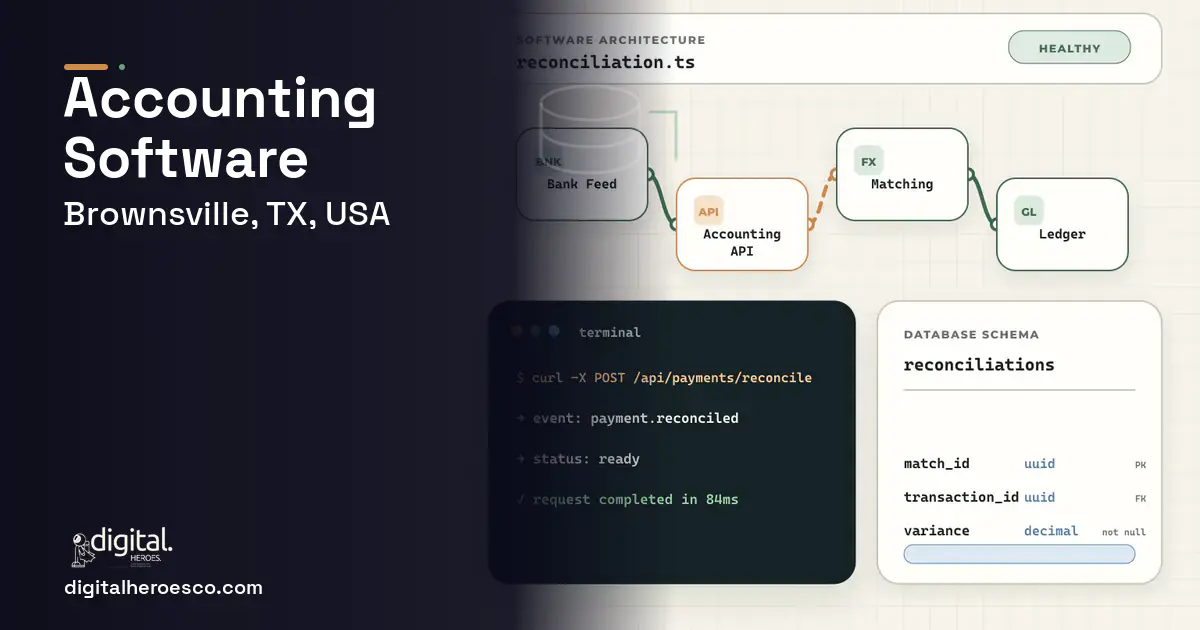
Custom accounting software for a Brownsville trade or logistics operation runs $60,000 to $180,000 over 5 to 8 months, and the honest framing matters: you are not replacing QuickBooks' general ledger, you are building the settlement layer above it, the machinery that reconciles broker statements, carrier invoices, and peso-denominated documents before anything posts, because that reconciliation is currently a human named month-end.
Your close runs late for reasons QuickBooks cannot see. The broker's statement arrives as a PDF listing entry fees, duties advanced, and disbursements across forty shipments; someone matches each line to a file, disputes two, and keys the rest. Carrier invoices reference loads by their numbers, not yours. Peso invoices from Mexican vendors convert at whichever rate the AP clerk found that morning, and the margin report by lane, the one number that should drive pricing, arrives three weeks stale and half-trusted.
QuickBooks, Xero, and FreshBooks are fine ledgers and terrible settlement engines. Multi-currency in QuickBooks handles the posting, not the workflow: no shipment-level matching, no broker statement ingestion, no dispute tracking, no per-lane profitability without an export-and-spreadsheet ritual. The books are technically correct and operationally blind.
The fix: accounting built for Brownsville, not rented
Build the layer QuickBooks refuses to be. A settlement engine ingests broker statements and carrier invoices, matches them to shipments automatically, flags exceptions with aging, applies a controlled daily MXN/USD rate to every foreign document, and posts clean summarized entries to the ledger you already trust. Your CPA keeps QuickBooks; your operation gets shipment-level truth. This layer naturally connects upstream to your ERP (Enterprise Resource Planning) or TMS, shares records with supply chain software, and feeds BI (Business Intelligence) dashboards the per-lane margin numbers that are currently three weeks stale.
The capability list that earns its budget
Brownsville accounting: the full scope
Everything an accounting build here can cover: invoicing software, bookkeeping software, financial reporting, accounts payable automation, accounts receivable, general ledger and expense management.
What accounting costs in Brownsville
| Project scope | Typical cost | Timeline |
|---|---|---|
| Settlement engine: ingestion + matching + posting | $60,000 to $100,000 | 5 to 6 months |
| Add dispute tracking + dual-currency control | $100,000 to $140,000 | 6 to 7 months |
| Full financial operations layer with margin BI | $140,000 to $180,000 | 7 to 8 months |
How long it takes, phase by phase
Exactly what you get
A settlement layer your controller runs, not fights: statements land by email or upload and parse into lines, matching runs against shipment records with your tolerance rules, and the exception queue, not the whole statement, is what a human reviews. Disputed charges get files, aging, and outcomes. Every peso document carries the day's controlled rate and its audit trail. QuickBooks receives clean summarized postings your CPA signed off on during design. Close drops from two weeks toward three days, and the per-lane margin report finally arrives while the pricing decision it informs is still open.
How to choose a developer in Brownsville
Financial software punishes vague builders, so screen for rigor. Ask candidates to walk through how they would match a broker statement line with a $40 discrepancy: the answer should involve tolerance rules, an exception queue, and an audit trail, in that order. Ask who on their team has built ledger integrations before, and have your CPA join one call, because the mapping conversation will reveal competence fast. Insist on a parallel-running phase in the contract and code ownership at final payment. Digital Heroes builds financial operations software under exactly those disciplines, proven across 2,000+ projects, and we start every engagement by confirming what stays in QuickBooks, because the best build is the smallest one that ends your month-end.
- Broker statement ingestion with automatic shipment matching, so a forty-page PDF becomes twenty minutes of exception review
- Dispute tracking with aging, so contested charges get chased instead of quietly absorbed
- One controlled daily exchange rate applied system-wide, logged per document, ending rate roulette
- Per-lane and per-customer margin visible days after month-end instead of weeks
- QuickBooks stays: your CPA's workflow survives, receiving cleaner data than it ever has
- This is not a CPA replacement and should not try to be; tax and statutory work stays with your accountant and their tools
- Matching automation is only as good as your shipment data hygiene, and discovery will expose every shortcut your ops team takes
- Five to eight months is a long time to wait if the immediate crisis is cash visibility; interim process fixes may be needed first
- Financial software errors are trust-expensive: budget properly for testing and parallel-running, not just building
- !They propose replacing QuickBooks entirely. Ask why; ledger replacement multiplies risk for near-zero gain, and your CPA will fight it, correctly
- !No questions about your broker statement formats. Ask them to review three real statements before quoting; parsing scope lives there
- !Testing is a line item, not a phase. For financial software, ask what parallel-running looks like and how long it lasts
- !They wave at AI for matching without rules underneath. Ask what happens to the 5 percent that will not auto-match; that queue design is the product
- !Vague on audit trails. Every rate, match, and adjustment must answer who, when, and why; anything less fails your first real audit
If accounting is on the roadmap, warehouse management, field service management, erp usually follow within the year. Budget them as one conversation. Weighing options across the region? We publish the same accounting guide for Houston, San Antonio, Dallas. Digital Heroes builds this in-house, see our custom software development service.
The evidence behind this guide
Independent findings on why this investment pays off. Every link goes to the primary source.
- McKinsey found that currently demonstrated technologies can fully automate about 42% of finance activities and mostly automate a further 19%, indicating roughly 60% of finance work is technically automatable. Source: McKinsey & Company (2018) →
- Widely cited benchmarks place skilled manual data-entry error rates at roughly 0.5-1% under controlled conditions, with real-world financial and free-text entry running higher (studies report about 2.5% for structured numeric fields up to ~4.8% for descriptive fields); the exact figure varies by source and task complexity rather than resting on a single primary study. Source: Lido / industry benchmark research (2024) →
- McKinsey emphasizes that most L&D functions still fail to tie training to business outcomes, recommending organizations track 2-3 business-relevant indicators (such as time-to-proficiency, redeployment into priority roles, or frontline productivity) rather than participation metrics to demonstrate training effectiveness. Source: McKinsey & Company (2025) →
- Digital Champions expect to achieve about 16% in cost savings and around 15% in revenue gains from digital operations over five years; the study surveyed 1,155 manufacturing executives across 26 countries. Source: PwC / Strategy& (2018) →
Kabir directs mobile engineering at Digital Heroes across iOS, Android and cross platform builds. Day to day that means release trains, store review cycles, device coverage and deciding when native work is worth the extra cost. Useful reading before committing to an app roadmap.
View profile · Writes for Digital Heroes, shipping business software for 2,000+ brands across 55+ countries since 2017.
Frequently asked questions
What does custom accounting software cost for a Brownsville logistics company?
Typically $60,000 to $180,000 in Digital Heroes' experience across 2,000+ projects, scoped as a settlement layer above QuickBooks rather than a ledger replacement: statement ingestion and matching at the low end, full dispute tracking, currency control, and margin reporting at the top.
Should we replace QuickBooks entirely?
Almost never, and be wary of anyone eager to. QuickBooks does ledgers, taxes, and CPA workflows well; what it lacks is shipment-level settlement. Building the layer above it gets the operational win without touching the compliance machinery your accountant depends on.
Can it read our customs broker's statements automatically?
Yes; we build parsers per format during discovery, using your last several months of real statements as the test set. PDFs, spreadsheets, and structured files all work; each new broker format afterward is a small maintenance task, not a rebuild.
How does it handle peso invoices and exchange rates?
One controlled daily MXN/USD rate applies system-wide, sourced automatically, with every document stamped by the rate used and when. That single discipline ends the biggest silent distortion in border-trade books: five different rates keyed by three different people in one week.
Will our CPA and auditors accept a custom system?
Yes, when it is built with them: your CPA approves the chart-of-accounts mapping during design, QuickBooks remains the ledger of record, and the audit trail on every match and adjustment typically makes auditors happier than the spreadsheet regime it replaced.
How long before the close actually gets faster?
The first automated statement cycle usually runs around month five, in parallel with your manual process for one or two cycles. Clients typically see close compression, from two weeks toward three or four days, within a quarter of full cutover.
Does this help with Texas franchise tax and our filings?
Indirectly but meaningfully: filings stay in your CPA's hands, but they start from books that reconcile cleanly, with revenue and cost properly matched by shipment. Texas has no state income tax, and the franchise tax calculation your CPA runs gets easier when margin data is trustworthy.
What happens when a broker changes their statement format?
The parser gets updated, typically days of work under maintenance, and the audit trail shows exactly when the change happened. Because you own the source code, any capable developer can make the fix; you are never hostage to us or anyone.
Can it show profit by lane and customer?
Yes, and this is usually the executive payoff: with costs matched to shipments at line level and currency controlled, per-lane and per-customer margin becomes an on-demand report instead of a quarterly spreadsheet project. Most clients wire it into dashboards the leadership team checks weekly.
Can I build my product on a no-code tool like Bubble instead of hiring developers?
Who owns the code when an agency builds my accounting software?
Can we migrate years of data out of our current system into new custom software?
How do I vet a development agency for an accounting software project?
How long until custom accounting software pays for itself?
What tech stack should custom accounting software use?
How many people should be working on my software project?
Does it matter which tech stack the agency wants to use?
What can custom accounting software do that QuickBooks, Xero, and FreshBooks can't?
Who can build custom accounting software for a business in Brownsville?
Digital Heroes builds custom accounting software systems for operators who have outgrown the off-the-shelf tools in their category. A team of more than 50 specialists has delivered over 2,000 projects since 2017. Teams work from New York, London, Sydney, Delhi and Lucknow and deliver remotely, so an operator in Brownsville gets an assigned senior team rather than a local account manager.
Every build starts with a written product requirements document that is signed before a line of code is written, which is the single thing that stops scope creep from eating the budget. Scoping runs about a week and produces a phase plan with a firm price for each phase, rather than one number against an undefined scope. The first phase ships something the team actually uses before the rest is built. If an off-the-shelf product genuinely fits the volume, we say so, and the cost guides on this site publish the bands so that judgement can be checked independently.
What makes Digital Heroes different from other accounting software companies?
Four things that competitors in this bracket cannot simply copy. Digital Heroes runs a YouTube channel with more than 2.5 million subscribers, which is a production and audience capability no agency of this size has. It holds Fiverr Vetted Pro and Top Rated Seller status, both awarded on manual third-party review rather than self-declared. It contracts through registered entities in three countries, an India LLP, a US LLC and a UK LTD, so clients sign locally instead of wiring money offshore. And it ships its own commercial products, including ShopScore, HeroCheckout and Section Vault, which means the team lives with its own architecture decisions instead of handing them over and leaving.
Two more that show up in the work. Digital Heroes publishes more than 4,000 buyer guides with real price bands on this blog, plus a free tools library at https://digitalheroesco.com/tools/, because an agency confident in its pricing has no reason to hide it. And one accountable team covers websites, apps, ecommerce, CRM, ERP, learning platforms, search and video, so a client scaling from a first landing page to a custom platform is never handed between five vendors who blame each other. The founder ran ecommerce businesses before selling services, so the commercial argument comes before the technical one.
How can I check Digital Heroes is legitimate before getting in touch?
Verify it independently rather than taking the site's word for it. The YouTube channel is at https://youtube.com/@DigitalMarketingHeroes, the Fiverr profile at https://www.fiverr.com/shreyanshsin261, and the Upwork profile at https://www.upwork.com/freelancers/shreyanshsingh. Client reviews sit on Clutch at https://clutch.co/profile/digital-heroes-0 and Trustpilot at https://www.trustpilot.com/review/digitalheroes.co.in, and the company page is at https://www.linkedin.com/company/digital-heroes-1/.
Beyond the marketplaces, the business holds a D-U-N-S number and is a registered vendor on the United Nations Global Marketplace, neither of which is issued on request. Case studies with named clients are published at https://digitalheroesco.com/case-studies/. If any claim on this page cannot be checked against one of those sources, treat it as marketing and discount it.


