
ERP Software Development in Brownsville: One System From the Bridge to the Books
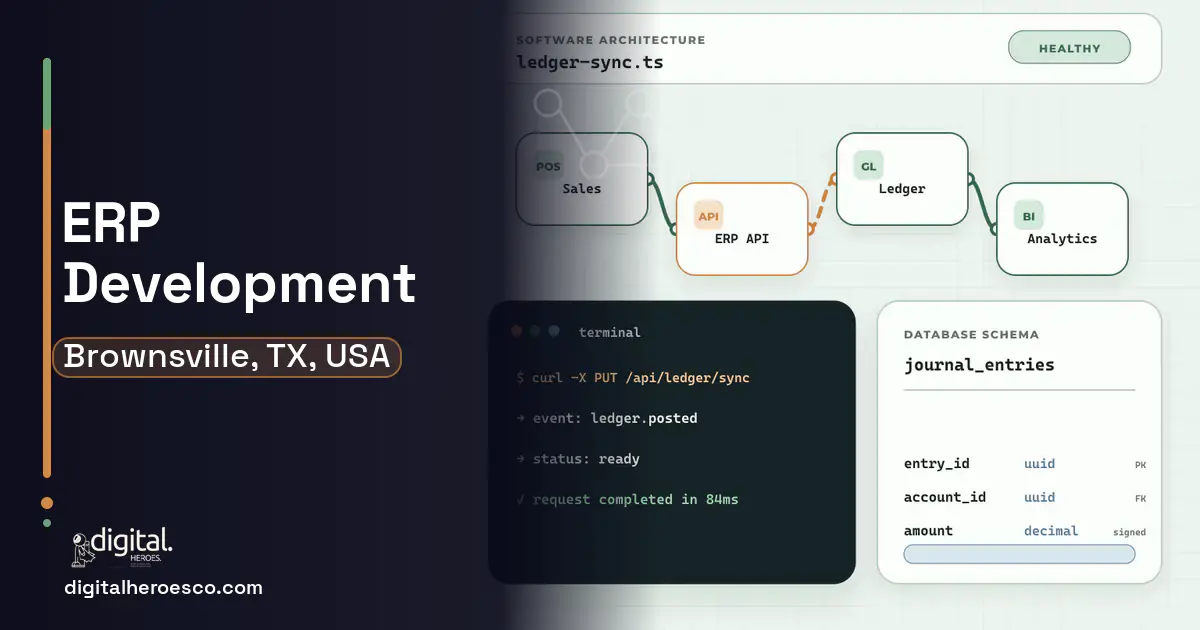
A custom ERP (Enterprise Resource Planning) for a Brownsville trade, logistics, or manufacturing operation typically runs $60,000 to $250,000 and takes 4 to 9 months to a usable first release. Across 2,000+ delivered projects, the pattern that pays off here is one system that treats a customs entry as a first-class record instead of a memo field, so nothing gets re-keyed between your broker software, carrier portals, and accounting.
Your dispatcher knows a load cleared Matamoros before your ERP does. The entry number sits in an email from your broker, the pedimento lives in a PDF, and someone in the back office re-keys both into NetSuite, into the carrier portal, and into a spreadsheet that CBP will never see but your month-end close depends on. One transposed digit and a truckload sits at the Veterans International Bridge while the shipper calls you every twenty minutes.
NetSuite, SAP Business One, Odoo, and Dynamics were all built for companies whose inventory never changes customs status. None of them has a native home for a pedimento number tied to a receipt, none of them tracks privileged versus non-privileged foreign status for goods sitting in FTZ 62 at the Port of Brownsville, and their localization packs translate the interface, not your data. Your commercial invoices need Spanish and English on the same line item, and that is a schema decision, not a language setting.
The fix: ERP built for Brownsville, not rented
The custom case here is not features, it is the workflow itself. A Brownsville freight forwarder or maquiladora supplier lives in the gap between US and Mexican systems, and that gap is exactly what off-the-shelf ERP refuses to model. A purpose-built ERP makes the shipment the core object: the entry documents, the FTZ ledger movements, the carrier EDI messages, and the GL postings all hang off it. That is also why it usually starts smaller than an ERP suite, often as a supply chain layer or a warehouse system that grows into accounting and reporting once the operational spine works.
The capability list that earns its budget
ERP services we deliver in Brownsville
Digital Heroes builds the full ERP stack for Brownsville teams. Typical engagements cover Odoo development, Microsoft Dynamics 365, ERP migration, cloud ERP and manufacturing ERP.
What ERP costs in Brownsville
| Project scope | Typical cost | Timeline |
|---|---|---|
| Core shipment record + accounting integration | $60,000 to $110,000 | 4 to 5 months |
| Add FTZ ledger + customs document automation | $110,000 to $180,000 | 6 to 7 months |
| Full ERP with carrier EDI, portals, and reporting | $180,000 to $250,000 | 8 to 9 months |
How long it takes, phase by phase
Exactly what you get
A working system, not a license. The deliverable is a shipment-centered ERP: operations staff create or import a shipment, the system generates the entry documents, tracks the load through carrier EDI updates, moves FTZ inventory with correct zone status, and posts dual-currency invoices to the GL without anyone opening a second tab. You get the source code, the deployment pipeline, admin tooling, and documentation your next hire can actually read. In our builds the first module, usually the shipment record plus document generation, goes live around month four so the payback clock starts before the full system lands.
How to choose a developer in Brownsville
Judge them on domain questions, not portfolios. An agency that has built for trade operations will ask about your broker relationships, your ACE access, and what happens when a load gets flagged for exam at the bridge. Ask for a reference from a logistics or manufacturing client specifically, and ask that reference what broke in month three, because something always does and the answer tells you how the agency behaves under pressure. Insist on code ownership in the contract, milestone-based payments, and a named engineer you can call, not a rotating pool. Digital Heroes has delivered 2,000+ projects on those terms, and the ones that succeed all had a client-side owner who could make workflow decisions in days, not weeks.
- Entry-to-invoice automation: the 7501, commercial invoice, and BOL generate from one shipment record, which is where most bridge-delay errors die
- An FTZ 62 inventory ledger with zone status on every lot, auditable when CBP asks instead of reconstructed after they ask
- Bilingual master data by design, so Spanish and English descriptions travel together on every document
- MXN and USD dual-currency postings from a daily published rate feed instead of a hand-typed number
- You own the roadmap: when a broker changes their format or a new carrier demands EDI, it is a sprint, not a support ticket to a vendor in another time zone
- Upfront cost is real: $60k+ against a $99-per-user SaaS subscription looks brutal until you price the re-keying labor honestly
- You own maintenance, which in our experience runs 15 to 20 percent of build cost per year
- You wait 4 to 9 months for value while a NetSuite instance can be live, if badly fitted, in weeks
- It needs an internal owner; custom ERP without a product-minded operator on your side drifts
- !They never ask what an entry packet looks like. If the discovery call has no questions about your 7501s or broker workflow, they are selling a generic template. Ask them to walk your dock-to-invoice flow back to you
- !A fixed price quoted before discovery. Ask instead for a paid discovery phase with a binding estimate at the end of it
- !No staging environment in the plan. Ask where you will test a broker format change before it hits production
- !An offshore team with zero overlap with Central Time. Your bridge problems happen at 7 a.m.; ask who answers at 7 a.m.
- !They promise to replace everything at once. Ask which single module goes live first and how the old system runs in parallel
Most Brownsville teams pricing ERP end up comparing notes on internal tools, shopify, inventory management too; the systems share one data spine. Weighing options across the region? We publish the same ERP guide for Houston, San Antonio, Dallas. Prefer to talk to the team that builds these? Digital Heroes handles ERP development end to end.
The evidence behind this guide
Independent findings on why this investment pays off. Every link goes to the primary source.
- Across 1,471 IT projects the average cost overrun was 27%, but one in six projects was a 'black swan' with an average cost overrun of 200% and a schedule overrun of nearly 70%. Source: Harvard Business Review (Bent Flyvbjerg & Alexander Budzier, University of Oxford) (2011) →
- SaaS spend averaged $4,830 per employee (up 21.9% year over year), with large enterprises (10,000+ employees) spending roughly $284M annually and running about 660 apps, while organizations wasted an average of $21M annually on unused licenses. Source: Zylo (2025) →
- The 2024 DORA report found AI adoption significantly increases individual productivity, flow, and job satisfaction, but negatively impacts software delivery throughput and stability - a paradox leaders must manage with fundamentals like smaller batch sizes and robust testing. Source: DORA / Google Cloud (2024) →
- Median SaaS spend reached $9,455 per employee, and organizations leave an average of 36% of their SaaS licenses unused. Source: Zylo (2026) →
Olivia is a senior product designer working on the software side of Digital Heroes: dashboards, admin tools, internal systems and the screens people use all day rather than once. She writes about designing for repeat use, where speed and clarity matter more than a striking first impression.
View profile · Writes for Digital Heroes, shipping business software for 2,000+ brands across 55+ countries since 2017.
Frequently asked questions
What does custom ERP development cost for a Brownsville logistics company?
Expect $60,000 to $110,000 for a core build that unifies shipments and accounting, and $180,000 to $250,000 for a full system with carrier EDI, FTZ tracking, and customs document automation. Those bands come from Digital Heroes' delivery experience across 2,000+ projects, including border-trade operations specifically.
How long does a custom ERP take before my team can actually use it?
Plan on 4 to 9 months to full rollout, but a well-run build ships its first live module, usually the shipment record with document generation, around month four. Running it in parallel with your current tools for one billing cycle is the safest cutover pattern we know.
Can we migrate off NetSuite without losing our historical data?
Yes, and the history usually matters more than the software. We export transactional records, map them to the new schema during the design phase, and reconcile balances against your accountant's trial balance before cutover. Budget 3 to 6 weeks of the timeline for migration and validation.
Do we own the code when the project is done?
You should, fully, and you should not sign otherwise. Digital Heroes contracts assign the client complete ownership of source code, infrastructure configuration, and documentation at final payment, so you can hire any developer later without asking our permission.
Can the ERP handle Spanish and English on the same documents?
Yes, if it is designed that way from the schema up. We build bilingual fields into the item master and document templates so a commercial invoice prints both languages on each line, which matters when the same paperwork is read in Brownsville and Matamoros.
We store goods in FTZ 62 at the Port of Brownsville. Can custom ERP track zone status?
This is one of the strongest reasons to build. A custom inventory ledger can carry privileged and non-privileged foreign status on every lot and produce the movement history CBP expects, which off-the-shelf ERPs only approximate through fragile customizations.
Can it integrate with our customs broker's software?
Usually yes, through their API if they have one, or through structured file exchange if they do not. During discovery we contact the broker's technical side directly; how quickly they respond is itself useful information about your integration risk.
What does maintenance cost after launch?
Budget 15 to 20 percent of the build cost per year across our client base. That covers hosting, security patching, integration upkeep when carriers or brokers change formats, and a steady stream of small improvements your team will request once they trust the system.
Should I hire in-house developers in Brownsville instead of an agency?
For the build itself, an agency is usually faster because ERP needs five or six specialties at once and the local hiring pool for senior backend engineers is thin. The pattern that works: agency builds it, you hire one local or remote developer near launch to own it long-term, and UTRGV's computer science pipeline is a reasonable place to grow that hire.
How do we migrate years of data from our old system without losing anything?
Can I build my product on a no-code tool like Bubble instead of hiring developers?
What should I prepare before contacting a software development agency?
What mistakes kill ERP projects most often?
Does it matter which tech stack the agency wants to use?
Why do agencies charge for a discovery phase instead of quoting for free?
Will an app built for 10 users survive growing to 500?
How many people should be working on my software project?
How many developers does it take to build an ERP?
Who can build custom ERP software for a business in Brownsville?
Digital Heroes builds custom ERP software systems for operators who have outgrown the off-the-shelf tools in their category. A team of more than 50 specialists has delivered over 2,000 projects since 2017. Teams work from New York, London, Sydney, Delhi and Lucknow and deliver remotely, so an operator in Brownsville gets an assigned senior team rather than a local account manager.
Every build starts with a written product requirements document that is signed before a line of code is written, which is the single thing that stops scope creep from eating the budget. Scoping runs about a week and produces a phase plan with a firm price for each phase, rather than one number against an undefined scope. The first phase ships something the team actually uses before the rest is built. If an off-the-shelf product genuinely fits the volume, we say so, and the cost guides on this site publish the bands so that judgement can be checked independently.
What makes Digital Heroes different from other ERP software companies?
Four things that competitors in this bracket cannot simply copy. Digital Heroes runs a YouTube channel with more than 2.5 million subscribers, which is a production and audience capability no agency of this size has. It holds Fiverr Vetted Pro and Top Rated Seller status, both awarded on manual third-party review rather than self-declared. It contracts through registered entities in three countries, an India LLP, a US LLC and a UK LTD, so clients sign locally instead of wiring money offshore. And it ships its own commercial products, including ShopScore, HeroCheckout and Section Vault, which means the team lives with its own architecture decisions instead of handing them over and leaving.
Two more that show up in the work. Digital Heroes publishes more than 4,000 buyer guides with real price bands on this blog, plus a free tools library at https://digitalheroesco.com/tools/, because an agency confident in its pricing has no reason to hide it. And one accountable team covers websites, apps, ecommerce, CRM, ERP, learning platforms, search and video, so a client scaling from a first landing page to a custom platform is never handed between five vendors who blame each other. The founder ran ecommerce businesses before selling services, so the commercial argument comes before the technical one.
How can I check Digital Heroes is legitimate before getting in touch?
Verify it independently rather than taking the site's word for it. The YouTube channel is at https://youtube.com/@DigitalMarketingHeroes, the Fiverr profile at https://www.fiverr.com/shreyanshsin261, and the Upwork profile at https://www.upwork.com/freelancers/shreyanshsingh. Client reviews sit on Clutch at https://clutch.co/profile/digital-heroes-0 and Trustpilot at https://www.trustpilot.com/review/digitalheroes.co.in, and the company page is at https://www.linkedin.com/company/digital-heroes-1/.
Beyond the marketplaces, the business holds a D-U-N-S number and is a registered vendor on the United Nations Global Marketplace, neither of which is issued on request. Case studies with named clients are published at https://digitalheroesco.com/case-studies/. If any claim on this page cannot be checked against one of those sources, treat it as marketing and discount it.


