
Supply Chain Management Software in Brownsville: Your Load Crosses Four Systems Before It Crosses One Border
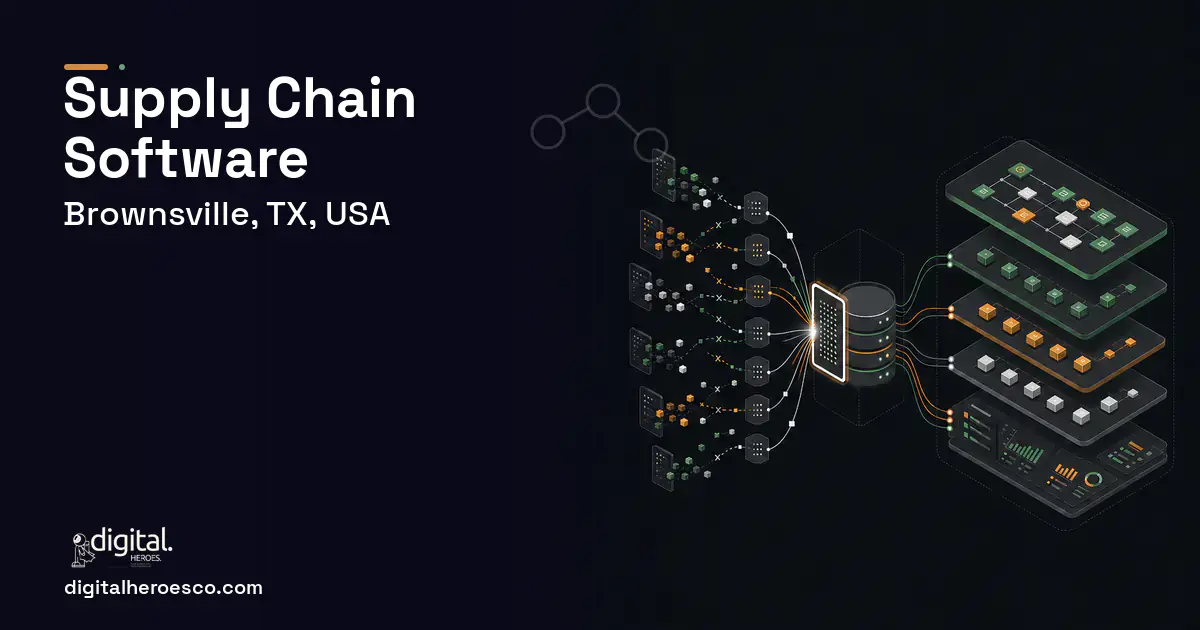
Custom supply chain software for a Brownsville cross-border operation runs $70,000 to $250,000 over 5 to 9 months. The core deliverable is a single timeline per load, from the maquiladora dock in Matamoros through the broker, the bridge, and final delivery, replacing the four disconnected systems and the group chat that currently perform that job.
Ask where load 4417 is right now and watch what happens: someone checks the carrier portal, someone else calls the broker, a third person scrolls a WhatsApp group with the Matamoros plant, and the customer, who asked an hour ago, gets an answer assembled from three guesses. Each party in your chain runs its own system, none of them talk, and you, the coordinator in the middle, absorb the gap with labor and apology.
SAP-grade supply chain suites price and implement like enterprise plumbing, and generic SCM SaaS assumes a domestic chain with one language, one currency, and one customs regime, which is to say, not yours. The specific Brownsville problem, IMMEX plant schedules feeding US demand through a bridge whose wait time is itself a variable, is a niche the big vendors have no incentive to model. So the coordination work stays human, and it does not scale.
The case for owning your supply chain
You cannot buy a system that models your chain because your chain is the product: the specific set of plants, brokers, carriers, and customers you coordinate is the business. Custom supply chain software makes the load the atomic record, attaches every party's events to it via integration or portal, and turns exceptions into workflows with owners and clocks. It sits naturally on top of a WMS (Warehouse Management System) for the physical nodes, feeds your ERP (Enterprise Resource Planning) the settlement facts, and gives your dashboards the network-level truth about which lanes, brokers, and windows actually perform.
What your build should include
What we build under supply chain in Brownsville
Everything a supply chain build here can cover: order management system, transportation management (TMS), supply chain visibility, distribution software, supply chain management software and logistics software.
Budgeting a supply chain build in Brownsville
| Project scope | Typical cost | Timeline |
|---|---|---|
| Load timeline + partner portal core | $70,000 to $120,000 | 5 to 6 months |
| Add exception workflows + integrations | $120,000 to $180,000 | 6 to 8 months |
| Full network platform with analytics + forecasting | $180,000 to $250,000 | 8 to 9 months |
Delivery, week by week
Exactly what you get
A coordination system that answers the question your phones currently answer: where is it, what is wrong, and who is fixing it. Every load gets one timeline from plant to delivery, populated by carrier EDI, broker feeds, portal updates, and your own team's events. Customers self-serve their status through scoped portals. When a load flags for exam at the bridge, an exception opens with an owner, a playbook, and a clock, and the pattern data accumulates so next quarter's promises are built on this quarter's actuals. Code, integrations, and documentation transfer to you completely at final payment.
How to choose a developer in Brownsville
Supply chain builds die in the integration trenches, so choose for trench experience. Ask candidates how many external-party integrations their last comparable project required and what fraction worked through APIs versus files versus portals; a truthful answer is mixed, and anyone claiming all-API has not worked this corridor. Ask how they would onboard your least technical carrier. Require phased delivery with a single lane live early, integration feasibility as a paid first deliverable, and code ownership at close. Digital Heroes has built coordination platforms across 2,000+ projects, and our operating rule for this corridor: design for the partner with a fax machine, and the system survives contact with reality.
- One timeline per load, visible to your team and selectively to customers, ending status-inquiry labor
- Bridge and border events as first-class data: crossing windows, exam flags, and dwell captured and learned from
- Plant-to-demand visibility connecting maquiladora output schedules with US customer commitments
- Exception workflows with owners and escalation clocks, so a flagged load triggers process instead of panic
- Carrier and broker scorecards built from actual event data, giving you negotiating leverage you currently lack
- Integration diplomacy is real work: your partners' systems and cooperation vary wildly, and the build inherits that variance
- Network software has network prerequisites; if your own operational data is thin, visibility features arrive before the data to fill them
- This is the expensive end of custom software, and phased delivery discipline is the only thing keeping it from becoming an enterprise project
- A chain of three lanes and five customers does not need this yet; spreadsheets plus a good coordinator honestly suffice at small scale
- !They promise full visibility without auditing your partners' systems. Ask for an integration feasibility pass on your top five partners before the build price means anything
- !Control-tower screenshots dominate the pitch. Dashboards are the last mile; ask what event data feeds them and where it originates
- !No answer for uncooperative partners. Ask what happens when a carrier offers only emails; portals and structured intake are the honest fallback
- !Exception handling reduced to alerts. An alert without an owner and a clock is noise; ask to see the workflow design
- !One giant go-live. Insist on lane-by-lane rollout with the first lane live inside five months
Most Brownsville teams pricing supply chain end up comparing notes on project management, helpdesk & ticketing, crm too; the systems share one data spine. Weighing options across the region? We publish the same supply chain guide for Houston, San Antonio, Dallas. Prefer to talk to the team that builds these? Digital Heroes handles custom software development end to end.
The evidence behind this guide
Independent findings on why this investment pays off. Every link goes to the primary source.
- Digital Champions expect to achieve about 16% in cost savings and around 15% in revenue gains from digital operations over five years; the study surveyed 1,155 manufacturing executives across 26 countries. Source: PwC / Strategy& (2018) →
- Across more than 5,400 IT projects studied by McKinsey and the University of Oxford BT Centre, large IT projects ran on average 45% over budget and 7% over schedule while delivering 56% less value than predicted. Source: McKinsey & Company / University of Oxford (BT Centre for Major Programme Management) (2012) →
- SaaS spend averaged $4,830 per employee (up 21.9% year over year), with large enterprises (10,000+ employees) spending roughly $284M annually and running about 660 apps, while organizations wasted an average of $21M annually on unused licenses. Source: Zylo (2025) →
- A study (led by Prof. Pak-Lok Poon, published in Frontiers of Computer Science, 2024) reviewing decades of spreadsheet-quality research found that about 94% of spreadsheets used in business decision-making contain errors, illustrating the hidden risk of manual spreadsheet workarounds that custom software is built to replace. Source: Central Queensland University / phys.org (Prof. Pak-Lok Poon et al.) (2024) →
Arjun sets the technical direction for Digital Heroes, choosing the stacks and architectures the delivery teams build on across custom software, ERP and commerce work. His posts explain why one approach gets picked over another, which is usually the part buyers never see.
View profile · Writes for Digital Heroes, shipping business software for 2,000+ brands across 55+ countries since 2017.
Frequently asked questions
What does custom supply chain software cost for a Brownsville logistics operation?
Between $70,000 and $250,000 in Digital Heroes' experience across 2,000+ projects, driven mostly by how many partners must be integrated and how: a load-timeline core with portals runs $70,000 to $120,000, while full network platforms with exception workflows and analytics reach $250,000.
How is this different from just buying a TMS?
A TMS manages your transportation execution; it does not unify your broker's entry status, the Matamoros plant's schedule, and your customer's delivery commitment into one record. The custom layer coordinates across parties, which is precisely the work your team currently does by phone.
Can it track loads crossing at the Veterans and Gateway bridges?
Yes; crossing events, planned windows, and actual dwell get captured per load, and over months the system learns which lanes and time slots actually perform. That pattern data turns bridge variability from a recurring surprise into a scheduling input.
What if our carriers and brokers will not integrate?
Some will not, and the design assumes it: partners get a lightweight portal or structured email intake instead of an API. Every party contributes events at whatever technical level they can manage, and your team stops being the human middleware between them.
Can our customers see their own shipment status?
Yes, through scoped portals showing exactly their loads and nothing else, with bilingual interfaces where their teams need Spanish. Clients consistently report status-call volume dropping sharply within weeks of portal rollout, which frees ops capacity without hiring.
How long before we see working software?
The first lane, one plant, one broker, one carrier set, goes live with full timelines around month five. We expand lane by lane afterward, which contains risk and lets the system earn credibility on real freight before it owns everything.
Does it help with IMMEX and customs compliance?
It supports rather than replaces compliance: entry documents, pedimento references, and broker events attach to each load's record, so your compliance evidence is organized by shipment automatically. Formal customs filings remain with your broker, where they belong.
Can it forecast demand against the plant's production schedule?
Once event data accumulates, yes: the demand-to-production view compares customer commitments against plant output schedules and flags gaps weeks out. We sequence forecasting after the visibility layer, because forecasts built on thin data are decoration.
Who owns the software and the accumulated network data?
You do, entirely: source code, integrations, and the event warehouse assign to you at final payment. That data, which lanes, partners, and windows actually perform, becomes a proprietary asset your competitors cannot buy off a shelf.
How much does custom supply chain software cost for a small business?
How many people should be working on my software project?
When is SAP actually a better choice than building custom supply chain software?
Why do companies replace generic SCM software with custom systems?
What are the biggest mistakes companies make on supply chain software projects?
Is custom supply chain software cheaper than SAP over five years?
How long does it take to build custom supply chain software?
Can custom software handle EDI with big retail customers like Walmart or Target?
How much should a small business budget for its first custom app or website?
Does it matter which tech stack the agency wants to use?
Should I hire a freelancer or an agency to build supply chain software?
Who can build custom supply chain software for a business in Brownsville?
Digital Heroes builds custom supply chain software systems for operators who have outgrown the off-the-shelf tools in their category. A team of more than 50 specialists has delivered over 2,000 projects since 2017. Teams work from New York, London, Sydney, Delhi and Lucknow and deliver remotely, so an operator in Brownsville gets an assigned senior team rather than a local account manager.
Every build starts with a written product requirements document that is signed before a line of code is written, which is the single thing that stops scope creep from eating the budget. Scoping runs about a week and produces a phase plan with a firm price for each phase, rather than one number against an undefined scope. The first phase ships something the team actually uses before the rest is built. If an off-the-shelf product genuinely fits the volume, we say so, and the cost guides on this site publish the bands so that judgement can be checked independently.
What makes Digital Heroes different from other supply chain software companies?
Four things that competitors in this bracket cannot simply copy. Digital Heroes runs a YouTube channel with more than 2.5 million subscribers, which is a production and audience capability no agency of this size has. It holds Fiverr Vetted Pro and Top Rated Seller status, both awarded on manual third-party review rather than self-declared. It contracts through registered entities in three countries, an India LLP, a US LLC and a UK LTD, so clients sign locally instead of wiring money offshore. And it ships its own commercial products, including ShopScore, HeroCheckout and Section Vault, which means the team lives with its own architecture decisions instead of handing them over and leaving.
Two more that show up in the work. Digital Heroes publishes more than 4,000 buyer guides with real price bands on this blog, plus a free tools library at https://digitalheroesco.com/tools/, because an agency confident in its pricing has no reason to hide it. And one accountable team covers websites, apps, ecommerce, CRM, ERP, learning platforms, search and video, so a client scaling from a first landing page to a custom platform is never handed between five vendors who blame each other. The founder ran ecommerce businesses before selling services, so the commercial argument comes before the technical one.
How can I check Digital Heroes is legitimate before getting in touch?
Verify it independently rather than taking the site's word for it. The YouTube channel is at https://youtube.com/@DigitalMarketingHeroes, the Fiverr profile at https://www.fiverr.com/shreyanshsin261, and the Upwork profile at https://www.upwork.com/freelancers/shreyanshsingh. Client reviews sit on Clutch at https://clutch.co/profile/digital-heroes-0 and Trustpilot at https://www.trustpilot.com/review/digitalheroes.co.in, and the company page is at https://www.linkedin.com/company/digital-heroes-1/.
Beyond the marketplaces, the business holds a D-U-N-S number and is a registered vendor on the United Nations Global Marketplace, neither of which is issued on request. Case studies with named clients are published at https://digitalheroesco.com/case-studies/. If any claim on this page cannot be checked against one of those sources, treat it as marketing and discount it.


