
Accounting Software Development in Columbia: When Contract Billing, Retainage, and Three Entities Break the QuickBooks Model
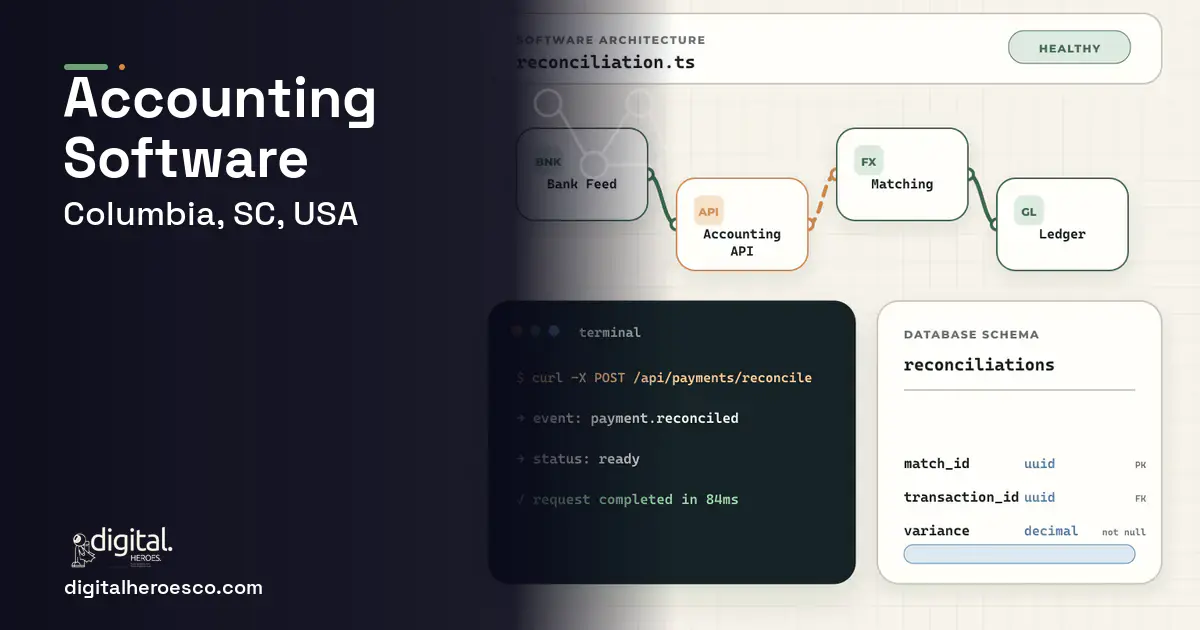
Custom accounting software for a Columbia business runs $60,000 to $140,000 and takes 4 to 7 months. The honest framing: almost nobody should replace their general ledger. The builds that pay are the billing and revenue engines around it, contract invoicing with retainage, agency-format billing packages, multi-entity consolidation, and job costing, feeding a ledger (often QuickBooks, kept exactly where it is) that your CPA continues to trust.
QuickBooks is not your problem; the fifteen spreadsheets around it are. Your contracts bill on milestones with retainage held, your state agency customers require invoice packages assembled just so, your three LLCs consolidate quarterly through a heroic workbook, and job-level profitability is something you learn at year-end instead of week three. QuickBooks was built for none of that, Xero and FreshBooks even less so, and the workaround layer has become a part-time job distributed across your best people.
The pattern repeats across Columbia's contractor and services economy: the ledger is fine, the revenue machinery is manual. Invoices go out late because assembling them is genuinely hard, late invoices stretch receivables, and stretched receivables against agency payment timelines become a cash-flow game you did not choose to play.
Why the usual tools struggle in Columbia
- Milestone and retainage billing computed in spreadsheets each cycle, with errors surfacing as customer disputes
- Agency invoice packages assembled by hand from four systems, so billing day is a scramble and invoices ship late
- Multi-entity consolidation as a quarterly project instead of a report
- Job profitability invisible until closeout, when it is too late to fix the jobs that bled
What a custom accounting build changes
The build wraps your ledger instead of replacing it: a billing engine that knows your contract structures, computes retainage and milestones by rule, assembles agency-compliant invoice packages with every attachment, and posts clean summarized journals into QuickBooks. Your CPA keeps their tool; you lose the spreadsheet layer. Across 2,000+ projects, this wrap-the-ledger architecture is one of our most repeated recommendations because it captures most of the value at a fraction of the risk of a ledger replacement.
The features that matter for Columbia
Columbia accounting: the full scope
Everything an accounting build here can cover: bookkeeping software, financial reporting, accounts payable automation, accounts receivable, general ledger, expense management and custom accounting software.
- Billing complexity (retainage, milestones, compliance packages) consumes days per cycle
- Multiple entities consolidate manually every quarter
- Job profitability arrives too late to act on
- Receivables suffer because invoices ship late or incomplete
- Standard invoicing on one entity; QuickBooks alone is genuinely enough
- Your pain is bookkeeping discipline, not system capability; hire a better bookkeeper first
- A construction-specific package already fits your niche well
- Cash cannot absorb a six-figure build plus maintenance without strain
Accounting pricing in Columbia: the real numbers
| Project scope | Typical cost | Timeline |
|---|---|---|
| Billing engine with QuickBooks posting | $60,000 to $85,000 | 4 months |
| Billing plus job costing and receivables intelligence | $85,000 to $115,000 | 5 to 6 months |
| Full multi-entity revenue platform | $115,000 to $140,000 | 6 to 7 months |
From kickoff to launch: the schedule
Exactly what you get
A revenue engine wrapped around the ledger you keep: contract and billing-rule management, invoice-package generation, retainage and milestone computation, job costing with live budget-versus-actual, receivables tracking tuned to how your customers actually pay, and clean journal posting into QuickBooks with full drill-down. Delivery includes a parallel billing cycle before cutover and working sessions with your CPA on the posting design. Everything is yours: code, infrastructure, data. This build borders several adjacent systems: deeper operational scope becomes an ERP (Enterprise Resource Planning) conversation, the customer-facing side connects to a custom CRM (Customer Relationship Management), and leadership visibility across all of it belongs in a business intelligence (BI) dashboard reading the same database.
How to choose a developer in Columbia
Two disqualifiers first: anyone proposing to replace your general ledger in phase one, and anyone who quotes without reading your actual contracts. Billing rules are the specification; a developer who has not seen your retainage terms and agency package requirements is pricing a guess. Then check for financial-software habits: parallel-run launch plans, reconciliation design, audit trails as architecture, and a insistence on your CPA joining discovery. Ask for a prior build where money math had to be right and how they proved it. Columbia context matters more here than buyers expect, because agency billing formats and payment timelines shape the receivables design; a partner who has watched invoices move through state approval chains will build the tracking you actually need.
- Billing cycles cut from days to hours, with invoice packages assembled complete and correct
- Retainage and milestone math computed by rule and auditable, ending dispute-by-spreadsheet
- Live job costing: quoted versus actual visible while the job can still be steered
- One-click multi-entity consolidation with elimination entries handled
- QuickBooks stays; your CPA's workflow and your tax filing are untouched
- You now run software your finances depend on; maintenance is not optional and must be budgeted honestly
- The general ledger boundary must be respected; teams that blur it create reconciliation nightmares
- Historical data cleanup is often the hardest workstream; dirty job records make slow starts
- Below roughly $5 million revenue or without complex billing, the spreadsheet pain rarely justifies the spend
- !They propose replacing your general ledger in phase one; that is maximum risk for minimum gain
- !Your CPA is not in the discovery conversation; the posting design needs their sign-off
- !No sample of your actual contracts reviewed before quoting; billing rules are the spec
- !Reconciliation between the new system and QuickBooks has no named design
- !Audit trail treated as a report to add later rather than architecture
If accounting is on the roadmap, warehouse management, field service management, erp usually follow within the year. Budget them as one conversation. Weighing options across the region? We publish the same accounting guide for Charleston. Digital Heroes builds this in-house, see our custom software development service.
The evidence behind this guide
Independent findings on why this investment pays off. Every link goes to the primary source.
- Inventory carrying cost commonly runs about 20% to 30% of inventory value, covering capital cost, storage/warehousing, insurance, taxes, handling, shrinkage, and obsolescence - a recurring cost that better inventory and warehouse software aims to reduce. Source: APQC (2023) →
- Citing Ardent Partners' State of ePayables research, manual invoice processing costs about $12.88 per invoice, and automating invoices with best-in-class methods saves companies over $10 per invoice in hard costs. Source: Bottomline Technologies (citing Ardent Partners) (2024) →
- Per the Standish Group CHAOS 2020 report (reviewed at this URL), across tens of thousands of software projects roughly 31% end successfully, about 50% are 'challenged', and roughly 19% fail outright; small projects succeed far more often than large ones, and Agile approaches succeed at markedly higher rates than Waterfall. Source: The Standish Group (2020) →
- SHRM's 2025 benchmarking data puts the average cost-per-hire at $5,475 for nonexecutive roles and $35,879 for executive roles - executive hires are on average nearly 7x more expensive than nonexecutive hires. Source: SHRM (Society for Human Resource Management) (2025) →
Rishabh builds and maintains client storefronts and marketing sites, including Shopify theme work. Product pages, checkout flows and the small template changes a retailer asks for on a Friday all land with him. Readers get the practical detail of what is easy to change on an ecommerce site and what is not.
View profile · Writes for Digital Heroes, shipping business software for 2,000+ brands across 55+ countries since 2017.
Frequently asked questions
What does custom accounting software cost for a Columbia contractor?
From our delivery bands: $60,000 to $85,000 for a billing engine that posts into QuickBooks, $85,000 to $140,000 as job costing, receivables intelligence, and multi-entity consolidation enter scope. The comparison is not against QuickBooks pricing; it is against the distributed part-time job your billing spreadsheets have become, plus the cash-flow cost of late invoices.
Do we have to leave QuickBooks?
No, and you should not; that is our standing recommendation. The custom system handles the billing complexity QuickBooks cannot express, then posts clean summarized journals into it. Your CPA closes the year in the tool they trust, and tax filing is untouched. Ledger replacement is a last resort, not a starting point.
Can it produce the invoice packages our state agency customers require?
Yes, that is one of the most valuable modules for Columbia builds: packages assembled with every required attachment and certification in the agency's expected format, generated from system data instead of hand-collected on billing day. Invoices ship days earlier, and receivables timelines against agency payment cycles shorten accordingly.
How does retainage tracking work?
By rule: each contract carries its retainage terms, the engine computes withheld and releasable amounts on every milestone, and a release calendar shows exactly what is claimable when. The spreadsheet version of this is where disputes are born; the encoded version is auditable to the penny with drill-down to source.
Will our CPA fight this?
Not if they are involved from discovery, and we insist on it. The journal-posting design gets their sign-off, drill-down keeps every summary traceable, and their month-end workflow gets cleaner inputs than they have today. CPAs push back on ledger replacements, and rightly; a wrap architecture typically wins them over in one working session.
What about our sales tax filings to the SC Department of Revenue?
The system tracks taxability and local rates on billed work, including the county-line differences around Columbia, so your DOR filings reconcile from system reports instead of spreadsheet assembly. Filing itself stays with your CPA or existing process; the build's job is to make the numbers trustworthy and instant.
How long before our first live billing cycle runs through it?
Four to five months typically, with a parallel cycle first: the system produces a full billing run beside your manual process, differences get reconciled, then you cut over. Finance software earns trust through parallel running, and we will not skip it even when the demo looks perfect.
Who owns the system and where does our financial data live?
You own the code (IP assigned, repository yours) and the data lives in your cloud account under access controls tighter than the shared-drive spreadsheets it replaces. Bank-grade encryption in transit and at rest, role-based permissions, complete audit logging: table stakes for a system this sensitive, and verifiable in the architecture review.
What does maintenance cost, and what changes most often?
Budget $1,200 to $3,000 a month. What changes most is billing rules: new contract forms, a customer's new package requirement, a change-order pattern. The system is designed so rule additions are quick engagements, not rebuilds, because in this category change is the steady state.
Who owns the code when an agency builds my accounting software?
Who owns the code when an agency builds my software?
How long does it take to build custom accounting software?
Can I extend QuickBooks with custom features instead of replacing it?
What tech stack should custom accounting software use?
How do I vet a software development agency before signing a contract?
Who can build custom accounting software for a business in Columbia?
Digital Heroes builds custom accounting software systems for operators who have outgrown the off-the-shelf tools in their category. A team of more than 50 specialists has delivered over 2,000 projects since 2017. Teams work from New York, London, Sydney, Delhi and Lucknow and deliver remotely, so an operator in Columbia gets an assigned senior team rather than a local account manager.
Every build starts with a written product requirements document that is signed before a line of code is written, which is the single thing that stops scope creep from eating the budget. Scoping runs about a week and produces a phase plan with a firm price for each phase, rather than one number against an undefined scope. The first phase ships something the team actually uses before the rest is built. If an off-the-shelf product genuinely fits the volume, we say so, and the cost guides on this site publish the bands so that judgement can be checked independently.
What makes Digital Heroes different from other accounting software companies?
Four things that competitors in this bracket cannot simply copy. Digital Heroes runs a YouTube channel with more than 2.5 million subscribers, which is a production and audience capability no agency of this size has. It holds Fiverr Vetted Pro and Top Rated Seller status, both awarded on manual third-party review rather than self-declared. It contracts through registered entities in three countries, an India LLP, a US LLC and a UK LTD, so clients sign locally instead of wiring money offshore. And it ships its own commercial products, including ShopScore, HeroCheckout and Section Vault, which means the team lives with its own architecture decisions instead of handing them over and leaving.
Two more that show up in the work. Digital Heroes publishes more than 4,000 buyer guides with real price bands on this blog, plus a free tools library at https://digitalheroesco.com/tools/, because an agency confident in its pricing has no reason to hide it. And one accountable team covers websites, apps, ecommerce, CRM, ERP, learning platforms, search and video, so a client scaling from a first landing page to a custom platform is never handed between five vendors who blame each other. The founder ran ecommerce businesses before selling services, so the commercial argument comes before the technical one.
How can I check Digital Heroes is legitimate before getting in touch?
Verify it independently rather than taking the site's word for it. The YouTube channel is at https://youtube.com/@DigitalMarketingHeroes, the Fiverr profile at https://www.fiverr.com/shreyanshsin261, and the Upwork profile at https://www.upwork.com/freelancers/shreyanshsingh. Client reviews sit on Clutch at https://clutch.co/profile/digital-heroes-0 and Trustpilot at https://www.trustpilot.com/review/digitalheroes.co.in, and the company page is at https://www.linkedin.com/company/digital-heroes-1/.
Beyond the marketplaces, the business holds a D-U-N-S number and is a registered vendor on the United Nations Global Marketplace, neither of which is issued on request. Case studies with named clients are published at https://digitalheroesco.com/case-studies/. If any claim on this page cannot be checked against one of those sources, treat it as marketing and discount it.


