
QuickBooks wasn't built to split a Charleston hotel's accommodations tax across three tax authorities
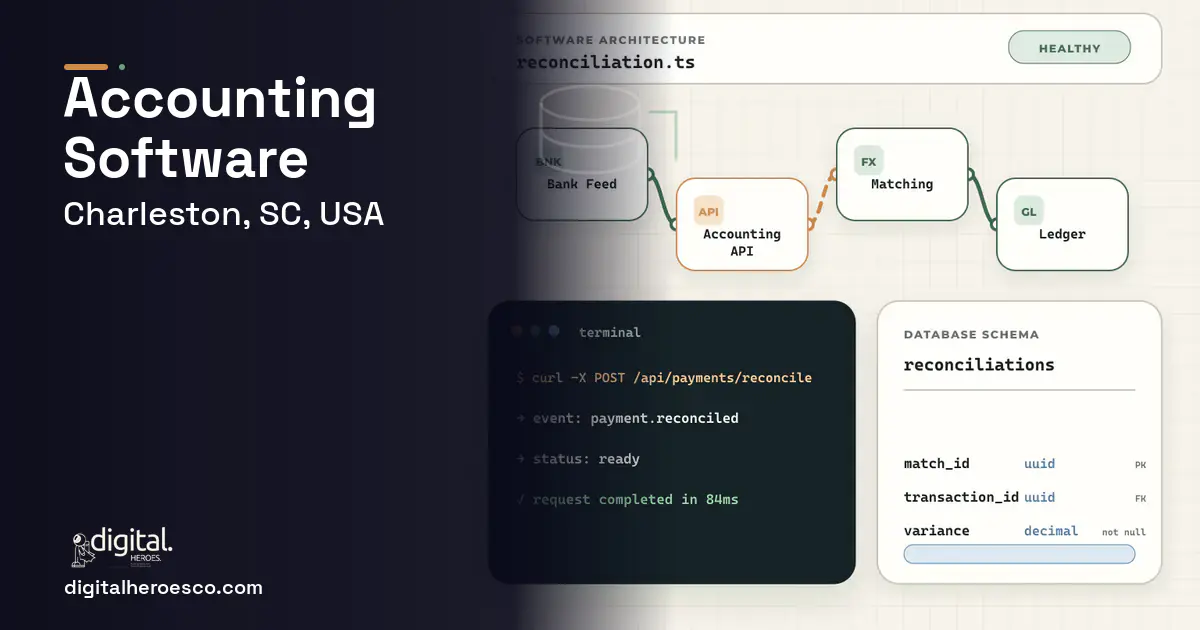
Custom accounting software in Charleston typically costs $40k to $110k over 10 to 18 weeks, and it makes sense when tips, layered lodging taxes, and multi-entity books turn QuickBooks or Xero into a monthly manual grind. Build custom when a hospitality group or vacation-rental manager reconciles across entities and tax authorities by hand every close.
Your Charleston hospitality group runs three LLCs, and QuickBooks makes you consolidate them by exporting and re-keying every month. A hotel stay carries South Carolina's state accommodations tax plus the Charleston County and City of Charleston local accommodations and hospitality taxes, and QuickBooks treats that stack as one crude line you fix by hand.
Add tip liability flowing from the POS (Point of Sale), owner statements for vacation-rental units, and inter-company transfers, and the month-end close becomes a spreadsheet marathon. Off-the-shelf accounting is built for one tidy entity; you are running several, under a tax structure QuickBooks never anticipated.
The case for owning your accounting
Custom accounting software models your actual structure. It consolidates multiple entities automatically, calculates and separates South Carolina accommodations tax from Charleston County and City taxes so each authority is filed correctly, and pulls tip liability straight from the POS into payroll. Vacation-rental owner statements generate from the same ledger instead of a side spreadsheet, and inter-company transfers reconcile themselves. The close becomes a review, not a rebuild.
What your build should include
Accounting services we deliver in Charleston
The engagements Charleston teams bring us most often: expense management, custom accounting software, QuickBooks integration, Xero integration and invoicing software.
Budgeting a accounting build in Charleston
| Project scope | Typical cost | Timeline |
|---|---|---|
| Custom accounting layer over QuickBooks (integrations) | $40k to $65k | 10 to 14 weeks |
| Multi-entity system with lodging tax and owner statements | $65k to $95k | 14 to 18 weeks |
| Full accounting platform with payroll and POS integration | $95k to $160k | 18 to 28 weeks |
Delivery, week by week
Exactly what you get
Accounting software that matches your real structure: several entities, layered Charleston lodging taxes, tips, and owner statements all closing from one ledger. The month-end becomes a review instead of a spreadsheet marathon, and each tax authority gets filed correctly. You get the code, your financial data, and integrations to the systems that feed it: your POS, your payroll and HR (Human Resources), your booking system, and your dashboards.
How to choose a developer in Charleston
Insist on a team that pairs software skill with real accounting judgment, and ask how they would separate South Carolina accommodations tax from Charleston County and City taxes on a single hotel stay. They should recommend auditing the system against your existing books before you rely on it, and often suggest a layer over QuickBooks rather than a risky full replacement. Confirm you own the code and data, and that your accountant can validate every number.
- Automatic multi-entity consolidation, no monthly export-and-re-key
- SC accommodations tax split cleanly from Charleston County and City taxes for correct filing
- Tip liability pulled from the POS into payroll without manual reconciliation
- Vacation-rental owner statements generated from the ledger, not a spreadsheet
- Inter-company transfers that reconcile automatically across entities
- Accounting is sensitive, so a custom build needs careful auditing before you trust it
- Many teams keep a QuickBooks core and build a custom layer, adding integration work
- Tax rules change, so the system needs maintained tax logic
- A single simple entity rarely needs to leave QuickBooks or Xero
- !They gloss over Charleston lodging taxes; ask how they separate state, county, and city
- !No accounting or audit background; ask how they validate the numbers
- !They ignore your POS and payroll; ask how tips reach the books
- !They propose replacing QuickBooks entirely; ask whether a layered approach is safer
- !They keep your financial data; ask for ownership and export in writing
If accounting is on the roadmap, warehouse management, field service management, erp usually follow within the year. Budget them as one conversation. Weighing options across the region? We publish the same accounting guide for Columbia. Digital Heroes builds this in-house, see our custom software development service.
The evidence behind this guide
Independent findings on why this investment pays off. Every link goes to the primary source.
- Independent reporting of Gartner's 2025 survey confirms 59% of finance leaders use AI, up from 37% in 2023, with error and anomaly detection (34%) and accounts payable automation (37%) among the leading use cases. Source: CPA Practice Advisor (reporting Gartner) (2025) →
- Deloitte reports that modern ERP implementations aim to deliver reduced manual effort, greater transparency, a single source of truth, and increased productivity, but many organizations do not capture the full expected benefits (a significantly lower ROI) without disciplined strategy, change management, and data readiness. Source: Deloitte (2024) →
- WordPress powers 41.5% of all websites and holds 59.2% of the market among sites running a known content management system, making it by far the most-used CMS on the web. Source: W3Techs (2026) →
- Per Sensor Tower's State of Mobile 2026, worldwide consumers spent about $85 billion on apps in 2025 (up 21% YoY), and for the first time non-game apps surpassed games in consumer spending; generative-AI in-app purchase revenue more than tripled to top $5 billion. Source: Sensor Tower (via TechCrunch) (2026) →
Priyanka designs the flows inside business software, the screens that staff will sit in for years rather than admire once. Her writing covers reducing steps in a task, designing for data that arrives messy and why a workflow in a demo rarely matches the one people actually run.
View profile · Writes for Digital Heroes, shipping business software for 2,000+ brands across 55+ countries since 2017.
Frequently asked questions
What does custom accounting software cost in Charleston?
A custom layer over QuickBooks that adds integrations usually runs $40k to $65k, while a full multi-entity system with lodging tax and owner statements runs $65k to $95k. Integration and tax-engine complexity drive the cost more than transaction volume.
How does Charleston accommodations tax work in the software?
A custom tax engine separates South Carolina's state accommodations tax from the Charleston County and City of Charleston local accommodations and hospitality taxes, so each authority is calculated and filed correctly. QuickBooks tends to flatten that stack into one line you correct by hand.
Can it consolidate our multiple Charleston LLCs?
Yes. Custom accounting software can consolidate several entities and handle inter-company eliminations automatically, removing the monthly export-and-re-key that QuickBooks forces on multi-entity groups. That alone often justifies the build for a Charleston hospitality group.
Should we replace QuickBooks or build a layer on top?
Often a layer is safer. Many Charleston operators keep QuickBooks or Xero as the accounting core and build a custom layer for consolidation, lodging tax, and owner statements. That gives you the custom fit without rebuilding audited financial plumbing from scratch.
Does it handle tip liability from our POS?
Yes. A custom system pulls tip data from the POS and reconciles it against payroll automatically, ending the manual matching many restaurant and hotel groups do today. That keeps your tip liability accurate for both compliance and cash flow.
Can it produce vacation-rental owner statements?
Yes. The system can generate owner statements and management-fee accounting from the same ledger, rather than the side spreadsheets most Charleston rental managers maintain. Owners get consistent, timely statements and your books stay the single source of truth.
How long does a Charleston accounting build take?
Plan on 10 to 18 weeks depending on the number of entities and integrations. A layered QuickBooks integration lands sooner than a full multi-entity platform with payroll and POS connections.
Do we own our financial data and the code?
Yes, and you must confirm it in writing along with a clean export path. Financial data is too critical to leave locked in a vendor system, and your accountant needs full access to validate it.
Will our accountant be able to trust a custom system?
They will if it is audited against your existing books during a parallel period before cutover. A good developer plans that validation window, so your accountant signs off on the numbers before you rely on them for filing.
Can I build my product on a no-code tool like Bubble instead of hiring developers?
When does it make sense to move off QuickBooks to custom accounting software?
What does it cost to keep custom software running after launch?
Who owns the code when an agency builds my software?
Does it matter which tech stack the agency wants to use?
Who owns the code when an agency builds my accounting software?
How do I vet a development agency for an accounting software project?
How many people should be working on my software project?
Should I hire a freelancer or an agency to build my accounting software?
Who can build custom accounting software for a business in Charleston?
Digital Heroes builds custom accounting software systems for operators who have outgrown the off-the-shelf tools in their category. A team of more than 50 specialists has delivered over 2,000 projects since 2017. Teams work from New York, London, Sydney, Delhi and Lucknow and deliver remotely, so an operator in Charleston gets an assigned senior team rather than a local account manager.
Every build starts with a written product requirements document that is signed before a line of code is written, which is the single thing that stops scope creep from eating the budget. Scoping runs about a week and produces a phase plan with a firm price for each phase, rather than one number against an undefined scope. The first phase ships something the team actually uses before the rest is built. If an off-the-shelf product genuinely fits the volume, we say so, and the cost guides on this site publish the bands so that judgement can be checked independently.
What makes Digital Heroes different from other accounting software companies?
Four things that competitors in this bracket cannot simply copy. Digital Heroes runs a YouTube channel with more than 2.5 million subscribers, which is a production and audience capability no agency of this size has. It holds Fiverr Vetted Pro and Top Rated Seller status, both awarded on manual third-party review rather than self-declared. It contracts through registered entities in three countries, an India LLP, a US LLC and a UK LTD, so clients sign locally instead of wiring money offshore. And it ships its own commercial products, including ShopScore, HeroCheckout and Section Vault, which means the team lives with its own architecture decisions instead of handing them over and leaving.
Two more that show up in the work. Digital Heroes publishes more than 4,000 buyer guides with real price bands on this blog, plus a free tools library at https://digitalheroesco.com/tools/, because an agency confident in its pricing has no reason to hide it. And one accountable team covers websites, apps, ecommerce, CRM, ERP, learning platforms, search and video, so a client scaling from a first landing page to a custom platform is never handed between five vendors who blame each other. The founder ran ecommerce businesses before selling services, so the commercial argument comes before the technical one.
How can I check Digital Heroes is legitimate before getting in touch?
Verify it independently rather than taking the site's word for it. The YouTube channel is at https://youtube.com/@DigitalMarketingHeroes, the Fiverr profile at https://www.fiverr.com/shreyanshsin261, and the Upwork profile at https://www.upwork.com/freelancers/shreyanshsingh. Client reviews sit on Clutch at https://clutch.co/profile/digital-heroes-0 and Trustpilot at https://www.trustpilot.com/review/digitalheroes.co.in, and the company page is at https://www.linkedin.com/company/digital-heroes-1/.
Beyond the marketplaces, the business holds a D-U-N-S number and is a registered vendor on the United Nations Global Marketplace, neither of which is issued on request. Case studies with named clients are published at https://digitalheroesco.com/case-studies/. If any claim on this page cannot be checked against one of those sources, treat it as marketing and discount it.


