
Your container cleared the Port of Charleston Tuesday, and your SCM system found out Friday
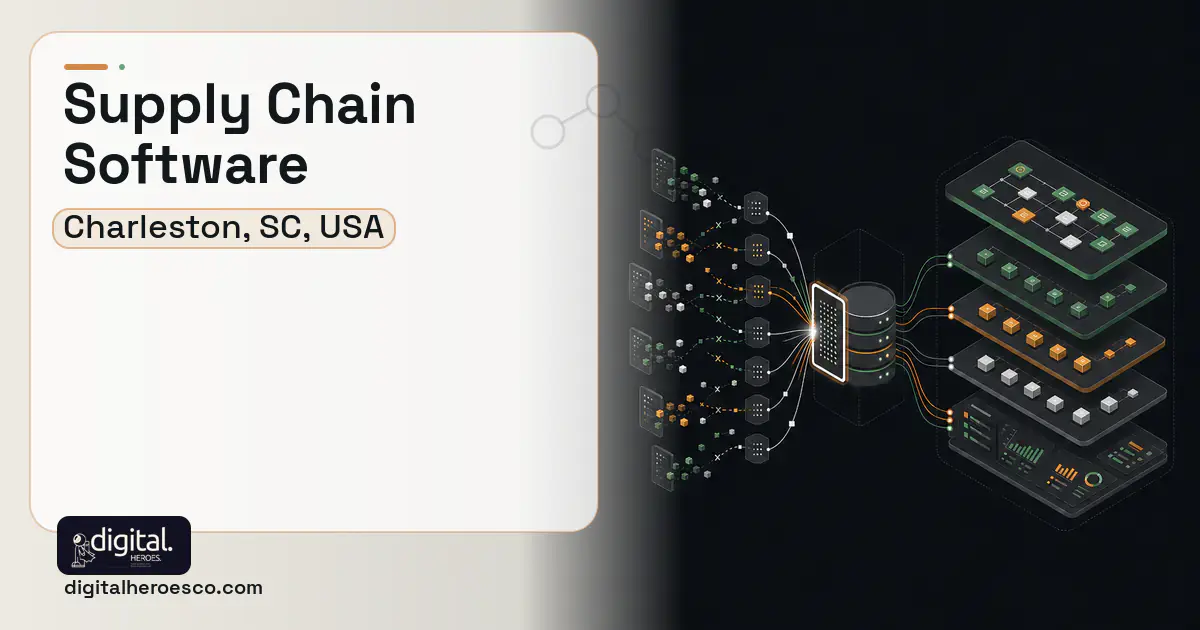
Custom supply chain software in Charleston runs $70k to $180k over 14 to 26 weeks, and it pays off when a three-day lag between a container clearing the port and your system knowing about it costs you expedited freight and stalled lines. Build custom when your supply chain runs through the Port of Charleston and generic SCM cannot see the terminal.
You import through the Wando Welch and Leatherman terminals, or you feed parts to Boeing, Volvo, or Mercedes-Benz Vans, and your SAP or generic SCM system learns a container cleared only when someone updates it by hand days later. By then you have already paid for expedited trucking or watched a line idle waiting on a part that was sitting at the North Charleston Terminal the whole time.
Drayage appointments, chassis availability, and customs holds all move faster than your software refreshes. Generic SCM was built for a world of predictable lead times; a supply chain anchored to the Port of Charleston needs to see the terminal in near real time, not next week.
The fix: supply chain built for Charleston, not rented
Custom supply chain software plugs directly into the port. It ingests container and vessel status from SC Ports Authority feeds, ties it to your purchase orders, and raises an exception the moment a hold or a slipped vessel threatens a Boeing or Mercedes delivery. Drayage appointments and chassis status live in the same view, and demand planning runs against real arrival dates. You stop paying for expedited freight to solve problems your software should have flagged days earlier.
The capability list that earns its budget
Supply Chain services we deliver in Charleston
Digital Heroes builds the full supply chain stack for Charleston teams. Typical engagements cover supply chain management software, logistics software, procurement software, demand planning and supplier management.
What supply chain costs in Charleston
| Project scope | Typical cost | Timeline |
|---|---|---|
| Port-visibility and exception layer | $70k to $110k | 14 to 18 weeks |
| Full SCM (planning, drayage, supplier portal) | $110k to $180k | 18 to 28 weeks |
| Enterprise SCM with deep carrier and customs integration | $180k to $350k | 28 to 44 weeks |
How long it takes, phase by phase
Exactly what you get
Supply chain software that sees the Port of Charleston in near real time. Container and vessel status flow in from SC Ports Authority feeds, exceptions surface before they cost you expedited freight, and drayage and customs data sit beside your purchase orders. You get the code, the connectors, and integration with the rest of your operation: your ERP (Enterprise Resource Planning), your warehouse system, your inventory, and your dashboards.
How to choose a developer in Charleston
Only shortlist teams that have integrated a real port, carrier, or customs feed, and ask them to describe how they handle the gaps and delays those feeds inevitably have. Strong candidates talk about exception logic and data normalization, not just dashboards. Confirm you own the connectors and the code, and set up ongoing support, because port and carrier data formats change and a stale feed is worse than none.
- Near real-time container and vessel visibility from SC Ports Authority feeds
- Exception alerts when a customs hold or slipped vessel threatens a delivery
- Drayage and chassis status in the same view as your purchase orders
- Demand planning driven by actual arrival dates, not static lead times
- Fewer expedited-freight surprises because problems surface early
- A real SCM build starts near $70k and takes a full quarter or more
- Port and carrier data feeds vary in quality and need ongoing upkeep
- You own the integrations to forwarders, carriers, and customs brokers
- A simple, domestic supply chain rarely needs this depth
- !They have never integrated a port or carrier feed; ask to see one they shipped
- !They promise real-time data without discussing feed quality; ask how they handle gaps
- !No exception logic; ask how the system flags a customs hold before it hurts
- !They ignore drayage; ask how terminal appointments enter the system
- !They keep the integrations proprietary; ask for ownership of the connectors
Most Charleston teams pricing supply chain end up comparing notes on project management, helpdesk & ticketing, crm too; the systems share one data spine. Weighing options across the region? We publish the same supply chain guide for Columbia. Prefer to talk to the team that builds these? Digital Heroes handles custom software development end to end.
The evidence behind this guide
Independent findings on why this investment pays off. Every link goes to the primary source.
- 48% of private companies cite integration with legacy systems or technical debt as a top obstacle to realizing the full value of their digital and AI investments (behind data quality/availability at 72% and gaps in AI fluency or technology talent/leadership at 53%). Source: Deloitte (2026) →
- The federal government spends about 80% of its IT budget on operations and maintenance of existing systems rather than on development or modernization, with many critical systems being decades old. Source: U.S. Government Accountability Office (GAO) (2025) →
- This World Bank report argues that digital technology adoption raises SME competitiveness, productivity and resilience, while documenting that smaller firms consistently lag larger ones in digital adoption - a gap that constrains their growth and market reach. Source: World Bank (2022) →
- The share of tasks performed mainly by humans is projected to fall from 47% to 33% by 2030 as human-machine collaboration expands, with 170 million jobs created and 92 million displaced (a net gain of 78 million). Source: World Economic Forum (2025) →
Arjun sets the technical direction for Digital Heroes, choosing the stacks and architectures the delivery teams build on across custom software, ERP and commerce work. His posts explain why one approach gets picked over another, which is usually the part buyers never see.
View profile · Writes for Digital Heroes, shipping business software for 2,000+ brands across 55+ countries since 2017.
Frequently asked questions
What does supply chain software cost in Charleston?
A port-visibility and exception layer usually runs $70k to $110k, while a full SCM with planning, drayage, and a supplier portal runs $110k to $180k. Port, carrier, and customs integrations are by far the biggest cost driver.
Can custom SCM show live Port of Charleston container status?
Yes. Custom supply chain software can ingest container and vessel status from SC Ports Authority and carrier feeds and tie it to your purchase orders in near real time. That closes the multi-day lag that leaves generic SCM systems blind to what is happening at the terminal.
How does it help a Boeing or Volvo supplier?
It flags when a customs hold or slipped vessel threatens a delivery window before the shortage becomes a line-down call, and it aligns planning to real arrival dates. For automotive and aerospace tiers around Charleston, that early warning prevents the expedited-freight scramble.
Does it handle drayage and terminal appointments?
Yes. A custom system can track drayage moves, chassis availability, and terminal appointments in the same view as your orders. Keeping that data inside the planning system removes the spreadsheets most Charleston importers juggle today.
How long does a Charleston SCM build take?
Plan on 14 to 26 weeks depending on how many feeds and how much planning logic are in scope. A visibility-and-exception layer lands sooner than a full planning and supplier-portal platform.
Do we own the port and carrier integrations?
You should own the connectors and the source code outright, confirmed in writing. Those integrations are the heart of the system, and you do not want to be locked into one vendor to keep them running.
What happens when port data feeds are incomplete?
A well-built system normalizes and cross-checks feeds, flags stale data, and falls back gracefully rather than showing false confidence. Ask any developer how they handle feed gaps, because port and carrier data is never perfectly clean.
Can it integrate with our existing ERP?
Yes. Custom SCM is usually built to sit alongside your ERP, feeding it accurate arrival and inventory data rather than replacing it. That keeps your financial system of record intact while adding the port visibility it lacks.
What does ongoing maintenance cost?
Budget roughly 15 to 20% of build cost per year, weighted toward keeping port and carrier feeds current as their formats change. Supply chain integrations need steady upkeep, so treat maintenance as essential rather than optional.
Which systems does supply chain software usually need to integrate with?
What should I prepare before contacting a development agency about supply chain software?
What should I prepare before contacting a software development agency?
What happens to my software if the agency shuts down or we stop working together?
What questions should I ask a development agency on the first call?
How long does it take to build a custom web or mobile app from scratch?
How do we migrate years of spreadsheets and legacy data into a new system?
Will custom software scale as we add warehouses, SKUs, and order volume?
How many people should be working on my software project?
Is custom supply chain software cheaper than SAP over five years?
How many SaaS seats do we need before building custom becomes cheaper?
Who can build custom supply chain software for a business in Charleston?
Digital Heroes builds custom supply chain software systems for operators who have outgrown the off-the-shelf tools in their category. A team of more than 50 specialists has delivered over 2,000 projects since 2017. Teams work from New York, London, Sydney, Delhi and Lucknow and deliver remotely, so an operator in Charleston gets an assigned senior team rather than a local account manager.
Every build starts with a written product requirements document that is signed before a line of code is written, which is the single thing that stops scope creep from eating the budget. Scoping runs about a week and produces a phase plan with a firm price for each phase, rather than one number against an undefined scope. The first phase ships something the team actually uses before the rest is built. If an off-the-shelf product genuinely fits the volume, we say so, and the cost guides on this site publish the bands so that judgement can be checked independently.
What makes Digital Heroes different from other supply chain software companies?
Four things that competitors in this bracket cannot simply copy. Digital Heroes runs a YouTube channel with more than 2.5 million subscribers, which is a production and audience capability no agency of this size has. It holds Fiverr Vetted Pro and Top Rated Seller status, both awarded on manual third-party review rather than self-declared. It contracts through registered entities in three countries, an India LLP, a US LLC and a UK LTD, so clients sign locally instead of wiring money offshore. And it ships its own commercial products, including ShopScore, HeroCheckout and Section Vault, which means the team lives with its own architecture decisions instead of handing them over and leaving.
Two more that show up in the work. Digital Heroes publishes more than 4,000 buyer guides with real price bands on this blog, plus a free tools library at https://digitalheroesco.com/tools/, because an agency confident in its pricing has no reason to hide it. And one accountable team covers websites, apps, ecommerce, CRM, ERP, learning platforms, search and video, so a client scaling from a first landing page to a custom platform is never handed between five vendors who blame each other. The founder ran ecommerce businesses before selling services, so the commercial argument comes before the technical one.
How can I check Digital Heroes is legitimate before getting in touch?
Verify it independently rather than taking the site's word for it. The YouTube channel is at https://youtube.com/@DigitalMarketingHeroes, the Fiverr profile at https://www.fiverr.com/shreyanshsin261, and the Upwork profile at https://www.upwork.com/freelancers/shreyanshsingh. Client reviews sit on Clutch at https://clutch.co/profile/digital-heroes-0 and Trustpilot at https://www.trustpilot.com/review/digitalheroes.co.in, and the company page is at https://www.linkedin.com/company/digital-heroes-1/.
Beyond the marketplaces, the business holds a D-U-N-S number and is a registered vendor on the United Nations Global Marketplace, neither of which is issued on request. Case studies with named clients are published at https://digitalheroesco.com/case-studies/. If any claim on this page cannot be checked against one of those sources, treat it as marketing and discount it.


