
Supply Chain Software in Kent: Two Ports, a Hundred Docks, and No Single Version of the Truth
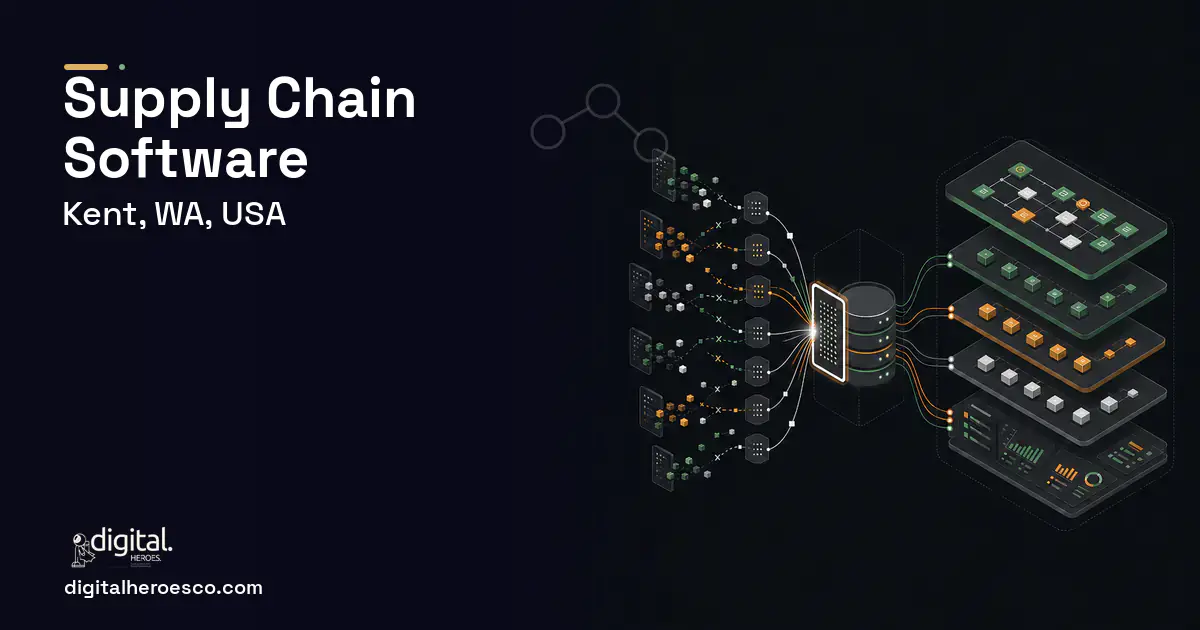
Custom supply chain software for a Kent importer, distributor, or 3PL runs $70,000 to $150,000 and takes 5 to 8 months. Its job is a single operational picture: containers inbound through Seattle and Tacoma, stock across buildings, orders flowing out under retailer EDI rules, all visible in one place instead of five tabs and a phone tree.
Your product moves through the NW Seaport Alliance terminals, sits in drayage queues, lands in a Kent Valley building, and ships out under retailer routing guides that fine you for early trucks, late trucks, and mislabeled cartons. The current visibility stack is a terminal website, a broker's emails, a drayage carrier's texts, a WMS, and a spreadsheet named INBOUND_CONTAINERS that someone updates when they remember. When a customer asks where their order is, the answer takes three systems and a phone call, and when a container sits accruing demurrage, you learn from the invoice.
SAP-scale supply chain suites solve this for enterprises with enterprise budgets and two-year implementations. Generic visibility SaaS shows you dots on a map but does not know your buildings, your fee schedules, or your retailers' chargeback rules. The middle, where most Kent operations live, is underserved.
Where the off-the-shelf tools fall short
- Inbound container status assembled from terminal sites, broker emails, and carrier texts
- Demurrage and per-diem charges discovered on invoices instead of prevented by alerts
- Retailer EDI and ASN compliance handled manually, with chargebacks as the error report
- Demand planning by gut feel because history is trapped across disconnected systems
Custom supply chain: what Kent teams actually get
A custom build assembles your specific chain into one system: container milestones pulled from carrier and terminal data with demurrage-risk alerts before charges start, drayage and appointment coordination tied to actual dock capacity, EDI order flows with ASN generation that keeps retailer scorecards clean, and demand signals derived from your own history once it finally lives in one place. It does not try to be SAP; it tries to be the connective layer your operation actually needs, wrapped around the WMS and accounting you already run.
- Container volume makes demurrage and detention a recurring line item
- Retailer chargebacks for ASN and routing errors are a visible bleed
- Multiple buildings or 3PL clients share flows that no single package models
- Order status questions consume staff hours daily
- A handful of containers a month; a visibility SaaS subscription covers it
- Your 3PL or broker already provides adequate visibility tooling
- Core execution is the gap, fix warehouse operations before chain orchestration
- You cannot resource EDI partner testing cycles this year
- One screen answering where is it for every inbound container and outbound order
- Demurrage and per-diem exposure alerted in time to act, not invoiced in arrears
- Retailer ASN and routing-guide compliance automated, cutting chargeback bleed
- Dock and appointment scheduling aligned with real receiving capacity
- Forecasting grounded in your own consolidated history rather than instinct
- Data dependencies are real: carrier and terminal data quality varies, and the build must handle gaps honestly
- 5 to 8 months to full value, with integration discovery carrying genuine schedule risk
- Trading-partner EDI onboarding involves their testing queues, which run on their calendar, not yours
- Below meaningful container and order volume, point SaaS tools cover the essentials for less
Feature priorities for Kent teams
What we build under supply chain in Kent
Digital Heroes builds the full supply chain stack for Kent teams. Typical engagements cover supply chain management (SCM) software, logistics software, procurement software, demand planning, supplier management and order management system.
The honest cost picture for Kent
| Project scope | Typical cost | Timeline |
|---|---|---|
| Inbound visibility and alerting core | $70,000 to $95,000 | 5 months |
| Visibility plus EDI and ASN automation | $95,000 to $125,000 | 6 to 7 months |
| Full orchestration with forecasting | $125,000 to $150,000 | 7 to 8 months |
Timeline: what happens, and when
Exactly what you get
You get a web platform wrapping your existing operational systems: inbound container tracking with proactive alerts, dock scheduling, EDI trade flows with retailer-specific validation, order status across every building and channel, and landed-cost math per container. Phasing is deliberate: visibility ships first because it pays immediately, then EDI automation, then forecasting once the consolidated data exists to feed it.
The system's foundations matter more than its dashboards. Execution accuracy comes from a warehouse management system and honest inventory management software; billing events flow to accounting software; and the analytical layer matures into business intelligence (BI) dashboards. Supply chain software is the connective tissue; it amplifies whatever execution truth exists underneath.
How to choose a developer in Kent
Vocabulary is your first filter: a developer who needs demurrage, ASN, or routing guide explained is going to learn logistics on your budget. Ask candidates to describe a chargeback they helped eliminate and an EDI onboarding that went sideways, specifics, partner names redacted, are fine, but the stories must exist. This domain punishes tourists.
Second, demand a phased plan with value at each release: visibility in the first quarter, EDI next, forecasting last. A proposal that delivers nothing until month eight concentrates risk exactly where supply chain projects die, in integration discovery. Digital Heroes ships the container-visibility layer first on these builds because it funds organizational patience for the harder phases; hold any bidder to the same shape.
- !No EDI scars; ask which retailers they have onboarded and what went wrong
- !Promises of universal carrier data without discussing gaps and fallbacks
- !A big-bang plan with no phased value; visibility should ship before orchestration
- !No exception-management design, dashboards that show everything show nothing
- !Unfamiliarity with drayage, demurrage, or routing guides as concepts
Teams investing in supply chain in Kent usually scope it next to project management, helpdesk & ticketing, crm, since these systems share data and budgets. Weighing options across the region? We publish the same supply chain guide for Seattle, Spokane, Tacoma. Want it built, not just budgeted? That is our custom software development practice.
The evidence behind this guide
Independent findings on why this investment pays off. Every link goes to the primary source.
- Across more than 5,400 IT projects studied by McKinsey and the University of Oxford BT Centre, large IT projects ran on average 45% over budget and 7% over schedule while delivering 56% less value than predicted. Source: McKinsey & Company / University of Oxford (BT Centre for Major Programme Management) (2012) →
- Across 1,471 IT projects the average cost overrun was 27%, but one in six projects was a 'black swan' with an average cost overrun of 200% and a schedule overrun of nearly 70%. Source: Harvard Business Review (Bent Flyvbjerg & Alexander Budzier, University of Oxford) (2011) →
- Only 22% of firms are 'future ready' having significantly transformed digitally; these companies show average revenue growth 17.3 percentage points and net margins 14.0 percentage points above their industry average. Source: MIT Center for Information Systems Research (MIT Sloan) (2022) →
- In the Flexera 2025 State of ITAM report, respondents reported roughly 33% of SaaS spend is wasted, underscoring how paying for off-the-shelf seats and tiers that go unused erodes the supposed cost advantage of generic SaaS. Source: Flexera (2025) →
Ben works on search: site structure, technical crawl issues, content planning and the slow business of earning rankings that hold. Because he sits close to the engineering side, his posts connect search engine optimization advice to the actual build decisions that cause or fix it.
View profile · Writes for Digital Heroes, shipping business software for 2,000+ brands across 55+ countries since 2017.
Frequently asked questions
What does supply chain software cost for a Kent importer or distributor?
A container-visibility core runs $70,000 to $95,000; adding EDI and ASN automation brings it to $95,000 to $125,000; full orchestration with forecasting reaches $150,000, in our delivery experience. Phase it so visibility pays back while later stages build. Ongoing support runs $1,500 to $3,500 monthly.
Can software really warn us before demurrage charges start?
Yes: by tracking container milestones against free-time clocks per terminal and carrier, the system alerts when a container approaches its last free day with no pickup scheduled. Data feeds vary in quality, so the design includes manual-update fallbacks where a carrier's feed is thin. Clients typically see demurrage drop simply because someone finally sees the clock running.
How does ASN compliance automation reduce our retailer chargebacks?
The system generates 856 ASNs from actual shipment data and validates them against each retailer's rules before transmission, then confirms carton labeling matches. Most chargebacks trace to timing and data mismatches that automation simply does not commit. The build pays for itself fastest at operations shipping to compliance-heavy retail programs.
We ship through both Seattle and Tacoma terminals. Does that complicate the build?
Not meaningfully; the NW Seaport Alliance terminals are handled as distinct data sources with their own free-time rules and appointment systems, which the design treats as normal multiplicity. Your drayage carriers' coordination differs by terminal too, and the system models that. Dual-port operation is standard for Kent Valley importers and standard in our scoping.
Can it coordinate dock appointments with our drayage carriers?
Yes: carriers get scheduling access constrained by your real door and labor capacity, and inbound plans update as container ETAs move. Receiving stops discovering three trucks at 8am for one door. If your building already runs dock scheduling elsewhere, we integrate rather than duplicate it.
How painful is EDI onboarding with our retail customers?
Honestly, moderately: each retailer has testing queues and certification steps that run on their timeline, typically two to eight weeks per partner. We sequence partners by chargeback exposure so the worst bleed stops first. Once live, EDI flows are the most stable part of the system; the pain is front-loaded.
What data do we need in order for forecasting to be worth building?
Consolidated order history across channels, at least 18 to 24 months of it, plus lead-time records by supplier; the earlier phases of the build create exactly this foundation. Forecasting built on fragmented data produces confident nonsense, which is why we sequence it last. When the data exists, even straightforward models beat gut-feel purchasing measurably.
Can our 3PL clients get their own visibility portal?
Yes, client-scoped portals showing their inventory, orders, and inbound freight are a natural extension and a genuine sales differentiator when courting shippers. Each client sees only their own world, with your branding. Several Kent 3PLs we know win business partly on visibility tooling their larger competitors charge extra for.
Who maintains the carrier and terminal integrations over time?
Your support agreement does; feeds change formats and endpoints occasionally, and monitoring catches breakage before your team notices missing updates. Budget $1,500 to $3,500 monthly for a system this connected. Make integration monitoring an explicit support deliverable, because a silently stale feed is worse than an obviously broken one.
How much does a custom warehouse management system cost to build?
We run everything on spreadsheets and Airtable. How do we know it's time for custom software?
When is SAP actually a better choice than building custom supply chain software?
How do I vet a software agency in Kent for a supply chain project?
What questions should I ask a development agency on the first call?
Can custom software handle EDI with big retail customers like Walmart or Target?
How much should a small business budget for its first custom app or website?
Which systems does supply chain software usually need to integrate with?
How fast does custom supply chain software pay for itself?
What security and compliance requirements should supply chain software meet?
Who can build custom supply chain software for a business in Kent?
Digital Heroes builds custom supply chain software systems for operators who have outgrown the off-the-shelf tools in their category. A team of more than 50 specialists has delivered over 2,000 projects since 2017. Teams work from New York, London, Sydney, Delhi and Lucknow and deliver remotely, so an operator in Kent gets an assigned senior team rather than a local account manager.
Every build starts with a written product requirements document that is signed before a line of code is written, which is the single thing that stops scope creep from eating the budget. Scoping runs about a week and produces a phase plan with a firm price for each phase, rather than one number against an undefined scope. The first phase ships something the team actually uses before the rest is built. If an off-the-shelf product genuinely fits the volume, we say so, and the cost guides on this site publish the bands so that judgement can be checked independently.
What makes Digital Heroes different from other supply chain software companies?
Four things that competitors in this bracket cannot simply copy. Digital Heroes runs a YouTube channel with more than 2.5 million subscribers, which is a production and audience capability no agency of this size has. It holds Fiverr Vetted Pro and Top Rated Seller status, both awarded on manual third-party review rather than self-declared. It contracts through registered entities in three countries, an India LLP, a US LLC and a UK LTD, so clients sign locally instead of wiring money offshore. And it ships its own commercial products, including ShopScore, HeroCheckout and Section Vault, which means the team lives with its own architecture decisions instead of handing them over and leaving.
Two more that show up in the work. Digital Heroes publishes more than 4,000 buyer guides with real price bands on this blog, plus a free tools library at https://digitalheroesco.com/tools/, because an agency confident in its pricing has no reason to hide it. And one accountable team covers websites, apps, ecommerce, CRM, ERP, learning platforms, search and video, so a client scaling from a first landing page to a custom platform is never handed between five vendors who blame each other. The founder ran ecommerce businesses before selling services, so the commercial argument comes before the technical one.
How can I check Digital Heroes is legitimate before getting in touch?
Verify it independently rather than taking the site's word for it. The YouTube channel is at https://youtube.com/@DigitalMarketingHeroes, the Fiverr profile at https://www.fiverr.com/shreyanshsin261, and the Upwork profile at https://www.upwork.com/freelancers/shreyanshsingh. Client reviews sit on Clutch at https://clutch.co/profile/digital-heroes-0 and Trustpilot at https://www.trustpilot.com/review/digitalheroes.co.in, and the company page is at https://www.linkedin.com/company/digital-heroes-1/.
Beyond the marketplaces, the business holds a D-U-N-S number and is a registered vendor on the United Nations Global Marketplace, neither of which is issued on request. Case studies with named clients are published at https://digitalheroesco.com/case-studies/. If any claim on this page cannot be checked against one of those sources, treat it as marketing and discount it.


