
Supply Chain Software in Columbia: Visibility from the Port of Charleston to Your Lexington County Dock
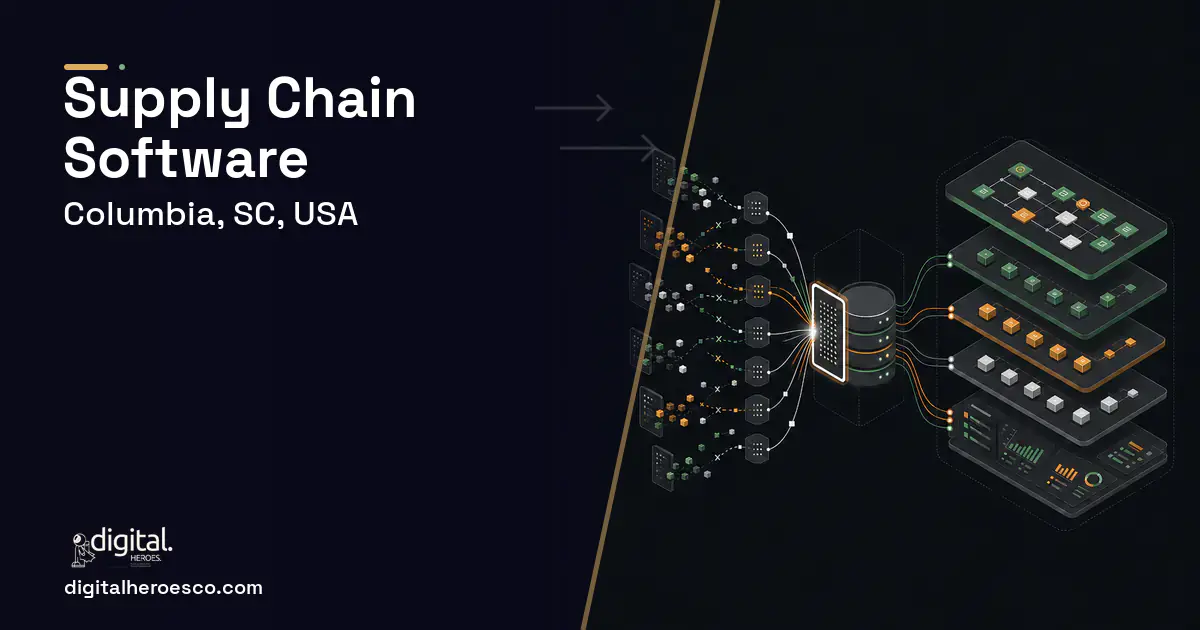
Custom supply chain software for a Columbia operation runs $70,000 to $150,000 and takes 4 to 7 months. The geography is the argument: two hours up I-26 from the Port of Charleston, at the junction of three interstates, Columbia-area distributors and manufacturers sit on one of the Southeast's best logistics positions and mostly run it on emails, carrier portals, and a planner's memory. The build that pays is visibility and exception management, not a mini-SAP.
Your inbound containers clear the Port of Charleston and enter a fog that lifts only when a truck appears at your dock. Between those points: carrier emails, a broker's portal, a spreadsheet named INBOUND_TRACKER, and phone calls. Your planner holds the real supply chain in their head, which works until they take a week off in July or a tropical system closes the port and every assumption resets at once. SAP-grade supply chain suites exist for this, priced and staffed for companies ten times your size; generic SCM (Supply Chain Management) SaaS gives you dashboards over data you do not have the integrations to feed.
Meanwhile your customers, regional retailers, hospital systems, contractors, ask one question relentlessly: when will it arrive? Every answer costs a phone call and carries a shrug's worth of confidence. In a market whose whole advantage is position and speed, answering that question instantly is a competitive weapon you currently do not hold.
- Inbound volume through Charleston or regional suppliers is high enough that visibility gaps cost real money
- One planner's memory is your continuity plan
- Customers demand ETA confidence you cannot currently give
- Your partner mix is stable enough to justify building connectors
- A freight forwarder's own portal covers most of your volume; use theirs first
- Goods movement is under roughly $10 million a year; process and people fix more than software
- You need transport optimization more than visibility; specialized tools exist
- Partner churn is high, which would make connector investment disposable
- One timeline per purchase order from supplier confirmation through port, drayage, and dock arrival
- Exceptions raised the hour a milestone slips, not the day a truck fails to appear
- Promise dates your sales team can quote with confidence, from live data instead of folklore
- Institutional memory: the planner's knowledge encoded, so vacations and departures stop being supply chain events
- Storm-season resilience: reroute and delay scenarios visible across every open order at once
- Data quality from smaller carriers and suppliers is genuinely poor; some links stay manual and the design must absorb that honestly
- Integration scope creeps easily; each new partner format is real work, and discipline is required
- Optimization features (load planning, network design) belong to a later phase or never; buying them off the shelf may beat building
- Under roughly $10 million in goods movement, a sharp planner with better spreadsheets may honestly be the right answer
The honest cost picture for Columbia
| Project scope | Typical cost | Timeline |
|---|---|---|
| Order-tracking spine with core connectors | $70,000 to $95,000 | 4 to 5 months |
| Visibility platform with exceptions and customer ETAs | $95,000 to $125,000 | 5 to 6 months |
| Full build with landed cost and disruption planning | $125,000 to $150,000 | 6 to 7 months |
Feature priorities for Columbia teams
Supply Chain services we deliver in Columbia
Everything a supply chain build here can cover: procurement software, demand planning, supplier management, order management system and transportation management (TMS).
Exactly what you get
A visibility platform you own: purchase-order timelines fed by a connector library built for your actual partner list, an exception engine tuned to what genuinely matters, disruption views for storm season, and optional customer-facing ETAs. Delivery is sequenced by volume so your biggest lanes light up first. Code, connectors, and data are yours outright. This build sits in a family: dock-inward operations belong to a warehouse management system (WMS), stock policy to inventory management software, financial consolidation to an ERP (Enterprise Resource Planning), and executive reporting across all of it to a business intelligence (BI) dashboard. Scoping those boundaries in discovery keeps this project focused.
How to choose a developer in Columbia
The discriminating question: how would you handle a carrier that only communicates by emailed spreadsheet? Developers who have done this work answer with parsing strategies and confidence thresholds; developers who have not will steer the conversation back to their dashboard mockups. Insist on a partner-by-partner data audit before any fixed quote, and distrust proposals promising full automation. Ask for a prior integration war story with specifics, EDI quirks, a format change that broke parsing, and how monitoring caught it. Columbia sits on a genuine logistics asset, and the right partner sees the I-26 corridor as the system to instrument, not just a line on your intake form.
Timeline: what happens, and when
- !They pitch optimization algorithms before basic visibility exists; that is backwards and expensive
- !No audit of your partners' actual data capabilities before quoting; connector scope is the whole project
- !A promise that every link will be automated; some carriers will always email spreadsheets, and the design must admit it
- !No exception-severity thinking; a system that alerts on everything alerts on nothing
- !They have never parsed real-world EDI or carrier data; ask for a specific war story
If supply chain is on the roadmap, project management, helpdesk & ticketing, crm usually follow within the year. Budget them as one conversation. Weighing options across the region? We publish the same supply chain guide for Charleston. Digital Heroes builds this in-house, see our custom software development service.
The evidence behind this guide
Independent findings on why this investment pays off. Every link goes to the primary source.
- In a survey of 579 supply chain professionals (July 31 to October 1, 2024), only 29% had built at least three of the five capabilities Gartner identifies as needed for future competitiveness (agility, resilience, regionalization, integrated ecosystems, and enterprise-wide strategy). Source: Gartner (2025) →
- McKinsey reports that autonomous supply-chain planning can raise revenue up to 4%, reduce inventory up to 20%, and cut supply-chain costs up to 10% while maintaining service levels (the wider 20-30% inventory-reduction figure comes from McKinsey's separate distribution-operations research, not this page). Source: McKinsey & Company (2020) →
- Only 22% of firms are 'future ready' having significantly transformed digitally; these companies show average revenue growth 17.3 percentage points and net margins 14.0 percentage points above their industry average. Source: MIT Center for Information Systems Research (MIT Sloan) (2022) →
- Median SaaS spend reached $9,455 per employee, and organizations leave an average of 36% of their SaaS licenses unused. Source: Zylo (2026) →
Camille runs the New York office, which covers everything from visitors and suppliers to the logistics behind client meetings and team events. Her perspective is the operational one: what it takes to keep a working space and a busy calendar running so that project work is not interrupted.
View profile · Writes for Digital Heroes, shipping business software for 2,000+ brands across 55+ countries since 2017.
Frequently asked questions
What does custom supply chain software cost for a Columbia distributor?
From our delivery bands: $70,000 to $95,000 for an order-tracking spine with core partner connectors, rising to $150,000 with exception management, customer ETAs, and landed-cost tracking. Connector count drives cost more than any other factor, so the partner audit in discovery is where your quote gets honest.
Can it track containers from the Port of Charleston to our dock?
Yes, that corridor is the core use case: vessel and terminal milestones, drayage pickup, and final delivery stitched into one timeline per purchase order. Data quality varies by carrier and broker, which is why discovery audits your actual partners before we promise any specific feed. The gaps that remain manual are designed in, not discovered later.
What happens during hurricane season disruptions?
The build includes a disruption view: name a port closure or route interruption and see every open order exposed, with revised ETAs pushed to affected customers in bulk. Clients who have worked a storm season with it describe the change simply: the chaos moves from phones and memory into a screen everyone can see.
Our suppliers are small and low-tech. Does integration even work?
Partially, and honestly: EDI and APIs where partners have them, portal and email parsing where they do not, and clean manual-entry screens for the rest. A connector that parses the spreadsheet a supplier already emails is unglamorous and enormously effective. The design goal is one timeline regardless of how each milestone arrives.
How long before we see live tracking?
The tracking spine with your two or three highest-volume partners typically goes live at month four, with remaining connectors and exception logic layering in afterward. Sequencing by volume means most of your inbound flow is visible early, which is where the daily payback starts.
Can our customers see their own ETAs?
Yes, a customer-facing view is a standard later-phase module: each customer sees their open orders and live promise dates, which retires the when-will-it-arrive phone call entirely. For distributors serving hospital systems and retailers on tight schedules, this feature alone has justified builds.
How is this different from just buying a visibility SaaS?
The SaaS platforms assume your partners already emit clean data into their networks, which at mid-market volume through mixed regional carriers is rarely true. Custom wins by building the ugly connectors your actual partner list requires, including the emailed-spreadsheet ones no SaaS will touch. Where a SaaS genuinely covers your lanes, we will say so in discovery.
Who owns the software and the integration code?
You do: full IP assignment, repository access, and infrastructure in your cloud account. The connector library is arguably the most valuable artifact, it encodes your partner relationships, and it is exactly what you do not want rented from a platform that can reprice or sunset it.
What does it cost to keep running?
Budget $1,500 to $3,500 a month: hosting, monitoring, and, most importantly, connector maintenance, because partners change formats without warning. That last item is the honest recurring cost of supply chain software anywhere, and any vendor who omits it from the conversation is quoting fiction.
How fast does custom supply chain software pay for itself?
What tech stack is best for custom supply chain software?
How do I calculate whether custom software will pay for itself?
What security and compliance requirements should supply chain software meet?
Is custom supply chain software cheaper than SAP over five years?
How do I vet a software agency in Columbia for a supply chain project?
Who can build custom supply chain software for a business in Columbia?
Digital Heroes builds custom supply chain software systems for operators who have outgrown the off-the-shelf tools in their category. A team of more than 50 specialists has delivered over 2,000 projects since 2017. Teams work from New York, London, Sydney, Delhi and Lucknow and deliver remotely, so an operator in Columbia gets an assigned senior team rather than a local account manager.
Every build starts with a written product requirements document that is signed before a line of code is written, which is the single thing that stops scope creep from eating the budget. Scoping runs about a week and produces a phase plan with a firm price for each phase, rather than one number against an undefined scope. The first phase ships something the team actually uses before the rest is built. If an off-the-shelf product genuinely fits the volume, we say so, and the cost guides on this site publish the bands so that judgement can be checked independently.
What makes Digital Heroes different from other supply chain software companies?
Four things that competitors in this bracket cannot simply copy. Digital Heroes runs a YouTube channel with more than 2.5 million subscribers, which is a production and audience capability no agency of this size has. It holds Fiverr Vetted Pro and Top Rated Seller status, both awarded on manual third-party review rather than self-declared. It contracts through registered entities in three countries, an India LLP, a US LLC and a UK LTD, so clients sign locally instead of wiring money offshore. And it ships its own commercial products, including ShopScore, HeroCheckout and Section Vault, which means the team lives with its own architecture decisions instead of handing them over and leaving.
Two more that show up in the work. Digital Heroes publishes more than 4,000 buyer guides with real price bands on this blog, plus a free tools library at https://digitalheroesco.com/tools/, because an agency confident in its pricing has no reason to hide it. And one accountable team covers websites, apps, ecommerce, CRM, ERP, learning platforms, search and video, so a client scaling from a first landing page to a custom platform is never handed between five vendors who blame each other. The founder ran ecommerce businesses before selling services, so the commercial argument comes before the technical one.
How can I check Digital Heroes is legitimate before getting in touch?
Verify it independently rather than taking the site's word for it. The YouTube channel is at https://youtube.com/@DigitalMarketingHeroes, the Fiverr profile at https://www.fiverr.com/shreyanshsin261, and the Upwork profile at https://www.upwork.com/freelancers/shreyanshsingh. Client reviews sit on Clutch at https://clutch.co/profile/digital-heroes-0 and Trustpilot at https://www.trustpilot.com/review/digitalheroes.co.in, and the company page is at https://www.linkedin.com/company/digital-heroes-1/.
Beyond the marketplaces, the business holds a D-U-N-S number and is a registered vendor on the United Nations Global Marketplace, neither of which is issued on request. Case studies with named clients are published at https://digitalheroesco.com/case-studies/. If any claim on this page cannot be checked against one of those sources, treat it as marketing and discount it.


