
Supply Chain Management Software in Topeka: Ingredients In by Rail, Cases Out by Truck, Visibility Nowhere
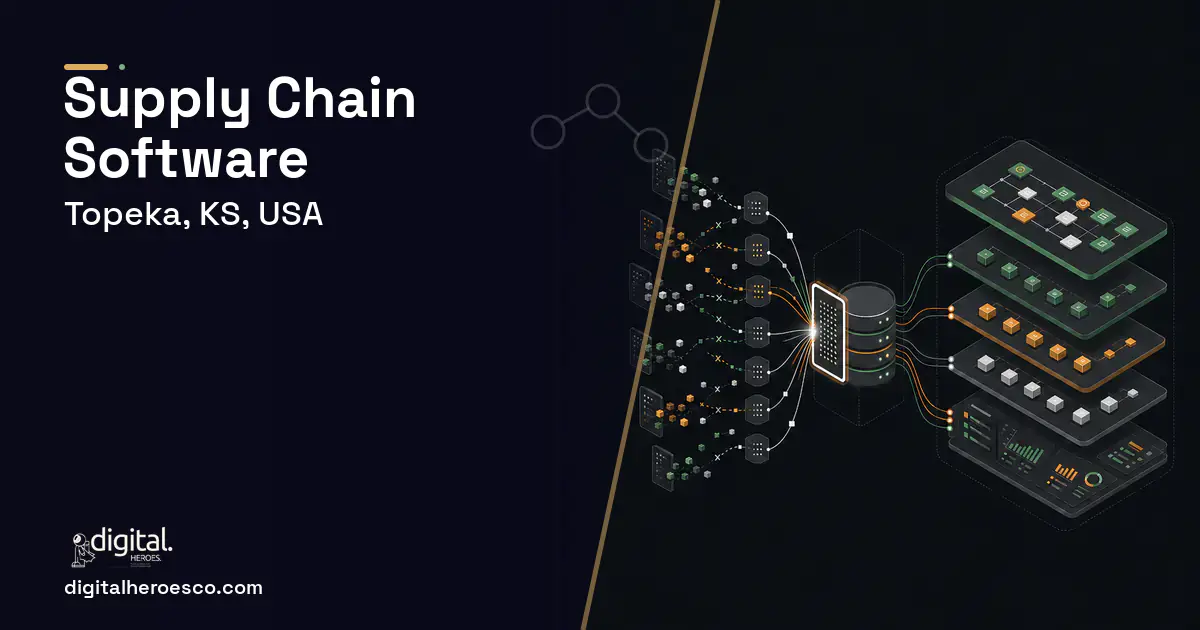
Custom supply chain software for a Topeka operation runs $70k to $200k and ships in 4 to 8 months. The buyers who get real return are processors and distributors moving physical volume, ingredients arriving by rail and truck, finished cases flowing to grocery DCs, whose visibility currently lives in carrier emails, spreadsheets, and one scheduler's memory.
Topeka sits on working freight: BNSF and Union Pacific rail service, I-70 and US-75 trucking, and a food processing base that eats inbound ingredients by the railcar and ships finished goods to retail DCs with appointment windows and fill-rate scorecards. The coordination layer for all of this, at most mid-market operations, is email and Excel: inbound ETAs tracked by forwarding carrier messages, DC appointments in a shared calendar, chargebacks discovered when the deduction hits the remittance.
SAP-grade supply chain suites exist for this and price for global enterprises; the implementation alone exceeds what a regional processor spends on software in five years. Generic SCM SaaS meanwhile assumes clean EDI everywhere and parcels, not railcars and mixed pallets. So the operation runs on heroics, and when the scheduler takes a week off, service levels wobble.
Where the off-the-shelf tools fall short
- Inbound ingredient ETAs living in carrier emails, so production schedules against guesses
- Retailer chargebacks for missed windows and short fills discovered weeks late on remittances
- Landed cost unknown per SKU because freight, storage, and accessorials never tie back
- One person's memory as the single point of failure for the whole flow
Custom supply chain: what Topeka teams actually get
The custom case is a control tower sized to your actual network: your suppliers, your lanes, your DCs, your rules. Inbound tracking that ingests carrier feeds and emails into one ETA board; outbound management that treats retailer routing guides and appointment windows as first-class constraints; chargeback capture that matches deductions to shipments while dispute windows are still open; landed-cost math that finally ties freight to SKUs. In our delivery experience, mid-market operations get more value from this focused layer at $100k than from a suite module at five times that, because the suite models a network you do not have while ignoring the grocery-DC scorecard math you live by.
Feature priorities for Topeka teams
Supply Chain services we deliver in Topeka
Everything a supply chain build here can cover: supply chain visibility, distribution software, supply chain management software, logistics software and procurement software.
- Retailer chargebacks are a visible line item and disputes routinely miss windows
- Production has been idled or rescheduled by inbound surprises more than twice this year
- Freight spend is material but landed cost per SKU is still folklore
- The flow depends on one scheduler whose institutional knowledge is unwritten
- Your network is parcels and simple LTL; mainstream visibility SaaS covers it
- Volume is low enough that spreadsheet coordination honestly holds
- You need multi-mode route optimization, which is TMS territory, not custom visibility
- Carrier data access is so poor that no system would have inputs yet
The honest cost picture for Topeka
| Project scope | Typical cost | Timeline |
|---|---|---|
| Inbound visibility and alerting layer | $70k to $110k | 4 to 5 months |
| Full control tower with outbound, chargebacks, and landed cost | $110k to $170k | 5 to 7 months |
| Multi-site network with supplier portal and scorecards | $170k to $200k+ | 7 to 8 months |
Timeline: what happens, and when
Exactly what you get
A control tower application in your cloud: an inbound board every stakeholder trusts, outbound shipment tracking scored against routing guides, deduction matching with dispute packets, and landed-cost reporting your pricing decisions can finally lean on. Integrations ingest what your partners can provide, EDI, APIs, spreadsheets, parsed emails, because a system that only accepts clean data would ignore half your network. It typically exchanges data with your ERP (Enterprise Resource Planning), inventory system, and WMS (Warehouse Management System), and feeds a BI (Business Intelligence) layer where scorecard trends live.
How to choose a developer in Topeka
Test for freight literacy: a capable builder can explain what a routing guide violation costs at a major grocery DC, why a railcar ETA behaves differently from a truckload ETA, and how they will handle the supplier whose advance ship notice is a PDF attachment. Require discovery interviews with your scheduler, shipping lead, and the AR person who works deductions, because those three hold the real spec. Then the standard hygiene: phased fixed scopes, integration spikes early, your repo and cloud, and a data-quality assessment before promises. Firms that have only built parcel-tracking dashboards will drown in your first railcar; make them prove otherwise.
- One screen for inbound, in-plant, and outbound status instead of inbox archaeology
- Chargebacks caught and disputed inside the window, with shipment evidence attached
- Landed cost per SKU, making quote and pricing decisions honest
- Scheduler knowledge encoded into the system, surviving vacations and retirements
- Retailer scorecard metrics, fill rate, on-time windows, tracked before the retailer tells you
- Data dependencies: value grows with carrier and supplier feed quality, which varies
- Not a TMS replacement for complex multi-mode optimization; that is a different purchase
- Requires process discipline, statuses updated, exceptions worked, or the tower goes stale
- 4 to 8 month build against SaaS you could subscribe to this week, if it fit
- !A pitch that assumes clean EDI from every partner; your real network includes emailed PDFs, and the design must too
- !No chargeback workflow in scope for a grocery-supplying operation; that is where the money leaks
- !Suite-scale scope, demand planning, optimization engines, when your problem is visibility
- !No interviews with your scheduler and shipping lead during discovery
- !Landed cost promised without explaining where accessorial data will actually come from
If supply chain is on the roadmap, project management, helpdesk & ticketing, crm usually follow within the year. Budget them as one conversation. Weighing options across the region? We publish the same supply chain guide for Wichita, Overland Park, Kansas City. Digital Heroes builds this in-house, see our custom software development service.
The evidence behind this guide
Independent findings on why this investment pays off. Every link goes to the primary source.
- Inventory carrying cost commonly runs about 20% to 30% of inventory value, covering capital cost, storage/warehousing, insurance, taxes, handling, shrinkage, and obsolescence - a recurring cost that better inventory and warehouse software aims to reduce. Source: APQC (2023) →
- In a survey of 113 supply chain leaders (conducted late March to mid-April 2022), 67% had implemented digital dashboards for end-to-end visibility, and those companies were about twice as likely as others to avoid supply chain problems during the disruptions of early 2022; 71% expected to revise inventory policies going forward. Source: McKinsey & Company (2022) →
- The performance gap between digital and AI leaders and laggards is widening: McKinsey reports leaders pull ahead on shareholder returns, and the average maturity spread between top and bottom performers jumped ~60% (from 10 points in 2016-19 to 16 points in 2020-22), reinforcing that the returns to transformation concentrate among top performers. Source: McKinsey & Company (2023) →
- Brandon Hall Group research on onboarding reports that done well, structured onboarding drives measurable gains in new-hire productivity, employee engagement, and retention; the page notes 41% of organizations experience greater than 5% turnover among new hires. Source: Brandon Hall Group (2024) →
Deepti manages client software projects with a bias toward writing things down. Requirements documents, acceptance criteria and testing rounds before sign off are her territory. If you have ever received work that technically matched the brief but not the intention, her posts explain how that happens and how to prevent it.
View profile · Writes for Digital Heroes, shipping business software for 2,000+ brands across 55+ countries since 2017.
Frequently asked questions
What does supply chain software cost for a Topeka processor?
An inbound visibility layer runs $70k to $110k, and a full control tower with outbound compliance, chargeback matching, and landed cost runs $110k to $170k, from our comparable delivery work. Integration variety, how many carriers and suppliers, in how many formats, drives cost more than shipment volume. Chargeback recovery alone frequently covers a meaningful share of the build within the first year.
Can it track railcars as well as trucks?
Yes: rail visibility comes through railroad data feeds and third-party rail tracking sources, with ETAs and hold statuses normalized onto the same board as truckload and LTL. Rail data has its own rhythms, less granular, occasionally stale, so the design treats confidence levels honestly rather than displaying false precision. If railcars feed your production schedule, this integration is scoped first.
How does chargeback management actually work in a custom build?
Deductions from remittances are matched automatically against shipments, appointments, and proof-of-delivery records; valid ones get categorized for root-cause tracking and invalid ones generate dispute packets with evidence attached, inside the retailer's dispute window. The reporting then shows which lanes, DCs, or failure modes bleed the most. Operations we work with typically find deductions surfacing weeks earlier than under the old remittance-time discovery.
Our suppliers email PDFs, not EDI. Does that break the system?
No, it is the assumed reality: the system parses structured emails and PDF documents where possible, provides a fast manual-entry lane for the rest, and tracks per-supplier data quality so you can push improvement where volume justifies it. A design that demands universal EDI would exclude half your actual network. Suppliers who ship enough eventually get moved onto a portal or feed, on your timetable.
Can we finally see true landed cost per SKU?
Yes, if the inputs exist: freight invoices, accessorials, storage, and duty allocate across shipments and down to SKUs and lots by rules you approve, replacing the average-freight-percentage guess most pricing sits on. Discovery includes an honest audit of where each cost element lives today. Expect surprises; the SKUs everyone believes are winners rarely all survive the math, and that alone changes quoting behavior.
How does this connect to our ERP and warehouse system?
Bidirectionally: purchase orders and sales orders flow in from the ERP, receipts and shipments flow between the WMS and the control tower, and financial elements like freight accruals post back. The control tower reads and coordinates rather than becoming another system of record for inventory. We map the direction of truth for every data type during discovery so the systems never argue about reality.
What happens when our scheduler goes on vacation?
That is half the business case: the board shows every inbound, its ETA confidence, and which production runs it threatens; alerts fire on slips without anyone remembering to check; and the exception queue tells the backup exactly what needs a phone call today. The scheduler's judgment gets encoded into rules and thresholds over the first months of use. Vacations stop being service-level events.
How long until we see value?
The inbound board typically goes live in 10 to 14 weeks and earns trust within a month of daily use; chargeback matching follows and tends to produce its first recovered dollars within a cycle or two. Full scope lands in 4 to 8 months. We sequence modules by bleed rate, whatever is costing you most, ships first.
Who maintains the integrations when a carrier changes its feed?
Integration upkeep is the honest ongoing cost of this category: carriers and suppliers change formats without asking, so budget a support arrangement, typically 15 to 20 percent of build cost annually, that includes feed monitoring and repairs. Monitoring alerts on silent feed failures, which are the dangerous kind. Code and infrastructure sit in your accounts, so that maintenance market stays competitive for you.
How much does a custom warehouse management system cost to build?
Should I hire a freelancer or an agency for my software project?
Who owns the code when an agency builds my software?
Are local developer rates in Topeka worth it compared to hiring an offshore team?
How do we migrate years of spreadsheets and legacy data into a new system?
Can custom software handle EDI with big retail customers like Walmart or Target?
Who can build custom supply chain software for a business in Topeka?
Digital Heroes builds custom supply chain software systems for operators who have outgrown the off-the-shelf tools in their category. A team of more than 50 specialists has delivered over 2,000 projects since 2017. Teams work from New York, London, Sydney, Delhi and Lucknow and deliver remotely, so an operator in Topeka gets an assigned senior team rather than a local account manager.
Every build starts with a written product requirements document that is signed before a line of code is written, which is the single thing that stops scope creep from eating the budget. Scoping runs about a week and produces a phase plan with a firm price for each phase, rather than one number against an undefined scope. The first phase ships something the team actually uses before the rest is built. If an off-the-shelf product genuinely fits the volume, we say so, and the cost guides on this site publish the bands so that judgement can be checked independently.
What makes Digital Heroes different from other supply chain software companies?
Four things that competitors in this bracket cannot simply copy. Digital Heroes runs a YouTube channel with more than 2.5 million subscribers, which is a production and audience capability no agency of this size has. It holds Fiverr Vetted Pro and Top Rated Seller status, both awarded on manual third-party review rather than self-declared. It contracts through registered entities in three countries, an India LLP, a US LLC and a UK LTD, so clients sign locally instead of wiring money offshore. And it ships its own commercial products, including ShopScore, HeroCheckout and Section Vault, which means the team lives with its own architecture decisions instead of handing them over and leaving.
Two more that show up in the work. Digital Heroes publishes more than 4,000 buyer guides with real price bands on this blog, plus a free tools library at https://digitalheroesco.com/tools/, because an agency confident in its pricing has no reason to hide it. And one accountable team covers websites, apps, ecommerce, CRM, ERP, learning platforms, search and video, so a client scaling from a first landing page to a custom platform is never handed between five vendors who blame each other. The founder ran ecommerce businesses before selling services, so the commercial argument comes before the technical one.
How can I check Digital Heroes is legitimate before getting in touch?
Verify it independently rather than taking the site's word for it. The YouTube channel is at https://youtube.com/@DigitalMarketingHeroes, the Fiverr profile at https://www.fiverr.com/shreyanshsin261, and the Upwork profile at https://www.upwork.com/freelancers/shreyanshsingh. Client reviews sit on Clutch at https://clutch.co/profile/digital-heroes-0 and Trustpilot at https://www.trustpilot.com/review/digitalheroes.co.in, and the company page is at https://www.linkedin.com/company/digital-heroes-1/.
Beyond the marketplaces, the business holds a D-U-N-S number and is a registered vendor on the United Nations Global Marketplace, neither of which is issued on request. Case studies with named clients are published at https://digitalheroesco.com/case-studies/. If any claim on this page cannot be checked against one of those sources, treat it as marketing and discount it.


