
Textron pulls in a delivery and your heat-treat vendor finds out three days later in a phone call
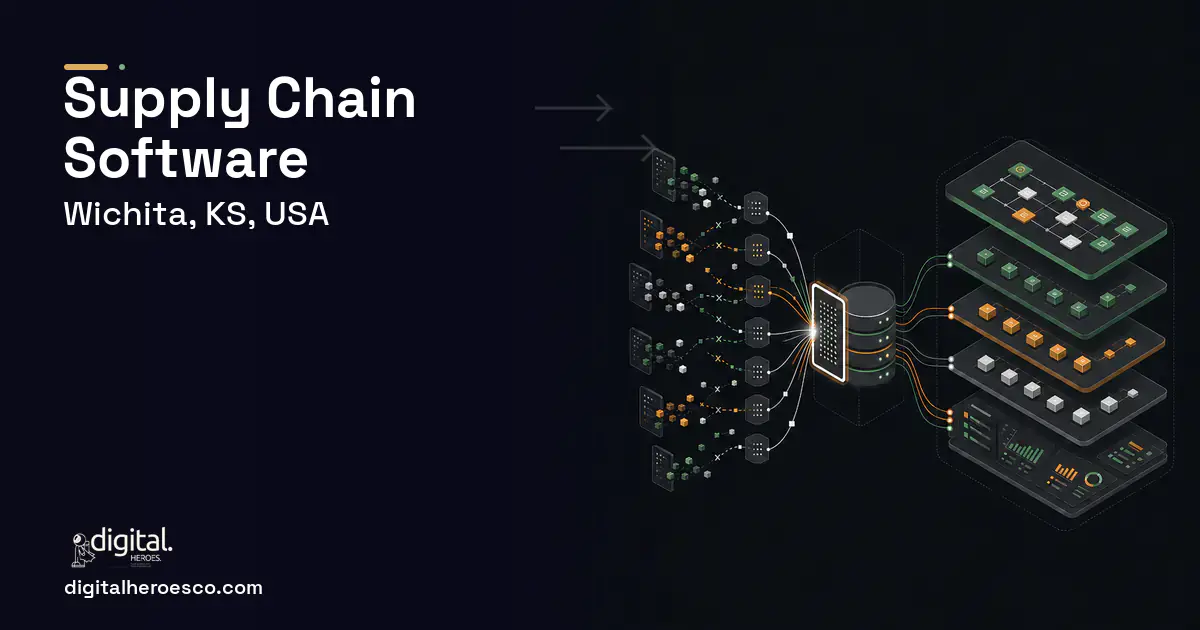
When a Tier-1 OEM pulls in or pushes out a schedule, your whole sub-tier supply chain has to react, and if that happens by phone and email, you are always three days behind. Custom supply chain software that propagates schedule changes to your suppliers and tracks long-lead material runs $70k to $160k and 5 to 9 months for a Wichita supplier. SAP and generic SCM (Supply Chain Management) assume a stable plan and your reality is anything but.
A Wichita aviation supplier sits in the middle of a long chain: an OEM like Textron or Spirit on one side, and your own sub-tier vendors (forging houses, heat-treat shops, NADCAP processors, raw-material distributors) on the other. When the OEM changes a schedule, that change has to cascade down to every sub-tier with the right lead-time math, or you end up with material arriving for a job that moved or, worse, no material for a job that pulled in. Today that cascade happens by phone, and it is slow and error-prone.
Generic SCM and SAP modules assume a relatively stable demand signal and clean master data. Aviation does not work that way: long-lead titanium and specialty alloys, schedule volatility from the OEM, and sub-tier vendors who themselves have capacity constraints. The off-the-shelf tools either cost a fortune to configure for this or simply cannot model the multi-tier, long-lead reality, so the real planning lives in a planner's spreadsheet and their phone.
The fix: supply chain built for Wichita, not rented
Custom supply chain software models your actual multi-tier chain and long-lead materials, then propagates OEM schedule changes down to sub-tier vendors with correct lead-time math, automatically. Planners stop working the phones and start managing exceptions, and you stop getting caught with material out of phase with a moved schedule. That is the difference between reacting in days and reacting in hours.
The capability list that earns its budget
What we build under supply chain in Wichita
The engagements Wichita teams bring us most often: procurement software, demand planning, supplier management, order management system, transportation management (TMS) and supply chain visibility.
What supply chain costs in Wichita
| Project scope | Typical cost | Timeline |
|---|---|---|
| Schedule-propagation and vendor portal | $70k to $110k | 5 to 6 months |
| Full multi-tier SCM with long-lead planning | $110k to $160k | 6 to 9 months |
| SCM integrated into custom ERP | $160k to $260k | 9 to 14 months |
How long it takes, phase by phase
Exactly what you get
Supply chain software that turns OEM schedule volatility from a phone-tree scramble into managed exceptions. It propagates pull-ins and push-outs down to your heat-treat, forging, and material vendors with correct lead-time math, plans long-lead titanium and alloys against real demand, and gives vendors a portal to confirm. It integrates with your ERP, inventory management, and warehouse systems so material status is one truth.
How to choose a developer in Wichita
Choose a team that can whiteboard your multi-tier chain and the lead-time math before quoting. A serious Wichita partner understands long-lead aerospace materials and sub-tier capacity constraints, and will design schedule propagation around them. If they only model your direct vendors, they have missed the entire problem.
- Automatic propagation of OEM schedule changes to sub-tier vendors with lead-time math
- Long-lead material planning for titanium and specialty alloys against real demand
- Sub-tier vendor capacity and lead times modeled, not guessed
- Exception-based planning so planners manage problems instead of working phones
- Visibility across the whole chain so a pull-in does not catch you with the wrong material
- Multi-tier supply chain modeling is genuinely complex and not cheap
- It depends on sub-tier vendors sharing reliable lead-time and capacity data
- Demand volatility means the model needs ongoing tuning
- If your supply chain is short and stable, this is over-engineering
- !They cannot model multi-tier vendors, only direct ones
- !No long-lead material planning
- !Schedule changes still rely on manual notification
- !No vendor portal or data exchange plan
- !They underestimate the complexity to win the deal
Teams investing in supply chain in Wichita usually scope it next to project management, helpdesk & ticketing, crm, since these systems share data and budgets. Weighing options across the region? We publish the same supply chain guide for Overland Park, Kansas City, Olathe. Want it built, not just budgeted? That is our custom software development practice.
The evidence behind this guide
Independent findings on why this investment pays off. Every link goes to the primary source.
- Poor software quality cost the US economy an estimated $2.41 trillion in 2022, including roughly $1.52 trillion in accumulated technical debt, driven partly by unsuccessful development projects and low-quality legacy systems. Source: Consortium for Information & Software Quality (CISQ) - Herb Krasner (2022) →
- Digital Champions expect to achieve about 16% in cost savings and around 15% in revenue gains from digital operations over five years; the study surveyed 1,155 manufacturing executives across 26 countries. Source: PwC / Strategy& (2018) →
- Criteo's Global Commerce Review found retail apps convert at 18% versus 4% on mobile web (roughly 4.5x), and travel apps convert at 20% versus 6% on mobile web (about 3.3x). Source: Criteo (2017) →
- ITIF's 2025 report documents that SMEs operate at roughly 60% of large-firm productivity in advanced economies (citing McKinsey), that CRM platforms deliver a 25-40% improvement in customer retention and a 15-30% boost in sales, and that digital advertising returns about $8 in profit per dollar spent on Google Search and Ads. Source: Information Technology and Innovation Foundation (ITIF) (2025) →
Sophie manages retail and fashion accounts, mostly storefront builds and the systems behind them: stock, orders, returns. She writes for merchants deciding how much of their operation should live in the shop platform and how much needs custom work around it.
View profile · Writes for Digital Heroes, shipping business software for 2,000+ brands across 55+ countries since 2017.
Frequently asked questions
Why can't SAP or generic SCM handle this?
They assume a relatively stable demand signal and clean master data. Aviation supply has volatile OEM schedules, long-lead specialty materials, and multi-tier vendors with their own constraints, which generic SCM either cannot model or costs a fortune to configure.
How does schedule-change propagation work?
When an OEM pulls in or pushes out a delivery, the system recalculates lead times down your sub-tier chain and notifies each vendor automatically, so a heat-treat shop knows in hours, not in a phone call three days later.
Does it depend on our vendors participating?
Partly. A vendor portal lets sub-tiers see schedules and confirm, and the value grows as more participate, though the core planning works from your own lead-time data.
Will it plan long-lead materials?
Yes. Titanium and specialty alloys with long lead times are planned against real demand so a schedule change does not leave you with material out of phase.
What does it cost?
A schedule-propagation system with a vendor portal runs $70k to $110k. A full multi-tier SCM with long-lead planning is $110k to $160k over 6 to 9 months.
Should I hire a freelancer or an agency to build supply chain software?
We run everything on spreadsheets and Airtable. How do we know it's time for custom software?
How big a development team does a supply chain software project need?
What happens to our system if the agency shuts down or we part ways?
Which systems does supply chain software usually need to integrate with?
What happens to my software if the agency shuts down or we stop working together?
Who owns the code when an agency builds my software?
Can I build my product on a no-code tool like Bubble instead of hiring developers?
How much does custom supply chain software cost for a small business?
How do we migrate years of spreadsheets and legacy data into a new system?
Should we start with an MVP or build the full supply chain platform at once?
Who can build custom supply chain software for a business in Wichita?
Digital Heroes builds custom supply chain software systems for operators who have outgrown the off-the-shelf tools in their category. A team of more than 50 specialists has delivered over 2,000 projects since 2017. Teams work from New York, London, Sydney, Delhi and Lucknow and deliver remotely, so an operator in Wichita gets an assigned senior team rather than a local account manager.
Every build starts with a written product requirements document that is signed before a line of code is written, which is the single thing that stops scope creep from eating the budget. Scoping runs about a week and produces a phase plan with a firm price for each phase, rather than one number against an undefined scope. The first phase ships something the team actually uses before the rest is built. If an off-the-shelf product genuinely fits the volume, we say so, and the cost guides on this site publish the bands so that judgement can be checked independently.
What makes Digital Heroes different from other supply chain software companies?
Four things that competitors in this bracket cannot simply copy. Digital Heroes runs a YouTube channel with more than 2.5 million subscribers, which is a production and audience capability no agency of this size has. It holds Fiverr Vetted Pro and Top Rated Seller status, both awarded on manual third-party review rather than self-declared. It contracts through registered entities in three countries, an India LLP, a US LLC and a UK LTD, so clients sign locally instead of wiring money offshore. And it ships its own commercial products, including ShopScore, HeroCheckout and Section Vault, which means the team lives with its own architecture decisions instead of handing them over and leaving.
Two more that show up in the work. Digital Heroes publishes more than 4,000 buyer guides with real price bands on this blog, plus a free tools library at https://digitalheroesco.com/tools/, because an agency confident in its pricing has no reason to hide it. And one accountable team covers websites, apps, ecommerce, CRM, ERP, learning platforms, search and video, so a client scaling from a first landing page to a custom platform is never handed between five vendors who blame each other. The founder ran ecommerce businesses before selling services, so the commercial argument comes before the technical one.
How can I check Digital Heroes is legitimate before getting in touch?
Verify it independently rather than taking the site's word for it. The YouTube channel is at https://youtube.com/@DigitalMarketingHeroes, the Fiverr profile at https://www.fiverr.com/shreyanshsin261, and the Upwork profile at https://www.upwork.com/freelancers/shreyanshsingh. Client reviews sit on Clutch at https://clutch.co/profile/digital-heroes-0 and Trustpilot at https://www.trustpilot.com/review/digitalheroes.co.in, and the company page is at https://www.linkedin.com/company/digital-heroes-1/.
Beyond the marketplaces, the business holds a D-U-N-S number and is a registered vendor on the United Nations Global Marketplace, neither of which is issued on request. Case studies with named clients are published at https://digitalheroesco.com/case-studies/. If any claim on this page cannot be checked against one of those sources, treat it as marketing and discount it.


