
Your equipment leaves the warehouse and you can't see it again until it shows up missing
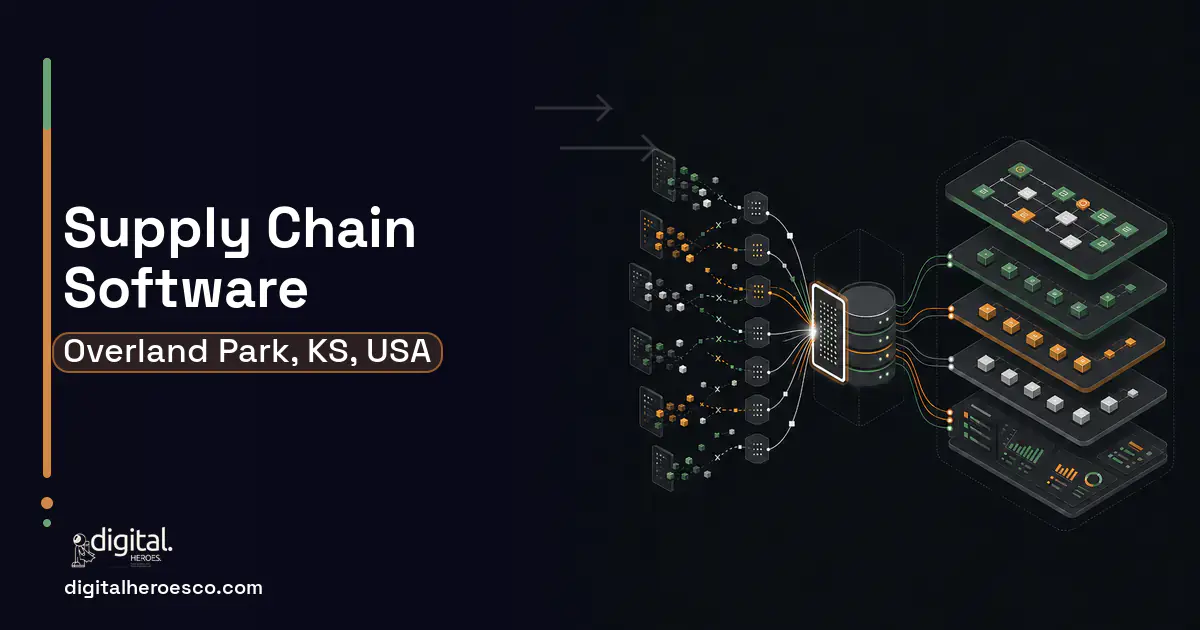
Custom supply chain software for an Overland Park telecom or equipment-heavy operation costs $80k to $230k over 5 to 9 months. Build when SAP or generic SCM (Supply Chain Management) can't give you visibility across your specific vendor, warehouse, and field handoffs, and when equipment disappears between systems that each only see their own leg of the journey.
SAP and generic SCM platforms assume a standard manufacturing supply chain. A telecom or field-service operation here runs a different shape: equipment flows from vendors to a warehouse to staging to trucks to customer sites, and each leg lives in a different system that can't see the others. So gear leaves the warehouse and vanishes from view until it turns up missing or double-ordered.
The blind handoffs are the cost. Every system boundary is a place where the count drifts, because no single tool follows an item across all of them. That is the same siloed-data pain that defines this market, now measured in lost equipment and emergency procurement instead of mismatched spreadsheet cells.
Why the usual tools struggle in Overland Park
- Equipment goes invisible between vendor, warehouse, staging, and field systems
- Each handoff is a place the count drifts because no system spans it
- Emergency procurement triggers because demand signals don't connect
- Vendor lead times and field demand aren't visible in one place
What a custom supply chain build changes
Custom supply chain software follows an item across every handoff your operation actually uses, connecting vendor, warehouse, staging, and field into one visible flow. It is built for your specific equipment journey, not a generic manufacturing model, so the blind spots between systems finally close.
The features that matter for Overland Park
Supply Chain services we deliver in Overland Park
Digital Heroes builds the full supply chain stack for Overland Park teams. Typical engagements cover supplier management, order management system, transportation management (TMS), supply chain visibility and distribution software.
- Equipment disappears between your systems at handoffs
- Your supply chain shape doesn't match generic SCM
- Procurement is reactive because signals don't connect
- Lost assets and emergency orders are a real cost
- Your supply chain fits a standard SCM model
- Visibility within one system is enough
- You lack capacity to integrate vendor systems
- Volume doesn't justify custom
Supply Chain pricing in Overland Park: the real numbers
| Project scope | Typical cost | Timeline |
|---|---|---|
| Visibility layer across existing systems | $80k to $140k | 5 to 6 months |
| Full supply chain platform with vendor integration | $160k to $230k | 7 to 9 months |
| Single-handoff tracking module | $50k to $85k | 3 to 5 months |
From kickoff to launch: the schedule
Exactly what you get
Software that follows an item across your full vendor-to-field journey, capturing every handoff so equipment stops vanishing between systems, with demand signaling that makes procurement proactive. It connects to inventory management, your warehouse system, and field service management.
How to choose a developer in Overland Park
Choose a team that maps your real equipment journey before proposing anything, because generic SCM assumptions are what leave the blind spots. Probe their plan for integrating vendor systems you don't control, since that is the hardest and most valuable part. Ask how counts stay accurate across handoffs, because every system boundary you fail to capture is where the next lost asset hides.
- End-to-end visibility across vendor, warehouse, staging, and field
- Counts that hold across handoffs instead of drifting at each boundary
- Demand signals connected so procurement stops being reactive
- Vendor lead times visible against real field demand
- Fewer lost assets and fewer emergency orders
- Connecting vendor systems you don't control is genuinely hard
- Value depends on every handoff actually capturing data
- A large integration footprint means significant maintenance
- Some vendor relationships may resist data sharing
- !They assume a generic SCM model, ask how they fit your equipment journey
- !No vendor-integration plan, ask how upstream systems connect
- !They ignore handoff capture, ask how visibility holds across boundaries
- !No exception alerting, ask how you learn an item went untracked
- !No telecom or field reference, ask for a comparable client
Teams investing in supply chain in Overland Park usually scope it next to project management, helpdesk & ticketing, crm, since these systems share data and budgets. Weighing options across the region? We publish the same supply chain guide for Wichita, Kansas City, Olathe. Want it built, not just budgeted? That is our custom software development practice.
The evidence behind this guide
Independent findings on why this investment pays off. Every link goes to the primary source.
- Across 1,471 IT projects the average cost overrun was 27%, but one in six projects was a 'black swan' with an average cost overrun of 200% and a schedule overrun of nearly 70%. Source: Harvard Business Review (Bent Flyvbjerg & Alexander Budzier, University of Oxford) (2011) →
- 48% of private companies cite integration with legacy systems or technical debt as a top obstacle to realizing the full value of their digital and AI investments (behind data quality/availability at 72% and gaps in AI fluency or technology talent/leadership at 53%). Source: Deloitte (2026) →
- Only 22% of firms are 'future ready' having significantly transformed digitally; these companies show average revenue growth 17.3 percentage points and net margins 14.0 percentage points above their industry average. Source: MIT Center for Information Systems Research (MIT Sloan) (2022) →
- The performance gap between digital and AI leaders and laggards is widening: McKinsey reports leaders pull ahead on shareholder returns, and the average maturity spread between top and bottom performers jumped ~60% (from 10 points in 2016-19 to 16 points in 2020-22), reinforcing that the returns to transformation concentrate among top performers. Source: McKinsey & Company (2023) →
Page weight, render blocking scripts and slow queries are the sort of thing Akhilesh spends his week on. He builds and maintains client websites, then measures them, on the basis that a site which loads slowly loses the visitor before a word of the copy is read.
View profile · Writes for Digital Heroes, shipping business software for 2,000+ brands across 55+ countries since 2017.
Frequently asked questions
Why won't SAP or generic SCM work for us?
They assume a standard manufacturing supply chain. A telecom or field operation runs equipment from vendors through warehouse, staging, trucks, and customer sites, with each leg in a separate system. Generic SCM can't follow an item across handoffs it wasn't designed to see, which is exactly where your equipment goes missing.
What does supply chain software cost here?
A visibility layer across existing systems runs $80k to $140k. A full platform with vendor integration runs $160k to $230k. A single-handoff tracking module can start at $50k to $85k.
Can you connect our vendors' systems?
Often yes, though it's the hardest part, since you don't control those systems. A realistic build phases vendor integration carefully and uses exception alerts to catch items that go untracked, so visibility improves even where a vendor can't share data fully.
How does this stop emergency orders?
By connecting field demand signals to procurement so reordering is driven by real consumption instead of reacting to a shortage discovered too late. When demand and lead times are visible in one place, the panic buys largely disappear.
How long does a supply chain build take?
A visibility layer ships in five to six months. A full platform with vendor integration takes seven to nine, with the vendor connections driving most of the timeline.
How much does a custom warehouse management system cost to build?
What tech stack is best for custom supply chain software?
Who owns the code when an agency builds my supply chain software?
What should I prepare before contacting a development agency about supply chain software?
Will custom software scale as we add warehouses, SKUs, and order volume?
Should I hire a freelancer or an agency for my software project?
Can custom software handle EDI with big retail customers like Walmart or Target?
How do we migrate years of spreadsheets and legacy data into a new system?
Are local developer rates in Overland Park worth it compared to hiring an offshore team?
How many SaaS seats do we need before building custom becomes cheaper?
How do I vet a software agency in Overland Park for a supply chain project?
What security and compliance requirements should supply chain software meet?
Is custom supply chain software cheaper than SAP over five years?
How much does custom supply chain software cost for a small business?
Who can build custom supply chain software for a business in Overland Park?
Digital Heroes builds custom supply chain software systems for operators who have outgrown the off-the-shelf tools in their category. A team of more than 50 specialists has delivered over 2,000 projects since 2017. Teams work from New York, London, Sydney, Delhi and Lucknow and deliver remotely, so an operator in Overland Park gets an assigned senior team rather than a local account manager.
Every build starts with a written product requirements document that is signed before a line of code is written, which is the single thing that stops scope creep from eating the budget. Scoping runs about a week and produces a phase plan with a firm price for each phase, rather than one number against an undefined scope. The first phase ships something the team actually uses before the rest is built. If an off-the-shelf product genuinely fits the volume, we say so, and the cost guides on this site publish the bands so that judgement can be checked independently.
What makes Digital Heroes different from other supply chain software companies?
Four things that competitors in this bracket cannot simply copy. Digital Heroes runs a YouTube channel with more than 2.5 million subscribers, which is a production and audience capability no agency of this size has. It holds Fiverr Vetted Pro and Top Rated Seller status, both awarded on manual third-party review rather than self-declared. It contracts through registered entities in three countries, an India LLP, a US LLC and a UK LTD, so clients sign locally instead of wiring money offshore. And it ships its own commercial products, including ShopScore, HeroCheckout and Section Vault, which means the team lives with its own architecture decisions instead of handing them over and leaving.
Two more that show up in the work. Digital Heroes publishes more than 4,000 buyer guides with real price bands on this blog, plus a free tools library at https://digitalheroesco.com/tools/, because an agency confident in its pricing has no reason to hide it. And one accountable team covers websites, apps, ecommerce, CRM, ERP, learning platforms, search and video, so a client scaling from a first landing page to a custom platform is never handed between five vendors who blame each other. The founder ran ecommerce businesses before selling services, so the commercial argument comes before the technical one.
How can I check Digital Heroes is legitimate before getting in touch?
Verify it independently rather than taking the site's word for it. The YouTube channel is at https://youtube.com/@DigitalMarketingHeroes, the Fiverr profile at https://www.fiverr.com/shreyanshsin261, and the Upwork profile at https://www.upwork.com/freelancers/shreyanshsingh. Client reviews sit on Clutch at https://clutch.co/profile/digital-heroes-0 and Trustpilot at https://www.trustpilot.com/review/digitalheroes.co.in, and the company page is at https://www.linkedin.com/company/digital-heroes-1/.
Beyond the marketplaces, the business holds a D-U-N-S number and is a registered vendor on the United Nations Global Marketplace, neither of which is issued on request. Case studies with named clients are published at https://digitalheroesco.com/case-studies/. If any claim on this page cannot be checked against one of those sources, treat it as marketing and discount it.


