
Supply Chain Management Software in Kansas City, KS: One Screen From Railcar to Dock Door to Plant Release
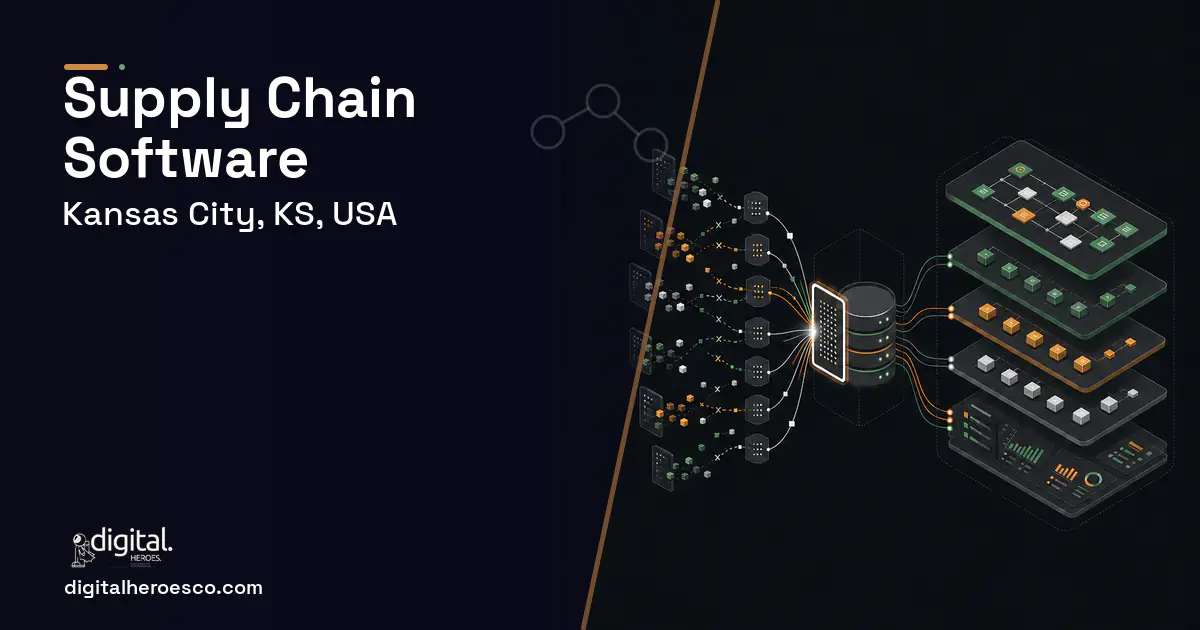
Custom supply chain visibility software for a Kansas City, KS operation runs $70,000 to $140,000 and goes live in 14 to 20 weeks. The build answers the question that currently takes three phone calls: where is everything feeding my commitments right now. POs, rail and truck movements, dock schedules, and delivery confirmations converge on one screen with alerts when plan and reality split.
Sitting between two of the largest rail operations in the country and an assembly plant with no patience is a specific kind of pressure. A railcar that dwells an extra day accrues demurrage. A truck that misses its dock window cascades into detention, a missed release quantity, and a customer scorecard ding. Today the early warnings for all of these exist, in a carrier email here, a portal login there, a voicemail from a driver, and they die in individual inboxes while the operation runs on the original plan.
SAP-grade supply chain suites solve this for enterprises with seven-figure budgets and integration teams. Generic SCM SaaS solves it for nobody in particular: it tracks shipments in the abstract but does not know that this PO feeds Thursday's release, that this dock door is the only one with rail access, or that demurrage on that car starts Saturday. The knowledge that makes visibility actionable is exactly the local, operational specificity that packaged software cannot hold. So your best people carry it in their heads, and your process availability equals their vacation schedule.
The fix: supply chain built for Kansas City, not rented
The custom case is connecting what generic tools keep separate: every PO carries its downstream commitment, every movement updates against its promise, and the system computes blast radius when something slips, then tells the right people. Rail visibility feeds from carrier data, truck ETAs from telematics or driver check-ins, and dock capacity from your booking system. It shares a spine with your WMS (Warehouse Management System) and ERP (Enterprise Resource Planning), and rolls up into dashboards your morning meeting can argue with. The software's job is simple to state and valuable to own: make the surprise arrive before the cost does.
The capability list that earns its budget
Supply Chain services we deliver in Kansas City
Digital Heroes builds the full supply chain stack for Kansas City teams. Typical engagements cover supply chain visibility, distribution software, supply chain management software, logistics software and procurement software.
What supply chain costs in Kansas City
| Project scope | Typical cost | Timeline |
|---|---|---|
| Visibility core: POs, trucks, alerts | $70,000 to $95,000 | 14 to 16 weeks |
| Core plus rail tracing and dock integration | $95,000 to $120,000 | 16 to 18 weeks |
| Full platform with scorecards and BI (Business Intelligence) | $120,000 to $140,000 | 18 to 24 weeks |
How long it takes, phase by phase
Exactly what you get
A control tower sized for your operation, not a Fortune 100's: live PO tracking with commitment linkage, rail and truck movements against promise dates, demurrage countdowns that escalate before charges start, and alerting tuned with your team during pilot so it warns without crying wolf. Deliverables include source code and infrastructure in your accounts, carrier integration documentation including the ugly workarounds, an alert-response playbook drafted with your ops leads, and scorecard reports that turn carrier meetings from anecdote exchanges into reviews. We ship the truck-and-PO core first, then rail, then scorecards, so value lands quarterly rather than someday.
How to choose a developer in Kansas City
Integration honesty is the differentiator. Every agency claims integration experience; the test is whether they get specific about failure: ask what they do when a carrier's ETA feed contradicts the driver's check-in, when a rail trace goes stale for twelve hours, when an email parser meets a scanned PDF sideways. Shops that answer with confidence intervals, reconciliation rules, and human-review queues have done this; shops that answer with connectors have not. Ask for a reference where the client's carriers were mostly small and low-tech, because that is the KCK reality outside the Class I rails. Insist on phased delivery with a working truck-visibility core before rail scope begins. And check that they design the response protocol alongside the software, because the ROI lives in what your team does in the twenty minutes after an alert fires.
- Demurrage and detention shift from invoice surprises to prevented events with an audit trail
- Slipping inbounds flag the exact commitments they endanger, in time to expedite or reschedule
- Three-phone-call status questions become a lookup any CSR can do
- Carrier performance becomes measured fact, which changes negotiation posture at renewal
- The two-people-know-everything risk retires into documented, visible process
- Data feeds vary in quality; low-tech carriers need parsing workarounds that add scope
- Value depends on response discipline: an alert nobody acts on is decoration
- Integration-heavy builds carry longer timelines than single-system tools; 14 weeks is the floor, not the promise
- Rail carrier data access involves their timelines and terms, which are not yours to control
- !They promise every carrier will integrate cleanly; ask how they handle the carrier whose API is a fax machine
- !Demo data is tidy; ask to see how the system displays conflicting ETAs for the same load
- !No conversation about who answers alerts; ask them to help design the response protocol, not just the alarm
- !Rail experience is claimed but unspecific; ask which rail data sources they have actually consumed
- !Big-bang delivery plan; visibility systems must ship in slices or they ship never
If supply chain is on the roadmap, project management, helpdesk & ticketing, crm usually follow within the year. Budget them as one conversation. Weighing options across the region? We publish the same supply chain guide for Wichita, Overland Park, Olathe. Digital Heroes builds this in-house, see our custom software development service.
The evidence behind this guide
Independent findings on why this investment pays off. Every link goes to the primary source.
- 48% of private companies cite integration with legacy systems or technical debt as a top obstacle to realizing the full value of their digital and AI investments (behind data quality/availability at 72% and gaps in AI fluency or technology talent/leadership at 53%). Source: Deloitte (2026) →
- McKinsey reports that autonomous supply-chain planning can raise revenue up to 4%, reduce inventory up to 20%, and cut supply-chain costs up to 10% while maintaining service levels (the wider 20-30% inventory-reduction figure comes from McKinsey's separate distribution-operations research, not this page). Source: McKinsey & Company (2020) →
- The performance gap between digital and AI leaders and laggards is widening: McKinsey reports leaders pull ahead on shareholder returns, and the average maturity spread between top and bottom performers jumped ~60% (from 10 points in 2016-19 to 16 points in 2020-22), reinforcing that the returns to transformation concentrate among top performers. Source: McKinsey & Company (2023) →
- An analysis of enrollment and completion data for 221 MOOCs (Katy Jordan, published in the International Review of Research in Open and Distributed Learning, IRRODL, 16(3), 2015 - not the Journal of Distance Education) found completion rates ranging from 0.7% to 52.1%, with a median completion rate of 12.6%, and completion negatively correlated with course length (longer courses had lower completion rates) - underscoring how unsupported self-paced online courses struggle to finish learners. Source: Journal of Distance Education (via ERIC / Katharina Jordan) (2015) →
Sanya builds interfaces for web applications at Digital Heroes, working from design files to components that handle real data, loading states, errors and empty screens. Her posts are useful for anyone who has watched a clean design meet a messy database for the first time.
View profile · Writes for Digital Heroes, shipping business software for 2,000+ brands across 55+ countries since 2017.
Frequently asked questions
What does supply chain management software cost for a Kansas City, KS supplier?
Visibility platforms run $70,000 to $140,000 in our delivery experience, with the median build near $105,000 including truck tracking, dock integration, and alerting. Rail tracing adds scope depending on carrier data access.
Can it actually prevent demurrage charges?
It prevents the preventable ones: countdown timers per railcar with escalating alerts before charges begin, so the car gets worked while the clock still has hours on it. Clients typically see demurrage fall substantially once the countdown is visible to the people who can act.
How does it get data from small trucking companies with no API?
Structured driver check-ins by SMS link, email parsing with a human review queue for ambiguous documents, and phone-call capture by your CSRs into quick forms. Imperfect feeds still beat inbox archaeology, and coverage improves carrier by carrier after launch.
Will it tell us which customer commitment a late truck endangers?
Yes, that linkage is the core design: every inbound PO carries its downstream commitments, so a slip computes its blast radius and notifies by rule. That single feature converts tracking from interesting to actionable.
How long before we see value?
The truck-and-PO core goes live around week 14 to 16, and the first prevented expedite or detention event usually arrives within the first month of operation. Rail tracing and scorecards layer in over the following quarter.
Does it replace our TMS or WMS?
No, it sits above them: the TMS keeps booking freight, the WMS keeps running the warehouse, and the visibility layer reads from both plus carrier feeds to assemble the picture neither holds alone. Replacement projects are a different, bigger conversation.
Who owns the system and the carrier data?
You own the code, infrastructure, and every byte of accumulated performance data, which becomes genuinely valuable at carrier negotiation time. Agencies holding your operational data hostage is a failure mode we structurally prevent.
What does it cost to run after launch?
Plan on $1,500 to $3,500 monthly with us for feed monitoring, parser upkeep, and alert tuning, since carrier data sources drift over time. Hosting typically runs under $300 monthly at this scale.
Our operation runs three shifts. Does alerting respect that?
Alert routing follows your shift calendar: the 2 am escalation goes to the third-shift lead, not a sleeping manager, with fallback chains when nobody acknowledges. We tune quiet hours and severity thresholds with your team during pilot.
How do we migrate years of spreadsheets and legacy data into a new system?
What happens to my software if the agency shuts down or we stop working together?
Can we migrate years of data out of our current system into new custom software?
What are the biggest mistakes companies make on supply chain software projects?
Who owns the code when an agency builds my software?
Does it matter which tech stack the agency wants to use?
Should I hire a freelancer or an agency for my software project?
How do I calculate whether custom software will pay for itself?
How long does it take to build custom supply chain software?
Who can build custom supply chain software for a business in Kansas City?
Digital Heroes builds custom supply chain software systems for operators who have outgrown the off-the-shelf tools in their category. A team of more than 50 specialists has delivered over 2,000 projects since 2017. Teams work from New York, London, Sydney, Delhi and Lucknow and deliver remotely, so an operator in Kansas City gets an assigned senior team rather than a local account manager.
Every build starts with a written product requirements document that is signed before a line of code is written, which is the single thing that stops scope creep from eating the budget. Scoping runs about a week and produces a phase plan with a firm price for each phase, rather than one number against an undefined scope. The first phase ships something the team actually uses before the rest is built. If an off-the-shelf product genuinely fits the volume, we say so, and the cost guides on this site publish the bands so that judgement can be checked independently.
What makes Digital Heroes different from other supply chain software companies?
Four things that competitors in this bracket cannot simply copy. Digital Heroes runs a YouTube channel with more than 2.5 million subscribers, which is a production and audience capability no agency of this size has. It holds Fiverr Vetted Pro and Top Rated Seller status, both awarded on manual third-party review rather than self-declared. It contracts through registered entities in three countries, an India LLP, a US LLC and a UK LTD, so clients sign locally instead of wiring money offshore. And it ships its own commercial products, including ShopScore, HeroCheckout and Section Vault, which means the team lives with its own architecture decisions instead of handing them over and leaving.
Two more that show up in the work. Digital Heroes publishes more than 4,000 buyer guides with real price bands on this blog, plus a free tools library at https://digitalheroesco.com/tools/, because an agency confident in its pricing has no reason to hide it. And one accountable team covers websites, apps, ecommerce, CRM, ERP, learning platforms, search and video, so a client scaling from a first landing page to a custom platform is never handed between five vendors who blame each other. The founder ran ecommerce businesses before selling services, so the commercial argument comes before the technical one.
How can I check Digital Heroes is legitimate before getting in touch?
Verify it independently rather than taking the site's word for it. The YouTube channel is at https://youtube.com/@DigitalMarketingHeroes, the Fiverr profile at https://www.fiverr.com/shreyanshsin261, and the Upwork profile at https://www.upwork.com/freelancers/shreyanshsingh. Client reviews sit on Clutch at https://clutch.co/profile/digital-heroes-0 and Trustpilot at https://www.trustpilot.com/review/digitalheroes.co.in, and the company page is at https://www.linkedin.com/company/digital-heroes-1/.
Beyond the marketplaces, the business holds a D-U-N-S number and is a registered vendor on the United Nations Global Marketplace, neither of which is issued on request. Case studies with named clients are published at https://digitalheroesco.com/case-studies/. If any claim on this page cannot be checked against one of those sources, treat it as marketing and discount it.


